Friday, September 02, 2005

Sentences

I intend no slight to my friends who are still alive, but my most radiant, joyous hours over the last week have been spent living with the dead. For instance, the other evening, I found myself amid what one could only call "shop-talk" at that Upper West Side institution, that mecca of swift, savory Vietnamese cuisine, Saigon Grill. Musicians seem to gather there, over noodles and satay, specifically for the task of discussing who-knows-who and who-played-where and other aspects of the "music biz" (my least favorite phrase ever). Occasionally even the topic of who-slept-with-who may be remarked upon; I hope the delicate eyes of my blog readers are not offended by this last revelation.

But coming off six hours of intensive work on Bach partitas, I found my attention wandering, and I was not able to participate... so I took leave of my lovely dinner partners and headed up Amsterdam Avenue to my new favorite sushi restaurant--

(by the way, there is a point to this long story, I think)--

where it is possible, I have discovered repeatedly, to spend a surprising amount of money. I promptly ordered one of their best bottles of sake, and every special maki listed on the menu (only in New York does "today's special" not mean "on sale" but rather "you're going to get reamed"), and sat down with Henry James' The Golden Bowl. Though a table of Croatians seemed to be celebrating their ability to make noise a few tables away, this only bothered me briefly, and after a thimble or two of sake, I was astonishingly able and willing to immerse myself in James' enormous sentences (whose style I seem to be subconsciously--I promise!--emulating here).

I came upon the amazing scene where Charlotte--having embroiled herself in the devil's bargain of marriage to an American tycoon--is appearing in her full, moneyed glamour, for the first time, and conspicuously "going about" at a party, waiting rather theatrically for the Prince, her ex-lover, who is also her son-in-law (!). And as she stands there, mid-staircase, James brings full to bear the weight of his enormous perception, in one of those endless, nuanced, magnificently branching sentences:

The ordered revellers, rustling and shining, with sweep of train and glitter of star and clink of sword, and yet for all this but so imperfectly articulate, so vaguely vocal--the double stream of the coming and the going, flowing together where she stood, passed her, brushed her, treated her to much crude contemplation and now and then to a spasm of speech, an offered hand, even in some cases to an unencouraged pause; but she missed no countenance and invited no protection: she fairly liked to be, so long as she might, just as she was--exposed a little to the public, no doubt, in her unaccompanied state, but, even if it were a bit brazen, careless of queer reflexions on the dull polish of London faces, and exposed, since it was a question of exposure, to much more competent recognitions of her own.


I was amazed at how amazed I was, how in my James "zone" I felt. Admittedly, I have occasionally been prone to petty irritation with James, and what one might term, ungenerously, his pompous verbosity ... but as I stared lovingly at the octopus, tuna, and salmon in the display case, I savored the afterglow of each sentence as it sunk in, and the complications each seemed to add to the characters, bit by bit, like constructing an enormous edifice. Indeed, the characters were getting themselves in deeper and deeper (so to speak), and I-as-reader was also, snorkeling around in the murk of the unspoken tension of this most complicated love quadrangle. The sentences were complex but like life... constantly adding to both the answers and the unanswerables. I looked around, finally, to find myself the last person in the restaurant. The sake bottle also appeared to be empty. Nonetheless the owners seemed not to be annoyed or impatient; rather, their eyes seemed moist with gratitude and solicitude, perhaps in anticipation of my check.

How happy I was, reading James in the sushi place! But when I returned home, I became even happier. I had left the music open to the Allemande of the 4th Partita, barely readable in the glow of my lamp, and I sat and was too impatient to begin in the beginning, and so I began playing nine measures in, which is the beginning of a sequence:


Now, for some heavy lifting. As in certain James sentences, in lots of Bach one cannot know beforehand where the clauses will start and stop... one only knows the structure (the unit-to-be-repeated, the thread of relation) "in hindsight." Measures 9 and 10 "mean something," but only in bars 11 and 12, the reiterated, reworked version, does this meaning, does even the mere fact of 9 and 10 being a unit, become clear. And it (the meaning) is defined by difference. By the time you know the meaning, the direction of events has already changed; it is time for another paradigm shift. (Meaning built on quicksand). Bars 11 and 12 make a change at the midpoint (the "crux" of the phraselet, also the melodic peak)... and this change struck me quite forcefully that evening... had I really heard it properly for the first time? In place of the dominant seventh chord at the crux in bar 10, bar 12 substitutes a diminished seventh chord, an accident which (though clearly no accident) suddenly seemed to me a major event, a kind of "slippage" of meaning, a crack through which the piece had suddenly fallen, not to reemerge for some time.

And though the next measure (a dominant pedal) is no great surprise, and could have been reached by any manner of ways, the fact that it was reached by that particular, odd, awkwardly beautiful way seems to affect the course of events, not out of necessity, but out of association, like a difficult memory from one's life that keeps cropping up and influencing your subsequent decisions. This is the way I began to "explain" to myself the remaining unfolding of the first half of the Allemande: the odd, beautiful, dissonant mingling of major and minor in bar 14; also, the extraordinary deceptive cadence to F-natural in the bass of bar 15; and the two fascinating tritones at the beginning of bar 17 (in the left hand) which make the subsequent cadence a sort of triumph over harmonic adversity. And on and on.

jamesbach2

The major and minor coexist so uneasily, so heartbreakingly... in their interaction the music courts ugliness, awkwardness, infelicity... and yet manages "to escape." The melody seems like a fragile, eroding trail between these two options. In bar 19, we seem to be freer of this past complication, the meaning seems released: ah, yes, a rising major sequence. Very beautiful. We might predict: it will rise, and peak, and flourish, and resolve into the cadence at the dominant. But (of course) the meaning slips again, in the second beat of measure 21. And for me, it was this association backwards, this sense of connection between all these "slipped" moments, that made it powerful, that made the sentence, as I played it, enormously consequential. Henry James, or at least my copy of The Golden Bowl, was sitting on the piano, listening. He might have observed yet another second thought, becoming, reluctantly, a generative first thought for a whole other line of enquiry, which, finally though suddenly, almost "accidentally" (the last, most fortunate, accident!) slips back into major, and resolves, succumbing to the compelling imperative of "always."

I stopped. I looked at the page.

This is really when the practicing pays off; when music and all its business seems quite worthwhile: when you "get" something, even if it might mostly vanish tomorrow, and might never make it out over the airwaves to your listeners, even if it may end up, finally, being something you only share between yourself and J.S. ... I shouldn't have begun by saying I lived "with" the dead. Rather, for that one sentence: I lived through the dead. Visions of Bach in his candlelight scribbling. That crusty old Lutheran might have stopped having more children in Heaven and taken a moment to give me, secular self-absorbed New Yorker, a little life.

Thursday, September 01, 2005

Self-Absorbed

This is not "that kind of blog." But I have been practicing Bach all day for a couple days, in my bubble, and then coming back to my computer to see ever more horrifying reports of New Orleans, Biloxi, and other places ... and I have been disturbed by my ivory tower existence. So, though this is really a music blog, and I don't want to opine on any of this human suffering, let's just take a moment to consider donating to those in need.

Tuesday, August 30, 2005

Moot? or Mute?

What a wonderful word is "moot"... I imagine a map like Tolkien's, of Middle Earth, with a land named Moot, to which all irrelevant comparisons and questions are banished; or perhaps they simply choose to live in Moot, like some people choose to live in Idaho. There they would live, exchanging non sequiturs, while the rest of us pursue our linear, logical ways.

Someone came up to me the other day after a Brahms g minor Piano Quartet performance and wondered why Brahms insisted on putting the mutes on the strings in the second movement. A perfectly reasonable question, I suppose (wouldn't the strings be able to play louder without them? wouldn't they have a greater emotional/dynamic range?) but to me it was moot. And I struggled against its mootness: my face, I am afraid, assumed that strained expression it gets when I am attempting to appear to consider something reasonably... something which I am aching to rudely dismiss. But something about this question was familiar, echoed within me, and I vaguely remembered moments from my many rehearsals of this piece, listening to string players discuss who should be muted, for how long, and why.

Hard experience has taught me often to put on my own mutes when matters of "string playing" are being discussed in rehearsal. Unless earnestly implored, I will never offer my thoughts, for instance, on bowings or fingerings or slides. I learned this a) from being yelled at, and b) from my own irritation, for example, when a string player (who also plays piano) will suggest some pedaling or fingering to me. This latter is especially irritating if the fingering or pedaling is good, and I must think up some extravagant, false reason to disprove their insights. Just kidding, sort of.

So, I tend to "zone out" when this mute question is discussed. I look benignly at the ceiling, or I think abstractly about how I will play some phrase later on in the movement, and when I feel the string players' eyes rest on me some minutes later, I smile my best smile and agree with whatever they have decided, even though I have very very strong feelings on the matter. For me, the whole movement must be inward, not too fast particularly, and never going out of a certain emotional frame... something recalled, something seen from a distance, slightly blurred, slightly worn down by experience, time, melancholy, or thought. The muting of the strings perfectly expresses this quality, and if occasionally I tend to play a chord too loud in the movement, it is never without severely reproaching myself afterwards. The mutes are synonymous with the movement then, the exact sonic equivalent of its emotional intent, and so to ask "why mute the strings?" ... well, to me it is like asking "why is blue blue"?

I am reminded of past witnessed mootnesses: my friend M. from grad school complaining that they were too cruel to Falstaff after a performance of the eponymous Verdi opera; and, a fellow faculty member at Indiana University wondering why Beethoven had to write that "ugly" pedaling in the last movement of the "Waldstein" Sonata. She/he was referring to the long, magnificent pedal markings in the main theme of the rondo, which indicate a blurring of the tonic and dominant. In both cases, what is questioned is what seems to me the essence, the most beautiful thing, the quality which makes the theme/work transcendent, unique, its reason-for-being.

And so these questions are not so much "moot" as strangely central; they challenge the root, the core. To be fair, then, to the very intelligent person who asked this moot mute question that I am unfairly dissecting, it is the most important question one can ask.

And anyway the post-concert schmooze is an absolute Invasion of the Moot. Everything seems moot after you have just played away for forty-five minutes at a giant romantic epic... or after any performance, when you descend or ascend into the green room and people mill about and pick up on little moments from your performance or your outfit or whatever tangent they can find. And sometimes I wish I could write down all the moot things people say, and make a compilation; it would be hilarious, or tragic, or both.

Sunday, August 28, 2005

Residential Evening

Wing carcasses were everywhere, and red, crumpled remains of napkins. As I brought the final wing to my mouth, and spread it with extra spicy sauce, I had the first pangs of end-of-summer sadness. As Proust might point out, I knew they were the "first pangs" precisely because I had had them before: because they resonated with past end-of-summer experiences, and this made them merge past and present in a powerful way, which took me by surprise and reminded me that although experience repeats itself, it can do so while feeling absolutely new.

And: the smallest thing can trigger the biggest sensations. I will mock myself: I found myself, against all odds, cleaning my room and the sight of a dry cleaning tag made me tear up, slightly. It was a dry cleaning receipt from the day before. It was a last-minute, desperate, pathetic attempt to get my white tux jacket recovered from its sea of wrinkles. So my thoughts ran: never, never again would I (probably) go back to that same dry cleaners, with that same person, and feel the same way. The summer is over! Now, that white tux jacket will go into the closet, be unused, dusty, till the next summer... I felt pity for the poor jacket, alone like us all ... And so on, yadda yadda. I was disgusted with myself, I laughed, even as I let the dry-cleaning nostalgia wash over me. (What other blog would discuss dry cleaning nostalgia? Tell me!) It reminded me suddenly of the moment in the hilariously horrible movie The Day After Tomorrow when the father and son were reunited at last after much idiotic tribulation in the frozen library, and I looked over at my friend C., and she was crying a little, she couldn't help herself, and she saw me seeing this, and saw a slightly mournful expression on my face as well, and burst into laughter with her tears; I laughed with her, helplessly.

The chicken wing was, by the way, purely incidental to my sadness; it was no madeleine. Probably it was the breeze, a smell in the breeze, a way the sunshine hit me in the little courtyard where we were eating, and the kind of sudden realization that that night was the last concert (which calls to mind the seemingly infinitely far away starting point)--no matter how well you know something, you must at some point know it "for real." These knowings are completely irrational and have their own timings.

I'm trying to connect a thread here. Really. Let me hit one more moment. An Oberlin night, fifteen years ago ... walking along one of its tree-lined, perfectly quiet streets ... I looked up from my careless dorm-bound footsteps, into the glow of the living room of a house, where several students were gathered, as if to celebrate simply the light of their own selves. On one boy's face--at that precise moment--I saw the birth of a smile, the turn of his head and the softening of his features in recognition of some affinity, some accord; his hand reached out beyond the window's frame.

Wanting to be the one in the window is a futile, inchoate longing, and a literary/artistic cliche, a "trope": the man (the wanderer, die Winterreise, "das ist ein Floten und Geigen" from Dichterliebe) stuck outside, looking in, seeing the conviviality of others, which brings home all the more forcefully the loneliness of the observer. The observer=the artist, of course... or just anyone, who, by the act of observing, and by nature of being separate, becomes (temporarily) an artist.

OK, lost the thread again! I keep wandering down the little avenues the thoughts suggest, rather than lumping them all together. (The taut thread of my summer is loose, and my brain is amok.) I am looking through the window in Oberlin... and this is a spatial metaphor for the sense I have of the brightness of the past, the idealization of memory. The past appears to be complete, enclosed, lit, separate, unreachable, "not your destination" ... like the living room in my story. But we all know exactly how boring it can be to actually walk into the living room we have seen from the street. So, whatever I saw that night actually does not belong to they who were gathered there (living those perfect, idealized, students-gathering lives); whatever "actually went on" was surely not what I saw through the window; what I saw, and wanted, belongs entirely to me. And so too the essence of those past moments for which a dry cleaning tag may seem like a no-trespassing sign. Knock again, and something will open.

Tonight I walked home along streets of Portland, Maine eerily similar to those in Oberlin (hence this stream of consciousness); no windows beckoned but the atmosphere of the street at night was very striking... almost tense in its tranquility! Tomorrow, a plane carries me back to New York and a total chaos of familiar faces and activities, concerts, etc. In Manhattan there are so many glowing windows that you cannot abandon yourself to the longing for any one...

Wednesday, August 24, 2005

Hosts

Those who, like I, go to a more than a few different festivals during the summer (there is a more indelicate term for this) know the phenomenon of a "host family." Like viruses, we musicians invade the homes of our hosts (ostensibly for the purpose of "playing concerts"), raid their provisions, make use of their facilities, and then flee for the next fully-stocked home. I imagine like viruses we occasionally leave our hosts feeling a bit dazed, not exactly tip-top, and it may take 7-10 days for them to recover from our "visits." Advice for these hosts: no need for the doctor; simply bed rest and lots of fluids, and try to stay away from musicians for the time being.

Sometimes, like in certain species of tree frog (I am entirely making this up), the host and hosted develop a symbiotic relationship in which the virus appears to be viewed benignly by the host. I am not kidding. Thus the other day I was practicing Bach partitas in one of the most beautiful, vast, serene rooms imaginable... wood everywhere, curving, graceful staircases, enormous, magisterial fireplace, subtly Asian furnishings, windows looking out over hills to distant water... and, as I say, I was invading this space with Bach. On his way to the shower, my host apparently paused. I noticed him, then, wandering around (extremely aimlessly) in a towel, with a camera, up and down the central staircase of the main hall, then off into the distance, then up close--so close that he was soon filming me from behind, right behind my left shoulder, at which point I became vaguely self-conscious, and began missing quite a few notes in the gigue of the 5th Partita. Then came the magnificent moment, the perfect response to my blooper: in a saucy voice, still filming, he said: "close."

"... but no cigar" would have been superfluous. A host who knows when you are missing notes in a complex work of Bach is rare, and a host who is willing to say so, point-blank, in a towel: rarer still. Then, he began bearing gifts: at some point he came in with an espresso; would I prefer a cappuccino?; an impromptu extraordinary lesson in foaming milk ensued (which began "when I was trying to stop using coke back in the 70s..."); at a later point he asked me if I wanted some pasta (his wife, in another room, separating herself gracefully from this delightful folly); I declined; minutes passed; he then emerged, grinning, with a beautiful steaming bowl of noodles emanating the summery scent of fresh pesto; I did not decline but eagerly dined. I expected him at some point to bring out frankincense and myrrh. I was a pampered practicer, and, somehow, I managed to play through all the Partitas, and the diversions served merely to focus my inner lens. Each new movement seemed a miracle, even the ones I knew to tedium, and his delight in the "mathematics of the staircase, and the house, and the music, like playing out the house" was contagious. Like a virus, contagious delight: lubricant of the universe.

They are gone now, leaving us the house to ourselves--often the privacy can feel like a blessing, but in this case (?) a loss. I sit here, foaming milk in that special newly-learned way, and ponder symbiosis, and the sad fact that I must get off my butt and do some serious practicing.

Saturday, August 20, 2005

Espresso Brevity

Over my third espresso this morning, I noticed that the penultimate paragraph of last eve's blog entry could be characterized as nostalgia about nostalgia, in other words, "God I miss the good old days when I used to miss the good old days." I'm trying to think of other examples of such meta-nostalgia... musical or otherwise. Blog-readers? Observe: I am now blogging about my own blogging.

You'll notice that I chose Strauss in those early Oberlin days; that was before I graduated to the turbocharged, "Extra Strength" nostalgia of Mahler--now with 30% more personal vulnerability and despair! Currently, Brahms Op. 116 #4 will do nicely, thanks.

Caffeinated, I looked back at my first blog entry and envied its brevity. Do other readers feel the same? (Ominous silence.) I just got off the phone with a friend who apparently went so far as to PLAY THROUGH some of the musical examples in my Mozart blog at the piano, but this effort, or my prose, exhausted her, and--as she put it--she got "caught up" in Dirty Dancing and stopped reading halfway. Then, inexplicably, she moved from Dirty Dancing to poems of Neruda. Which suggests the following, ascending order of artistic interest:

My blog
Dirty Dancing
Pablo Neruda

Am I as far below Dirty Dancing as Neruda lies above? Sad, but perhaps not as sad as this picture of an RV camp moved into the environs of Mahler's famous hut where he composed the Third Symphony. Thank you, Alex Ross, for that final reminder of the destruction of all that is sacred. At least the hut makes me feel less bad about the size of my own apartment.

Friday, August 19, 2005

The Exile's Letter

I'm having a weird sensation tonight. My last day in Vermont, I felt as though I had a million kazillion things to write about, material for an infinity of blogs, and I felt this immense desire to write it all down (no way to get it down fast enough). Now I have had four days to "recover" in the city, and I feel that the valves that were open are now closed, closing, vanishing. My body is awake, sniffing around like a dog on the hunt, restless, aggressive, but my mind has no clue, is a neglectful, lazy master. So that my prey--the ideas I had, their realizations--have had the luxury of running far away, since the dogs do not follow closely; they scurry and find their impregnable hiding places.

But, I am posting anyway.

In one of my very favorite poems, Pound (as "translator") alternates visions of joyful meetings and hopeless farewells. There seems to be no structure, except this chain, this gobbledygook of "we met, then we left, then we met, then we left..." ad infinitum. And each time it seems like the last farewell, and then somehow they manage to meet again, and the meeting is wonderful again, but different--each time different/same (Barthes' "let us begin again"). The chain calls to mind for me the first movement of Mahler's Ninth Symphony, which alternates what seem to be happy, if loaded, memories (nostalgic lyrical passages) with premonitions of death. They were written very close to the same time, if you don't count that Pound was working (loosely, rhapsodically) from Chinese verse well over a thousand years old. We can well understand preoccupation with farewell and death in the period just before and during World War I, but how do we understand this episodic structure? In the Mahler, I find it difficult to settle on the "most important" memory, the "most catastrophic" premonition; the tale is too long for an abstract, for an outline, too unmanageable to graph or compare... it is a series of events, cycles, uncategorizable in some ways like life. Writing out "life" skirts tedium, and it is a miracle that I don't find either work tedious, though I feel and love their loosenesses intensely, like a stretched-out, worn out piece of clothing that you wear into the ground. So that when they meet the first time--

By the south side of the bridge at Ten-Shin.

--and--

... were drunk for month on month, forgetting the kings and princes.
Intelligent men came drifting in from the sea and from the west border,
And with them, and with you especially
there was nothing at cross purpose,
And they made nothing of sea-crossing or of mountain-crossing,
If only they could be of that fellowship...

--I am not at all spoiled for the later times, when

In the storied houses of San-Ko they gave us more Sennin music,
Many instruments, like the sound of young phoenix broods.
The foreman of Kan Chu, drunk, danced
because his sleeves wouldn't keep still.

--and the still later time:

Pleasure lasting, with courtezans, going and coming without hindrance,
With the willow flakes falling like snow,
Adn the vermilioned girls getting drunk about sunset,
Adn the water, a hundred feet deep, reflecting green eyebrows...

--for each time Pound's brutal ending to the festivities is as beautiful as brutal can be--

With that music playing ...
And I, wrapped in brocade, went to sleep with my head on his lap,
And my spirit so high it was all over the heavens,
And before the end of the day we were scattered like stars, or rain.

--or--

... then I was sent off to South Wei,
smothered in laurel groves,
And you to the north of Raku-hoku,
Till we had nothing but thoughts and memories in common.

--or--

And the wind lifting the song, and interrupting it,
Tossing it up under the clouds.
And all this comes to an end.
And is not again to be met with.

This (the Exile's Letter from Pound's collection of translations entitled Cathay) is the power of alternation; each phrase (to perpetrate musical semantics on a poem) concludes with a "deceptive cadence," a denial (party's over), the opposite direction, a reversal; but Pound's language is most assured, most vivid at these moments. The awful recurrences of reality, necessity, the need to part, the impossibility of being together, coincide with the most beautiful, clear, lyrical nodes in the verse. Including this final, unbelievable passage:

And if you ask how I regret that parting:
It is like the flowers falling at Spring's end
Confused, whirled in a tangle.
What is the use of talking, and there is no end of talking,
There is no end of things in the heart.

Now, at 35, I can see something peculiar in the fact that as an Oberlin student, from the tender age of 16, I would indulge in the last days of each school year in a nostalgic free-for-all: I had a tape of Strauss' Four Last Songs which I would blast again and again out my dorm windows, and it had also the trio from Rosenkavalier, and there was some late Brahms piano music also, I think, and oh I forget what else. And my then off-again-on-again significant other Polly would come into my room and make herself useless while I packed, interjecting snide comments, and I would babble at her about memories and the year gone by and where has it gone. Time flew and "all this comes to an end and is no longer to be met with." Nowadays I am a little less prone to this sort of thing, though it takes me unawares. I have been listening today to CDs of my Marlboro performances (Mozart Wind Quintet), presumably to educate myself, but partly of course to enjoy myself. Oh God you're thinking, he's having an attack of Marlboro nostalgia. No. I found myself listening and thinking "this is what I have said, this is what I have done, this is what I am aiming for..." (musically) and though I like some of it, most of me thinks, "There is no end of things in the heart," and a small corner of me wonders: "What is the use of talking"? Cause there is always more in the phrase to say, and it's exhausting. The Mozart phrase I was talking about yesterday on the blog: I listened to myself play it with a certain conviction, and was immediately convinced of an absolutely opposite way of playing/thinking about it.

Some music tries to get away from alternation and dualism, overblown oppositional rhetoric, to the endless gradual process (say, Steve Reich), so that the changes are "unnoticeable" which is all very cool. But perhaps unlifelike? Piano-Phase feels like music to me, while Mahler's Ninth feels like life. Changes are very noticeable, I'd say. "Something else" always happens. Again and again. (And we begin again). Yet another premonition, yet another memory. Last week in Vermont was something, and this week in New York is other, to be sure; I can't for the life of me decide which one to be nostalgic for.

Thursday, August 18, 2005

Curtains for Mozart

Last post's concerns: words containing layers of metaphors and connections... words as fossil poems, poems which can be dug up again, reconsidered. At least one reader, Erin, seems to enjoy this line of thought, and that's enough encouragement for me.

I was intending to write about the opening of the Mozart Wind Quintet, which I played at Marlboro... and I got stopped by a metaphor. "Opening" means "beginning;" in this case I am using a synonym (constant, careless expedient of writing) to refer to the piece's slow, magnificent introduction. But: "opening" like the opening/raising of the curtain at the beginning of an opera, of an entertainment? I posit this equivalence of spatial (curtain going up) and temporal (first moments of anything) without any hesitation; it is an accepted currency exchange. But how is this moment of the piece like other openings--like, say, the lifting of the lid of a box to see what lies inside; or, the opening of a flower; or, to use a metaphor given me by Anner Bylsma post-concert, the cracking open of a walnut? In each case, something is revealed, which was initially concealed; we have to "get at" the main thing, which is behind the opening (opening as looking for a thing, opening as action, opening as layer/obstruction which must be pulled aside). Again, these are spatial constructions, seemingly separate from music, where tones dance in their so-called abstract space: how can one moment in music be "behind" another, in the way that the opera's set lies behind the curtain? It would seem that every moment in music comes "after" the previous (not behind)... in a row, in order... if we were to be literal. But I think every listener feels at some point that some moment in a piece is a core, a kernel, a revealed, lurking truth (it's out of order, from another place). And I am speaking not just of goals or climaxes, which are the obvious cores and kernels, but also the secret, random, quiet moments, parenthetical turns of phrase from which other things radiate (another spatial, physical metaphor).

Schenkerian analysis seems to address this spatial possibility of music by proposing levels: background, middleground, foreground. Music has deeper and more surface levels, like a cave! But the background in the Schenker view is almost always the same, the deepest level is the unfolding of a triad, of a single chord. It is true that very often phrases seem to reveal harmonic frameworks; I will concede that this may be, in fact, the purest, least metaphorical way of expressing what phrases reveal (as they open, unfold, show). But I cannot resign myself to that; for me this prioritization is too meticulous, systematic. Sometimes, I think, phrases reveal quirks, they reveal not the central thing but the detail; I have a more "literary" view of these levels. Each phrase of music pulls back, opens, to reveal its own rounding, its own completion... (or lack thereof) ... which may happen with a flourish, or merely "by the way," or any number of ways. A single word may outweigh the grammar of the whole.

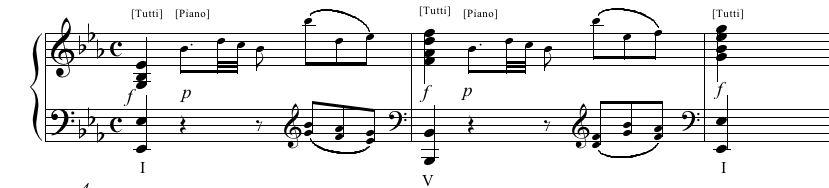
The Mozart Quintet begins with the "usual" suspects--strong chords outlining our main characters--


Tonic, dominant, tonic. I, V, I. I resolve, therefore I am. But these three pillars, announcing the bold opening curtain, seem to exist to reveal this quiet, intense, compressed phrase in the piano, this little powerful truth--


--which one feels barely has time to express itself before the demands of the next phrase weigh in. "I am opening" the first chords say, and the piano says what is behind the curtain, the intensities hidden in the tonal world.

The focus of this little phrase is a seventh chord. (Avid readers may notice a similarity to the seventh chord at the center of the passage in E major I cited a ways back as being played in a rather amazing manner by Mitsuko Uchida.) A digression on seventh chords: consider this linchpin of Western tonality:


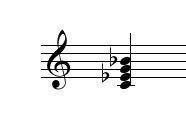
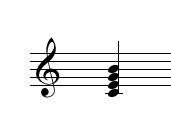
The dominant seventh chord (seen above, bar 2 of the Mozart Quintet, opening curtains). As posed in this example it is poised to resolve to F major, perfectly, with no loose ends. But if you take the third of this chord, and shift it down a half-step, you have something quite different:


Now there are loose ends, there is no one-step resolution... (there is no simple solution)... the chord is more free-floating. So, too, if you raise the seventh of the chord a half-step:


These two, more complicated, seventh chords are part of a larger group, a species... Allow me a little oversimplification, musician friends, starting now! I feel like they (these kinds of seventh chords) live most naturally, freely, decadently (like Gauguin in Tahiti, say) in French music of the late 19th century, for some reason, though of course they appear very often in Mozart, Bach, whatever. But French music tends to savor these seventh chords, or let them savor themselves, as sound. They lounge nude in the flora of romantic French excess. In this classical German music they live a less easy existence; they need to be "resolved," intellectually dealt with... against the three enlightened, classical, clarity-obsessed chords of the opening of the Wind Quintet the seventh chord in the piano is a dangerous blurring, a sensual transgression. I have observed this many times... which is why I feel justified rambling on at length about it here!

[To cite another instance: at the opening of Beethoven Op. 111 (brutal, intellectual, obsessive first movement), we have a couple of shocking diminished seventh chords which, despite their radical appearance, resolve relatively easily (dim 7th, V, I)... but the third time the phrase departs, and the pivotal moment of this departure is one of these seventh chords--E-flat, G-flat, B-flat, D-flat--neither here nor there, not resolvable with ease, promising a long untanglement, which indeed is what happens.]

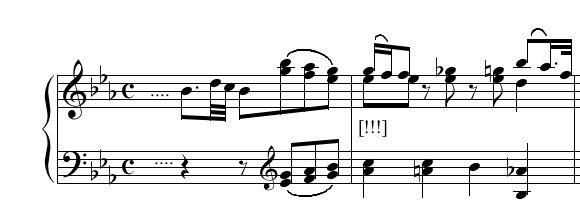
All this just to answer a child's question: Why, oh why, is the opening of the Mozart Wind Quintet so incredible? And the recurring refrain for me, some inevitable part of the answer, has to do with these seventh chords, the ascending sequences based on seventh chords... pouring over, one after the other--notice the dynamic contrasts in this passage for the piano, the seventh chords coming like thunderbolts, like flashes of inspiration:


sequencesevenths

And, to take it further: these seventh chords are a metaphor for the extraordinary, supernatural, the sensual, the unresolvable--that which later would become the foundation of the romantic. There is a wonderful audacity in Mozart's way of including the sensual in the language, and mastering it intellectually, allowing it to be both celebrated and absorbed--a dangerous element which is summoned, and against which the music must break itself (break itself open, like a walnut). So that every time it happens, every time you hear that same old Mozart masterpiece which belongs in a dusty museum somewhere, and you hear the predictable unpredictable event--the shock keeps shocking, its electricity keeps flowing. It's just a seventh chord, a common chord, nothing to write home about, the stuff of music theory books. And how do you make these common, workaday chords do such heavy lifting? How also do you get really common words to do beautiful things, Hugh Kenner wonders in "The Pound Era"... and he cites T.S. Eliot's

Because I do not hope to turn again

and Yeats's

The fire that stirs about her, when she stirs

and Pound's

So slow is the rose to open

Interesting: the opening flower. And he sums up: "Such power, as experience suggests, is latent (though rarely released) in the simplest words..." Which brings us full circle.

Tuesday, August 16, 2005

New York, New York

With something like ecstasy I am plunging into my second cup of Starbucks coffee, and to be truly New Yorkish, home again, I am insisting on eating a bagel while composing this post, which means I shall have to stop and occasionally wipe poppy seeds and dollops of lox spread off of my trackpad. Some lone poppy seed will probably make its way into the bowels of my laptop, and lounge there indefinitely.

It seems I have a tradition, now, forged secretly and now confirmed, today of all days. After a summer's committments, the race from concert to concert, and then the inevitable Odysseus-like (though not so heroic) return... the journey through festivals being something like a guided, regimented trip through the underworld ... the lures of various Sirens being ignored of scheduling necessity ... there is that day (or set of days, a month, sometimes a whole year) when I must reorient myself, get my "real life" legs back. A million dancing deadlines appear in my head, born paradoxically of my sudden, total lack of schedule. (Projects, projects, dreams, desires, total organization fantasies, lives yet unlived!) And at that moment, when I am paralyzed by things to do when I have nothing obvious to do... I always seem to resort to the same process, the same expedient, an act like a dog's peeing on a hydrant or a pole, declaring territory-time: I go to Starbucks with an old, favorite book, I drink a lot of coffee and I read. I almost force myself to do this, slowly, patiently, "wasting" my newfound time. As I waited in line today for my Grande Drip, I remembered many beautiful occasions when I had done this before: on a stoop of my friend Evelyne's house in Bloomington, while she dashed around trying to organize the piano department at the beginning of an IU September semester, I read Proust lazily in the sunshine, smelling newcut grass and feeling alive, and she grumbled at me about my freedom; on a boat with my then-friend Zach (these things happen) in the Adirondacks, also reading lovely, irrelevant (?) Proust while Zach prepared frantically for his upcoming lectures; sitting in Cafe Lalo reading something I can't quite remember several Augusts ago while my friend Carmelle brought me steamed, herbed eggs... reading Susan Sontag guiltily in Starbucks, as I had just satirized her at Marlboro, and being caught by Scott Nickrenz "in the act"... all these memories came to me in a rush. Amazing. Always that same end-of-summer bubble, a million variations of a life theme.

But today's exactitude pressed in. I chose to read a chapter from "The Pound Era," by Hugh Kenner, which was an excellent choice, very inspiring: all about the interconnectedness of languages, etymologies, the web of Language (above and beyond any single language), the nodes of meaning in single words or phrases ... But meanwhile, as I read snippets of Provencal-esque poetry set in idyllic landscapes--

Wind over the olive trees, ranunculae ordered
By the clear edge of the rocks
The water runs, and the wind scented with pine
And with hay-fields under sun-swath

--I gazed across 93rd street to the gray, looming wall of the opposite building, and my fellow Starbucks denizens seemed to conspire to remind me of the gridded city: a nice, friendly Jewish boy talking on the phone to his girlfriend (perhaps?) about the frog in his throat, saying "what are your problems?," sharing at length stories of disease, colds, fevers, complaints; then, a very unpleasant woman stranded on the far end of a visit to New York, deeply eager to get out, kvetching endlessly at her poor uncomplaining husband about everything ("this place is so dingy," she said, nailing it on the head, finding the precise, poetic, even onomatopoeic word); and two men with their iPods and Blackberries discussing business deals, acquisitions, real estate (grrr, more "problems" which require "solutions"); and finally, touchingly, the two elderly men, respectful, shaking with Parkinson's, who come in day in and day out to play chess. I was thinking, I love this place, but want also to be separate, untouched by it, uncontaminated by the negativity which seemed to radiate here and there, inflamed by coffee and cloudy weather, and presently I came to the following passage in "The Pound Era":

Nicea moved before me
And the cold grey air troubled her not
For all her naked beauty, bit not the tropic skin...

My "tropic skin," returned from Vermont/Seattle/North Carolina/etc., slightly in shock from cold grey New York air... I am still lingering in the surreal ending day or two of Marlboro (rainswept, dark, half-built, not civilized) ... people leaving the place in all their varied, bizarre ways, at their own times, beginning or ending relationships, packing up impossibly messy cars, flailing at all the recurring farewells of summer camp, and I am still feeling my body as arranged for country life, toned by lots of swimming and hiking up and down the hills, accustomed to sweating in my cot-bed, now finding itself underused, pampered by luxury in my not exactly luxurious apartment... It feels like (as it always, always does at this time of year) my mind is bubbling, and I want to stay in, let the bubble float off for a bit, keep it from hitting anything hard and bursting:

And if I see her not,
no sight is worth the beauty of my thought.
(Si no'us vei, Domna don plus mi cal,
Negus vezer mon bel pensar no val.)

Does any of this make any sense? Staying in my own mind? If that passage is applicable to me, what is my "her"? Unanswerable, today. And so I have turned to the bubble of my blog... Here I can be in the abstract space of my browser window, listening to the airconditioner hum. Let the dogs howl: Bach to practice, bios to send out, recordings to find, schedules to fix, friends to catch up with, groceries to buy, students to teach, people to call, toilet paper to obtain, mice to trap humanely, pianos to tune, suitcases to unpack, failures to apologize for, insurance to arrange, emails to write en masse, and in general things to straighten out, priorities to choose. But I choose none, today, or if I choose one or another, it will be a whim and not a plan, winding and not straight... I want my acts today to be both practical and metaphorical.

Which reminds me of this most wonderful passage from "The Pound Era":

The great thing to remember is that all poetry was once in the language itself, and still underlies the dry bones of even our dictionaries. Every word, a metaphor, perhaps several degrees deep, still has the power to flash meaning back and forth between apparently divergent and intractable planes of being.

So: my apologies for not blogging for a few weeks. I should be blogging more now, as I attempt to flash meaning back and forth between my Marlboro and "normal" planes... wish me luck!

Tuesday, July 26, 2005

Transitions

I knew something was up. The sign next to the refrigerator read: "white wine in the frig". (Perhaps: the frigging fridge? the frigate?) On a nearby shelf, my newly acquired Mozart action figure was lifting his left hand dramatically up to pounce upon a Quaker Oatmeal Bar, balanced cleverly upon a pair of Sunmaid raisin boxes to simulate a piano. Though unsettled by these backstage oddities, I went bravely onstage to deliver a delicate Mozart duet, and then an impassioned Piano Quartet of Joseph Suk. Well, not all the notes were there, but... something was communicated. Meanwhile, all my ill-sorted, bulging bags were outside in the car, saying take me! take me! check me in at baggage claim! And then, too suddenly, I was whisked--no, I whisked myself?--away to the airport, and without setting my head down again on a real bed I have managed to eke out 40 hours or so, split between Seattle and Vermont. A giant pair of plastic woman's breasts stood at the gateway to my Vermont destination... as you may have guessed, now I am in a dubious dorm in Marlboro, in a warm dusty barren room, with nighttime's bugs pressing at my window screens, and two empty suitcases, and I am sitting on a metal folding chair, at a student's industrial desk, next to two army cots--and a copy of the Mozart Wind Quintet is lying open on the desk, like a reminder of civilization. (Outside, I hear "do you know where the hooch went?" And off the hooch-seekers go.) I am not tired, because Seattle is back 3 hours and I am still partly there... but I cannot address myself fully to Mozart either; he is too demanding.

I am thinking about my transition from place to place, and the whole summer already, and all the little things that strike the memory. Pitiful, hapless details: the detritus of festivals. In my bag, now veteran of several festivals this summer, I find:

1) a scrawled note (perhaps by Unabomber disciple?): "Tuned 7-8-05"
2) the business card of Cathy L., "Professional, Limo-Style Taxi Service"... the card does not mention her propensity for cannabis, easily sensed upon proximity
3) deodorant (thank goodness, that's where it is)
4) USB and other adapter cables of unknown usage or origin
5) the business card for "Pho of Aurora" (i.e. Crazy Pho Lady of earlier post)
6) twelve wadded-up Starbucks credit card receipts
7) the email address, scrawled on the back of a program, of the lovely bartenderess from Boone
8) fifteen used boarding passes and a partridge in a pear tree

What a bizarre thing it is to pack up your mini-lives (for that is what festivals are, summer camps for adults, where your roots grow in and you tear them out), and set off for others... Enough uprootings in a row, and you have, voila! the monotony of difference. Somehow between hello and goodbye you should be able to say something different, to take another path. (Roland Barthes: "those who never reread are condemned to read the same story over and over again...") How to tie it all together? How not to be overwhelmed by the accumulation of these bizarre facts, the history of your life?

This all sounds very overdramatic and kind of contemplative in a dark way, which is only understandable given my redeye flight and my long lazy swimming session in the afternoon and two beers and probably also the sun and heat which got to my head today... But the point being I have left Seattle and now I am in a whole other Petri dish of people and situations (Marlboro) and it will be an effort to dip myself in, commit myself, and get out while the getting's good. I can distinguish certain brain states: like the totally involved, fairly carefree state when I am working on a piece --because you really NEED the whole brain to play the piano, to make a piece work... in fact you need more, you need at least all you've got... and then, when I come out of the glare of the work, my brain is a deer in the headlights of contingencies, of these bizarre, strung-together, random events, emergences and subsidences of people/ things/concerns... of "normal life," which is so much less organized than music. The brain is underused, and prone to pick up on peculiar details. And perhaps I don't have a strong enough balance right now of real, non-musical concerns, so that these transition moments and their salient details can make me feel odd, bizarre... my mind's a bagful of neglected boarding passes... Right now, that's where I am: I am one unmoored ship, heading off to crazyland, and I hope to drag my blog readers down with me! Hooray!

Tuesday, July 19, 2005

The Meaning of Chorale

Yet another coffeeshop: students finishing papers behind me, a couple finishing (amicably?) their divorce settlement to my right, three men forming a start-up on the patio, and to top it all off: some man continuously clearing his throat, an act which produces a bizarre sound, quasi Fat Albert (It is a four-part chorale: studential giggle, strained financial discussion, business bravado, and finally the Fat Albert basso continuo: ahhh, the counterpoint of coffeeshops!) Oh, and it's a barista's birthday, they are lifting a cake over the counter and singing and cheering. Grrrr. I have had a rough couple days, with the onset of some cold/flu thingy and yet--no rest for weary pianists--the concerts continue to come on, every two days... I'm industrial-strength miffed.

I've played many pieces since getting here--Dvorak D major Piano Quartet, Strauss Piano Quartet, Shostakovich Quintet, Schubert Adagio and Rondo--but the piece that is still sticking in my mind, making me happy, is the Brahms A major Piano Quartet, which I played in North Carolina. As I drove, the last night, over back mountain roads, towards Greensboro (my birthplace)... I found myself needing comfort, which Christian and right-wing talk radio did not seem to provide (to each his own). Instead, then, I played over and over in my head passages from the A major Piano Quartet. The entire black, curvy drive was surreally lit by this sunny piece.

For me, this is one of the holiest, most sacred of pieces, perfect in every detail. But very serious, intelligent musicians have suggested that the opening theme of this piece is evidence of Brahms' mediocrity... an aberration, a mess. It is true, it is an odd opening theme... made of chords more than melody (there are too many chords for the melody). And yet it would be "fine," except for an odd move to F#-major in its fourth bar, sounding a little forced, ill-prepared, artificial... the A# jangles like a "mistake" against the A, the main note of the piece... of course this artificial (let's say "extraordinary") event, once accepted, clearly poses itself as a premise for the whole piece, as a protagonist. Perhaps the piece, its vast structure, requires an initial suspension of disbelief. Perhaps any vast structure does.
I remember thinking, when I first looked at the score, what a stupid theme it was... what an idiot.

It is a very difficult theme to play because you want to keep the legato of the melody, and yet each chord must have its integrity, must be beautifully voiced, entire. But when it feels good, it feels GOOD; your hands move from chord to chord, as if running over, caressing, the roots of harmony ... and the best feeling, the real satisfaction, comes at the recapitulation, when you play the same theme down an octave... the lower, richer register making it sound like a chorus of horns or a men's chorus, something deep, the root, basis, the fundament. There has been much Romantic angst in the development, and now... harmony.

The four-part harmony of Bach chorales is, in a sense, an "archaic" item, an anachronistic insertion in the more homophonic world of Romantic music; but, paradoxically, can also be seen to underly everything, the whole of Western classical composition (the art of counterpoint, etc.) In the Mendelssohn C Minor Trio, which I also happily played in North Carolina, a chorale makes two entrances in the last movement, and in that case the chorale stands out as an "other," as a symbol, a triumphalist religious moment which Charles Rosen (I think unfairly) labels "kitsch."

I was listening in my car to some Bach chorales I played on a recital with the Ives "Concord" Sonata (!) and even though I theoretically played the damn thing, I was stunned at how beautiful the harmonies were, at how they illuminated the simplest notes: going up and down the same old (in this case, G major) stupid scale seemed like a magical journey.

In the A major Piano Quartet, the chorale element intervenes not in order to give the music some "plot." It is not triumphalist at all (unlike the Mendelssohn), and if it is religious it is utterly nondenominational. When you hear the chorales in that piece, you hear pure voicings; the chords are objects of contemplation; the piece suddenly becomes communal, "harmonious;" the basic building blocks of Western harmony are beautiful for their own sake (and not for the sake of where they are going)... harmony as solace, as shelter (from the storm of rhetoric, of musical plot). This is made clear in one of the piece's most extraordinary moments: in the slow movement, after the pianist "lets loose" with an anguished, full-throttle outburst, the height of Romantic direction and pouring-over... after this, the strings play the only thing "they can," a quiet, intensely beautiful chorale. Opposed to Romantic outcry... but somehow also its answer and source, its vanishing point.

Saturday, July 16, 2005

Symposium

I would really like to post right now, but it is a beautiful, searingly clear Seattle morning and out there in the wider world there are coffeeshops and parks and pines and blue shining bays. I mean, really, which would you choose? Unfortunately, today, I have some five hours of rehearsal, during which I will NOT be sailing across Elliott Bay to some distant island and watching the Olympic mountains come closer and closer, and drinking rosé. (Yes, I have a standing offer, which I have to refuse). The coffeeshops here ... I just stepped out of one, with a large Americano in my slightly singed hands (no java jackets!) ... and the people in them seem to be perfectly typecast for coffeeshop-people: a blondish, late twenties fellow with a pensive look and a Hawaiian shirt, smoking in his flipflops on the entrance ramp, probably contemplating his next short story for workshop; a dark-haired fellow with an intense face, looking like a hipster evolving into a therapist; a pert woman with red hair, numerous piercings, a blue t-shirt and a Red Sox cap, joining a much larger table of pert, sassy ladies... They are like extras, hired by some producer (God perhaps, the God of the Pacific Northwest) to appear charming and fascinating (though indigenous), grungy yet sexy, to make you want to sit over a big creamy dark cup of espresso and stare at them, and write silly blog entries.

Anyway, I said I wouldn't post, but here are some bits from The Symposium that I am really enjoying:

...

"No god is a philosopher or seeker after wisdom, for he is wise already; nor does any man who is wise seek after wisdom.

Neither do the ignorant seek after wisdom. For herein is the evil of ignorance, that he who is neither good nor wise is nevertheless satisfied with himself: he has no desire for that of which he feels no want...

Who then ... are the lovers of wisdom, if they are neither the wise nor the foolish?...

They are those who are in a mean between the two; Love is one of them. [Emphasis shamelessly added] For wisdom is a most beautiful thing, and Love is of the beautiful; and therefore Love is also a philosopher or lover of wisdom, and being a lover of wisdom is in a mean between the wise and the ignorant."

...

Love itself (a "great spirit... intermediate between the divine and the mortal") is just one (!) of the myriad lovers of wisdom? I "love" that. I'm sure this translation is mangled, but somehow I don't care. (How often do you read one translation of a poem and you go to another and the line you loved is suddenly totally flat? This happens to me a lot. Which do I prefer... my own happiness or an accurate translation?) At one moment, also, Love seems to be a great spirit, at another, a kind of poor relative of the other gods, at another, Love transmutes from person to principle. Love is one of us! But not.... This business of love as a mean, as an intermediary, not as an absolute ("neither mortal nor immortal"), but something in between, relative, connecting, is opposed to this (more expectedly Platonic) conception of beauty: "beauty absolute, separate, simple, and everlasting, which without diminution and without increase, or any change, is imparted to the ever-growing and perishing beauties of all other things." Another extraordinary, paradoxical image. I'm a sucker for paradoxes. I am now looking out the window longingly from the computer/piano room: through the window, the beauty of the sun outside and Seattle waterscapes; to my right, the piano, the beauty of (for example) the slow movement of the Mendelssohn d minor Trio; and if I jump in the car, the beauty of the people happening to be in the coffeeshops, their ever-changing congregation. How can I possibly choose?

One more quote:

All creation or passage of non-being into being is poetry.

Why do I feel that even my choice, what to do today, how to relate to the sunlight, what coffee to drink and how to savor it, how to play certain Andante tempos, how to quell my jealousy that my computer illiterate hosts just bought a 17-inch Apple Powerbook ... all of this passes from non-being to being, is being created every second (against, or with, my will)... all of this could be my poem of the day.

Tuesday, July 12, 2005

Crazy Lady Pho

I was on the brink of devastation. My colleague, the violist Toby Appel, gave me the worst possible news: my usual Pho joint was closed.

On concert days I insist on regular, predictable food. As if they are mini-birthdays, any departure from my desires, any obstacle, makes me irritable, petulant, a fussy child. I do what I do those days, and woe betide those who tell me otherwise.

In Seattle, every concert day, after dress rehearsal, this is what I do: I cut via backroads, through industrial zones and car repair shops and adult bookstores, and other businesses of dubious aspect, and settle myself in the most dubious of all: Pho of Aurora. From the parking lot, the view through the steamy kitchen's back door is not enticing... it promises nausea, not nutrition... but one day, in the distant past, like Columbus sailing westward, I was brave or hungry enough simply to walk in, and so a compulsion was born.

A compulsion? An addiction. I was hooked, not by the broth, nor by the voluminous fatty tendon, but by the place's unearthly patroness. How can I describe her? Though she presides over the dumpiest Pho joint in Seattle, she dresses each day as if descending, reluctantly, to the ballroom of the Palace of Versailles. White lacy gowns, powder blue dresses, purple velvet: no outfit too outlandish, no makeup too heavy. Radiant, resplendent, she finds it enough to exist: she does (nearly) nothing, she simply talks. But it is not normal speech, it is closer to incantation ... an unearthly voice ... she delivers, I think, sermons from the noodle god. Vietnamese from her mouth is a garden of fascinating, dangerous phonemes, sounds foreign to human cords. She "talks," and I slurp, and since no one responds (several younger people seem to do all the actual work of the place, while watching Vietnamese Idol), I assume she is talking to herself. Or she is very, very frustrated. Or both. How many hours have I spent, speculating as to what she might be saying? Perhaps in my belongings, my heirs will find endless sketches for a (sadly) unfinished novel: Thoughts of Crazy Lady of the Pho. It will be my masterpiece.

A calendar next to her each month presents a different beautiful Asian model (a modest centerfold calendar), and it appears she dresses partly to match the woman on the wall. Though timeless, and anachronistic, she's in cahoots with the calendar! Her acolytes dress in deliberately shabby American garb, torn jeans, faded T-shirts. All business is transacted with them (she is too noble for this menial work, though her nobility is confined to this one dreary room). If I go up to pay, and none of her assistants are there, she will condescend to take my money, but only--get this--after putting on white silk gloves. My fellow noodle-eaters--truck drivers, mechanics, a decidedly blue-collar crowd--seem to accept all this... to accept their queen... they, like I, respect the place's bizarre order; they laugh only on the inside.

So with a heavy heart, I went by to see the place closed up, to bid it goodbye. But imagine my delight. Toby was wrong... it was still open (though in even more disrepair than before). I walked in, joyfully, saw that the personnel were EXACTLY AS I LEFT THEM last year, and ordered my noodles promptly. What do they think of me? I only come for a week or two each summer, show up quite regularly on Mondays, Wednesdays, and Fridays (and on no other days), and then depart. I never speak to the help; we never penetrate each other's mysteries. Are they curious about me? Do they wonder why a nerdy fellow with scores and books, and with a taste for really spicy soup, comes in like a token breeze of summer, and spills broth all over chamber music masterpieces? Does my pageturner at this festival ever wonder at the red and brown stains on, say, the Shostakovich Quintet?

For me the lesson (the warning) of the summer festival season is mystery, variety, youthfulness, love. (I have been rereading The Symposium.) What do I mean by that? Though the piece (any piece, whatever) has been played many many times for numerous festivals and often in the same way... all those qualities (mystery, variety, etc.) are still valuable, necessary, even: indispensable. Why would I go into Pho of Aurora? Totally arbitrary. Why would Crazy Lady dress up (at no minimal effort) to sit there, a useless appendage, every single day? In summer festivals, preparing these familiar pieces on short notice, we tend to have scads of "sensible" rehearsals, putting things in place, balancing them out, being mature... and sometimes as I go through the season of this sort of rehearsal, I find myself wanting to say totally unsensible things, to take unseemly rubati, to be contrary, simply cause the spirit seems to boil up inside of me, something feels too familiar, too confining, too conventional. I could easily, in these situations, become like the Crazy Lady of the Pho... sometimes indeed I do feel like I'm dressed in the wrong outfit, speaking the wrong language to no one, a nutcase babbling to himself at the piano. And perhaps that is when I am happiest.

Friday, July 08, 2005

Boone

Rule #1: Pursue hints of unexpected pleasure. Rule #2: relax. These rules are applicable to both life and musical interpretation.

Two nights ago, at dinner, a lovely bartenderess. Same bartenderess (go figure!) shows up at coffee joint while I am blogging yesterday, chats me up. I took the hint, and invited her to join us for drinks/dinner last night, and there she proposes going to hear some zydeco being played at the Boone Saloon. FANTASTIC! I discovered the real reason to come to Boone. I watched people totally consumed with pleasure: good old (and young) country boys, whose faces seemed at first reticent and reserved, began to stomp the floor with contagious musicality and abandon, with unmistakable unfeignable joy in life; and the girls were bouncier, a little goofier, floating all sorts of hilarious and eclectic moves around them... I remember thinking I have never enjoyed a dominant-seventh chord more (it was prolonged so long, almost like Tristan and Isolde). Though it was a bar, the music and the dancing were clearly the main thing, much more so in some ways than in the classical concert hall, where the focus is enforced. I don't want this to be another "I wish classical music were more unbuttoned" post, but .... what can I say? I wish classical music were more unbuttoned, but only in a certain, not vulgar way. (Carnegie Hall, but with pool tables?) The Boone Saloon didn't feel vulgar at all, though the floor was sticky with spilled beer and people wore wide-brimmed cowboy hats and there was a hefty mean-looking bouncer at the door: not even seedy, just: real. I think it was the music that did this, that made the space perfect. It was fantastic to watch the violinist too, who looked completely uninvolved, almost moronic; his bow arm barely seemed to move; and yet his playing was super-energetic, uplifting. There's a lesson for my own piano playing in there. I followed both rules above by the way: I pursued the hints, against better judgement, and I got an unexpected pleasure, and my elation relaxed me.

...

To quote (or rather paraphrase) Alex Ross, "there is no specifically musical reason for including" the following, but it seemed noteworthy. As last night's bartenderess (which is not same as earlier bartenderess) served us our appetizers, she regaled us with a tale of tooth damage. An old chipped tooth had become rechipped, and she had gone to the dentist to have it repaired. Lest this not be sufficient detail, she drew us a diagram (no, this is true, this actually happened) on a cocktail napkin, which we could study next to our bruschetta:

tooth

Magnificent. Especially the way she scribbled horribly with the pen, nearly tearing the napkin in two, to indicate the irritated part of her tongue. I have tried to simulate this, as best I can, with my laptop trackpad. Why did this dose of dental reality not turn me off as I sat at the rather fancy bar, preparing to eat? It seemed merely hilarious and not disgusting. This would never happen in New York; nor would the repair of said tooth cost a mere $22 (I am not kidding, that is what she paid). Have I seen people dance like that in New York either? I have to admit I will play the last movement of the Brahms A major Piano Quartet quite differently tonight, with a little hillbilly in my gypsy.

Thursday, July 07, 2005

What's The Score?

I have been blog-lazy; no more. I've been storing up thoughts about scores and musical interpretation, which sounds like a truly annoying and boring post, and probably is.

Basically, I've been trying to find a recording of Davidsbündlertänze (by Robert Schumann) for my new friend X. X does not demand anonymity, I just enjoy naming him/her X. I have dibbled and dabbled, online and elsewhere, and due to the nature of the piece, it's fairly easy to extract little bits -- it's a piece made of little bits, a meal of German, evocative, romantic, elusive tapas. I won't name names, but I've consulted quite a few recordings and found none remotely to my satisfaction. The problem, you may say, and I will say, lies with my unending need for satisfaction rather than the artistry of the various recordings... So far, I have not recommended X a recording. (V. Nabokov, when asked "what's your favorite book?" answered: "the one I am about to write.")

Inciting event: X and X's colleagues were arguing with me in a bar that Schumann really was not such a great composer after all. Well into my second, or third, Belgian ale, my arguments distilled themselves frighteningly into a very narrow retort: simply the word "Davidsbündlertänze," nearly screamed, several times in a row, with accompanying head-shakes and signs of distress, like those of a mental patient. Feeling rather replete, I adjourned to the facilities. Upon my return, my argument was not augmented: I simply kept saying, overly loudly, in the Irish pub, the title of my favorite Schumann work, (I feel sure I was the only one in the pub using that particular word, possibly ever) which seemed to me the purest, most eloquent defense of Schumann's genius ... How I longed for the powerful, calm derision and reserve with which, say, Mitsuko Uchida might have looked upon persons who dared to question Schumann; if only I had been able to consult her as to what to say, what to do. I could almost see her, perched over an Egg McMarlboro (at Marlboro, of course), her eyes narrowing ... I myself was a clown in comparison.

Davidsbündlertänze is full of clowns and clowning, the boisterous Florestan messing around with the ruminative Eusebius... full of moments of silliness, but that kind of humor which is so extraordinary and manages to coexist with the most unbelievable, haunting sadness. (The humor that virtually generates that sadness.) That would almost seem to be the piece's premise: the posing of funny, displaced fragments and their metamorphosis/assembly either into crazy, lopsided dances, or long lyrical outpourings, or laments, or whatever: come what may.

So there I was listening, to my favorite moments in one of my favorite pieces, and so often the pianist would seem to miss the "main point," that is, the sort of overarching gesture, mood, gestalt of the thing. And I would say to myself: you are imposing too much of your own desire on this! Try to listen impersonally, to see what they see. Because these are serious artists, they see important things. And so I would try again; I would start the track from the beginning, and try to listen through their lens, pay attention to their priorities, hear their desires. Sometimes this works for me, but in this piece I could NOT. I had to give up too much, it was too painful, too many intervals went unnoticed, too many searing moments passed by, it just couldn't make emotional sense to me. I gave up, unhappy, kind of exhausted. I took the coward's way out: I went and played it myself.

I think (and this may be partly the cause of my unhappiness, above) this is one of those pieces with an amazing plural--whether because of its "loose" structure, or its dependence on fragments (where just a few notes are made to take on a lot of meaning), or its utterly Romantic frame of mind, its intense if brief emotional states. We are used to saying and thinking that a piece has any number of possible interpretations, and we are used to hearing the expression that certain performances/recordings can be considered fairly "definitive." I would like to express my total detestation of the word "definitive;" a performance is never a definition, unless we are willing to reconsider entirely our definition of definition.

We classical musicians lurk under the idea, a burden, that there may be, hiding in the score, somewhere, some "true" interpretation of a piece, some original composer's intent. But I have begun to wonder if even the composer, as he puts his notes down on paper, considers the score-as-written already, partly, his enemy? (It limits what he has to say, what he has meant to say; on the other hand, it lets the piece loose from the limits of his mind, opens it to other, maybe lesser, minds.) We say, casually, that a musical score "lends itself to many different interpretations," which is a sort of cliché which makes us comfortable with the difficulties of scores. I want to go further:

A musical score does not just "allow for" differing interpretations, for disagreements; it provokes them. This is because a set of notes will inevitably suggest nuances that cannot be simultaneously realized--which are antithetical to each other. The score is a provocateur, a trickster (although it is of course also a comfort, a guide, a resource). It contains paradoxes, and thus makes consistent, complete definition impossible.

This is truer of some scores than others. Every performance leaves out, by definition, a good deal (an infinite amount) of the score, of its possibility. This would seem to be a negative view of performance, from a performer. What does the performer put in its place, how does he/she fill the space cleared away, the destruction wreaked, by his/her choices? I have to admit I tend to distrust those colleagues of mine who seem to know every dynamic, dot, dash, and marking of the score, every last articulation and expressive indication, and who seem to feel they "know the score" as a result (not that it is bad to know the score well!)... I guess it is an emotional thing, I always prefer to think of the score as harboring yet some unknown, as a jungle whose overgrowth will not be pruned, penetrated... I hate to think of it as a cleared field, as laid bare, too clear, too evident, prematurely disillusioned. Only with the performance is the score temporarily bare (temporarily absent), and then from the moment of applause onward the score reasserts itself, just as impossible to untangle.

To take up this thread of "definition," I love the notion of every word as a "fossil poem." (Words as active, not passive, webs of force, not solid, named things--read Hugh Kenner's The Pound Era...) Think, if we reawaken each of a word's origins, etymologies, mythical antecendents, the primal acts of classifying, connecting, understanding, which finally gave way to the "civilized" word, its so-called definition? Poems do indeed reactivate these sense of words ("give words back their tribal meaning," is this Mallarmé?). Okay, in this sense, I could imagine a "definitive" performance, one which makes the musical word active, definitive not as in "really getting it right", not as in just-as-the-composer-"intended" (How do we KNOW the composer had a single intention? Don't we think the composer might have been just as mystified and overwhelmed by the options of his own notes?), but as in opening up some active possibilities of the piece, working backwards to origins and forwards to consequences, an act which I think is closer to "un-definining" the piece, removing it from the dictionary... freeing it.

For an example of the sorts of notes in Schumann that particularly defy this notion of "definitive," perhaps:

davidsopening

It is a waltz, (a waltz in fragments) that much is relatively certain (this notion of waltz is somehow extramusical, right? it brings in a whole cultural world, codes of nostalgia, loss, experience)... but which notes to "go to," which to emphasize, and how? Nothing is more idiotic than the comment in rehearsal, the agreement to "go to" a particular note... how will we go there? Rhythmically (by rushing, ritarding)? Dynamically (by crescendo, diminuendo)? Texturally? Emotionally? The possibilities are infinite, and each has a satisfying opposite. Everything is going or coming, to say "let's go here" says (almost) nothing.

For you music readers, including X, if you do not feel a shiver of pleasure, a moment of "perfect Schumann" at the end of this last example, when the second voice enters, at the "wrong time" (in the middle of the established grouping), and deliberately in order to form a dissonance with the upper voice... (C against B) ... if you don't "get that moment," if you aren't waiting to see in what beautiful fashion the wrong-note B will resolve, you are voted off the Schumann island. (You non-music readers, just listen to the last track, shouldn't be too hard to follow). This dissonance, which is just the edge of longing to which the preceding fragments allude, becomes generative, becomes an obsession; the waltz, though sad and gentle, is suddenly full of these dissonances which need to be resolved, which create more, the sense of clash, every note's (by turns) inability to live with itself:

davidsmiddle

... a stream of consciousness leading from that first entrance of the "second voice," from that generative dissonance, following the idea of the dissonance to whatever consequences ... and another stream, gradually attempting to "fill in" the fragmented waltz, to swing gradually from halting pairs of quarter notes into a more typical, dotted waltz rhythm (see example above, second measure, A G F E): this second stream, an urge to find melodic/rhythmic continuity. Two streams, and many others which we haven't mentioned, and how can you possibly feel them all while playing? Not to mention, in public? All these are in the score, simultaneous, clamoring: a bewildering cacophony of thought. The score is impossibly demanding.

The streams seem to lead gradually downward, smoothing out their dissonances, to this "answer":

davidsend

Yes, it is the same sixth leap which began the waltz, G up to E, but now instead of fragments and half-steps and half-phrases, there is just a long, unbroken, lilting descent... I adore this final phrase, partly because I feel it is not enough, it does not really, truly resolve; but it is heartbreaking for me: the essence of tenderness, too late. I have words for this final phrase; I have written them in my score; but I will never tell anyone; anyway, they are nonsense words, meaningful only for me, German words with no grammar whatsoever. (Tribal meanings?) Can I say that this beautiful phrase "resolves" the previous longing and dissonances? Yes and no, I'm not sure that I totally "understand" the relation of the final phrase to the rest... it is a meager connection, sustained by slight threads of thought, threads that can never be definitive.

It is totally infuriating to imagine a music theorist at this point trying to describe the form of this last piece. (Is it ternary? binary? modified binary? Arrggghhh!) With a piece like this, Schumann seems to satirize even the idea of musical form, the notion of completeness, and its relevance. And it was infuriating to hear all these beautiful, sensitive versions which did not capture even an iota of my tremendous emotional attachment to this last waltz... they were all incomplete somehow. I can't help thinking of my own hypothetical version. Someday, when I return to this piece, my version ... will hopefully be even more incomplete, even less definitive.

Wednesday, June 29, 2005

Unexpected

I am dangerously attempting to begin this post without having truly consumed an appreciable amount of coffee. Sip sip. But it may not kick in soon enough...

I just thought this event was surreal enough to warrant mentioning. Yesterday afternoon, I went down round 5 to the hotel fitness room, to do some stairmaster. And I was full-on sweaty and stepping and dazed, when I heard the door open; I turned my head, and to my utter shock and disbelief: Leon Fleisher entered the room. For you non-pianists or non-musicians out there, this may not seem like such a big deal, but pianists will understand... (for a scientist, the parallel might be that Einstein entered the room; for an author, Salman Rushdie... I don't know, you get the idea). It is the sort of thing that would happen in a dream. Listen to this, man: last night I dreamed I was washing the dishes, and Leon Fleisher walked in and told me to do it more spiritually, etc. What's more, it was too late for me to turn off the drippy romantic comedy about three aspiring country western singers I was watching (at FULL volume), starring River Phoenix and a young Sandra Bullock and other people too mediocre to mention. (I certainly could not claim I was NOT watching it; the stairmaster faced the TV completely and closely). They were making their way onscreen to success via love, loss, and the sober road of experience. Leon seemed not to notice this more profound aspect of the film as he cast what I (perhaps overly) interpreted as a rather dismissive glance in the movie's direction, and headed for the treadmills. How could I explain to him, without becoming ridiculous, that I had brought Cervantes' Dialogue of the Dogs with me to read (certainly a philosophical and profound entertainment), but that this particular stairmaster had no holder for reading material? That therefore I was a helpless TV consumer? That I had read much of Proust on the stairmaster as well, in years past (in lost time)? How could I explain that I was allowing myself to be moved (were they beads of sweat or tears on my brow?)by country-western music just hours before my Mozart Double (my debut, for God's sake!) with the Philadelphia Orchestra? Why was I watching this drivel instead of, say, the MacNeil-Lehrer News Hour? No. All explanations were moot; all I could do was finish my routine, and slink out of the room. So it goes. I noted, as I left, that he was watching the weather. Ah, indeed, sigh, that is what a great artist does on the treadmill, I thought! Perhaps he did not even notice the weather forecast; it was only a background for his great treading thoughts, as the ever-changing weather is a background for our lives.

My new favorite quote: "The best part of repentance is the sinning."

Wednesday, June 22, 2005

Better

I'm better today, thank the powers that be. I thought I would post another installment of the subway poetry "experiment"... zipping back and forth from 91st street to Mozart rehearsals on 58th street, I found plenty of time to contemplate the #1 trains... for those who don't remember, it is a not-so-subtle attack on the whole "subway verse" thing, by intermingling lines from the posted poems with the surrounding advertisements and public service announcements. I wish I could say I was continuing by "popular request," but really I'm just continuing for my own perversity. The following, to my mind, gives the nihilistic and famous speech from Macbeth a kind of post-modern, ironic punch, which it probably didn't need:

Tomorrow, and tomorrow, and tomorrow.
Investing in futures
creeps in this petty pace from day to day.

Tighten skin without surgery
to the last syllable of recorded time.

Lighten up!
And all our yesterdays have lighted fools.
Please don't rush or push on
the way to dusty death. Out, out, brief candle!
Number One makes all stops.

Life's but a walking shadow, a poor player.
My future: a theatre director
that struts and frets his hour upon the stage.
What you thought you knew is history
and then is heard no more; it is a tale
it's a work in progress,
Told by an idiot, full of sound and fury--
He may be without a home, but he's not without help,
Signifying nothing.
Get prepped for success!

I feel the end is even more bitter than the original? Comments, including cease-and-desist orders, are welcome, but may be ignored.

Tuesday, June 21, 2005

Carter and the Things You Want

I'll admit it. I'm in a foul mood today. For me there are three kinds of foul:

1) "Irritable" foul: where everything just peeves me, from the wait in line at Starbucks to the cheery hello of my doorman.
2) "Overwhelmed" foul: when the volume of unopened mail and unattended crap gets all metaphysical on me, and makes me feel panicky.
3) "Seriously" foul: where something deep has shifted, and part of me has yet to adjust.

Today's foul is a bit of 2, mixed with a lot of 3. It's funny: I'm cheering myself up just a bit, even enumerating these foulnesses. Ironic that my foul day should be the longest day of the year. (Bitter laugh)

What does all this have to do with music, you ask? Well what I'm suffering from is a fascinating medical condition known as the Post-Festival Blues, COMBINED with a little bit of Pre-Festival Panic (since I am simply between festivals). Post-Festival blues is like the melancholy of the last day of summer camp... all of us overgrown classical-music-children, going to camp every summer, making friends and enemies, not writing home as much as we should, and then it's over... This one is particularly bad, for reasons that are hard to pin down, irrational reasons; it feels as though something were given to me, and then taken away. And I want it, even though I'm not precisely sure what "it" is.

As it is impossible for me to deal with any personal issues in my life without sublimating them into music first (just kidding, kind of) it got me to thinking about musical passages where this sort of thing happens: and it seems to me that this giving and taking away is not a bad thing in music, but an essential part of its meaning... I've often enjoyed the quality of certain music where only a few notes are made to suffice (not TOO many notes, because that would ruin it, overwhelm it): one of the great virtues of modernism. Late Romanticism: a giant surplus of notes, of "explained" meanings, of overblown programs, of chromatic complexity. Modernism converts

O fair white silk, fresh from the weaver's loom,
Clear as the frost, bright as the winter snow--
See! friendship fashions out of thee a fan,
Round as the round moon shines in heaven above ... [etc.]

to

O fan of white silk,
clear as frost on the grass-blade,
You also are laid aside.

Less is often more; the single word (the single note) connotes more, is free, open-ended. (For example, the fabulous
"also.")

I played the Elliott Carter Piano Sonata this last Saturday, and while I was practicing it I kept playing over the final section; it seemed at once elusive, impossible (because of its spareness) and also to hold, behind its reserve, the most profound and beautiful thoughts. The piece continually plays with the giving and taking away of harmonic information, the expansion of one or two notes into an complex harmony, and then back again, until you are made to find satisfaction in fewer notes, to find resolution in absence. It is so beautiful to trace his thinking in this manner in the last bars of the piece: he carefully delineates which notes should be retained with the pedal, and when precisely should they be made to vanish: a constant game of resolving to "too few notes," then adding some other notes which raise new questions, which necessitate further resolutions, which keep the piece alive. Just when there is too little, he adds something new (which is "too much," which needs to be dealt with in some way, just like I need today to deal with my unresolved, undirected wants)...

Each time I played it, I couldn't get over the beauty of the final bars, of the piece's "answer." Let me be analytical for a second: here Carter summarizes and merges two main themes of the piece, this melodic cell:

cartertune

and this rhythmic motive:

carterrhythm

Both of these are "protagonists" of the piece; we have heard them millions of times (seemingly). But not like this, their merging moment:

smallercarterending

F# (high), F# (low), C# (top note of chord)... that would seem to be it, one more recap of the "tune," BUT as you slowly release the pedal, the B emerges from beneath its cloud of notes, a lonely, uninflected, uncluttered tonic. This note, on the "weak beat," the unaccented syllable of the sentence, a rhythmic aftershock ... turns out to be the strong foundation, the center, the fundament from which the other notes have radiated. Carter does not want it to be played so much as revealed. Instead of overtones coming off of a played note, Carter here allows the "undertone" to come from its overtones, allows cause to follow effect.

And there it is: just that B. You hold it until it fades away. The other notes, beautiful B major notes like A#, F#, C# linger in the memory more faintly (vanished overtones). And why do I find this so affecting? When I start to hear just the B, there is at first a rush of pleasure: it is so pure, perfect, so resolving; then I begin to feel its relation backwards, its threads of connection... I want to go back and play the whole piece again, to hear his flights of fancy, racing through fifths and fourths from B up and down the keyboard... those amazing scorrevole passages from the first movement, the giant jazz fugue in the second. But no, it is over. The B is a relinquishing of all the other notes, not at all a triumphant arrival, but a removal...

Right now, in my foulness, in my apartment with laundry and dry cleaning to do and millions of unopened bills and pieces to practice, I would love to go back also, perhaps to the last festival, and argue about Schumann with quirky musicians in the sports bars of suburban Detroit; but today, there is only the B and the thought of what notes might come of the B--entirely hypothetical musings, speculations. I am awaiting the return of my overtones.

Saturday, June 18, 2005

Groceries

For those who suspect classical musicians are a different breed, I have solid scientific evidence. The other evening, I was playing a concert with violinist Soovin Kim and cellist Peter Stumpf. In a distant (15-20 miles) suburb, cellist Andres Diaz and violinist Chee Yun were also playing a concert. After our concert, Soovin and I parted company with Peter, who went home to drop off his cello. Soovin and I then decided, on a whim, to go directly to the grocery store for post-concert treats...

We wandered the lonely aisles, selecting the usual gourmet fare: an Entenmann's danish, white peaches, a frozen pizza, baked Cheetos... and there at the checkout counter, we ran into Peter, who had just then run into Andres and Chee Yun! We were like migratory birds, destined for groceries, magnetically and mysteriously drawn from distant climes to a single Kroger at a particular hour... What Beethovenian machination of fate was at work?

One further oddity: Soovin's and my white jacket and tie drew some amused remarks from some 30-ish ladies ("nice tuxes")... who then kept waving at us in the parking lot, kind of desperately, as if we were soldiers going off to war. Soovin thinks they were trying to "pick us up," but my theory is they were like minor divinities, somehow associated with the fateful musical convergence, trying to deliver us some omen or message which we will never, ever know. As Rilke says, "we must live the questions, and someday our lives will become the answer." Or something like that.

Following up, finally, on the narcissistic theme from the last post, I went to Barnes & Noble (boo hiss) to pick up some Montale poetry which had been very inspiring ... (texts for an Elliot Carter piece which I just heard). Alas, there was no Montale in the Bloomfield Hills B&N, as I was informed by a pierced, patchouli-scented aide; but next to where he might have been (again fate) was Ovid's Metamorphoses, which I drew out of the shelf to refresh my memory of the tale of Narcissus. What a beautiful tale! Especially the encounter of Narcissus (the boy in love with his own image), and Echo (the girl who can do nothing but echo what other people say)... what a spectacular, symbolic, heavy, association-rich episode this is in the tortured history of the Western mind! And super-fraught with associations for us migratory classical musician-birds: we are forced to echo pieces written long ago; in one sense, we are as helpless as Echo, we can only say what "has been said;" but what we get out of them, the return of our encounter with them, is always at least partly ourselves. We cannot help seeing and feeling ourselves, reflected in these pieces. These pieces (great masterworks, texts of seemingly infinite association and possibility) are like mirrors to us, like Narcissus' fatal pond... mirrors against which we cannot help but feel insecure, vulnerable, incomplete.

Thursday, June 16, 2005

Wow and Wind

Anonymous writes, "this entire blog is an exercise in narcissistic pretense." Hooray for anonymous! He/she is correct, as always. Pretense courses through every entry: things are omitted, rewritten, made readable, given "a style, a voice"... there lurks in the background that pretentious word "literary." I can't, therefore, present myself, whoever that might be; I seem to present how I imagine myself, or even how I imagine others imagine me, or--and these are the parts I admit, in my narcissism, I like the best--myself as illuminated by certain passages of music, the cross-section between my persona and certain sound patterns... Some parts of Jeremy Denk: did they exist until I encountered particular phrases, pieces of music? Chicken and egg: until the "Dumky" Trio, was humanity's sense of nostalgia less rich? (Or did "Dumky" depend entirely on preexisting emotional patterns in humanity?) Did those tender phrases permanently add to mankind's emotional repertoire, give nostalgia a definitive auditory example?

Today (for me) is a joyous day, with a fresh cool wind blowing through the suburbs of Detroit... (oppressive summer lifts)... I am so happy today and part of this happiness is stuck to, glued to, the act of putting my hands down on the piano keys a certain way and coming up with a luminous, sensual sound, a sound of which I approve, which suggests further sounds, further motions, further pleasures. The exact equality of the intention and the result; motion=sound; idea=event. Me me me. But add to this the liberating fact that the music is already written for you (Dvorak, Mendelssohn for me tonight), so that you just "throw yourself into it." I am a puppet with strings pulled by dead European composers; but I love it, this willing marionette is me. Don't you think the puppet influences the puppeteer? I think so (in my narcissism). Dvorak depends on me to express something about Dvorak. Pooh on the people who say it's all on the page; it most certainly is not.

In the puppet vein, I saw a production of Pierrot Lunaire this last weekend featuring Lucy Shelton's riveting, completely possessed sprechstimme, a delightful life-sized Pierrot puppet (Blair Thomas puppet theatre of Chicago), and my fellow Oberlin alums, the ensemble Eighth Blackbird. The work was frantically staged, and all the musicians performed from memory! It was tremendous to watch Lucy interact with the puppet, to "literally" address Pierrot (who eventually is brought out, poor fellow, in a wheelchair); but my favorite part was how she and the puppet interacted with the instrumentalists (and even their instruments). Musicians are usually "left alone," treated with deference (after all, they must concentrate!), but here they were treated irreverently, like just another part of the surreal gang. Music inspires choreography, which in turn rebounds back and influences the music, the musicians, draws them into the game... There they were, marching across the stage behind a prancing Pierrot, who jumps into the piano, turns back to look at them... the musicians in turn look back, as if to see what Pierrot is looking at... who or what are they looking for (is there some secret agent in the wings?)... Who or what is in charge? No member of the ensemble seemed to lead, to be privileged. Which to me is the perfect way to express the unhinged, expressionist mind.

I really liked the sense that the musicians were forced to confront their own creation (like a mad scientist, like Dr. Frankenstein); the music they were playing almost attacked them! There are musicians out there who aim to be pure, uninvolved channels for music to pass through, who look on impassively while their fingers create... For them, this Pierrot would be kind of a nightmare. I have never been able to pursue this ideal (never cherished it especially, either), except to the extent that you don't want your personal involvement, your emotional attachment to the music to get "in your own way," to hinder auditory expression. In my narcissism I find that the music keeps turning in on me, and vice versa, and I cannot stop this wheel from turning, except every so often to send it back the other way, like a pendulum or seesaw. And so this Pierrot was like an actualization of something I feel so often: the meddling of music in my personal life, its lack of boundaries, of respect for my "personal space."

Saturday, June 11, 2005

Rubato from Another Planet; or, Waking Up Early

Last night, inexplicably, I put a new CD in my CD alarm clock. (Avid Think Denk readers--is this a plural? or even a singular?--will recall volume two of Nina Simone's "Tomato Collection" residing there previously.) I felt no particular urge for change; it just hit me, like the smell of sour milk emanating from a Mr. Softee truck. And let me tell you, there is nothing like waking up, bleary, at 6:50 AM on a Friday morning, after staying up stupidly late staring at an over-packed suitcase and a list of things to do upon awakening (1. Throw out garbage 2. Pack toothbrush and toothpaste 3. Pay rent 4. Check wallet for credit card and drivers license) and trying to remember music I might have forgotten to pack... there is nothing like waking up after one of those short, stressed-out nights to zany Viennese lilt, chords and notes flying everywhere, and sudden blasts of tender, lyrical playing unheard of in modern days: in other words there is nothing like waking up, exhausted, to Ignaz Friedman's Alt Wien. It coaxed a silent laugh out of what is often my darkest hour; I was awake for a strange non-moment before it came on (curse my inescapable, time-laden consciousness) and I drifted back to sleep; with a harrumph it began in B-flat, and I was smilingly, totally awake; its joyous abandon blasted into the half-lit, half-cleaned apartment like secular incense, blessing my early morning scramble.

I meant what I said about the "harrumph." In the boisterous waltzes, Friedman's downbeats have outrageous, tremendous impulse; they are huge, sprawling, but also springy, dancing catapults ... the intervening 2 and 3 beats are often overwhelmed, virtually swallowed within the downbeat's energy, in a way that modern conservatory education would find unacceptable (tut tut! don't swallow those beats!) I yell back: Yes Friedman, swallow them! Keep it coming! Go for it, baby! This is taken to almost comical extremes, admittedly; sometimes neither the rhythms or notes of the 2 or 3 are very clear or accurate, there is only a vague sense of intervening chatter between the rollicking, galloping 1s. This is when Friedman surrenders himself entirely to the waltz as frenzy, as leap, as twirl... then he stops, reassembles, recomports himself, a tender strain enters ... everything is suddenly placed again, the internal beats are nuanced, proportioned, perfect .... ah, Vienna, the good old days...

A very famous pianist (and irreproachable artist) of my acquaintance disparaged Friedman for being too crass. I know he is wrong. Or, maybe, I think he is right but I don't care; when he says it it passes into one ear, one lobe of my brain, and I smile an empty smile; the other lobe recalls all my favorite Friedman moments and adores them internally while I pretend to agree. Am I a hypocrite? Anyway, Friedman makes up for any vulgarities--his sudden accents, added octaves, etc.--with an abundance of grace. His B-flat Chopin Polonaise (which comes right after Alt Wien in my Naxos recording) is a virtual philosophical demonstration of charm (Hmmm, apply the Kantian Categorical Imperative: what if every pianist in the world today were suddenly compelled to play as charmingly as that? Would piano playing in the modern world come to an end?), he transfigures an "ordinary" piece: Chopin's filigree has never been so light, and not sugary-sweet-syrupy-silly... simply appropriate, decorative, the pianist's hand passing over the keys, "like a feather."

I know what it is: Friedman's playing is not limited by a Beethovenian "es muss sein" (it must be)... it has a place for the arbitrary and the accidental. Sometimes he seems motivated by rhythmic/musical forces from another planet, and there is no way to know what he is thinking, and why he is thinking it. This makes me happy; I puzzle over his rhythms with pleasure. For example, Friedman's account of the opening (rather simple) bars of the B-flat Polonaise doesn't resemble any way that anyone I know would play the dotted rhythms they contain. It is as if some other layer of harmony and tension, unbeknownst to mortals, was apparent to Friedman, made it impossible to play the dotted rhythm in its typical tum-tee-tum; somehow the "tee" is too important to him, it's got something to say, it drags against itself. I adore these rhythmic displacements in his playing, irregularities born of secret expression which sometimes succeed and sometimes fail. I know a lot of pianists out there cannot accept the "sometimes fail" (despite this, they still sometimes fail, as we all do)--they must aim for the "always succeed."

In case you don't own any recordings of Ignaz Friedman, go on and buy one. Obviously he is one of my heroes, especially at 7 in the morning. And when else do we need heroes more desperately?

If you thought the writing in this post was a bit fanciful, perhaps it can be explained by this photograph, taken "candidly" in the Northwest airlines terminal, awaiting the flight that Friedman woke me up for, which I feel captures my state of mind perfectly. I append it with no further comment.

gmail