"Better if food is late," the Indian man on the line informed me, "than you end up in hospital." Poof, snip: he neutered my complaint. Suddenly it was petty, silly, and short-sighted of me to be wondering why my Vindaloo was oozing so slowly up Amsterdam Avenue. If it takes an hour to make fresh food and carry it over, then so be it. Epiphany: a million little irritating things in my life were nonetheless preferable to ending up in the hospital; and I bounced around my apartment, starving, but bravely sucking up fumes of forcefed positivity. I could love irritating things: by comparison! Think how much lower the benchmark would be for my next Great Love: Shall I compare thee to a surgical procedure?/Thou art more lovely and more temperate, etc.
I quickly noted the utility of this technique for my own life. For example: suppose someone complains to me about the fact that I'm a few minutes late for rehearsal. Turn the tables, right away: "Sorry but at least you didn't end up in the hospital." Never mind the non-sequitur; go for broke!
One question, though: why would a man taking delivery orders at a restaurant leap so quickly for the drastic, Pyrrhic hospital option? Are those the connotations to cultivate in your clients? It confirmed my belief that the place was run by a strange bevy of often conflicting forces, a dysfunctional family of Indian take-out; I imagined a long-drawn-out TV primetime soap, like Dallas; in early episodes, the unstable self-destructive father of the clan controls the restaurant, and presides over its drip-drop decline; eventually he is ousted by the energetic younger son (the older son meanwhile squandering his oversated youth in Bali), who brings a light but bracing culinary touch to all sorts of quirky regional specialties, attracts a celebrity following, opens a hip club, a chain of resorts, reaches a fabulous zenith, and finally, in his somewhat deserved hubris, becomes the inevitable cause of his own unimagined destruction.
... I was obviously delirious with hunger ... After I finally received and consumed my order, I walked outside for some fresh air. I had been so many places on tour and had come back to good old New York City which many of my family members seem to imagine as some sort of bizarre piece of conceptual art, and not a geographical space. It seemed to me I had to wallow, kiss the pavement (metaphorically), get back in touch with the native "land." "My" section of the city definitely sleeps, and succumbs to a strange, quasi-serene urban desolation after 11 pm. There is a spooky to-and-fro of ghosts--or so they seem huddled in their coats--headed to the bodega for milk, or to the video store, or yanking their wrapped dog familiars along on mysterious, unknowable quests. Among this semi-bustle, which seems as if it is randomly generated by some computer program, I stood still outside the diner at 90th Street for some time, looking at faces. I enjoyed watching a man who in turn was looking very earnestly at his table mate, explaining something; there may be things in life that can only be explained in a diner, over a cheeseburger, between 11 pm and 3 am. I love those things. And then I focused on another image: an older man, sitting at a table alone, his head tilted back, looking pretty depressed, over an empty plate.
This second image, a kind of distilled New York City sadness, hit me fairly strongly at the moment, but not negatively; I felt something run through me like a chill or current, which prompted me to keep walking and not dig too deep.
Then the very next night I got myself in a cab and some catchy silly song was playing and I smiled and at that moment, when I was infected with the virus of happiness, the image of the sad old man came back to me immediately, in full force. I followed this paradoxical train of thought and by the time the cab was passing the facade of Lincoln Center I was thinking that the opposite of happiness is not sadness, but worry. The sad, recollected image was of a piece, was contiguous with the silly song; I felt no contradiction, but the same surge of experience, and relief. Relief, that is, from the general bustle of wondering what you will do when and how you will accomplish it and scheduling and managing and predicting and fretting, which in relentless time-devouring madness conspires to push out the possibility of happiness or sadness, the raw beauty of both of which is thereby lost; they are forced out of their habitat, which is time.
I had just finished performing a beautiful work of Stravinsky's, the Serenade in A, which nonetheless left me unsatisfied. Indeed, I admit to my shame that the song in the cab seemed at that moment a more complete expression of joy than that 1925 masterwork. I might reiterate a fairly conventional complaint about Stravinsky: too much head, not enough heart. But I don't think this complaint is entirely fair; Stravinsky captures a special kind of tenderness, a kind of reflected happiness, bemused and brilliant. (The smile of an older man watching children at play?) For me, the limiting thing is his strength, his unerring sense of taste, and culture; a reluctance ever to go too far, ever to become swept away; at those moments when the music might sweep out of the frame, some dislocation occurs, some delicious irony... and though I love his irony, I often get the sense he is avoiding something, trying to steer clear of invisible cliches and patterns; Stravinsky is "worrying" too much, worrying about proportion, classicism, culture, style. Let us take a counterexample from a fellow modernist: Ives doesn't worry too much; sometimes you wish he might worry a bit more, and keep the reins a little tighter on his material. The two of them could be a madcap couple in a sitcom, or movie--one straitlaced, the other wacky and loose--with heartwarming lessons to learn from each other and a happy ending for musical modernism. (I'll get started on the screenplay, "Igor and Charles," immediately.) But I doubt either would take the other's advice well; no; they stand separately, worrying in their own ways. Ironically, Ives, who had no reputation and should have worried, compensated by worrying not at all, by thumbing his nose by and large at proportion, tradition, and system; whereas the established Stravinsky, comfortably settled on the armchair of an unshakeable reputation, worried himself into beautiful, restrained, cultured knots.
Happiness and sadness both seem to have shelf lives; they are both perishable goods, like us; I find myself clinging to both; whereas worry always seems to me to be a self-perpetuating nonsense, clinging to us, durable like a cockroach; necessary, but too immortal to be likable. There is a beautiful moment in the documentary film, "Rivers and Tides," about Andy Goldsworthy, where he has constructed an astounding spiderweb/latticework off the side of a tree, using the most fragile materials (weeds, twigs); he is sitting on the ground, adding bit by bit to one end of this impossible, gravity-defying spectacle, sprouting out of the tree horizontally, a fantasy of lines. He has obviously been at work for a considerable time, and we see this latticework lit by the sun, slightly stirred by the breeze. The breeze is actually picking up. Between wind and gravity (one might worry) this thing stands no chance. If he adds one more filament (one might worry) surely it will collapse; but he adds to it patiently, knowing the long odds. And as we watch, the breeze finally delivers the invisible fatal blow and in a short flurry of disintegrations the whole thing comes to the ground. Now we see the empty sky next to the tree which used to be filled with his fantasy. And he is still sitting on the ground, holding remnants; his work is gone.
Friend M, who gave me the DVD, loves the look on the artist's face just then, and I have to agree: it is an amazing, complicated sadness that powerfully connects back to the joy of seeing the whole crazy latticework hanging there in the sun, and accepts the end of the artwork not as a price to be paid, but as the essence of experience.
Sunday, March 19, 2006


Thursday, March 09, 2006
Touring Quiz
1) Friend M carried both a violin and a viola aboard a plane, but found himself boarding nearly last. Tyranny of overhead bins! He was attempting to reorient some nearby bags when their owner spoke: "we are very well situated here." What, one may well ask, about their situated state precluded the reorientation of bags from x to y? Against this enigma, M pressed on. "If I could only turn this bag around..." And he was thus rebuffed: "I really wish you wouldn't reroute everything." So much irrationality and odd vocabulary cannot be easily confronted. M was flustered; a steward offered a closet; all was saved. But co-traveler L thought inwardly, "Reroute THIS, you [expletives deleted]!" Can she be forgiven this uncharitable moment? Explain. Extra credit: what is the Platonic form of an overhead bin?
2) Pianist J while on tour playing a transcription of Ysaye was excited to find that Ysaye's granddaughter would be attending that evening's concert. What an honor! J was expecting insights, or illuminating anecdotes. Afterwards, this rather elderly woman came up to J, who waited with baited respectful breath, and asked: "are you a professional pianist?" Insight to insult; honor to shame. J did not know what to say; at a loss, he laughed in her face, which was not nice. How should J have responded instead? Who is more to blame: the granddaughter, or the presenter who neglected to print J's biography in the program, in breach of contract? Discuss.
3) En route, post-gig, back to the airport, lovely woman states she has been a "star schlepper for 20 years." Shortly thereafter, amused pianist J muses happily and repeats the phrase "star schlepper" aloud. The woman qualifies: "I was being polite." J is yet more amused. What do you think the impolite version would have been? A riff on "star" or "schlepper"? Or both?
4) Musician X hosts unexpected but delightful companion Y overnight in X's hotel room, while on tour. Musician X and companion Y are single, consenting adults. In the morning, picking up X for an early flight, experienced artist liaison Z recognizes not only X, but also the emerging Y (Z met Y the night before, when Z helped X secure Y tickets for the concert). Z lifts an inordinately expressive eyebrow towards X. What is X's classiest response: a) a similarly lifted eyebrow; b) a muted smirk; c) total feigned ignorance and non-noticing of eyebrow; or d) other response to be determined? Please justify your answer.
2) Pianist J while on tour playing a transcription of Ysaye was excited to find that Ysaye's granddaughter would be attending that evening's concert. What an honor! J was expecting insights, or illuminating anecdotes. Afterwards, this rather elderly woman came up to J, who waited with baited respectful breath, and asked: "are you a professional pianist?" Insight to insult; honor to shame. J did not know what to say; at a loss, he laughed in her face, which was not nice. How should J have responded instead? Who is more to blame: the granddaughter, or the presenter who neglected to print J's biography in the program, in breach of contract? Discuss.
3) En route, post-gig, back to the airport, lovely woman states she has been a "star schlepper for 20 years." Shortly thereafter, amused pianist J muses happily and repeats the phrase "star schlepper" aloud. The woman qualifies: "I was being polite." J is yet more amused. What do you think the impolite version would have been? A riff on "star" or "schlepper"? Or both?
4) Musician X hosts unexpected but delightful companion Y overnight in X's hotel room, while on tour. Musician X and companion Y are single, consenting adults. In the morning, picking up X for an early flight, experienced artist liaison Z recognizes not only X, but also the emerging Y (Z met Y the night before, when Z helped X secure Y tickets for the concert). Z lifts an inordinately expressive eyebrow towards X. What is X's classiest response: a) a similarly lifted eyebrow; b) a muted smirk; c) total feigned ignorance and non-noticing of eyebrow; or d) other response to be determined? Please justify your answer.
Saturday, March 04, 2006
15 Minutes
Today I had 15 minutes to make it from pure sleep to the hotel lobby: from 5:45 to 6:00 AM. I lay still after the first heart-jolting buzzer; I sacrificed some time to inertia, a counterfeit peace. But the phone cruelly rang; the electronic, mystifying voice was Josh, checking if I was awake. I feigned sentience. I struggled over to the armchair and put on my shirt. My pants seemed arduous and I postponed them. Bathroom; toothbrush; toothpaste. My cell phone alarm went off. Its sound was muffled, mournful, as if a phone from another life; time passed (hours, years?) while I sorted out this mystery; where could it be? Ah, reality: it called from between the covers, where I had left it, next to my Sudoku puzzles. I was stabbed as I grabbed my phone, by my mechanical pencil. Blood of Sudoku. Pants on. I decided to try to zip up my suitcase. I was sitting atop, crushing my belongings into a convenient volume, when the phone rang again--my horrible, evil backup wake-up call, loud and vehement, a post-apocalyptic rooster of the pre-dawn. Back to the bedside I flew, picked up the phone, put it down... I fell on the bed, exhausted. And then passed 3 minutes of danger, when sleep's siren called. Now there was no time to waste; everything had to be done at once. Most of my 15 minutes had elapsed simply turning off the alarms I had set into motion. Let us hope our lives will not pass in the same fashion.
Tuesday, February 28, 2006
Update
Vis a vis the "torment" mentioned at the end of the last post: after a massage, a long shower, some more aloe cream, a short walk, a thin crust pizza with prosciutto and mountains of arugula, a cup of mango and coconut gelato, and a short dip in the pool, my torment seems to have abated somewhat. Concert? What concert?
Monday, February 27, 2006
Pleasures
Basking in the breeze, awaiting my chimichurri, I paused to contemplate my complicated relationship to pleasure. A recurring motif of this blog is certainly the tug between my artyfarty tendencies (the "real Jeremy"?) and my evil twin who wishes for nothing more than to be a skateboarder or a surfer, or some such bumlike person, living idly in fair climes off a trust fund while meticulously scheduling my irrelevancies according to whim. More than several such persons, I am guessing, wander the streets here in South Beach. I love the sun and the sand, and even just the idea of a frozen drink, frozen perhaps just in the moment of my reaching for it, on a hot day, from my wicker chair... in the moment before it can be tasted, and limited by reality.
The young, sickly Proust is told by a family friend that though he cannot travel he at least has "the life of the mind," which is the best life, and the young sickly Proust is quite nonplussed. My heart aches with his at that moment. The limitless, boggling brain suddenly seems a very small room encased in a skull. Proust eventually does travel, and then the most miraculous, beautiful things happen (even though they are nothing more than "the usual" travel incidents); his processes of metaphor and association move and flow then like the train or boat he is aboard. It is still, to be sure, the life of the mind, but the mind's doors are open and the breeze is blowing in.
It is interesting to contrast the sensualism of making music onstage every evening for crowds massed in the dark, and the sensualism of a sunny afternoon walking alone around South Beach. Onstage, I am supposed to communicate, give off, radiate out; even the lighting conspires in this metaphor; but walking down the street here, I feel it all the other direction, coming into, at me; I can be no significant source of sensualism in this pleasure-dome; it, the sun, the place, the mode of living, coats me in its excess. I am the dark audience for this lit spectacle. I love these solitary walks through Xanadu, but there is also a hint of antagonism in the relationship, a sense that my presence there is tolerated only provisionally. I am an impostor on the beach, but also perhaps at the concert hall; how can someone so attracted to the pleasures of the flesh be at home in the stuffy Classical Music world?
Perfectly and painfully encapsulating in reality this conundrum, today I am punished for yesterday's pleasure with a significant amount of sunburn, which could have been avoided so easily. I have tried to atone by spending spectacular amounts of money on aloe lotions. It is clear to one and all from my vivid face that I am a beach novice who fell into the stupidest of traps, and so this morning I put on my Johann Sebastian Bach T-shirt as a way of explaining. "You see, everybody, I'm really a classical musician and I think about Bach a lot and that's why I forgot to put on sunscreen." Perhaps though people won't read so deeply into the shirt as I imagine, and they will just see a sunburned fool.
This fool cannot go out on the beach today, but can only watch the surfers from his room, with the plasma TV on mute, where a preacher explains more or less that loving God will make you rich (he never got around to that "eye of the needle" bit), and Bach's Well-Tempered Clavier spread out on the desk. Luckily JS reminds me that the contradiction of flesh and mind I have been feeling is moot. Reaching for the aloe cream, I look at those black scratchings on the page, and I feel like there is no wall, no division, no audience or performer; just revelation; the music seems animated to me, like blood rushing through my veins... so touching, so immediate, even if it is centuries distant ... this beautiful intervention convinces me that if Miami seems to exacerbate a certain torment of my inner sensualist, perhaps it is just the torment I need in order to be me.
The young, sickly Proust is told by a family friend that though he cannot travel he at least has "the life of the mind," which is the best life, and the young sickly Proust is quite nonplussed. My heart aches with his at that moment. The limitless, boggling brain suddenly seems a very small room encased in a skull. Proust eventually does travel, and then the most miraculous, beautiful things happen (even though they are nothing more than "the usual" travel incidents); his processes of metaphor and association move and flow then like the train or boat he is aboard. It is still, to be sure, the life of the mind, but the mind's doors are open and the breeze is blowing in.
It is interesting to contrast the sensualism of making music onstage every evening for crowds massed in the dark, and the sensualism of a sunny afternoon walking alone around South Beach. Onstage, I am supposed to communicate, give off, radiate out; even the lighting conspires in this metaphor; but walking down the street here, I feel it all the other direction, coming into, at me; I can be no significant source of sensualism in this pleasure-dome; it, the sun, the place, the mode of living, coats me in its excess. I am the dark audience for this lit spectacle. I love these solitary walks through Xanadu, but there is also a hint of antagonism in the relationship, a sense that my presence there is tolerated only provisionally. I am an impostor on the beach, but also perhaps at the concert hall; how can someone so attracted to the pleasures of the flesh be at home in the stuffy Classical Music world?
Perfectly and painfully encapsulating in reality this conundrum, today I am punished for yesterday's pleasure with a significant amount of sunburn, which could have been avoided so easily. I have tried to atone by spending spectacular amounts of money on aloe lotions. It is clear to one and all from my vivid face that I am a beach novice who fell into the stupidest of traps, and so this morning I put on my Johann Sebastian Bach T-shirt as a way of explaining. "You see, everybody, I'm really a classical musician and I think about Bach a lot and that's why I forgot to put on sunscreen." Perhaps though people won't read so deeply into the shirt as I imagine, and they will just see a sunburned fool.
This fool cannot go out on the beach today, but can only watch the surfers from his room, with the plasma TV on mute, where a preacher explains more or less that loving God will make you rich (he never got around to that "eye of the needle" bit), and Bach's Well-Tempered Clavier spread out on the desk. Luckily JS reminds me that the contradiction of flesh and mind I have been feeling is moot. Reaching for the aloe cream, I look at those black scratchings on the page, and I feel like there is no wall, no division, no audience or performer; just revelation; the music seems animated to me, like blood rushing through my veins... so touching, so immediate, even if it is centuries distant ... this beautiful intervention convinces me that if Miami seems to exacerbate a certain torment of my inner sensualist, perhaps it is just the torment I need in order to be me.
Saturday, February 25, 2006
I Have A Question
Are dumplings the answer? Yesterday, a steaming circle of them looked like a bundle of immaculate food-children dropped by a divine stork: fecund, promising, chaste. To mar their whiteness with black soy sauce was a necessary, beautiful sin. I curse today limitations on the parameters of questions and answers, their too-easy, too-obvious pairing... i.e.:
Are you hungry? Eat something.
Are you tired? Get some sleep.
What would you like to drink with those nachos? A margarita.
Yes, these catechisms seem timeless and indisputable. But I submit that answers often jump ship and interpose themselves on questions to which they do not belong. For instance I did not eat the dumplings; they were not an answer to my hunger, which was solved by spicy soup; but they seemed an answer to another question: something having to do with relaxation, the comforts of lunchtime, of workday routines which are not oriented towards evening concerts, but which revolve around more predictable effort, into which steaming dumplings may come as a soothing relief... it may sound ridiculous to say that when I saw the dumplings (I did not need to eat them, only see them) they relieved me internally and made me cherish my nook for the moment, in time and in space. I was the satisfied filling of a dumpling. I felt like someone settling down to a good old-fashioned novel, or squishing into the perfect armchair by the fire for a conversation that does not promise to be usual or tiresome. And also yesterday evening, when a chilled bottle of white wine approached the table, and four of us were arranged around its square with our waiting glasses, I felt it was an answer, not to thirst or stress or food, but to some larger question of ritual and companionship...
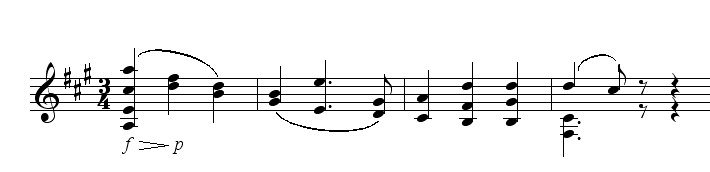
At the opening of the "Kreutzer" Sonata, I sit idly but reverently by while the violin poses a very beautiful and difficult question (difficult to play, difficult to answer). It is a major-key question, filled with consonances (thirds, octaves, sixths, fifths), and trailing off.

The last note (the resolution) is short; after the breadth and lyricism of the idea, it gives itself over abruptly to silence. I think this is one of those unusual, extraordinary beginnings that distinguishes itself from the greater mass of classical openings not through any outrageous harmonic maneuver, ambiguity, or daring, but through the audacity of its sudden, naked Appearance: the Idea itself, presented whole (immaculate conception). It does not ask the typical questions of "famous" openings, such as What Key Am I In? or Where's the Downbeat? or What's the Tempo? or so forth (all more or less rephrasings of the common life question Where Am I Going?); all those questions are dismissed as unimportant (the neurotic concerns of other pieces), as the initial Idea speaks, presents to us its "grain" (like that of a piece of wood). A lot of times listening to the beginnings of classical pieces, I can say to myself: yes, this opening idea comes from the tonic triad, and this is the coy reply moving us to the dominant, etc. etc ... in these cases the opening ideas, the premises, their questions and answers, derive from the familiar and common, and allow us to experience the music gradually, as an unfolding of "logic": drapery on the scaffolding of tonality. Not as a shock of identity. I have a hard time seeing where the opening of the Kreutzer "comes from." There are no easy sources for its particular beauty. The sort of question I feel it asks is Why Do I Exist? or How Did I Come Into Being? And that is what gives it, for me, a kind of surreal beauty: an oddly certain question, a fragment that is strangely and prematurely complete. The piece is mature beyond its measures.
[Regular readers of Think Denk are not deluding themselves if they imagine, or anticipate with sinking certainty and dread, that I am drawing some implicit comparison between the opening of the Kreutzer Sonata and a steaming plate of dumplings; BUT do they suspect I am willing to sink yet sillier and imagine the ensuing piano phrase as soy sauce? This may yet have been left to the imagination; too late, now. I am sorry.]
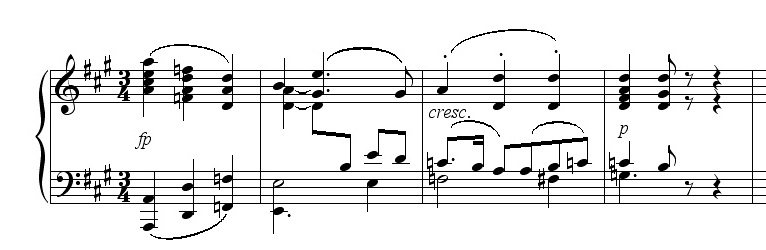
After a half bar of silence... a silence that might be interpreted "how do I respond to that?" ... the piano finds something to say: what appears to be the same idea, but from its second note shifting dramatically into the minor key.
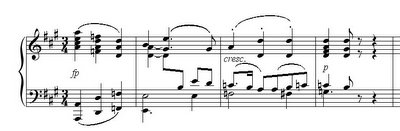
After the shock of this, one can come to an understanding: Beethoven is setting up a dualism of light/dark. The violin idea, unmarred by accidentals, seems to represent light, pure A major; whereas the pianist wanders into a darker place, the shadowy antithesis. But interestingly, the pianist's phrase, for all its dark F-naturals, concludes on a luminous G major chord (with a beautiful F-sharp suspension!)... it cannot decide whether to be night or day. I sense four separate moments of shock in the piano's opening statement: 1) the pianist's first note, the opening forte/piano, breaking the silence; 2) the pianist's second note (shifting unexpectedly to minor); 3) the downbeat of the pianist's third bar, with the deceptive bass motion up a half-step; and 4) the G major "arrival" (subito piano... a beauty, a sweetness, which was not anticipated). Such a density of surprise is hard to absorb; I realize, that for the "average" concertgoer, it may not even exist; but I think it is there. At one level, one perceives a very simple light/dark antithesis, but at another, events present a much more complicated question/answer in which the nature and identity of the essential dualism is in doubt.
From the outset, the piano is not an original thinker; it (he/she) is repeating, rethinking, reassessing... derivative, complex, living in a world already created by the hand of the violinist. (Pianist as original sin? curse of knowledge?) As events unfold, the violinist and pianist together undergo the darkest, most searing moment of the introduction--a moment which basically repeats the bass motion, and thus the essential "meaning" of the pianist's opening statement--

And they, too, together come to realize that fragile G major is the precarious answer. How can G major be an answer, in the key of A major? Through the obvious expedient of two rising fourths, A-D, D-G, (or two descending fifths) Beethoven arrives impossibly far afield. This, too, I think the "average" hypothetical median concertgoer (who does not really exist) does not always perceive. Sometimes, while I am playing the piece, and when we get to that moment, and someone coughs a bored cough right then, in the shocked, supreme, post-G-major silence, I want to get up from the piano and explain to them how incredibly amazing it is that Beethoven takes us there, how he tries to rock our world and propose that 2+2=3. It is like that scene in Ocean's Twelve where Clooney and co. want to rob a house in Amsterdam and the window is a foot too low for their scheme, and so they decide to dive underwater and raise the entire building up a foot using winches or something. That's how weird and wild it is to move from tonic A major to G major (flat seven!!!!!!); imagine the two root position chords next to each other, all the parallel fifths and octaves; all the rules and taboos that are broken to be there. I would deliver this little speech and people would be weeping for amazement, fainting for pleasure, and paralyzed by the marvel of Beethoven's audacity; one small sob would break out from the back of the house, and be reluctantly muffled; and then we would sit back down and play on. Haha.
For G major is the "wrong" answer to A major; it fits in no nacho/margarita category of the obvious. Its answeritude (answer+attitude=the quality of being an answer) comes from another source; it is more of a spiritual, metaphorical answer (light passing through dark to get to another, different light), which of course spins around on itself and becomes the question. I cannot help juxtaposing the strangeness of this answer against the circularity and precocious completeness of the violin's first statement; what kind of world is it where the opening idea can be so serene, beautiful and extraordinary, so insular and perfect; and then the harmonic basis can tectonically shift down a radical whole-step? A world where dumplings don't have to be eaten to be savored, where questions and answers are like free radicals, bonding with unexpected mates.
Towards the end of the first movement, after all our storm and stress, there is another wonderful, disturbing nexus of questions and answers. The violin proposes a cadence in B-flat major (impossible), in Adagio:
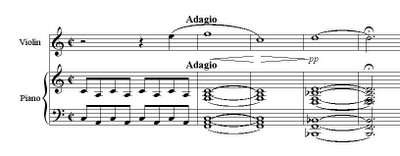
Every night at the piano I offer up a little prayer of thanks to my bassline of that moment, sinking that unthinkable fifth from F to B-flat. As always, V goes to I; the cliché spawns the revolution. A revolution because the "grain" of B-flat grates deeply against the prevailing A minor... literally and metaphorically. The moment is temporally distended; we are forced to sit and listen to the impossible. As in so many Beethoven angry minor-key movements, the metaphor of the island of calm is engaged; little patches, oases of lyricism, scattered throughout the movement (the second theme, for instance), call to each other structurally across stormy expanses ... and this is the crucial last one, farewell and summary, the violin's last halt to the movement's urge of relentless motion, so unutterably beautiful, expressing so much in the concision of its three chorale-like notes, distilling the idea again back to its essence... saying "stop, wait." To which the piano responds fatefully, without speeding up, twisting the harmony with the same three notes:

Although the rhythm is still stopped, though we are yet suspended in the standstill (marvelling, waiting), the harmonies have wended their way back to A minor, which means we know with that sinking feeling that we are back in the tragic world of the movement's overall gesture. The piano is again "too complicated," it answers with mixed messages; we are stopped, but wary; we know that an outburst is coming (we fear it)... there is a realization but it is fatal. I will never play to my satisfaction those last two Adagio chords; the connection between them has to express so much (falling, relinquishing, inevitability, despair).
And then the outburst happens ... the movement crashes to an end... The audience seems always to get caught up in this moment, to want to applaud; I too am thrilled and often feel demonically possessed by this ending, by our scales and ferocious concluding chords, dominant/tonic. But something about this last answer always seems misplaced. Its fury cannot possibly "answer" or resolve the pathos of those two preceding Adagios; there is no balancing, no summing up, what has occurred: there is too much. It is like a person in denial, a person who still thinks one question has one answer, and rages impotently against multivalence. Wow, how did I get there from dumplings? Perhaps via Beethoven.
Are you hungry? Eat something.
Are you tired? Get some sleep.
What would you like to drink with those nachos? A margarita.
Yes, these catechisms seem timeless and indisputable. But I submit that answers often jump ship and interpose themselves on questions to which they do not belong. For instance I did not eat the dumplings; they were not an answer to my hunger, which was solved by spicy soup; but they seemed an answer to another question: something having to do with relaxation, the comforts of lunchtime, of workday routines which are not oriented towards evening concerts, but which revolve around more predictable effort, into which steaming dumplings may come as a soothing relief... it may sound ridiculous to say that when I saw the dumplings (I did not need to eat them, only see them) they relieved me internally and made me cherish my nook for the moment, in time and in space. I was the satisfied filling of a dumpling. I felt like someone settling down to a good old-fashioned novel, or squishing into the perfect armchair by the fire for a conversation that does not promise to be usual or tiresome. And also yesterday evening, when a chilled bottle of white wine approached the table, and four of us were arranged around its square with our waiting glasses, I felt it was an answer, not to thirst or stress or food, but to some larger question of ritual and companionship...
At the opening of the "Kreutzer" Sonata, I sit idly but reverently by while the violin poses a very beautiful and difficult question (difficult to play, difficult to answer). It is a major-key question, filled with consonances (thirds, octaves, sixths, fifths), and trailing off.
The last note (the resolution) is short; after the breadth and lyricism of the idea, it gives itself over abruptly to silence. I think this is one of those unusual, extraordinary beginnings that distinguishes itself from the greater mass of classical openings not through any outrageous harmonic maneuver, ambiguity, or daring, but through the audacity of its sudden, naked Appearance: the Idea itself, presented whole (immaculate conception). It does not ask the typical questions of "famous" openings, such as What Key Am I In? or Where's the Downbeat? or What's the Tempo? or so forth (all more or less rephrasings of the common life question Where Am I Going?); all those questions are dismissed as unimportant (the neurotic concerns of other pieces), as the initial Idea speaks, presents to us its "grain" (like that of a piece of wood). A lot of times listening to the beginnings of classical pieces, I can say to myself: yes, this opening idea comes from the tonic triad, and this is the coy reply moving us to the dominant, etc. etc ... in these cases the opening ideas, the premises, their questions and answers, derive from the familiar and common, and allow us to experience the music gradually, as an unfolding of "logic": drapery on the scaffolding of tonality. Not as a shock of identity. I have a hard time seeing where the opening of the Kreutzer "comes from." There are no easy sources for its particular beauty. The sort of question I feel it asks is Why Do I Exist? or How Did I Come Into Being? And that is what gives it, for me, a kind of surreal beauty: an oddly certain question, a fragment that is strangely and prematurely complete. The piece is mature beyond its measures.
[Regular readers of Think Denk are not deluding themselves if they imagine, or anticipate with sinking certainty and dread, that I am drawing some implicit comparison between the opening of the Kreutzer Sonata and a steaming plate of dumplings; BUT do they suspect I am willing to sink yet sillier and imagine the ensuing piano phrase as soy sauce? This may yet have been left to the imagination; too late, now. I am sorry.]
After a half bar of silence... a silence that might be interpreted "how do I respond to that?" ... the piano finds something to say: what appears to be the same idea, but from its second note shifting dramatically into the minor key.
After the shock of this, one can come to an understanding: Beethoven is setting up a dualism of light/dark. The violin idea, unmarred by accidentals, seems to represent light, pure A major; whereas the pianist wanders into a darker place, the shadowy antithesis. But interestingly, the pianist's phrase, for all its dark F-naturals, concludes on a luminous G major chord (with a beautiful F-sharp suspension!)... it cannot decide whether to be night or day. I sense four separate moments of shock in the piano's opening statement: 1) the pianist's first note, the opening forte/piano, breaking the silence; 2) the pianist's second note (shifting unexpectedly to minor); 3) the downbeat of the pianist's third bar, with the deceptive bass motion up a half-step; and 4) the G major "arrival" (subito piano... a beauty, a sweetness, which was not anticipated). Such a density of surprise is hard to absorb; I realize, that for the "average" concertgoer, it may not even exist; but I think it is there. At one level, one perceives a very simple light/dark antithesis, but at another, events present a much more complicated question/answer in which the nature and identity of the essential dualism is in doubt.
From the outset, the piano is not an original thinker; it (he/she) is repeating, rethinking, reassessing... derivative, complex, living in a world already created by the hand of the violinist. (Pianist as original sin? curse of knowledge?) As events unfold, the violinist and pianist together undergo the darkest, most searing moment of the introduction--a moment which basically repeats the bass motion, and thus the essential "meaning" of the pianist's opening statement--
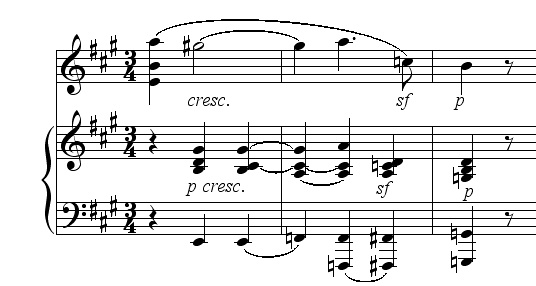
And they, too, together come to realize that fragile G major is the precarious answer. How can G major be an answer, in the key of A major? Through the obvious expedient of two rising fourths, A-D, D-G, (or two descending fifths) Beethoven arrives impossibly far afield. This, too, I think the "average" hypothetical median concertgoer (who does not really exist) does not always perceive. Sometimes, while I am playing the piece, and when we get to that moment, and someone coughs a bored cough right then, in the shocked, supreme, post-G-major silence, I want to get up from the piano and explain to them how incredibly amazing it is that Beethoven takes us there, how he tries to rock our world and propose that 2+2=3. It is like that scene in Ocean's Twelve where Clooney and co. want to rob a house in Amsterdam and the window is a foot too low for their scheme, and so they decide to dive underwater and raise the entire building up a foot using winches or something. That's how weird and wild it is to move from tonic A major to G major (flat seven!!!!!!); imagine the two root position chords next to each other, all the parallel fifths and octaves; all the rules and taboos that are broken to be there. I would deliver this little speech and people would be weeping for amazement, fainting for pleasure, and paralyzed by the marvel of Beethoven's audacity; one small sob would break out from the back of the house, and be reluctantly muffled; and then we would sit back down and play on. Haha.
For G major is the "wrong" answer to A major; it fits in no nacho/margarita category of the obvious. Its answeritude (answer+attitude=the quality of being an answer) comes from another source; it is more of a spiritual, metaphorical answer (light passing through dark to get to another, different light), which of course spins around on itself and becomes the question. I cannot help juxtaposing the strangeness of this answer against the circularity and precocious completeness of the violin's first statement; what kind of world is it where the opening idea can be so serene, beautiful and extraordinary, so insular and perfect; and then the harmonic basis can tectonically shift down a radical whole-step? A world where dumplings don't have to be eaten to be savored, where questions and answers are like free radicals, bonding with unexpected mates.
Towards the end of the first movement, after all our storm and stress, there is another wonderful, disturbing nexus of questions and answers. The violin proposes a cadence in B-flat major (impossible), in Adagio:
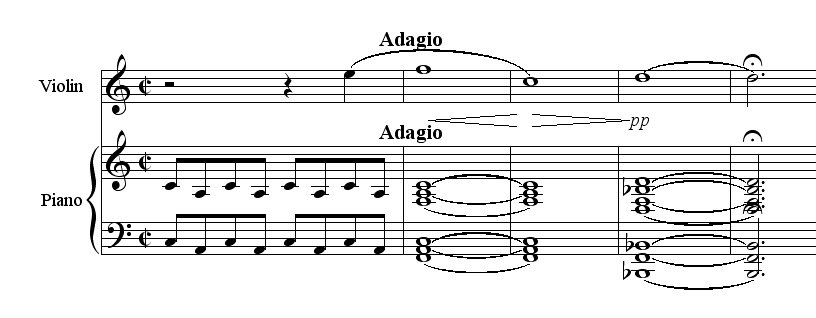
Every night at the piano I offer up a little prayer of thanks to my bassline of that moment, sinking that unthinkable fifth from F to B-flat. As always, V goes to I; the cliché spawns the revolution. A revolution because the "grain" of B-flat grates deeply against the prevailing A minor... literally and metaphorically. The moment is temporally distended; we are forced to sit and listen to the impossible. As in so many Beethoven angry minor-key movements, the metaphor of the island of calm is engaged; little patches, oases of lyricism, scattered throughout the movement (the second theme, for instance), call to each other structurally across stormy expanses ... and this is the crucial last one, farewell and summary, the violin's last halt to the movement's urge of relentless motion, so unutterably beautiful, expressing so much in the concision of its three chorale-like notes, distilling the idea again back to its essence... saying "stop, wait." To which the piano responds fatefully, without speeding up, twisting the harmony with the same three notes:
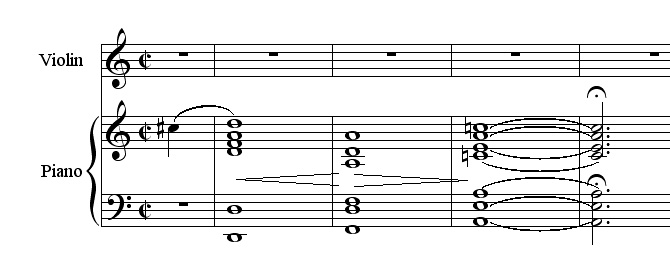
Although the rhythm is still stopped, though we are yet suspended in the standstill (marvelling, waiting), the harmonies have wended their way back to A minor, which means we know with that sinking feeling that we are back in the tragic world of the movement's overall gesture. The piano is again "too complicated," it answers with mixed messages; we are stopped, but wary; we know that an outburst is coming (we fear it)... there is a realization but it is fatal. I will never play to my satisfaction those last two Adagio chords; the connection between them has to express so much (falling, relinquishing, inevitability, despair).
And then the outburst happens ... the movement crashes to an end... The audience seems always to get caught up in this moment, to want to applaud; I too am thrilled and often feel demonically possessed by this ending, by our scales and ferocious concluding chords, dominant/tonic. But something about this last answer always seems misplaced. Its fury cannot possibly "answer" or resolve the pathos of those two preceding Adagios; there is no balancing, no summing up, what has occurred: there is too much. It is like a person in denial, a person who still thinks one question has one answer, and rages impotently against multivalence. Wow, how did I get there from dumplings? Perhaps via Beethoven.
Friday, February 17, 2006
Back
"Time to wake up, my fine moron friends." Cars were stopped ahead at the corner of 97th and Park, despite a green light, and the driver, through this remark, and some gentle beeping, reminded them of this paradox. Ahh, the gentle northeast, which I rhapsodized yesterday on this very site!
From the very first SECONDS of rearriving in the Homeland (a word now inextricably linked, sadly, with Security, and a sense of insecurity), I was confronted with an evocative and representative situation, proving 1) that I was in fact home, and 2) that nothing is too trivial for me to discuss it here on Think Denk. A little backstory: I slept heavily through my entire cross-country flight, emerging into the terminal at a rather advanced point of the day without having consumed a drop of coffee. Au Bon Pain, near my gate, seemed like a good place to rectify this urgent situation, and I placed myself in line. However, there was a small quandary, as shown in the diagram below:
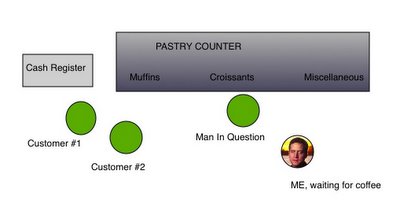
Two persons were clearly and umambiguously in line for the cash register, as evidenced by their proximity, whereas a third man (labelled Man In Question), a rather nebbishy fellow in his late forties, stood rather farther away... I intuited that he was nonetheless probably "in line," and merely consumed with choosing a pastry, but the question remained open in my mind, and it seemed possible he might head over to the refrigerator, for instance, to get a sandwich, or some sushi, an action in the cruel Lord-of-the-Flies world of the airport concession stand that would certainly place him "out of line" and force him to begin again from scratch. Groggy and caffeine-starved though I was, I reminded myself of our common humanity, and gave him the benefit of the doubt ... and ... all would have been well ... EXCEPT that soon enough, pressure came to bear on this situation, in the form of some impatient youths:
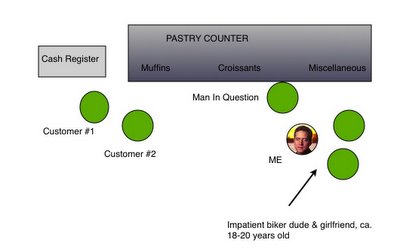
They had in fact chosen sandwiches from the refrigerator and were now coming to consummate their choices with a purchase. However, in the meantime, as the diagram shows, the nebbish in question had moved even a bit farther away from the invisible vector of the line, in order apparently to peer at more remote croissants. I still assumed that he represented the "end of the line," despite this renegade behavior, but the youths to my rear, in leather jackets, chafing at their fashionable bits, saw the huge gap between Customer #2 and the Man In Question and began to move past me... asking in the meantime "are you in line?" in a very dismissive way, like an unnecessary formality. It seemed too cruel for me to lose my spot in this fashion, and indefinitely postpone my cup of coffee at the whim of these youths, and I felt my hand was forced, and perhaps a bit overforcefully I said to the Man in Question, "Excuse me sir are you in line?" and at that moment he turned his head away from the croissants and gave me a pained expression I shall never forget. It seemed to distill a lifetime of being hassled and to convey a deep consciousness of the inexplicable impatience of the human sphere, within which we are all yoked. Yes: I, I, was the focus of this terrible, baleful, look, like that of an animal you have just fatally shot, and for a moment everything went still and the airport grew dim and the sun went behind the moon and time itself seemed to pause for my punishment:
"That's a real good question. Yes, I'm in line, and in another way I guess no, I'm looking and deciding; a little bit of both; is that OK with you?; does that mean I'm not still in line? If you have to, just go ahead, go ahead, do whatever you want, please just go on ahead, don't worry about me... whatever you want..."
So bitter, and so beautifully executed. A man who cut ahead at this point, as he was inviting me to do, would be ravaged by guilt, pursued by a croissant curse, for the remainder of his days; it was a passive-aggressive masterpiece. Somewhere in the cosmos there was silent, respectful applause. I looked helplessly at the youths who now also paused, and fell back into place behind me; I could not now shift the blame onto them, though of course I was caught between the generations, my 35-year-old impatient self harrassing the next older generation at the behest of the younger, by fateful proxy, against my will. It was so archetypal! Oh, the humanity!
I promise at some point some future post may actually discuss music again.
From the very first SECONDS of rearriving in the Homeland (a word now inextricably linked, sadly, with Security, and a sense of insecurity), I was confronted with an evocative and representative situation, proving 1) that I was in fact home, and 2) that nothing is too trivial for me to discuss it here on Think Denk. A little backstory: I slept heavily through my entire cross-country flight, emerging into the terminal at a rather advanced point of the day without having consumed a drop of coffee. Au Bon Pain, near my gate, seemed like a good place to rectify this urgent situation, and I placed myself in line. However, there was a small quandary, as shown in the diagram below:

Two persons were clearly and umambiguously in line for the cash register, as evidenced by their proximity, whereas a third man (labelled Man In Question), a rather nebbishy fellow in his late forties, stood rather farther away... I intuited that he was nonetheless probably "in line," and merely consumed with choosing a pastry, but the question remained open in my mind, and it seemed possible he might head over to the refrigerator, for instance, to get a sandwich, or some sushi, an action in the cruel Lord-of-the-Flies world of the airport concession stand that would certainly place him "out of line" and force him to begin again from scratch. Groggy and caffeine-starved though I was, I reminded myself of our common humanity, and gave him the benefit of the doubt ... and ... all would have been well ... EXCEPT that soon enough, pressure came to bear on this situation, in the form of some impatient youths:
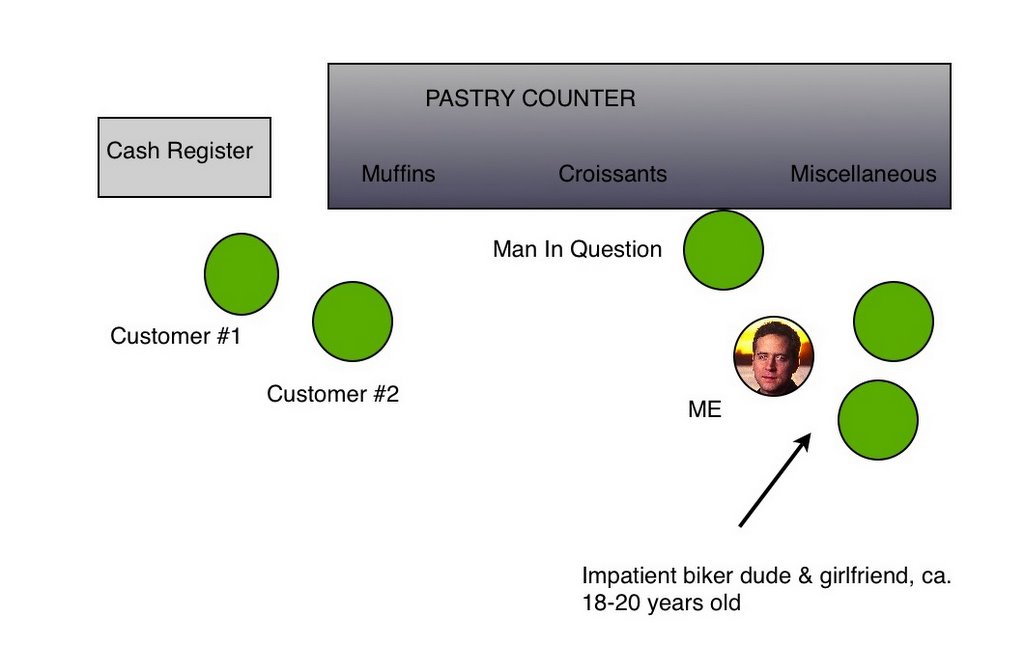
They had in fact chosen sandwiches from the refrigerator and were now coming to consummate their choices with a purchase. However, in the meantime, as the diagram shows, the nebbish in question had moved even a bit farther away from the invisible vector of the line, in order apparently to peer at more remote croissants. I still assumed that he represented the "end of the line," despite this renegade behavior, but the youths to my rear, in leather jackets, chafing at their fashionable bits, saw the huge gap between Customer #2 and the Man In Question and began to move past me... asking in the meantime "are you in line?" in a very dismissive way, like an unnecessary formality. It seemed too cruel for me to lose my spot in this fashion, and indefinitely postpone my cup of coffee at the whim of these youths, and I felt my hand was forced, and perhaps a bit overforcefully I said to the Man in Question, "Excuse me sir are you in line?" and at that moment he turned his head away from the croissants and gave me a pained expression I shall never forget. It seemed to distill a lifetime of being hassled and to convey a deep consciousness of the inexplicable impatience of the human sphere, within which we are all yoked. Yes: I, I, was the focus of this terrible, baleful, look, like that of an animal you have just fatally shot, and for a moment everything went still and the airport grew dim and the sun went behind the moon and time itself seemed to pause for my punishment:
"That's a real good question. Yes, I'm in line, and in another way I guess no, I'm looking and deciding; a little bit of both; is that OK with you?; does that mean I'm not still in line? If you have to, just go ahead, go ahead, do whatever you want, please just go on ahead, don't worry about me... whatever you want..."
So bitter, and so beautifully executed. A man who cut ahead at this point, as he was inviting me to do, would be ravaged by guilt, pursued by a croissant curse, for the remainder of his days; it was a passive-aggressive masterpiece. Somewhere in the cosmos there was silent, respectful applause. I looked helplessly at the youths who now also paused, and fell back into place behind me; I could not now shift the blame onto them, though of course I was caught between the generations, my 35-year-old impatient self harrassing the next older generation at the behest of the younger, by fateful proxy, against my will. It was so archetypal! Oh, the humanity!
I promise at some point some future post may actually discuss music again.
Thursday, February 16, 2006
Threats
When the driver handed us a business card, I was surprised to read, in boldface, "Threat Assessment." My dubious naïveté felt punctured, like a flat tire on the road to Vegas. Perhaps in the post-9/11 world, I was too complacent. All around me anti-pianist threats lurked, on the way from airport to hotel to hall, and thank goodness some strongman was there to assess them. For example, when i ordered a $14 entree in my hotel room, I found when the bill arrived that the total, with accompanying fees, was $35! Spectacular, devilish ingenuity of the Room Service Gods. The driver oddly did not save me from that pitfall (perhaps too busy assessing others), but he "reassured" me further on the way to the concert, boasting he was more than ready to break an arm or two (it "would not be the first time," he hinted), and reenacting a sarcastic conversation he might have with some hypothetical difficult concertgoer: "Oh I'm SO SORRY your shoulder got dislocated, now get out of here." I kid you not. I laughed what I hoped was a mollifying laugh and secretly cherished my fear and horror. Then a different laugh overtook me as I suddenly imagined some of the gentler Northeast presenters, in Philadelphia, or Boston, or a lovely, deeply cultured Italian lady running a small, modest, but serious series down in Washington DC--imagining any of them threatening to break arms as they drove me from the train station. Was it so much safer there than in the wild West? And what a strange preparation for the first, gentle, beatific phrase of Mozart's K 301...
Tuesday, February 14, 2006
Chameleon
It is not always so easy to "be oneself." Looking back at various comments on this blog, I see scattered suggestions for me to be true to myself, which causes me undue anxiety; I wrack my brain, soul, stomach to find what I was when I was I. Am I, was I, not really myself for that short period? And why? I am now touring with Joshua Bell; we get up every night on a stage to project maybe three different selves: the identity of the music (hopefully first), and each of our respective identities, our thoughts in relation to the music, and maybe one could talk about a fourth--the identity of our intertwining dialogue. Josh's persona is quite strong; I find myself by turns dissolving into his playing and thinking, and then crystallizing back into my own self, trying to find the razor's edge, the bridge, between these states: in chemistry terms, a solute on the edge of solution. Supersaturated.
It is disquieting to imagine our identity in flux, that we are not as stable a thing as we imagine (Barthes calls each of us a patchwork of interlacing codes)... Perhaps one of the consoling things about the icons of classical music: a composer's style gives the sense of a recurring, identifiable personality between all his different pieces: the preservation of the elusive human soul-fingerprint, despite variety, in sound. Brahms is Brahms, X is X, and when Josh and I sit down to play the Five Melodies of Prokofiev, from the very first sonorities I can "feel" Prokofiev's strange beautiful breath on my ear. I love how the first, lyrical phrase is followed by a ghostly echo (identity/loss of identity?) where the piano descends into the bass (melody/non-melody)... a kind of disquieting undertone belying the almost too-easy lyricism of the first idea--a love is expressed; beneath it some ulterior motive, some dark relationship. I am partial to this side of Prokofiev, the Prokofiev of complicated (not too obvious) irony and stream-of-consciousness fragments, of digression and fantasy; I have to say it is my favorite side of his "self"; he is a friend whom I like best in a particular mood. The more bitterly ironic Prokofiev I find too bitter, too in-my-face, too simply rejecting; the pounding piano ostinatos and marches are fun but do not speak to my soul; and when his tremendous lyricism is unlaced with irony I often find it saccharine. So here I have another razor's edge: my own relationship to Prokofiev, which is personal, part of my identity ... my own agenda! I also adore his piano playing, which seems to me mainly lyrical, fanciful, evanescent--courting arrhythmia, in opposition to the oppressively rhythmic manner in which his music is often executed. Sometimes I wish only Prokofiev were permitted to play Prokofiev.
The third of the Five Melodies begins with a kind of ecstatic climax (from where? why? how?)--already a bizarre notion, an unjustified, preemptive lightning bolt--and gradually dies down to a long, still, ethereal arc; then the climax returns but softer -- an echo, an aftershock. Perhaps the form could be expressed thus:
ClIMAX... dying... dying... dead (a beautiful, sensual death) ... climax? (awake from dead? life remembered from death?)... disturbing, grinding coda...
Usually the "bigger" version of an idea would be towards the end--logically, progressively--but Prokofiev reverses this typical pattern, subtly using echo and disintegration (rather than development and ascension) as his formal motivations. Ahh, like a sinking feeling, some loss of meaning, some weird, falling, changing perspective. These asymmetries and peculiarities, these reversals of rhetoric, with the questions of tone and meaning they pose, cause me to connect these little five pieces to modernist verse, with the ambiguous alchemy of their bare-minimum words. It is not hard to move from the opening bars of the Five Melodies, for instance, to the following lines...
Let us go then, you and I
while the evening is spread out against the sky
like a patient etherized upon a table.
As Hugh Kenner points out in his wonderful book The Pound Era, the first two lines falsely promise a kind of Romantic outlook, a "conventional" love poem, while the third line deliciously delivers nonsense, antithesis, irony, the infusion of the modern, medicinal, procedural... the most un-Romantic simile imaginable. What kind of poem is it? Who is speaking? How can those lines possibly belong together? In other words, the questioning and challenging of identity, of the consistency of the self of the poem ... to what is the Love Song of J. Alfred Prufrock true? ... the beauty of the shifting self, of the moment of uncertainty, of the impossibility of fixing anything in place ... and yet, behind that flux, there is a new once-removed identity, the observer self looking at, following, his own complicated changing states, savoring, knowing, dissolving.
The maid left some smooth jazz on in my hotel room here in Arizona--a pure strange accident--and while I check emails my head is bopping, it seems to make me happy. Again a crisis of self. Am I really the kind of person who can enjoy smooth jazz? And then, is it possible for me, tonight, to play the "Kreutzer" Sonata? Arizonans will know soon enough.
It is disquieting to imagine our identity in flux, that we are not as stable a thing as we imagine (Barthes calls each of us a patchwork of interlacing codes)... Perhaps one of the consoling things about the icons of classical music: a composer's style gives the sense of a recurring, identifiable personality between all his different pieces: the preservation of the elusive human soul-fingerprint, despite variety, in sound. Brahms is Brahms, X is X, and when Josh and I sit down to play the Five Melodies of Prokofiev, from the very first sonorities I can "feel" Prokofiev's strange beautiful breath on my ear. I love how the first, lyrical phrase is followed by a ghostly echo (identity/loss of identity?) where the piano descends into the bass (melody/non-melody)... a kind of disquieting undertone belying the almost too-easy lyricism of the first idea--a love is expressed; beneath it some ulterior motive, some dark relationship. I am partial to this side of Prokofiev, the Prokofiev of complicated (not too obvious) irony and stream-of-consciousness fragments, of digression and fantasy; I have to say it is my favorite side of his "self"; he is a friend whom I like best in a particular mood. The more bitterly ironic Prokofiev I find too bitter, too in-my-face, too simply rejecting; the pounding piano ostinatos and marches are fun but do not speak to my soul; and when his tremendous lyricism is unlaced with irony I often find it saccharine. So here I have another razor's edge: my own relationship to Prokofiev, which is personal, part of my identity ... my own agenda! I also adore his piano playing, which seems to me mainly lyrical, fanciful, evanescent--courting arrhythmia, in opposition to the oppressively rhythmic manner in which his music is often executed. Sometimes I wish only Prokofiev were permitted to play Prokofiev.
The third of the Five Melodies begins with a kind of ecstatic climax (from where? why? how?)--already a bizarre notion, an unjustified, preemptive lightning bolt--and gradually dies down to a long, still, ethereal arc; then the climax returns but softer -- an echo, an aftershock. Perhaps the form could be expressed thus:
ClIMAX... dying... dying... dead (a beautiful, sensual death) ... climax? (awake from dead? life remembered from death?)... disturbing, grinding coda...
Usually the "bigger" version of an idea would be towards the end--logically, progressively--but Prokofiev reverses this typical pattern, subtly using echo and disintegration (rather than development and ascension) as his formal motivations. Ahh, like a sinking feeling, some loss of meaning, some weird, falling, changing perspective. These asymmetries and peculiarities, these reversals of rhetoric, with the questions of tone and meaning they pose, cause me to connect these little five pieces to modernist verse, with the ambiguous alchemy of their bare-minimum words. It is not hard to move from the opening bars of the Five Melodies, for instance, to the following lines...
Let us go then, you and I
while the evening is spread out against the sky
like a patient etherized upon a table.
As Hugh Kenner points out in his wonderful book The Pound Era, the first two lines falsely promise a kind of Romantic outlook, a "conventional" love poem, while the third line deliciously delivers nonsense, antithesis, irony, the infusion of the modern, medicinal, procedural... the most un-Romantic simile imaginable. What kind of poem is it? Who is speaking? How can those lines possibly belong together? In other words, the questioning and challenging of identity, of the consistency of the self of the poem ... to what is the Love Song of J. Alfred Prufrock true? ... the beauty of the shifting self, of the moment of uncertainty, of the impossibility of fixing anything in place ... and yet, behind that flux, there is a new once-removed identity, the observer self looking at, following, his own complicated changing states, savoring, knowing, dissolving.
The maid left some smooth jazz on in my hotel room here in Arizona--a pure strange accident--and while I check emails my head is bopping, it seems to make me happy. Again a crisis of self. Am I really the kind of person who can enjoy smooth jazz? And then, is it possible for me, tonight, to play the "Kreutzer" Sonata? Arizonans will know soon enough.
Friday, February 10, 2006
Wisdom
Cabbie: Where to?
Me: Symphony Hall, please.
[pulls away from my hotel, turns right, begins to careen down Powell Street]
Cabbie: So, you a musician?
Me: You got me.
Cabbie: I knew it. What do you play?
Me: Piano.
Cabbie: I bet you know your middle C pretty well.
Me: [attempting wit] C is pretty solid. Still working on D and E...
Cabbie: And those thumbcrossings. Eh.
[Ensuing pantomime of a thumbcrossing--possibly a major scale. One or both hands leaves the wheel. He looks back to smile at me. Car in front of us stops suddenly. Dumbstruck me. Somehow he notices in time, abandons scale, swerves, brakes. Near-death. We survive. Diminishing panic. Other driver is accused of stopping "too late." Drive resumes.]
Cabbie: So. I had piano lessons.
Me: Is that so?
Cabbie: Yeah. The teacher told me "no, you're not doing that thumbcrossing right," and I told her go to hell, I'm going to play football.
[I silently reflect this is the shortest piano lesson story I have ever been told, and perhaps the best. This man probably speaks for piano students everywhere.]
Me: You ever regret not sticking with it?
Cabbie: [Conspicuously unregretful in tone] Yeah, all the time. You know San Francisco at all?
Me: A little.
Cabbie: Well, there used to be this piano shop round here which my friend owned, and it connected to a deli. You could walk right through from one to the other! You know, piano salesmen are like used car guys, with all the extra charges, and the one-more-things. Anyway, I worked the deli for a little while, to help my friend out cause of some trouble ... that's another story ... and so one day I was working and the shop was about to close, it was ten to six and we closed at six, and the Opera called, and they wanted some sandwiches!
Me: OK.
Cabbie: And so these two women came in, and I was still making their food, and the one, her accompanist, walked into the piano shop, and the other one asked me if I minded if she sang, and what am I gonna say? I don't want a free concert?! So they sang, and it was amazing. Beautiful. Really good.
Me: Nice.
Cabbie: So I fell in love with her.
Me: Really?
Cabbie: It's true I did. And you know I took her out and you know...
Me: Really?
Cabbie: Yeah and this went on for like a week or so. I sent her flowers and all that crap.
Me: Hmm.
Cabbie: Then one day she was like, you know I have this dilemma, there's this guy in Sacramento and he's very close to being my fiancee and I just don't know what to do. And after that I never heard from her again.
[Silence. Very close to the hall now.]
Me: [Stammering] I'm sorry.
Cabbie: No no, it was a great experience, you know.
Me: Yeah. Can I pay with a credit card?
Me: Symphony Hall, please.
[pulls away from my hotel, turns right, begins to careen down Powell Street]
Cabbie: So, you a musician?
Me: You got me.
Cabbie: I knew it. What do you play?
Me: Piano.
Cabbie: I bet you know your middle C pretty well.
Me: [attempting wit] C is pretty solid. Still working on D and E...
Cabbie: And those thumbcrossings. Eh.
[Ensuing pantomime of a thumbcrossing--possibly a major scale. One or both hands leaves the wheel. He looks back to smile at me. Car in front of us stops suddenly. Dumbstruck me. Somehow he notices in time, abandons scale, swerves, brakes. Near-death. We survive. Diminishing panic. Other driver is accused of stopping "too late." Drive resumes.]
Cabbie: So. I had piano lessons.
Me: Is that so?
Cabbie: Yeah. The teacher told me "no, you're not doing that thumbcrossing right," and I told her go to hell, I'm going to play football.
[I silently reflect this is the shortest piano lesson story I have ever been told, and perhaps the best. This man probably speaks for piano students everywhere.]
Me: You ever regret not sticking with it?
Cabbie: [Conspicuously unregretful in tone] Yeah, all the time. You know San Francisco at all?
Me: A little.
Cabbie: Well, there used to be this piano shop round here which my friend owned, and it connected to a deli. You could walk right through from one to the other! You know, piano salesmen are like used car guys, with all the extra charges, and the one-more-things. Anyway, I worked the deli for a little while, to help my friend out cause of some trouble ... that's another story ... and so one day I was working and the shop was about to close, it was ten to six and we closed at six, and the Opera called, and they wanted some sandwiches!
Me: OK.
Cabbie: And so these two women came in, and I was still making their food, and the one, her accompanist, walked into the piano shop, and the other one asked me if I minded if she sang, and what am I gonna say? I don't want a free concert?! So they sang, and it was amazing. Beautiful. Really good.
Me: Nice.
Cabbie: So I fell in love with her.
Me: Really?
Cabbie: It's true I did. And you know I took her out and you know...
Me: Really?
Cabbie: Yeah and this went on for like a week or so. I sent her flowers and all that crap.
Me: Hmm.
Cabbie: Then one day she was like, you know I have this dilemma, there's this guy in Sacramento and he's very close to being my fiancee and I just don't know what to do. And after that I never heard from her again.
[Silence. Very close to the hall now.]
Me: [Stammering] I'm sorry.
Cabbie: No no, it was a great experience, you know.
Me: Yeah. Can I pay with a credit card?
Wednesday, February 08, 2006
Early Flight
The first events of the day were a vague beeping and a dream of boiling clouds. The clouds scattered, the beeping grew more present, and like a tribal signal I began to understand with horror what sacrifice it demanded of me. Shortly thereafter I found myself wandering around the room, vaguely disembodied, halting, like an outdated packing robot. I was leaning over to put on my socks when a man in charge of a fleet of black four-door sedans took pity on me. I could hear soft sympathy in his dispatching tone, though I was late for my pickup. "How are you feeling this morning, Sir?" I tried to sound brave, nonchalant, optimistic. Why did I not want him to lose confidence in me as a customer? Never mind my three hours' sleep, I was thrilled to hit the airport, and I would be dashing out the door of my building with my bags any second, all smiles, giggles, and existential bliss. A small list of things-to-do-before-I-leave bubbled through my brain and threatened to leak out all over the floor, and I kept cramming them back in, like items in a suitcase, through mantric repetition, which made me feel kind of desperate or insane, like the insomniacs in One Hundred Years of Solitude who label everything around them as lack of sleep erodes their sense of language. For some reason in the midst of the madness I picked up "Awakenings" (by Oliver Sacks) and read a paragraph about a woman who dreamed she was imprisoned in a castle, which was herself.
And now the glow over the industrial, rusty wastes of Queens is really quite beautiful, especially from the comfort of a backseat. If I were out there in the cold hard world, lugging luggage from train to bus to train, I may not have had quite the impulse or occasion to savor this super-orange curtain rising from a side of the sky. After the first five minutes in the cab or car, five minutes of residual panic where you go over all the possible things you have forgotten (music--always music first!--wallet, keys, credit card, driver's license, joie de vivre, itinerary, etc.), then there is a delicious surrender. The vehicle, motion itself, takes you; it is generally sad but pleasant; there is either traffic which is its own pattern of starts and stops, or there is the empty sleepy city, with all the faintly glowing apartments of peaceful and warlike people with their distant unknowable lives; and you float or inch alone in your bubble towards another bubble which will carry you across continents or oceans ... as I said, it is generally sad, a time for musing, for seeing what's past and done, for remembering all the previous trips, all the old, dilapidated Triboro bridges of your life to date, the motivations (loves, desires, needs) which carried you all these places, many forgotten; I look out the window and wallow in this slightly ridiculous mood, such that I am always surprised by the practicality of dealing with the driver at the destination. The cold, present airport curb, where accumulated, hoarded memory makes way for anonymous transit.
And now, through security: the strange light of the coffee kiosk. A line of fifteen people or more awaits, and I glare from afar at the barista. Even if he were some outrageous, wonderful monster of coffee-serving efficiency, some super-human grinder/brewer who wasted not one millimeter of motion or iota of thought in preparing our beverages, it would still not be enough; coffee means to resent the postponement of coffee. A woman, perversely, decides to try to find exact coins for her purchase; she ransacks her change purse; pennies are long sought, dropped, re-found; I have never seen such an outrage; I seethe. Woman, can you not see the inhumanity of what you are doing?
Calm down, gentle soul. Soon you will be on the plane and off to the West Coast; visions of dim sum, spas, espresso, blue waters... of people who have prioritized the pure pleasure of life, and not distilled action. I will stare lovingly at their pierced lips, torn jeans, and half-hidden tattoos, and envy an imaginary, unwanted freedom. As I gave my boarding pass to the lady at the gate, I thought I asked her if I was boarding at the right time. Did she hear me? I think she did, but she probed deeper and saw behind my eyes an early morning mania, that slightly more dangerous question posed by the three-hour sleeper with last night's ginger chicken undigested in the premature morning. And she chose to address that deeper question instead: "Everything's okay so far," she said--a broader, diagnostic answer--oddly echoing the dispatcher's earlier solicitude. I did find myself enjoying her smile as I went down the jetbridge, taking disproportionate comfort ... I was happier and more grounded now that she had welcomed me onto the plane; but what did she mean by "so far"? That, I suppose, was all she could promise.
It was contingent, but from the car service which was a bubble of the past, mulled over in orange, I find myself transported to a room with sunny windows, and a view of the blue water I had hoped for, and expensive bottled water (clear, blue, light); a room which feels like the present, which opens onto a promising outdoors; only unpacking now needs to be done; no going, only being; for which I need no saintly dispatcher or ticket-taker, no reassurance.
And now the glow over the industrial, rusty wastes of Queens is really quite beautiful, especially from the comfort of a backseat. If I were out there in the cold hard world, lugging luggage from train to bus to train, I may not have had quite the impulse or occasion to savor this super-orange curtain rising from a side of the sky. After the first five minutes in the cab or car, five minutes of residual panic where you go over all the possible things you have forgotten (music--always music first!--wallet, keys, credit card, driver's license, joie de vivre, itinerary, etc.), then there is a delicious surrender. The vehicle, motion itself, takes you; it is generally sad but pleasant; there is either traffic which is its own pattern of starts and stops, or there is the empty sleepy city, with all the faintly glowing apartments of peaceful and warlike people with their distant unknowable lives; and you float or inch alone in your bubble towards another bubble which will carry you across continents or oceans ... as I said, it is generally sad, a time for musing, for seeing what's past and done, for remembering all the previous trips, all the old, dilapidated Triboro bridges of your life to date, the motivations (loves, desires, needs) which carried you all these places, many forgotten; I look out the window and wallow in this slightly ridiculous mood, such that I am always surprised by the practicality of dealing with the driver at the destination. The cold, present airport curb, where accumulated, hoarded memory makes way for anonymous transit.
And now, through security: the strange light of the coffee kiosk. A line of fifteen people or more awaits, and I glare from afar at the barista. Even if he were some outrageous, wonderful monster of coffee-serving efficiency, some super-human grinder/brewer who wasted not one millimeter of motion or iota of thought in preparing our beverages, it would still not be enough; coffee means to resent the postponement of coffee. A woman, perversely, decides to try to find exact coins for her purchase; she ransacks her change purse; pennies are long sought, dropped, re-found; I have never seen such an outrage; I seethe. Woman, can you not see the inhumanity of what you are doing?
Calm down, gentle soul. Soon you will be on the plane and off to the West Coast; visions of dim sum, spas, espresso, blue waters... of people who have prioritized the pure pleasure of life, and not distilled action. I will stare lovingly at their pierced lips, torn jeans, and half-hidden tattoos, and envy an imaginary, unwanted freedom. As I gave my boarding pass to the lady at the gate, I thought I asked her if I was boarding at the right time. Did she hear me? I think she did, but she probed deeper and saw behind my eyes an early morning mania, that slightly more dangerous question posed by the three-hour sleeper with last night's ginger chicken undigested in the premature morning. And she chose to address that deeper question instead: "Everything's okay so far," she said--a broader, diagnostic answer--oddly echoing the dispatcher's earlier solicitude. I did find myself enjoying her smile as I went down the jetbridge, taking disproportionate comfort ... I was happier and more grounded now that she had welcomed me onto the plane; but what did she mean by "so far"? That, I suppose, was all she could promise.
It was contingent, but from the car service which was a bubble of the past, mulled over in orange, I find myself transported to a room with sunny windows, and a view of the blue water I had hoped for, and expensive bottled water (clear, blue, light); a room which feels like the present, which opens onto a promising outdoors; only unpacking now needs to be done; no going, only being; for which I need no saintly dispatcher or ticket-taker, no reassurance.
Thursday, January 26, 2006
WOW!
I have noticed a slight uptick in the irritability of the universe lately. My evidence? The other day, I was in Starbucks minding my own business (so all these stories begin), typing nonsense at my too-cool-for-school laptop, when I noticed a man set something down at the empty adjoining table. Perhaps a minute later, another man put something at another spot by the same table. Both left to get in line, and both, sadly, came to the table with their drinks simultaneously, intending to sit and occupy (veni, vidi, vici): a childish spat ensued. I couldn't believe how stubborn each was to the cause, which was, after all, just a table (or perhaps more: a moment of repose?). The dispute ended by "sharing"; they each refused to relinquish, and sat the same table, glowering, sucking up each other's negative energy. One was in his early 20s, impeccably dressed, indubitably gay, and somewhat on the sniffy side of the spectrum; the other probably early 60s, peccably dressed, squarely straight, far on the grumpy side of the spectrum (almost invisible to the genial eye), and reading--of course--the NY Post. A mini culture war for my benefit. The younger one talked loudly on his cellphone to irritate his table mate, while the older read his Post, crinkling and uncrinkling, folding and refolding: a motion like the flapping wings of a giant, tired, grimy bat. Needless to say, I was quite irritated and distracted by this tempest in a teapot, perhaps even enraged, and eventually got up, pulled my handy chainsaw out of its case, and made a clean slice...
Just kidding.
I also witnessed this morning a similar dispute between a burly construction worker from Long Island and a small elderly Jewish lady, in Tal Bagels, revolving around the eternal issue of "where the line begins." (If only we could always know!) Luckily this dispute did not come to blows; I feel sure she would have embarrassed him rather badly.
These, along with several other instances of New Yorker irritability, have made me sense the vague winds of a trend... And this trend has even carried over into this very blog (heavens!) since my snarky post "BS of the day," in which I took a Mr. Wilson to task for some vague comments about Mozart, inspired quite a few reactions, and even the unimaginable: criticisms. I suppose this is to be seen not as a sad outcome, or even as a loss of innocence (a de-virginization of the blog) but as a positive thing, an act of birth, even: something has engendered a "discussion."
Let me just say a few more things toward this discussion, to try and mend some fences.
1) "BS of the day" was a self-conscious attempt to imitate other, snarky blogs such as Wonkette. I do not intend to adopt this style permanently, and I apologize to those readers who felt offended. Occasionally is it OK, though, if I just rant about something? Thanks.
2) I think opera is fantastic.
3) I was disheartened by the disintegration of the discourse into (sigh, as usual) a maligning of analysis. This happens so easily! I saw it in one of the comments: it began with the coupling of the words "erudite" and "analysis," which makes it seem a bit elitist already; and then, sure enough, the word "dissection" made its way in there; and then "there's no pleasure left." People say "you are analyzing this to death!" as if discussion and contemplation of music were some sort of murderous activity, some sort of science-lab experiment in which a frog must die, pinned to the table.
I have my own gripes with analysis, believe me. But I don't think the answer is this kind of dismissal, this kind of easy getaway, as in: what's the point of analysis anyway? followed by "meet you at the Redeye Grill for martinis." Specifically to keep my vision fresh, I feel the need to keep asking the same unanswerable questions about the music I am playing over and over again, to reach into verbal language for what it has to offer and cross back into the language of tones like a returning tourist. I feel this is similar to when I sing a phrase to myself in my head, when I imagine the music without sound (or at least anything that anyone else could hear); things are almost always better back at the piano--wider, freer--after this kind of removal, the removal of music from sound, its temporary passage into gesture, thought, imagination. If you are still thinking about martinis, I don't blame you.
I spent a great deal of time on Op. 111 this week, verbally and mentally, thinking how to communicate something about it to 25 freshmen. Of course I think the happiest, most enlightened person after the hour-and-a-half lecture was me. For the umpteenth time I felt I "finally" knew what I wanted to say (notice how we use that phrase as a compliment: "his playing really SAYS something to me, really SPEAKS to me"--even for non-verbal music!) with this piece, and the next day on the train back down the Hudson, this happiness became more pronounced. Scarfing my stir-fry in Penn Station, amidst a hassled underground crowd, I was singing inaudibly over and over again thirds, fourths, fifths from the Arietta. Well, perhaps not inaudibly; in my blissful imagined solitude, I might have moaned a little, enough so that the man who had cooked up my stirfry looked up and asked "It tastes good?" He looked either amused or concerned; food in that place wasn't really meant to be "enjoyed;" I smiled like a good little deranged maniac and said yes, it was delicious; he really didn't need to know the truth.
How was it that magic dust had been sprinkled again all over that theme, in that ugly place? Maybe it was partly the article that my colleague had xeroxed for me, in which I read that Schenker (a hardcore theorist if there ever was one) broke off from the world of technical terms and called the cadenza of the Arietta a "strange dream;" maybe it was the little technical/emotional phrase in the article "vertiginous fall of fifths" which showed me a pattern I had been too lazy to notice, while feeling all the while something frightening about that place--that it was too much to absorb, that everything was slipping away, that it was gravity-free, like the sense of (infinitely, impossibly) falling in a dream; maybe it was the part in which Schenker talks about the one high F which means so much to him, at a moment when the movement leaves off, loses track of itself, in which its ecstasy is so extreme that it cannot possibly continue along the path it is taking; and maybe it was partly a phone conversation with my friend C who said he was struck again, freshly, how in the wild, syncopated variation Beethoven seemed to see, ahead of time, the joyfulness of jazz, to anticipate so amazingly things which are now part of our lives, and C's use of the word "joyful" which is probably the perfect word to define on what side of an invisible fence the movement's austerity and transcendence lies.
How is that these little "academic thoughts" managed to whip me up into a frenzy of enjoying the movement all over again? It was not analyzed to death; it was analyzed to life. Only the three notes, long-short-long: just that, and the path leads off into a labyrinth in which the means of escape is never twice the same, in which the focal moments can change according to the observer or the day... Each time to play it: like entering/creating a universe. There is always the moment of being "too full," the sense that the adventure has reached a crisis point, that the emotion or invention has gone so far that you or the piano will explode; and always the balancing moment where things are slipping away, and dangerously "empty;" and always the starry conclusion, resolving or disappearing, twinkling with the high frequencies of the piano, promising, always promising...
Just kidding.
I also witnessed this morning a similar dispute between a burly construction worker from Long Island and a small elderly Jewish lady, in Tal Bagels, revolving around the eternal issue of "where the line begins." (If only we could always know!) Luckily this dispute did not come to blows; I feel sure she would have embarrassed him rather badly.
These, along with several other instances of New Yorker irritability, have made me sense the vague winds of a trend... And this trend has even carried over into this very blog (heavens!) since my snarky post "BS of the day," in which I took a Mr. Wilson to task for some vague comments about Mozart, inspired quite a few reactions, and even the unimaginable: criticisms. I suppose this is to be seen not as a sad outcome, or even as a loss of innocence (a de-virginization of the blog) but as a positive thing, an act of birth, even: something has engendered a "discussion."
Let me just say a few more things toward this discussion, to try and mend some fences.
1) "BS of the day" was a self-conscious attempt to imitate other, snarky blogs such as Wonkette. I do not intend to adopt this style permanently, and I apologize to those readers who felt offended. Occasionally is it OK, though, if I just rant about something? Thanks.
2) I think opera is fantastic.
3) I was disheartened by the disintegration of the discourse into (sigh, as usual) a maligning of analysis. This happens so easily! I saw it in one of the comments: it began with the coupling of the words "erudite" and "analysis," which makes it seem a bit elitist already; and then, sure enough, the word "dissection" made its way in there; and then "there's no pleasure left." People say "you are analyzing this to death!" as if discussion and contemplation of music were some sort of murderous activity, some sort of science-lab experiment in which a frog must die, pinned to the table.
I have my own gripes with analysis, believe me. But I don't think the answer is this kind of dismissal, this kind of easy getaway, as in: what's the point of analysis anyway? followed by "meet you at the Redeye Grill for martinis." Specifically to keep my vision fresh, I feel the need to keep asking the same unanswerable questions about the music I am playing over and over again, to reach into verbal language for what it has to offer and cross back into the language of tones like a returning tourist. I feel this is similar to when I sing a phrase to myself in my head, when I imagine the music without sound (or at least anything that anyone else could hear); things are almost always better back at the piano--wider, freer--after this kind of removal, the removal of music from sound, its temporary passage into gesture, thought, imagination. If you are still thinking about martinis, I don't blame you.
I spent a great deal of time on Op. 111 this week, verbally and mentally, thinking how to communicate something about it to 25 freshmen. Of course I think the happiest, most enlightened person after the hour-and-a-half lecture was me. For the umpteenth time I felt I "finally" knew what I wanted to say (notice how we use that phrase as a compliment: "his playing really SAYS something to me, really SPEAKS to me"--even for non-verbal music!) with this piece, and the next day on the train back down the Hudson, this happiness became more pronounced. Scarfing my stir-fry in Penn Station, amidst a hassled underground crowd, I was singing inaudibly over and over again thirds, fourths, fifths from the Arietta. Well, perhaps not inaudibly; in my blissful imagined solitude, I might have moaned a little, enough so that the man who had cooked up my stirfry looked up and asked "It tastes good?" He looked either amused or concerned; food in that place wasn't really meant to be "enjoyed;" I smiled like a good little deranged maniac and said yes, it was delicious; he really didn't need to know the truth.
How was it that magic dust had been sprinkled again all over that theme, in that ugly place? Maybe it was partly the article that my colleague had xeroxed for me, in which I read that Schenker (a hardcore theorist if there ever was one) broke off from the world of technical terms and called the cadenza of the Arietta a "strange dream;" maybe it was the little technical/emotional phrase in the article "vertiginous fall of fifths" which showed me a pattern I had been too lazy to notice, while feeling all the while something frightening about that place--that it was too much to absorb, that everything was slipping away, that it was gravity-free, like the sense of (infinitely, impossibly) falling in a dream; maybe it was the part in which Schenker talks about the one high F which means so much to him, at a moment when the movement leaves off, loses track of itself, in which its ecstasy is so extreme that it cannot possibly continue along the path it is taking; and maybe it was partly a phone conversation with my friend C who said he was struck again, freshly, how in the wild, syncopated variation Beethoven seemed to see, ahead of time, the joyfulness of jazz, to anticipate so amazingly things which are now part of our lives, and C's use of the word "joyful" which is probably the perfect word to define on what side of an invisible fence the movement's austerity and transcendence lies.
How is that these little "academic thoughts" managed to whip me up into a frenzy of enjoying the movement all over again? It was not analyzed to death; it was analyzed to life. Only the three notes, long-short-long: just that, and the path leads off into a labyrinth in which the means of escape is never twice the same, in which the focal moments can change according to the observer or the day... Each time to play it: like entering/creating a universe. There is always the moment of being "too full," the sense that the adventure has reached a crisis point, that the emotion or invention has gone so far that you or the piano will explode; and always the balancing moment where things are slipping away, and dangerously "empty;" and always the starry conclusion, resolving or disappearing, twinkling with the high frequencies of the piano, promising, always promising...
Wednesday, January 25, 2006
Cheating
"The close of the Arietta variations has such a force of looking back, of leavetaking, that, as if over-illuminated by this departure, what has gone before is immeasurably enlarged. This despite the fact that the variations themselves, up to the symphonic conclusion of the last, contain scarcely a moment which could counterbalance that of leavetaking as fulfilled present--and such a moment may well be denied to music, which exists in illusion. But the true power of illusion in Beethoven's music--of the 'dream among eternal stars'--is that it can invoke what has not been as something past and non-existent. Utopia is heard only as what has already been. The music's inherent sense of form [emphasis added by blogger] changes what has preceded the leavetaking in such a way that it takes on a greatness, a presence in the past which, within music, it could never achieve in the present."
--Adorno, musing on Op. 111 Beethoven
and then:
Poetry
I
The agonizing question
whether inspiration is hot or cold
is not a matter of thermodynamics.
Raptus doesn't produce, the void doesn't conduce,
there's no poetry a la sorbet or barbecued.
It's more a matter of very
importunate words
rushing
from oven or deep freeze.
The source doesn't matter. No sooner are they out
than they look around and seem to be saying:
What am I doing here?
II
Poetry
rejects with horror
the glosses of commentators.
But it's unclear that the excessively mute
is sufficient unto itself
or to the property man who's stumbled onto it,
unaware that he's
the author.
--Eugenio Montale, musing
--Adorno, musing on Op. 111 Beethoven
and then:
Poetry
I
The agonizing question
whether inspiration is hot or cold
is not a matter of thermodynamics.
Raptus doesn't produce, the void doesn't conduce,
there's no poetry a la sorbet or barbecued.
It's more a matter of very
importunate words
rushing
from oven or deep freeze.
The source doesn't matter. No sooner are they out
than they look around and seem to be saying:
What am I doing here?
II
Poetry
rejects with horror
the glosses of commentators.
But it's unclear that the excessively mute
is sufficient unto itself
or to the property man who's stumbled onto it,
unaware that he's
the author.
--Eugenio Montale, musing
Saturday, January 21, 2006
BS of the day award
Though the mountains of BS we as a species create each day make it difficult to choose, today this seems like a winner to me:
Only an opera person (he says, gingerly) would place Mozart in the context of Wagner, and Puccini, and I must say it is very perceptive of him to notice that the music of Mozart is indeed quite different from either of those two LATE-ROMANTIC COMPOSERS. I'd like to take this moment to perceptively and brilliantly observe that I find the mood of Jane Austen quite different from that of Kafka.
As to the whole mishmosh of "mental light, mental landscape, virtual light": give me a break. I mean I get it, he's putting it in the terms of his art, but some specificity would avert my encroaching nausea. And: "the work is the light," but later "It's a special light I associate with the music." And wandering around in circles like this we could spend days and days learning nothing.
Read the whole article for yourself here; this man has redecorated Mozart's birthplace, and I have to admit, after all that snark, that it looks pretty cool.
His work appears on the surface to be something very simple, but at the same time it’s very complex," Wilson said. [editor's note: ugh.] "That’s something that fascinates me in the work of Mozart. Secondly, the body of the work is the light that he creates, the mental light, the mental landscape, and one could say the virtual light. That’s very different from Wagner, Puccini. It’s a special light I associate with the music, with the Requiem, the Magic Flute.
Only an opera person (he says, gingerly) would place Mozart in the context of Wagner, and Puccini, and I must say it is very perceptive of him to notice that the music of Mozart is indeed quite different from either of those two LATE-ROMANTIC COMPOSERS. I'd like to take this moment to perceptively and brilliantly observe that I find the mood of Jane Austen quite different from that of Kafka.
As to the whole mishmosh of "mental light, mental landscape, virtual light": give me a break. I mean I get it, he's putting it in the terms of his art, but some specificity would avert my encroaching nausea. And: "the work is the light," but later "It's a special light I associate with the music." And wandering around in circles like this we could spend days and days learning nothing.
Read the whole article for yourself here; this man has redecorated Mozart's birthplace, and I have to admit, after all that snark, that it looks pretty cool.
Thursday, January 19, 2006
Realizations
I realize now--and as always, too late--that one of the great purposes of the blogworld is interconnection, the ongoing dialogue of concerns, weaving in and out of the worldwideweb. A virtual, impossibly sprawling watercooler. Everyone else on the in blogland seems to be constantly quoting and linking--linking like a giant string of idea-sausages, held thinly in their word-casings--and buzzing back at the buzz of the day, week, or month. Added to the giant list of my faults (something like Don Giovanni's list, as enumerated by Leporello) is a general lack of links on my site to other sites, and a reluctance to engage in "current topics." I hesitated to blog about fluorescent green pigs a week or so ago; and when Beethoven's Grosse Fuge manuscript surfaced, you read nothing of it here either.
But yesterday I read (with some envy) a short and sophisticated post by Alex Ross ("Truthiness.") I came to its powerful final sentence, something about totalitarianism depending upon myth, and I thought: there's someone who can sum up a thought in a decent amount of space; why does it take me so long to offer an opinion? At the same time, I felt vaguely uneasy at the swiftness and totality of his judgement, and yearned to ask qualifying questions. Ross is hard on Frey; he is skeptical of the "essential truth" defense (in which the spirit is somehow more important than the literal facts); he refers to a general "diseased attitude toward truth in American society." I do not attempt to refute the main thrust of his post (the usefulness of truthiness for political deception and power)... But I wonder why people are so attracted to "true stories" in the first place? What is the appeal of novels and movies "based on real events"? I'm not sure that "truth" itself is not a more dangerous entity than we are giving it credit for; perhaps the desire for truth is part of the problem.
Though an avid and sheepish consumer of TV, I abhor "reality shows;" they bore and disgust me. What could be more ridiculous and sad than swallowing those cued-up, coached, crocodile tears? Feelings are not as easy to record as all that. If they were, then Beethoven et al would be out of business. Alex Ross might say (leading the witness, your honor!) the problem with reality shows is also a kind of truthiness, a kind of lifeyness masquerading as life. But I think this issue is not graphable on the axis true/false; these shows are too true and too false simultaneously; because of the desire for truth, they downplay aesthetic consideration (which makes them aesthetically false) and to compensate for this, leaping into the gap, there is the choking falsehood of coerced emotionalism. Why do people buy into this? I always wonder. Is it that people want gritty reality, people want stories that they can either identify with, or which represent a "more real" life than the sheltered existence they lead? Perhaps the lie begins with this urge for reality.
Last night, looking at the dresser in my bedroom, I realized I felt light again. I wondered why "again." I realized I had struggled against the obvious, and there was now just the obvious path of being light, and doing what's necessary, and practicing the piano, and loving the art. But there always seems to be, preceding the realization of the obvious, a long period of denying it, of being sure the truth is elsewhere. Working harder against the imaginary obstacle. Even Narcissus manages to figure out he's been looking in the wrong place:
...and subsequently Echo, the aural mirror who cursed him with his visual reflection, comes to regret her curse and take pity on the boy she loved and killed. Is this myth totalitarian? I guess I find myself, at my moments of realization, wishing in some way that I could be in constant possession of the truth as I see it then (but always then, then, then). I blame myself for being temporarily blind and climbing downhill. Why couldn't I have seen it sooner? In some way one wants the time between epiphanies to get shorter and shorter, towards some infinitely small limit, meaning eventually: constant total awareness. But really I think truth is part of a myth, and always at the end of the struggle, following denial or quest: the end (but not necessarily the purpose) of a narrative. And my life constitutes so many of these little myths, ending in discoveries or blank walls; all dovetailing, and of necessity taking time. My desire to free truth from time, to have more and more truth all the time, may be as fatal and unnatural as Narcissus gazing at himself in the pond.
Readers will groan if I make a musical parallel? But good old Beethoven and his Sonata forms ... if you know enough Beethoven, you are familiar with the myriad moments at the ends of the development sections, when he hovers suspensefully on the dominant. Even those who love and revere Beethoven must have thought on occasion that he dips into that well rather often, for the same (generic) suspense. And what is he holding back, anyway? The most obvious possible thing: the tonic, the home key. Hmmm. What kind of truth is that? Has anyone else ever thought impatiently, while listening to one of those passages: just resolve it already!? Perhaps I was wrong to call it generic: sometimes this suspense is humorous, sometimes otherworldly, eerie, thrilling... etc. (In a side-note I think Brahms wins the prize for best returns to recaps...more later?) But it is funny, all this drama around the obvious, necessary solution; pretending you can't find it. Musical narratives are full of these kind of myths, enacted, "pretend" struggles, like the ones I realize I am waging within myself. They depend on not knowing the truth all the time. Eagerness for the truth would not necessarily make them better works of art. The recurring quality, the sense of deja-vu, of reenacted pattern and ritual, of formal conformity, cannot be totally explained by my cynical side, which points and says "he did this before!" Call it if you will a trick, a gimmick, a falsehood; its pretend wonder seems more sincere than many other people's truths.
But yesterday I read (with some envy) a short and sophisticated post by Alex Ross ("Truthiness.") I came to its powerful final sentence, something about totalitarianism depending upon myth, and I thought: there's someone who can sum up a thought in a decent amount of space; why does it take me so long to offer an opinion? At the same time, I felt vaguely uneasy at the swiftness and totality of his judgement, and yearned to ask qualifying questions. Ross is hard on Frey; he is skeptical of the "essential truth" defense (in which the spirit is somehow more important than the literal facts); he refers to a general "diseased attitude toward truth in American society." I do not attempt to refute the main thrust of his post (the usefulness of truthiness for political deception and power)... But I wonder why people are so attracted to "true stories" in the first place? What is the appeal of novels and movies "based on real events"? I'm not sure that "truth" itself is not a more dangerous entity than we are giving it credit for; perhaps the desire for truth is part of the problem.
Though an avid and sheepish consumer of TV, I abhor "reality shows;" they bore and disgust me. What could be more ridiculous and sad than swallowing those cued-up, coached, crocodile tears? Feelings are not as easy to record as all that. If they were, then Beethoven et al would be out of business. Alex Ross might say (leading the witness, your honor!) the problem with reality shows is also a kind of truthiness, a kind of lifeyness masquerading as life. But I think this issue is not graphable on the axis true/false; these shows are too true and too false simultaneously; because of the desire for truth, they downplay aesthetic consideration (which makes them aesthetically false) and to compensate for this, leaping into the gap, there is the choking falsehood of coerced emotionalism. Why do people buy into this? I always wonder. Is it that people want gritty reality, people want stories that they can either identify with, or which represent a "more real" life than the sheltered existence they lead? Perhaps the lie begins with this urge for reality.
Last night, looking at the dresser in my bedroom, I realized I felt light again. I wondered why "again." I realized I had struggled against the obvious, and there was now just the obvious path of being light, and doing what's necessary, and practicing the piano, and loving the art. But there always seems to be, preceding the realization of the obvious, a long period of denying it, of being sure the truth is elsewhere. Working harder against the imaginary obstacle. Even Narcissus manages to figure out he's been looking in the wrong place:
I burn with love for my own self: it's I
who light the flames--the flames that scorch me then.
What shall I do? Should I be sought or seek?
But, then, why must I seek? All that I need,
I have: my riches mean my poverty.
If I could just be split from my own body!
The strangest longing in a lover: I
want that which I desire to stand apart
from my own self.
--Ovid, Metamorphoses, tr. Mandelbaum
...and subsequently Echo, the aural mirror who cursed him with his visual reflection, comes to regret her curse and take pity on the boy she loved and killed. Is this myth totalitarian? I guess I find myself, at my moments of realization, wishing in some way that I could be in constant possession of the truth as I see it then (but always then, then, then). I blame myself for being temporarily blind and climbing downhill. Why couldn't I have seen it sooner? In some way one wants the time between epiphanies to get shorter and shorter, towards some infinitely small limit, meaning eventually: constant total awareness. But really I think truth is part of a myth, and always at the end of the struggle, following denial or quest: the end (but not necessarily the purpose) of a narrative. And my life constitutes so many of these little myths, ending in discoveries or blank walls; all dovetailing, and of necessity taking time. My desire to free truth from time, to have more and more truth all the time, may be as fatal and unnatural as Narcissus gazing at himself in the pond.
Readers will groan if I make a musical parallel? But good old Beethoven and his Sonata forms ... if you know enough Beethoven, you are familiar with the myriad moments at the ends of the development sections, when he hovers suspensefully on the dominant. Even those who love and revere Beethoven must have thought on occasion that he dips into that well rather often, for the same (generic) suspense. And what is he holding back, anyway? The most obvious possible thing: the tonic, the home key. Hmmm. What kind of truth is that? Has anyone else ever thought impatiently, while listening to one of those passages: just resolve it already!? Perhaps I was wrong to call it generic: sometimes this suspense is humorous, sometimes otherworldly, eerie, thrilling... etc. (In a side-note I think Brahms wins the prize for best returns to recaps...more later?) But it is funny, all this drama around the obvious, necessary solution; pretending you can't find it. Musical narratives are full of these kind of myths, enacted, "pretend" struggles, like the ones I realize I am waging within myself. They depend on not knowing the truth all the time. Eagerness for the truth would not necessarily make them better works of art. The recurring quality, the sense of deja-vu, of reenacted pattern and ritual, of formal conformity, cannot be totally explained by my cynical side, which points and says "he did this before!" Call it if you will a trick, a gimmick, a falsehood; its pretend wonder seems more sincere than many other people's truths.
Wednesday, January 18, 2006
So there!
For those of you complainers and whiners out there, you can just stop! I have achieved the mindblowing technological and organizational feat of posting my concert schedule online, on a dedicated Denksite. I know, I know; be dazzled by my internetitude at jeremydenk.net. This is a temporary, bare-bones site, before I really get jiggy with it. For my target audience of hardcore readers who couldn't really give a crap about coming to any of my concerts, ever, I'm sorry; this had to happen; this boulder of practicality will only temporarily disrupt the stream of my arcane, obscure, intensely unmarketable musings.
Sunday, January 15, 2006
Cynical?
Well, well, you never know what will be in the dreaded INBOX. One private email suggests, on the basis of my recent posts, that my mind must be a "quite fun but cynical place." Another private email deduces from blog "evidence" that my Beethoven preparations are "agonies."
I was surprised and depressed by both. No, no, I wrote back to one: my current practicing is intense, but never agony: for kicks, let's call it an "arduous ecstasy." And to the other, who suggests I am cynical, I don't know what to say... A cup of coffee sips by while I mull.
Before consulting my INBOX, I had just performed, rather dramatically, but for myself, a raw groan of disgust at politicans and pundits of all stripes grandstanding on talk shows and C-SPAN, and it seemed only coffee and Beethoven would soften my irritation with them, and their emptiness. But here I was, passing vocal judgment on their awful cynicism, and the charge came sneakily back at me, through pixels and packets, karmically. It is not the first time the c-word has been levelled at me, but it seemed odd in this case... to receive it when my motives had seemed so "ideal."
I guess my motivation in the last post had been idealistic in the sense of being impossible: to "explain" the beauty of the coda of the slow movement of Beethoven's Op. 10 #1. This coda has always made me feel something very unusual. I wanted to translate a vague sense of my feeling into words other people could understand. To do this, I ignored a cynical voice, and personified the theme (A), (what if A were a person?) and by this metaphoric extension attempted to explain its transformation in the coda as a kind of epiphany, an emotional turning-point and completion. Some people may find this distasteful--too personal, too intrusive, too specific, too Oprah--and I completely sympathize with their qualms; some people prefer to refer to themes as "generative cells," or "gestalts," or whatever... I prefer to shift as the situation suggests. To me the abstract voice saying "It's just a variation on the theme," though appropriate in some cases, does not satisfy here. Often when I hear pianists I admire I feel what I can only describe as "animation," phrases imbued with a kind of momentary personality; there may be hundreds or thousands of these in a piece ... or only a few ... and when you see certain pianists perform, you also see some of these mini-possessions take hold, you see a schizophrenic flitting across their face, a nanosecond glint in their eye, reflecting a clear harmonic shift or even some unheard cadential possibility, which molds the music into people you know, you once knew, or wish you knew. And this metaphoric cast of characters, this invisible infinite operatic company, is part of much of the language of our "Western art music." Sometimes pianists prefer visually to remain impassive, to look on and not let their faces register the changes of the music; in this case, though, I think there is another personification going on: pianist-as-God. Many people prefer this impassive approach (which I have never been able to manage), but I am not sure it is not the more "arrogant" solution: why must the musician always be "above" the music? Can't we get down in the muck also? Or do some audience members prefer not to be reminded of the (necessarily imperfect) humanity of music?
Back to my point. I guess it seemed so clear to me that the whole gist of my last post was a certain emotional fulfillment laid bare, that I was shocked by the "cynical" characterization. Also, it expressed a certain (perhaps foolish) confidence in the idea, against all odds, that even very elusive things can be shared. True, I began with the bit about being a jerk: but the point of that was somehow partly hyperbole, partly that I regretted it, that I wished I could/would communicate more clearly certain emotional, personal things about music at all times; and the post and the blog as a whole are often kind of an outlet for these confessions/communications. Perhaps though, I should think like a pianist practicing and try to hear "outside myself," outside my own desires and intentions to what is actually communicated. Did it communicate a cynical message? I sure hope not.
I will be controversial: I think there are certain aspects of the meaning of that coda that can only be expressed in words. Music is not "above everything." Reaching into music for "mundane" words can be a redemptive act--a humanization of music, a connection back to ourselves--so that music is not a circular, isolated ritual in concert halls but a part of the language of life.
I was surprised and depressed by both. No, no, I wrote back to one: my current practicing is intense, but never agony: for kicks, let's call it an "arduous ecstasy." And to the other, who suggests I am cynical, I don't know what to say... A cup of coffee sips by while I mull.
Before consulting my INBOX, I had just performed, rather dramatically, but for myself, a raw groan of disgust at politicans and pundits of all stripes grandstanding on talk shows and C-SPAN, and it seemed only coffee and Beethoven would soften my irritation with them, and their emptiness. But here I was, passing vocal judgment on their awful cynicism, and the charge came sneakily back at me, through pixels and packets, karmically. It is not the first time the c-word has been levelled at me, but it seemed odd in this case... to receive it when my motives had seemed so "ideal."
I guess my motivation in the last post had been idealistic in the sense of being impossible: to "explain" the beauty of the coda of the slow movement of Beethoven's Op. 10 #1. This coda has always made me feel something very unusual. I wanted to translate a vague sense of my feeling into words other people could understand. To do this, I ignored a cynical voice, and personified the theme (A), (what if A were a person?) and by this metaphoric extension attempted to explain its transformation in the coda as a kind of epiphany, an emotional turning-point and completion. Some people may find this distasteful--too personal, too intrusive, too specific, too Oprah--and I completely sympathize with their qualms; some people prefer to refer to themes as "generative cells," or "gestalts," or whatever... I prefer to shift as the situation suggests. To me the abstract voice saying "It's just a variation on the theme," though appropriate in some cases, does not satisfy here. Often when I hear pianists I admire I feel what I can only describe as "animation," phrases imbued with a kind of momentary personality; there may be hundreds or thousands of these in a piece ... or only a few ... and when you see certain pianists perform, you also see some of these mini-possessions take hold, you see a schizophrenic flitting across their face, a nanosecond glint in their eye, reflecting a clear harmonic shift or even some unheard cadential possibility, which molds the music into people you know, you once knew, or wish you knew. And this metaphoric cast of characters, this invisible infinite operatic company, is part of much of the language of our "Western art music." Sometimes pianists prefer visually to remain impassive, to look on and not let their faces register the changes of the music; in this case, though, I think there is another personification going on: pianist-as-God. Many people prefer this impassive approach (which I have never been able to manage), but I am not sure it is not the more "arrogant" solution: why must the musician always be "above" the music? Can't we get down in the muck also? Or do some audience members prefer not to be reminded of the (necessarily imperfect) humanity of music?
Back to my point. I guess it seemed so clear to me that the whole gist of my last post was a certain emotional fulfillment laid bare, that I was shocked by the "cynical" characterization. Also, it expressed a certain (perhaps foolish) confidence in the idea, against all odds, that even very elusive things can be shared. True, I began with the bit about being a jerk: but the point of that was somehow partly hyperbole, partly that I regretted it, that I wished I could/would communicate more clearly certain emotional, personal things about music at all times; and the post and the blog as a whole are often kind of an outlet for these confessions/communications. Perhaps though, I should think like a pianist practicing and try to hear "outside myself," outside my own desires and intentions to what is actually communicated. Did it communicate a cynical message? I sure hope not.
I will be controversial: I think there are certain aspects of the meaning of that coda that can only be expressed in words. Music is not "above everything." Reaching into music for "mundane" words can be a redemptive act--a humanization of music, a connection back to ourselves--so that music is not a circular, isolated ritual in concert halls but a part of the language of life.
Saturday, January 07, 2006
Patterns of A
When people ask me about "how exciting" being a pianist is, I tend to be a jerk. I reply with stupid things, the mere accessories of the trade: the monotony of hotel rooms and airport lounges; the Sisyphean accumulation of frequent flyer miles; the little voice inside that whispers in your brain that you could always practice more, more, more.
Sometimes I'm a jerk for virtuous reasons: someone has just shared with me how boring their job is, how much they hate it, and they ask me, with a weird light in their eyes, what it's like being a pianist. This happens on dates. And I try to reasonably downplay the pleasures of a musical career, with the hope that I don't sound false. Probably other times I'm a jerk for jerk's sake, because I'm impatient, or because I'm lazy. Maybe I'm in one of those moods where I imagine that that which I truly love cannot be shared. Anyway--do people really want to hear?
Yesterday I came back from a late, lonesome lunch at the ubiquitous Saigon Grill; I did not take off my coat; but sat down at the piano with a plain lust for the following measures:
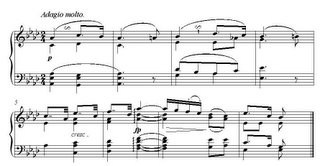
I played them several times; wrote in fingerings (soon to be corrected, changed); tried to connect my brain more definitely to the tips of my fingers; contemplated the shaping and timing of the turn; and then--shamelessly--skipped to the coda. I am only human! I admit sometimes I just want to skip to the "good parts." As much as I wish I could, I do not always enjoy every piece equally at every moment; I have weaknesses for certain moments and I build my conceptions around them, toward them. But, I tell myself, Beethoven must have built his conception towards this coda too. How could he not? I often enjoy thinking about the pride composers must have felt at having written certain passages; even they were pleased, even their impossible standards were met.
As I played the coda, I felt guilty. Not for skipping to it; but because I needed to accomplish "something useful" before I gave myself this searing pleasure. In a flash, I recalled my former teacher, Gyorgy Sebok, impeccably dressed--having parked, as always, illegally in the loading zone--walking into a lesson I had with him, saying that he had just vacuumed the house, and that it made him "feel useful." He smiled his European, utterly cultured smile, which commented ironically all at once on the vacuum, on himself vacuuming, and on the very idea of usefulness. The incomparable guru finding himself useless, sucking up dust.
So, I tore myself away from the piano and I hauled the Hoover out of the closet and cursed its non-retractable cord and cursed the astonishingly outdated electrical systems of my building, and cursed the red carpet I put in the piano room, which seems to put an exclamation point on every morsel of dirt it collects.... and thus cursing, I did a serviceable job. With the unpleasant Hoover smell lingering in my nostrils, making me want to cough, I removed my coat and sat down at the piano, calmed by the carpet's clarity. Now I took on the coda in earnest. This slow movement is a difficult, painstaking narrative, in that we have to follow (Beethoven unravels) the same long thread twice: he makes us re-experience the same sequence of events with only a small modification the second go-around. It tests our patience, or at least it tests mine.
I hate formal diagrams, but sometimes I succumb to them. Here's what I'm talking about:
A ... transition ... B ...
A ... transition ... B ...
And by this point most of the movement is over. So you had better like A and B. I'm fond of A and B (though I prefer to refer to them by their "real names"), but I have to admit they're "not enough" for me. As beautiful as they are, they are kind of naked; they are sparely scored; Beethoven is testing the limits of how few notes he can get away with, how little material he can use to fill out a large space. This is not a weakness! I remind myself as I play and try to find lots to love in A and B, but even as I am adoring these materials I heed the craving they create. What's missing? When will I not feel I am filling in the spaces left by the composer? To be fair, I think A and B are not "missing anything;" they are trying to express something-like-this; they are a symbol of spareness; their existence defines a void which must be filled.
When I had to grade students' papers at Indiana University, I would anticipate with horror the concluding paragraphs, which would inevitably begin "In conclusion," or "Summing up," or etc. It's true, the student had usually made all the points he/she had to make by that point, and there was no escape except through redundancy. Some sense of finality was necessary; how else could the paper be over? And don't get me wrong; I was as glad as the student that the paper was over. But how do you say again what has been said, while not just saying it again? I would ponder this imponderable while gleefully crossing out their final paragraphs: "said that already," I would helpfully inscribe.
Let's be boring for another moment and establish that theme A has a certain pattern to it:
Short. Short. Long.
OR
a a b
OR
Idea. (Responding) Idea. Arc.
In this pattern, the third time's the charm. Though the first two segments (short, short) establish the crucial "grammar" of the theme--a dialectical rhythm--the third segment (long) provides a paradox: it simultaneously functions as a symmetrical, rounding idea (being exactly as long as the preceding two segments combined), as conforming filler, and on the other hand functions as a force for the unexpected and new: it sends the whole musical paragraph in search of some meaning or goal.
Let's say, then, that the very structure of A--its one-two-three punch, which we have now analyzed so heartlessly-- has some serious semantic baggage. I might even say it has a personality, a way-of-being.
At first glance, Beethoven's coda falls into the "said that already" trap, because: here comes A again, for a third time. But it is a bit different:
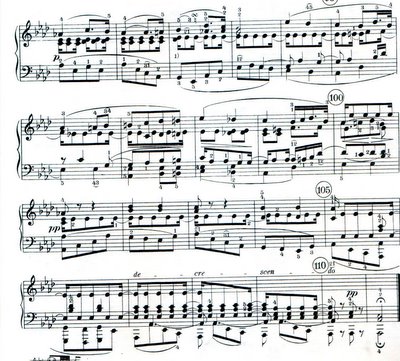
The melody is now supported by a web of other voices, which fill out the slow rhythmic spaces, which make the theme more fluid, make it seem to float above a current of rhythm. In this he fills a void in A, he gives it a continuity it had longed for. (Or we had longed for?) But Beethoven is not just dealing with A-as-theme... in which case this coda could be written off as a fleshed-out variation, with added notes. Earlier in the movement we have had these kind of added-note variations, which are lovely but do not add, somehow, to the "meaning" of A; they merely help to beautify its stasis. So, added notes are not enough themselves to do what the coda does. I think Beethoven is dealing below the level of the theme, delving towards A-as-personality, towards A's "reason for being," which is its giving over of itself to its third part. Because Beethoven has put more voices in play ... when the pattern of A heads into its third (searching) phase, the dangers and beauties of these extra voices can be unleashed. While the melody simply descends from the fifth scale degree down to the tonic, in the most predictable way--
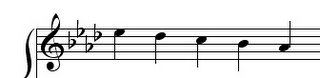
--the other voices do unpredictable and extraordinary things, creating momentary breathtaking dissonances that become a part of the total feeling (the total image) of the phrase, which make the "simple" descent of the top line more deeply felt, which color the relinquishing of the movement's slow energies with a tremendous intensity and regret. (To put it all analytically: the tenor line moves from A-flat to G, and this G clashes against the C in the top line, and then just after that, the alto line moves from E-flat to F through an amazing passing tone E-natural, and the moment of that E-natural, perched "between chords," coloring the A-flat major tonic with its wrong-right-noteness, is the most memorable sonority of the passage for me, though it is the briefest.) While our "original A," in its third phase, reached up melodically, to try to "escape" the registral space in which it was inscribed--
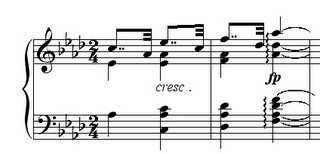
--the intensities of this last A are within, quite literally and music-theoretically: in the play of the inner voices. Whatever A is looking for, it finds in a different space, in a different solution; it searches, now, inside itself. (Is A a person? And how has A found this solution?) And this is it, my big why, the transformation of meaning that the coda does to me, the place where a streak of amazement clouds my brain's connection to my hands and I find fulfillment in my ears, hanging on to those dissonances, my body buzzing ... and knowing that "something has changed." I would not be happy calling it by any music-theoretical name but I can trace how the music-theoretical names wind themselves into this changed moment.
Without ego, Beethoven adores his own moment; he winds us back up to E-flat in the top voice, and repeats the falling, fantastic gesture; now the structure and therefore the balance of power in A has changed: a struggle against the structure of A transforms itself into a prolonged farewell. And because he has now injected the falling five-line (E-flat down to A-flat) with such meaning, he then is able to repeat it, and call up the meaning without the meaning; we keep hearing those descending notes as the movement falls away, and though they are relatively plain, they are full: they symbolize the alteration we have just witnessed.
I have allowed myself to get carried away from the haven of identifiable notes to the scary world of interpretation and meaning, to suggest even that the movement interprets itself. Do you think, on a date, over a glass of white wine, in a noisy New York restaurant, I could manage to get this across? Because sometimes I think I need to go at least this deep to express why piano playing makes me happy. I really don't want to be a jerk when people ask me about being a pianist, but sometimes I am anyway. Wait. I said that already.
Sometimes I'm a jerk for virtuous reasons: someone has just shared with me how boring their job is, how much they hate it, and they ask me, with a weird light in their eyes, what it's like being a pianist. This happens on dates. And I try to reasonably downplay the pleasures of a musical career, with the hope that I don't sound false. Probably other times I'm a jerk for jerk's sake, because I'm impatient, or because I'm lazy. Maybe I'm in one of those moods where I imagine that that which I truly love cannot be shared. Anyway--do people really want to hear?
Yesterday I came back from a late, lonesome lunch at the ubiquitous Saigon Grill; I did not take off my coat; but sat down at the piano with a plain lust for the following measures:

I played them several times; wrote in fingerings (soon to be corrected, changed); tried to connect my brain more definitely to the tips of my fingers; contemplated the shaping and timing of the turn; and then--shamelessly--skipped to the coda. I am only human! I admit sometimes I just want to skip to the "good parts." As much as I wish I could, I do not always enjoy every piece equally at every moment; I have weaknesses for certain moments and I build my conceptions around them, toward them. But, I tell myself, Beethoven must have built his conception towards this coda too. How could he not? I often enjoy thinking about the pride composers must have felt at having written certain passages; even they were pleased, even their impossible standards were met.
As I played the coda, I felt guilty. Not for skipping to it; but because I needed to accomplish "something useful" before I gave myself this searing pleasure. In a flash, I recalled my former teacher, Gyorgy Sebok, impeccably dressed--having parked, as always, illegally in the loading zone--walking into a lesson I had with him, saying that he had just vacuumed the house, and that it made him "feel useful." He smiled his European, utterly cultured smile, which commented ironically all at once on the vacuum, on himself vacuuming, and on the very idea of usefulness. The incomparable guru finding himself useless, sucking up dust.
So, I tore myself away from the piano and I hauled the Hoover out of the closet and cursed its non-retractable cord and cursed the astonishingly outdated electrical systems of my building, and cursed the red carpet I put in the piano room, which seems to put an exclamation point on every morsel of dirt it collects.... and thus cursing, I did a serviceable job. With the unpleasant Hoover smell lingering in my nostrils, making me want to cough, I removed my coat and sat down at the piano, calmed by the carpet's clarity. Now I took on the coda in earnest. This slow movement is a difficult, painstaking narrative, in that we have to follow (Beethoven unravels) the same long thread twice: he makes us re-experience the same sequence of events with only a small modification the second go-around. It tests our patience, or at least it tests mine.
I hate formal diagrams, but sometimes I succumb to them. Here's what I'm talking about:
A ... transition ... B ...
A ... transition ... B ...
And by this point most of the movement is over. So you had better like A and B. I'm fond of A and B (though I prefer to refer to them by their "real names"), but I have to admit they're "not enough" for me. As beautiful as they are, they are kind of naked; they are sparely scored; Beethoven is testing the limits of how few notes he can get away with, how little material he can use to fill out a large space. This is not a weakness! I remind myself as I play and try to find lots to love in A and B, but even as I am adoring these materials I heed the craving they create. What's missing? When will I not feel I am filling in the spaces left by the composer? To be fair, I think A and B are not "missing anything;" they are trying to express something-like-this; they are a symbol of spareness; their existence defines a void which must be filled.
When I had to grade students' papers at Indiana University, I would anticipate with horror the concluding paragraphs, which would inevitably begin "In conclusion," or "Summing up," or etc. It's true, the student had usually made all the points he/she had to make by that point, and there was no escape except through redundancy. Some sense of finality was necessary; how else could the paper be over? And don't get me wrong; I was as glad as the student that the paper was over. But how do you say again what has been said, while not just saying it again? I would ponder this imponderable while gleefully crossing out their final paragraphs: "said that already," I would helpfully inscribe.
Let's be boring for another moment and establish that theme A has a certain pattern to it:
Short. Short. Long.
OR
a a b
OR
Idea. (Responding) Idea. Arc.
In this pattern, the third time's the charm. Though the first two segments (short, short) establish the crucial "grammar" of the theme--a dialectical rhythm--the third segment (long) provides a paradox: it simultaneously functions as a symmetrical, rounding idea (being exactly as long as the preceding two segments combined), as conforming filler, and on the other hand functions as a force for the unexpected and new: it sends the whole musical paragraph in search of some meaning or goal.
Let's say, then, that the very structure of A--its one-two-three punch, which we have now analyzed so heartlessly-- has some serious semantic baggage. I might even say it has a personality, a way-of-being.
At first glance, Beethoven's coda falls into the "said that already" trap, because: here comes A again, for a third time. But it is a bit different:
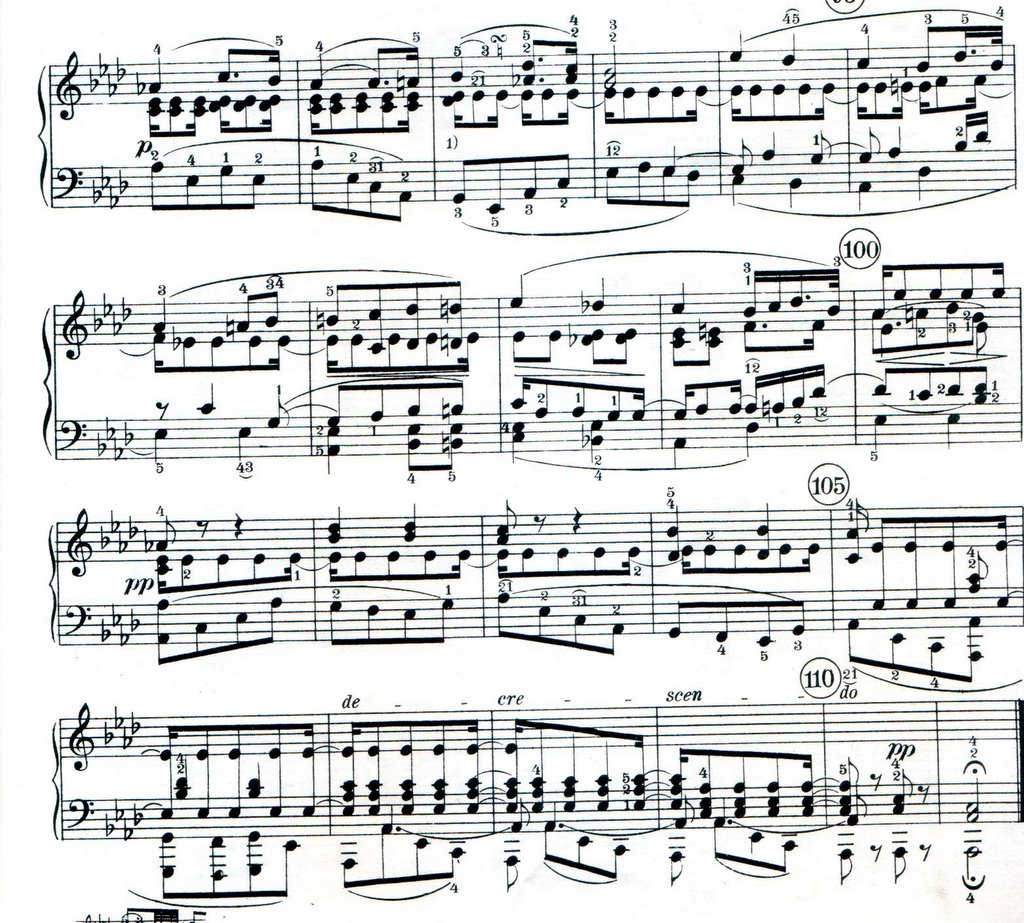
The melody is now supported by a web of other voices, which fill out the slow rhythmic spaces, which make the theme more fluid, make it seem to float above a current of rhythm. In this he fills a void in A, he gives it a continuity it had longed for. (Or we had longed for?) But Beethoven is not just dealing with A-as-theme... in which case this coda could be written off as a fleshed-out variation, with added notes. Earlier in the movement we have had these kind of added-note variations, which are lovely but do not add, somehow, to the "meaning" of A; they merely help to beautify its stasis. So, added notes are not enough themselves to do what the coda does. I think Beethoven is dealing below the level of the theme, delving towards A-as-personality, towards A's "reason for being," which is its giving over of itself to its third part. Because Beethoven has put more voices in play ... when the pattern of A heads into its third (searching) phase, the dangers and beauties of these extra voices can be unleashed. While the melody simply descends from the fifth scale degree down to the tonic, in the most predictable way--
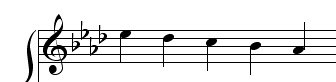
--the other voices do unpredictable and extraordinary things, creating momentary breathtaking dissonances that become a part of the total feeling (the total image) of the phrase, which make the "simple" descent of the top line more deeply felt, which color the relinquishing of the movement's slow energies with a tremendous intensity and regret. (To put it all analytically: the tenor line moves from A-flat to G, and this G clashes against the C in the top line, and then just after that, the alto line moves from E-flat to F through an amazing passing tone E-natural, and the moment of that E-natural, perched "between chords," coloring the A-flat major tonic with its wrong-right-noteness, is the most memorable sonority of the passage for me, though it is the briefest.) While our "original A," in its third phase, reached up melodically, to try to "escape" the registral space in which it was inscribed--

--the intensities of this last A are within, quite literally and music-theoretically: in the play of the inner voices. Whatever A is looking for, it finds in a different space, in a different solution; it searches, now, inside itself. (Is A a person? And how has A found this solution?) And this is it, my big why, the transformation of meaning that the coda does to me, the place where a streak of amazement clouds my brain's connection to my hands and I find fulfillment in my ears, hanging on to those dissonances, my body buzzing ... and knowing that "something has changed." I would not be happy calling it by any music-theoretical name but I can trace how the music-theoretical names wind themselves into this changed moment.
Without ego, Beethoven adores his own moment; he winds us back up to E-flat in the top voice, and repeats the falling, fantastic gesture; now the structure and therefore the balance of power in A has changed: a struggle against the structure of A transforms itself into a prolonged farewell. And because he has now injected the falling five-line (E-flat down to A-flat) with such meaning, he then is able to repeat it, and call up the meaning without the meaning; we keep hearing those descending notes as the movement falls away, and though they are relatively plain, they are full: they symbolize the alteration we have just witnessed.
I have allowed myself to get carried away from the haven of identifiable notes to the scary world of interpretation and meaning, to suggest even that the movement interprets itself. Do you think, on a date, over a glass of white wine, in a noisy New York restaurant, I could manage to get this across? Because sometimes I think I need to go at least this deep to express why piano playing makes me happy. I really don't want to be a jerk when people ask me about being a pianist, but sometimes I am anyway. Wait. I said that already.
Sunday, December 25, 2005
According to the Text
Like millions of other Americans, I find myself celebrating Christmas morning by immersing myself in the form and analysis musings of students at DePauw University. Only an insane man with a Venti drip in his hand (please, people: not "VENTAY," "VENTEE"!) could possibly survive these multiple, deeply redundant analyses: except that the students seem to try to put a little bit of themselves in there, to be Cheeky with their Theory. I suppose there is no other defense.
To be fair, I don't think this blog was meant to be read "for pleasure."
For you non-music types: Form & Analysis is a REQUIRED COURSE for all "serious" music students at the Conservatory, something like Anatomy for medical students, except for the fact that the skeletons of music theory have almost no basis in any kind of observable reality. (I said "almost"! But I "almost" deleted it.) So while it may be useful for a doctor, say, to know the heart has a certain number of ventricles, musicians find themselves wondering why they need to know whether a section of a particular Chopin Mazurka is "terminative" or "developmental." I am sounding terribly cynical on this Christmas morning; it is hard, I admit, to think of the baby Jesus as a music theorist, promising perfect authentic cadences in exchange for our sins (although in a way that is exactly what happens). And as you know I am actually a HUGE FAN of musical analysis, and I wouldn't have brought up this mean-spirited topic at all except for one student's little acts of revolution, which made me smile so very, very much.
Self-named "Snoop," presumably one of the students, analyzes the Chopin Mazurka in e minor, Op. 17 #2. He begins in the traditional manner, carving up the pie heartlessly into pieces:
Yawn. I was at the point of scrolling to the next analysis (why, oh why, on Christmas morning was I reading these at all?) But the beginning of the next paragraph arrested my scroll:
I love these moments, when students bump themselves against the fairly obvious idiocies of music theoretical jargon; they bang their heads and wonder "is that all there is to say, other than putting it in fancier words?" Perhaps they don't realize that at that very moment of pain and frustration they should scratch their bruised heads and look around; they are lost in the vicinity of truth. What tickles me about this little sentence is that I can't quite tell whether the student is being sarcastic or not. I like to assume he/she is. You see, a great object of Form and Analysis is the reduction of vocabulary. Instead of whatever words the student comes up with, the textbook comes up with a limited set of words, which can be used "objectively," so that the wishy-washy notions of the student can be measured. A great premium seems to be placed on making these words as heartless and scientific-sounding as possible, so that the student can experience the maximum disillusionment and pain in reducing his/her musical experience into them. Section B: is it "expository" or "developmental"? It's gotta be one or the other. Choose, now!!! I can see this battle at work in the following passage from Snoop's analysis:
Snoop is trying to choose between "developmental" and "transitional" to describe this B section, both of which terms presumably are elucidated in the text. But between these generic terms, poor Snoop can't help using more evocative ones: "agitation," "stretched-out," "undulating." Danger, danger! Luckily, he is able to bring this veering ship to shore, with words like "dominant" and "A section." A term like "harmonic activity" straddles this divide interestingly: it suggests something intriguing, some kind of unusual event; and yet it describes it in the most nonspecific possible manner ...
Finally, Snoop delivers the coup-de-grâce:
"According to the text"!!!!!! Fantastic, Snoop. Now that's good stuff. What is this mysterious "text" to which the student refers? Presumably a book wherein "terminative sections" are defined. I'm sure all you readers, even the ones who are bored stiff by this whole post, can see how asinine it is to use a term like "terminative." (Not just to use it, but to force it as a generic term for every analysis.) The connotations and associations are horrendous (termination, terminator, California, death, term papers, term limits, bringing to term, terminology, oy); and like expository it could be seen as just a fancier, uglier, meaner way of saying "ending." And how tersely Snoop draws our attention to the reductive nature of this unspecified text! Reinforcing the tonal center is the "primary attribute" of terminative sections? Oh, REALLY? Magnificent, transcendent codas pile themselves into my mind one after the other; the endings of Beethoven Sonatas, the "Waldstein" Sonata, Op. 110, the final passage of the first movement of the Schumann Fantasy... and on and on. Life-changing conclusions which, while ending in the same old home key, leave everything else (connotation, meaning, affect) completely altered. But wait! this is not Music Theory.
"According to the text." But not, perhaps, according to Snoop. Snoop delivers his skepticism in a little verbal pill, at once deferential and destructive, a bomb cleverly written in the very language of conformity ("According to Hoyle," the gospel according to X, etc.) As I write this, I begin to wonder if Snoop intended this double meaning at all, whether I might be over-reaching. Haha. The muffled, affirmative snickers of blogreaders reach me even here. I have even gone so far as to muse on Snoop's signature, "word out": is it really a commentary on the nature of words, as applied to music? Really: kidding.
This post would seem to be an attack on Music Theory, but it most definitely isn't. When I posted, a little bit ago, about the condescending tone of a particular concert review, I haplessly tapped into some deep-seated anti-critic sentiment, which I perused in the Comments section. Wow! Let me be clear: I disassociate myself from those comments (critics as frustrated performers, etc.) I feel sure that there will be some anti-theory people out there too, who may jump on my bitter bandwagon. But I want to preach a more positive Yuletide gospel. I do not feel that "talking about music is like dancing about architecture;" actually, I have always detested that quote, which I consider to be patently untrue. Moreover, I think dancing about architecture would be a very interesting thing to do. Let's imagine the baby Jesus, analyzing the song of the Magi. I think he would love and tolerate talk of cadences, even Schenkerian diagrams. Why do I imagine him treating theorists as he did Mary Magdelene? This suggests a conception of theory as a particularly unsexy form of prostitution. No, wait, I can do better: the expectancy of the Christmas ritual, the presents wrapped under the tree, the smell of the tree, the candles, the late night, the early morning awakening, stumbling out to the family room in your pajamas, getting ready to convert the whole beautiful waiting thing into a storm of crumpled paper. Sometimes it seems Theory wants you to unwrap the gift, but not to see what's inside. It is cold-hearted: it wants you to "understand" expectancy. But I assure you, Theory for all its jargon wants you to receive music's gift too; to receive with gratitude the ingenuity of the composer, the generosity of invention, to appreciate the process of composition, a kind of wrapping and unwrapping of the human spirit. That is why, finally, we suffer through Form and Analysis. Mr. Spiegelberg's students seem to be in good humor about the whole thing, interjecting irony, sarcasm, etc., which is a victory for both student and teacher.
I myself have caught the Christmas spirit lately too. I released something and allowed in myself the (imagined) possibility of light-heartedness (which I didn't know I had forbidden), and somehow then the external world complied and "real" light-hearted things came into it, flooding my weird days. Yesterday (I am not kidding) I was thinking through the form of Op. 110 with a joyous spring to my step. Perhaps the danger is the conflation of Music Theory's terms with the real. And is the music itself any more "real" than the Theory it has created, like a monster? Let's toss reality and truth aside, and Merry Christmas.
To be fair, I don't think this blog was meant to be read "for pleasure."
For you non-music types: Form & Analysis is a REQUIRED COURSE for all "serious" music students at the Conservatory, something like Anatomy for medical students, except for the fact that the skeletons of music theory have almost no basis in any kind of observable reality. (I said "almost"! But I "almost" deleted it.) So while it may be useful for a doctor, say, to know the heart has a certain number of ventricles, musicians find themselves wondering why they need to know whether a section of a particular Chopin Mazurka is "terminative" or "developmental." I am sounding terribly cynical on this Christmas morning; it is hard, I admit, to think of the baby Jesus as a music theorist, promising perfect authentic cadences in exchange for our sins (although in a way that is exactly what happens). And as you know I am actually a HUGE FAN of musical analysis, and I wouldn't have brought up this mean-spirited topic at all except for one student's little acts of revolution, which made me smile so very, very much.
Self-named "Snoop," presumably one of the students, analyzes the Chopin Mazurka in e minor, Op. 17 #2. He begins in the traditional manner, carving up the pie heartlessly into pieces:
The piece is ternary - mm. 1-24 are the first A section, mm. 25-52 are the B section and the second A section is mm. 53 to the end.
Yawn. I was at the point of scrolling to the next analysis (why, oh why, on Christmas morning was I reading these at all?) But the beginning of the next paragraph arrested my scroll:
The first section is expository, like the beginning of most pieces.
I love these moments, when students bump themselves against the fairly obvious idiocies of music theoretical jargon; they bang their heads and wonder "is that all there is to say, other than putting it in fancier words?" Perhaps they don't realize that at that very moment of pain and frustration they should scratch their bruised heads and look around; they are lost in the vicinity of truth. What tickles me about this little sentence is that I can't quite tell whether the student is being sarcastic or not. I like to assume he/she is. You see, a great object of Form and Analysis is the reduction of vocabulary. Instead of whatever words the student comes up with, the textbook comes up with a limited set of words, which can be used "objectively," so that the wishy-washy notions of the student can be measured. A great premium seems to be placed on making these words as heartless and scientific-sounding as possible, so that the student can experience the maximum disillusionment and pain in reducing his/her musical experience into them. Section B: is it "expository" or "developmental"? It's gotta be one or the other. Choose, now!!! I can see this battle at work in the following passage from Snoop's analysis:
In that sense, the B section could be considered to have developmental function - it starts off with previous motivic material, or at least a melody that is very similar. However, the second part of the B section (mm. 39-52) seems more like a transitional section, in that there's a lot of agitation and harmonic activity. Basically, it's a stretched-out, undulating passage that goes through lots of chords and eventually ends on the dominant, which leads into the return of the A section.
Snoop is trying to choose between "developmental" and "transitional" to describe this B section, both of which terms presumably are elucidated in the text. But between these generic terms, poor Snoop can't help using more evocative ones: "agitation," "stretched-out," "undulating." Danger, danger! Luckily, he is able to bring this veering ship to shore, with words like "dominant" and "A section." A term like "harmonic activity" straddles this divide interestingly: it suggests something intriguing, some kind of unusual event; and yet it describes it in the most nonspecific possible manner ...
Finally, Snoop delivers the coup-de-grâce:
The second A section has a terminative function - the extension to the final cadence reinforces the tonal center, which is the primary attribute of terminative sections, according to the text.
"According to the text"!!!!!! Fantastic, Snoop. Now that's good stuff. What is this mysterious "text" to which the student refers? Presumably a book wherein "terminative sections" are defined. I'm sure all you readers, even the ones who are bored stiff by this whole post, can see how asinine it is to use a term like "terminative." (Not just to use it, but to force it as a generic term for every analysis.) The connotations and associations are horrendous (termination, terminator, California, death, term papers, term limits, bringing to term, terminology, oy); and like expository it could be seen as just a fancier, uglier, meaner way of saying "ending." And how tersely Snoop draws our attention to the reductive nature of this unspecified text! Reinforcing the tonal center is the "primary attribute" of terminative sections? Oh, REALLY? Magnificent, transcendent codas pile themselves into my mind one after the other; the endings of Beethoven Sonatas, the "Waldstein" Sonata, Op. 110, the final passage of the first movement of the Schumann Fantasy... and on and on. Life-changing conclusions which, while ending in the same old home key, leave everything else (connotation, meaning, affect) completely altered. But wait! this is not Music Theory.
"According to the text." But not, perhaps, according to Snoop. Snoop delivers his skepticism in a little verbal pill, at once deferential and destructive, a bomb cleverly written in the very language of conformity ("According to Hoyle," the gospel according to X, etc.) As I write this, I begin to wonder if Snoop intended this double meaning at all, whether I might be over-reaching. Haha. The muffled, affirmative snickers of blogreaders reach me even here. I have even gone so far as to muse on Snoop's signature, "word out": is it really a commentary on the nature of words, as applied to music? Really: kidding.
This post would seem to be an attack on Music Theory, but it most definitely isn't. When I posted, a little bit ago, about the condescending tone of a particular concert review, I haplessly tapped into some deep-seated anti-critic sentiment, which I perused in the Comments section. Wow! Let me be clear: I disassociate myself from those comments (critics as frustrated performers, etc.) I feel sure that there will be some anti-theory people out there too, who may jump on my bitter bandwagon. But I want to preach a more positive Yuletide gospel. I do not feel that "talking about music is like dancing about architecture;" actually, I have always detested that quote, which I consider to be patently untrue. Moreover, I think dancing about architecture would be a very interesting thing to do. Let's imagine the baby Jesus, analyzing the song of the Magi. I think he would love and tolerate talk of cadences, even Schenkerian diagrams. Why do I imagine him treating theorists as he did Mary Magdelene? This suggests a conception of theory as a particularly unsexy form of prostitution. No, wait, I can do better: the expectancy of the Christmas ritual, the presents wrapped under the tree, the smell of the tree, the candles, the late night, the early morning awakening, stumbling out to the family room in your pajamas, getting ready to convert the whole beautiful waiting thing into a storm of crumpled paper. Sometimes it seems Theory wants you to unwrap the gift, but not to see what's inside. It is cold-hearted: it wants you to "understand" expectancy. But I assure you, Theory for all its jargon wants you to receive music's gift too; to receive with gratitude the ingenuity of the composer, the generosity of invention, to appreciate the process of composition, a kind of wrapping and unwrapping of the human spirit. That is why, finally, we suffer through Form and Analysis. Mr. Spiegelberg's students seem to be in good humor about the whole thing, interjecting irony, sarcasm, etc., which is a victory for both student and teacher.
I myself have caught the Christmas spirit lately too. I released something and allowed in myself the (imagined) possibility of light-heartedness (which I didn't know I had forbidden), and somehow then the external world complied and "real" light-hearted things came into it, flooding my weird days. Yesterday (I am not kidding) I was thinking through the form of Op. 110 with a joyous spring to my step. Perhaps the danger is the conflation of Music Theory's terms with the real. And is the music itself any more "real" than the Theory it has created, like a monster? Let's toss reality and truth aside, and Merry Christmas.
Saturday, December 24, 2005
Twain
Care of Maud Newton:
It is my heart-warmed and world-embracing Christmas hope and aspiration that all of us, the high, the low, the rich, the poor, the admired, the despised, the loved, the hated, the civilized, the savage (every man and brother of us all throughout the whole earth), may eventually be gathered together in a heaven of everlasting rest and peace and bliss, except the inventor of the telephone.
- Mark Twain's Christmas greetings, 1890
It is my heart-warmed and world-embracing Christmas hope and aspiration that all of us, the high, the low, the rich, the poor, the admired, the despised, the loved, the hated, the civilized, the savage (every man and brother of us all throughout the whole earth), may eventually be gathered together in a heaven of everlasting rest and peace and bliss, except the inventor of the telephone.
- Mark Twain's Christmas greetings, 1890
Friday, December 23, 2005
Holiday Cheer
As I walked past the Dive Bar on 96th and Amsterdam last night, a woman and her friend stumbled out those saloon-style doors, clinging to each other for balance. "Good night," she said, "I'm headed to the liquor store." He did not dissuade her. We won't let these little sordid city moments, or a subway strike, cloud our Christmas cheer. Admittedly, the city in its profusion gives mixed holiday signals, and in this spirit I would like to do a little blog experiment, a first for Think Denk: a holiday reading list. ACTUALLY two lists: one for the optimist who wants his or her heart warmed ("Just what I need," said Woody Allen, "hot cockles") and another for the black-hearted Scrooge who wants to wallow in holiday depression. Choose your poison.
Anti-Holiday Reading List
1. Dostoevsky: The Idiot. I think Crime and Punishment is probably too heartwarming.
2. Shakespeare Troilus and Cressida. Perhaps the most nihilistic Shakespeare play? Certainly a contender. For instance: "... thou great-sized coward,/ No space of earth shall sunder our two hates./I'll haunt thee like a wicked conscience still,/That moldeth goblins swift as frenzy's thoughts." Or how about: "O false Cressid! False, false, false!/Let all untruths stand by thy stainèd name, /And they'll seem glorious."
3. Baudelaire, Selected Poems. I am referring to my beloved Penguin Classics edition with ugly English literal translations in small print at the bottom of the page. Imagine waking Christmas morning as a family to read "La Squelette Laboreur":
4. Nabokov, Lolita. Lost laughter of childhood, incurable perversion, etc. ("Picnic, lightning.")
5. Mann, Doctor Faustus. "In those days Germany, a hectic flush on its cheeks, was reeling at the height of its savage triumphs, about to win the world on the strength of the one pact that it intended to keep and had signed with its blood. Today, in the embrace of demons, a hand over one eye, the other staring into the horror, it plummets from despair to despair." Etc.
6. Sebald, Austerlitz. Especially the passages about the futility of fortifications and the organization of Theresienstadt.
7. James, The Golden Bowl. For instance its final line: "And the truth of it had with this force after a moment so strangely lighted his eyes that as for pity and dread of them she buried her own in his breast." Ahh, and they lived happily ever after.
8. Atwood, Cat's Eye. More childhood cruelty, yippee!
9. Hardy, The Mayor of Casterbridge. I've never finished it, but I assume everything turns out horribly. Am I wrong? Have always enjoyed the first third of it though, before casting it away out of dread. Perhaps I got too caught up emotionally in the story; I am not the "ideal" reader.
10. (Of course) Kafka, the complete works, but if you had to select one: The Castle.
Okay enough enough. In the list above, with only one exception, I tried to choose books that I actually ENJOYED despite their high depressive quotients. But, on to the heartwarming recommendations:
1. Nabokov, Pnin. For just being beautiful: "Presently all were asleep again. It was a pity nobody saw the display in the empty street, where the auroral breeze wrinkled a large luminous puddle, making of the telephone wires reflected in it illegible lines of black zigzags." Or for being tender: "... the little sedan boldly swung past the front truck and, free at last, spurted up the shining road, which one could make out narrowing to a thread of gold in the soft mist where hill after hill made beauty of disance, and where there was simply no saying what miracle would happen." Or both.
2. Chabon, Wonder Boys. No, not the movie. I will hold to my opinion that this is the best of his books. Its tale of renunciation and self-awareness, brilliantly plotted over the weekend of a writer's conference, makes me happy again and again. How dare they cut the f**&()#$ tuba from the movie!
3. Capote, A Christmas Memory. How topical! How about this passage:
That's what I call musical prose.
4. Proust, Time Regained. The catch of course is that there are six essential prequels, which makes the title of this last volume somewhat ironic.
5. Emerson, Essays: "We grizzle every day. I see no need of it. Whilst we converse with what is above us, we do not grow old, but grow young ... In nature every moment is new; the past is always swallowed and forgotten; the coming only is sacred. Nothing is secure but life, transition, the energizing spirit. No love can be bound by oath or covenant to secure it against a higher love. No truth so sublime but it may be trivial tomorrow in the light of new thoughts. People wish to be setlted; only as far as they are unsettled is there any hope for them." And more in that vein.
6. Frazier, Coyote v. Acme. The title essay alone probably worth the purchase price. Don't forget Boswell's "Life of Don Johnson," however.
7. Thoreau, Walden. "Every winter the liquid and trembling surface of the pond, which was so sensitive to every breath, and reflected every light and shadow, becomes solid to the depth of a foot or a foot and a half, so that it will support the heaviest teams, and perhaps the snow covers it to an equal depth, and it is not to be distinguished from any level field. Like the marmots in the surrounding hills, it closes its eyelids and becomes dormant for three months or more. Standing on the snow-covered plain, as if in a pasture amid the hills, I cut my way first through a foot of snow, and then through a foot of ice, and open a window under my feet, where, kneeling to drink, I look down into the quiet parlour of the fishes, pervaded by a softened light as through a window of ground glass, with its bright sanded floor the same as in summer; there a perennial waveless serenity reigns as in the amber twilight sky, corresponding to the cool and even temperament of the inhabitants. Heaven is under our feet as well as over our heads."
8. Marianne Moore, Nevertheless.
The weak overcomes its
menace, the strong over-
comes itself. What is there
like fortitude! What sap
went through the little thread
to make the cherry red!
9. Oliver Sacks, Awakenings. I know it's a bit of a stretch. How about this passage:
"I used to think of Hell as a place from which no one returned. My patients have taught me otherwise."
Okay, so far, not so heartwarming. Going on:
"Those who return are forever marked by the experience; they have known, they cannot forget, the ultimate depths. Yet the effect of the experience is to make them not only deep but, finally, childlike, innocent, and gay."
10. Cervantes, Don Quixote. What more needs to be said? If you own the new translation by Edith Grossman, my favorite passage is on page 145.
Okay, really got to get back to Beethoven now. So far behind, so much to do.
Anti-Holiday Reading List
1. Dostoevsky: The Idiot. I think Crime and Punishment is probably too heartwarming.
2. Shakespeare Troilus and Cressida. Perhaps the most nihilistic Shakespeare play? Certainly a contender. For instance: "... thou great-sized coward,/ No space of earth shall sunder our two hates./I'll haunt thee like a wicked conscience still,/That moldeth goblins swift as frenzy's thoughts." Or how about: "O false Cressid! False, false, false!/Let all untruths stand by thy stainèd name, /And they'll seem glorious."
3. Baudelaire, Selected Poems. I am referring to my beloved Penguin Classics edition with ugly English literal translations in small print at the bottom of the page. Imagine waking Christmas morning as a family to read "La Squelette Laboreur":
Are you trying to show ... that even in the grave the promised sleep is not certain; That the Void betrays us; that everything, even Death lies to us, and that for all eternity, alas! we shall perhaps, in some unknown country, be obliged to flay the stubborn earth, and to push a heavy spade under our naked, bleeding foot?
4. Nabokov, Lolita. Lost laughter of childhood, incurable perversion, etc. ("Picnic, lightning.")
5. Mann, Doctor Faustus. "In those days Germany, a hectic flush on its cheeks, was reeling at the height of its savage triumphs, about to win the world on the strength of the one pact that it intended to keep and had signed with its blood. Today, in the embrace of demons, a hand over one eye, the other staring into the horror, it plummets from despair to despair." Etc.
6. Sebald, Austerlitz. Especially the passages about the futility of fortifications and the organization of Theresienstadt.
7. James, The Golden Bowl. For instance its final line: "And the truth of it had with this force after a moment so strangely lighted his eyes that as for pity and dread of them she buried her own in his breast." Ahh, and they lived happily ever after.
8. Atwood, Cat's Eye. More childhood cruelty, yippee!
9. Hardy, The Mayor of Casterbridge. I've never finished it, but I assume everything turns out horribly. Am I wrong? Have always enjoyed the first third of it though, before casting it away out of dread. Perhaps I got too caught up emotionally in the story; I am not the "ideal" reader.
10. (Of course) Kafka, the complete works, but if you had to select one: The Castle.
Okay enough enough. In the list above, with only one exception, I tried to choose books that I actually ENJOYED despite their high depressive quotients. But, on to the heartwarming recommendations:
1. Nabokov, Pnin. For just being beautiful: "Presently all were asleep again. It was a pity nobody saw the display in the empty street, where the auroral breeze wrinkled a large luminous puddle, making of the telephone wires reflected in it illegible lines of black zigzags." Or for being tender: "... the little sedan boldly swung past the front truck and, free at last, spurted up the shining road, which one could make out narrowing to a thread of gold in the soft mist where hill after hill made beauty of disance, and where there was simply no saying what miracle would happen." Or both.
2. Chabon, Wonder Boys. No, not the movie. I will hold to my opinion that this is the best of his books. Its tale of renunciation and self-awareness, brilliantly plotted over the weekend of a writer's conference, makes me happy again and again. How dare they cut the f**&()#$ tuba from the movie!
3. Capote, A Christmas Memory. How topical! How about this passage:
Three hours later we are back in the kitchen hulling a heaping buggyload of windfall pecans. Our backs hurt from gathering them: how hard they were to find (the main crop having been shaken off the trees and sold by the orchard's owners, who are not us) among the concealing leaves, the frosted, deceiving grass. Caarackle! A cheery crunch, scraps of miniature thunder sounds as the shells collapse and the golden mound of sweet oily ivory meat mounts in the milk-glass bowl. Queenie begs to taste, and now and again my friend sneaks her a mite, though insisting we deprive ourselves. "We mustn't, Buddy. If we start, we won't stop. And theere's scarcely enough as there is. For thirty cakes." The kitchen is growing dark. Dusk turns the window into a mirror: our reflections mingle with the rising moon as we work by the fireside in the firelight. At last, when the moon is quite high, we toss the final hull into the fire and, with joined sighs, watch it catch flame. The buggy is empty, the bowl is brimful.
That's what I call musical prose.
4. Proust, Time Regained. The catch of course is that there are six essential prequels, which makes the title of this last volume somewhat ironic.
5. Emerson, Essays: "We grizzle every day. I see no need of it. Whilst we converse with what is above us, we do not grow old, but grow young ... In nature every moment is new; the past is always swallowed and forgotten; the coming only is sacred. Nothing is secure but life, transition, the energizing spirit. No love can be bound by oath or covenant to secure it against a higher love. No truth so sublime but it may be trivial tomorrow in the light of new thoughts. People wish to be setlted; only as far as they are unsettled is there any hope for them." And more in that vein.
6. Frazier, Coyote v. Acme. The title essay alone probably worth the purchase price. Don't forget Boswell's "Life of Don Johnson," however.
7. Thoreau, Walden. "Every winter the liquid and trembling surface of the pond, which was so sensitive to every breath, and reflected every light and shadow, becomes solid to the depth of a foot or a foot and a half, so that it will support the heaviest teams, and perhaps the snow covers it to an equal depth, and it is not to be distinguished from any level field. Like the marmots in the surrounding hills, it closes its eyelids and becomes dormant for three months or more. Standing on the snow-covered plain, as if in a pasture amid the hills, I cut my way first through a foot of snow, and then through a foot of ice, and open a window under my feet, where, kneeling to drink, I look down into the quiet parlour of the fishes, pervaded by a softened light as through a window of ground glass, with its bright sanded floor the same as in summer; there a perennial waveless serenity reigns as in the amber twilight sky, corresponding to the cool and even temperament of the inhabitants. Heaven is under our feet as well as over our heads."
8. Marianne Moore, Nevertheless.
The weak overcomes its
menace, the strong over-
comes itself. What is there
like fortitude! What sap
went through the little thread
to make the cherry red!
9. Oliver Sacks, Awakenings. I know it's a bit of a stretch. How about this passage:
"I used to think of Hell as a place from which no one returned. My patients have taught me otherwise."
Okay, so far, not so heartwarming. Going on:
"Those who return are forever marked by the experience; they have known, they cannot forget, the ultimate depths. Yet the effect of the experience is to make them not only deep but, finally, childlike, innocent, and gay."
10. Cervantes, Don Quixote. What more needs to be said? If you own the new translation by Edith Grossman, my favorite passage is on page 145.
Okay, really got to get back to Beethoven now. So far behind, so much to do.
Wednesday, December 21, 2005
The X Files
The desire for a treat steals upon me, wickedly, in every dutiful day. A day of rehearsing, some practicing, and of course strike-related walking, left me vulnerable in the final minutes of my favorite show, House. Though I had eaten wisely, with perhaps an excess of conscious prudence, the grocery downstairs beckoned; my stockinged feet were shod, a jacket donned, and I was out the gloomy entrance of my building in a flash.
Newly expanded, Barzini's is even more of a pleasure dome. Its single automated door is now cruelly, Satanically stationed before a barrage of cheese; though I had intended to pass by, it was as though I were suspended, held, in the very idea of cream. My meals of the day, I realized, had been so fat-free as to leave me morally ill-equipped for a night in the Valley of Temptation. My eyes even lingered on the pates, for a moment of aspic desire. No no! And I would have made it, too! except just as I turned the corner, the dust of other customers' impatience kicking beneath my heels, a hidden bank of Shropshire Blue met some inner feast of my imagination in a field of joy, and I snapped up cheese and crackers without a further qualm. On to the ice cream freezer, my original target. Cunningly some organic English Ale (perhaps the perfect mate for my Shropshire Blue?) caught my eye on the way and it too was gathered up into the folds of my now burgeoning winter coat, and then just as I rounded the home stretch and approached the cash register and opened the door to the adjoining freezer, just as I felt the first frost on my bare fingers, twitching to choose a flavor, I heard a horrible sound. The very symbol of perversion and guilt. The Dominican girl with dyed blonde, curly, greasy hair at the register began to dance along to the rockin' beat. She understood it better than I! As my hand further froze, and my eyes tried to distinguish Homemade Ice Cream Ben & Jerry's from Frozen Yogurt Ben & Jerry's through the now-misting glass (through a looking-glass, darkly), I realized it--the horrible sound--was a ringtone, and Beethoven's four fateful notes had filtered through two centuries only to be slapped together with this horrendous rhythm section, to indicate and signify nothing except to the owner of Barzini's that someone, anyone had called. I marvelled briefly at Beethoven's universality, and then fell morose at the sheer horrible cooption of it all, the way in which anything can become anything. Hadn't I just yesterday taken a little cheap shot at the Fifth Symphony, here on the blog? And here it was coming back to haunt me, perhaps--even?--to dissuade my gluttony. But I paid it no mind; I chose my flavor, paid my tab, and shunted back out past the cheese to the cold lanes of Broadway.
And let that be the lesson. At two in the morning, when the combined forces of cheese, ale, and ice cream awakened me unpleasantly, I was confronted both with the discomfort of my stomach and another mysterious sonic sensation, emanating from a screen at the other side of the room which I did not quite yet understand. The screen said: "Mulder, be careful." Believe your omens.
Newly expanded, Barzini's is even more of a pleasure dome. Its single automated door is now cruelly, Satanically stationed before a barrage of cheese; though I had intended to pass by, it was as though I were suspended, held, in the very idea of cream. My meals of the day, I realized, had been so fat-free as to leave me morally ill-equipped for a night in the Valley of Temptation. My eyes even lingered on the pates, for a moment of aspic desire. No no! And I would have made it, too! except just as I turned the corner, the dust of other customers' impatience kicking beneath my heels, a hidden bank of Shropshire Blue met some inner feast of my imagination in a field of joy, and I snapped up cheese and crackers without a further qualm. On to the ice cream freezer, my original target. Cunningly some organic English Ale (perhaps the perfect mate for my Shropshire Blue?) caught my eye on the way and it too was gathered up into the folds of my now burgeoning winter coat, and then just as I rounded the home stretch and approached the cash register and opened the door to the adjoining freezer, just as I felt the first frost on my bare fingers, twitching to choose a flavor, I heard a horrible sound. The very symbol of perversion and guilt. The Dominican girl with dyed blonde, curly, greasy hair at the register began to dance along to the rockin' beat. She understood it better than I! As my hand further froze, and my eyes tried to distinguish Homemade Ice Cream Ben & Jerry's from Frozen Yogurt Ben & Jerry's through the now-misting glass (through a looking-glass, darkly), I realized it--the horrible sound--was a ringtone, and Beethoven's four fateful notes had filtered through two centuries only to be slapped together with this horrendous rhythm section, to indicate and signify nothing except to the owner of Barzini's that someone, anyone had called. I marvelled briefly at Beethoven's universality, and then fell morose at the sheer horrible cooption of it all, the way in which anything can become anything. Hadn't I just yesterday taken a little cheap shot at the Fifth Symphony, here on the blog? And here it was coming back to haunt me, perhaps--even?--to dissuade my gluttony. But I paid it no mind; I chose my flavor, paid my tab, and shunted back out past the cheese to the cold lanes of Broadway.
And let that be the lesson. At two in the morning, when the combined forces of cheese, ale, and ice cream awakened me unpleasantly, I was confronted both with the discomfort of my stomach and another mysterious sonic sensation, emanating from a screen at the other side of the room which I did not quite yet understand. The screen said: "Mulder, be careful." Believe your omens.
Subscribe to:
Posts (Atom)
