Sunday, October 09, 2005

Puppy Love, Proven

What better morning than oatmeal, juice, coffee, whatever CDs strike my fancy, and a pile of books (Bellow, Baudelaire, Montaigne) on my bed, while the clouds gloom it up outside? And playing a phrase of Schubert over and over, for kicks, and running to the piano, trying to figure out the harmonies in Rufus Wainwright. I know these hours (the first, "most productive" hours of the day) are sinful idleness, an egghead's Eden, and only marginally my profession; I know that my own pleasure is unreasonable but it exists. Afterwards I do not feel a stomachache as I do after nachos, popcorn, etc. How can I harvest my own positive energy at these times for the world's greater good? I must be plugged in there somewhere.

I am very insecure about what I'm about to do: "prove" a puppy love. Today, and yesterday, and the day before, I am truly loving Memphis Skyline from Rufus Wainwright's album, Want Two. I am worried this blog contains nothing but love letters to pieces whose right to be loved is already beyond dispute (though these pieces are, therefore, loved less than they deserve--like old friends taken for granted). So, let me stick my neck out into dangerous territory of which I know little. Will this bring me any "street cred"?

I want to be specific (even rational) about this affection, not just gesture at it. It has to do with these lines:

So kiss me my darling
Stay with me till morning

Not noteworthy, maybe even banal? In fact, of all the interesting, playful, allusive lines in this song, the least so. Rufus sang them; I was reading on my bed; I stopped reading, and looked at the stereo as if to ask the appliance itself to explain the mystery. Lines that could be in any song, that would take no poet to write, but set and sung with tremendous, individual, poetic intensity. The lines do not speak for themselves; the music speaks for them. I did not know yet they were addressed to the dead.

The HOW and WHY of this passage became important to me. And so I tried to trace it back, its causes and effects; is it possible for Holmesian deduction to be applied to something so frankly, completely emotional?

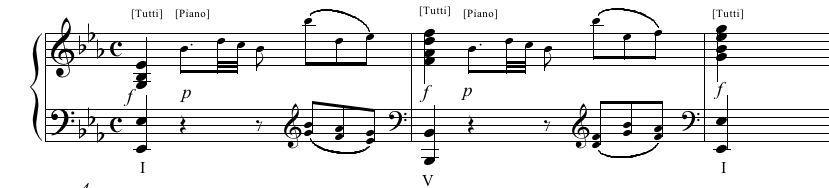
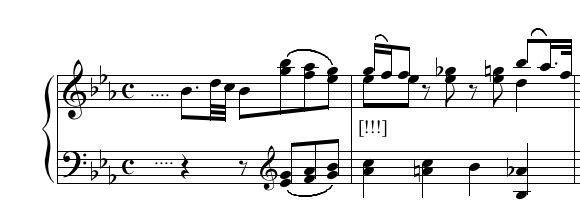
The first idea of this song is (just) a spoken-sung phrase, which (always) begins on the tonic, and (always) ends on a half-cadence. The cadence is a pretty common thing:


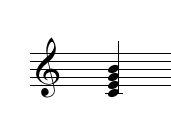
A deliberate, unassuming cliché. Where does it come from ... ? Nowhere and everywhere. I wouldn't even think about it, wouldn't bother about it (in the same sense you wouldn't analyze a comma), except that it seems to be a subject of contemplation in the song: the song ITSELF submits this cadence to analysis. It does this by toying with cadential possibilities. The example above is the "basic" version--ending in a root position V chord (G)--but Rufus colors it most of the time with the third below, E:


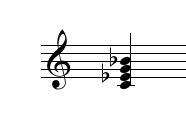
And some of the time he goes further, adding a more disturbing, questioning, intruding note (B-flat):


The E (voiced carefully down) simply makes the cadence somewhat "multivalent," softens its too-classical tonality. But if this E is a "coloration" of the dominant, the B-flat feels more like a "contradiction." In music theory terms, the B-flat heads us in the other (the wrong?) direction, back towards the subdominant ...

So, Rufus is toying with options, with shadings of this cadence--and the music keeps coming back to this incomplete cadence, almost irritatingly. (No matter what). Again and again starting tonic, going to dominant; each phrase a question, never really answered. No corresponding, replying phrase: no "consequent."

It is in this consequent-free context that my magical moment appears. Towards the end of Memphis Skyline, the piano is ruminating (obsessively) over this same cadence. We hear it three times in a row! (The cadence is now isolated, seprated from the phrase, understood as "the point"). The first two times, the E is present, the B-flat is played; an impasse; an unanswerable contradiction; let's try again. But the third time, the piano plays a conventional V, a good old-fashioned V-7, actually... sounds almost hymnic, barbershop quartet? ... perhaps it will simply resolve, finally, this cadence, this obsession?


But Rufus, so close to the ground, seizes this opportunity to take off, to make a visit to an implication: the B-flat, that "contradiction."

So, when this B-flat is heard a third time, it is not an accident, not a "wrong note" (though it has posed as one). Rufus, inspired by it, enters a third above this B-flat ("So ... "), on a D; a high F tremolo is heard. Voila! A harmony: B-flat; D; F. Are we in "pure" B-flat major, is this what the B-flat has "meant" all this time?

Before answering that question, obliquely, another: If you were going to set those lines ("so kiss me my darling, stay with me till morning"), give them a melodic contour, would it be this?:


This is Rufus' setting. (I have flattened out the rhythmic relationships to make a point). It seems like the setting of an idiot, someone with only three notes on his electronic keyboard. These (E, D, C) are "cadential" melodic notes ... (Three Blind Mice, Lebewohl, Schenkerian 3-line) falling, relinquishing, and if only Rufus could settle on C, it could end, the tension could be resolved... but you can see that he keeps going over the three notes, reiterating the obvious. The texture explodes into shimmering, quiet, pulsing arpeggios. The whole purpose of this passage is to introduce a shifting cast of characters beneath these familiar notes (to think over the cadence!). Rufus visits upon these basic, relinquishing tones (E-D-C) a tremendous amount of expressive resistance. The melody's desire to resolve (leave, depart, be finished, pass away) vs. the harmony's desire to prolong? ("Stay with me till morning.") And so each go-around has a different harmonic connotation... first D-C ("kiss me"):


Then back through E-D-C with an especially long wait on the beautifully harmonized D:


Then my favorite! He takes another spin through the 3 notes, with a fantastically unexpected bassline. Rufus must love this one too because the bass slides down from A to D, calling attention to itself. I always feel a little desire to jump around, to make some frenetic movement at this moment, because there is this supercharged static electricity for me here, some sense of repressed force:


And one last, incomplete, version... E E D ... (where's my C?)...


Don't forget that that dominant cadence (from before we ever got into this beautiful mess) is still waiting to be resolved. Rufus has not forgotten. With that B-flat excursion, he merely wanted to make us forget; so we can be made to remember. He was written a purple patch. And on this last D ("-ning") he seems to notice at once that the dominant's time has come (though of course he has prepared it inexorably), and to want moreover to make the "simple dominant" as thrilling as all the rest has been. Wonderful, ranging scales in the bass, unexpected voicings, permutations of the dominant, the dominant is alive! And no simple ending either. At the moment of resolution, while the strings are still holding a suspension (C), a "wrong-note/right-note", a muted trumpet enters with B. B and C blur against each other: another contradicted cadence.

I was on the phone with a good friend who told me, if I "ever ran into Rufus," to tell him that the sucking, breathing sounds he makes between phrases in the live recordings are "very distracting." Hopefully I will "run into" Rufus someday, if only to tell him how much I have enjoyed even just thinking about this one passage, but I will not pass on my friend's advice. I sympathize with those sounds. If you have a simple melody note to sing, over complicated harmonies, there is a gap of meaning which you are dying to fill. I often take complicated breaths before simple notes at the piano, trying to put as much meaning into my little E or D or C as I can, as much as I feel is in there. It is never enough, and my moaning and gesturing and whatever body language I bring to the piano will never be enough either. But: the gap is thrilling. I am glad Rufus (someone out there!) is writing melody notes that have so much to yearn for, that are so incomplete. Listening to this acoustic desire, I wallow in my own desires and let them carry me to elation or melancholy, by turns. Isn't that puppy love? QED.

Saturday, October 08, 2005

See You Later

Unearthed in my desperate attack on the mail, a program from the Great Lakes Chamber Festival, with texts:

Non c'e un unico tempo: ci sono molti nastri
che parelleli slittano
spesso in senso contrario e raramente
s'interseccano. E quando si palesa
la sola verita che, disvelata,
vienne subito espunta da chi sorveglia
i congegni e gli scambi. E si repiomba
poi nell'unico tempo. Ma in quell'attimo
solo i pochi viventi si sono riconosciuti
per dirsi addio, non arrivederci.


[Montale speaks of time in terms of parallel paths "that rarely intersect." When these paths do cross, the observer experiences their intersection as a single moment, negating their multiplicity. Yet in that moment, the observer perceives that only addio (farewell) is possible, not arrivederci (see you again).]


The poem is by Eugenio Montale, the summary by Elliott Carter. Even this dispassionate, deliberately non-poetic summary (oddly, describing the poem from a place "once removed") managed to blow me away, the night of the concert. Two days ago, when I came across it in the pile, it seemed less earth-shaking, but then yesterday it hit me again, full force, with one of those lovely non-insights. (Poetry not as a collection of insights, aphorisms, truisms, but as the expression of lack-of-knowledge.) It came in and out of focus, like a lens. You know there is a truth there, something that speaks to your experience. But you hesitate to nail it down. Once you have nailed it, it will seem less beautiful. Anyway, it is sufficiently "nailed" by the poem, right? (But something tells you you still want to know/name more.) I will chance a metaphor from my own daily experience: a piece of silverware falls behind the refrigerator, but you know this only from the sound, from the clunk; you cannot tell which; a knife, fork, spoon, spatula?; is it one of the essential utensils, that you cannot go another day without?; or can you wait till the next spring cleaning?; is it worth leaning, reaching blindly in the near-dark brought on by the burnout of my halogen bulb?

Such hesitations do not trouble one of my dear friends, for which I tease her unfairly. In the midst of my gesticulating ecstasies on a passage of Roland Barthes, she will fix me with the gaze of a woman judging vegetables at the market, and ask "but what does it mean?" And I will stumble to explain. In the process I discover how little of its meaning I possess, perhaps even how little I want it to mean anything at all. Curse your pesky questions and meanings. I am often satisfied if it simply beautiful, well-phrased, intriguing, if it has the "appearance of meaning;" I am a dandy of ideas, like the man in the gold leather zip-up boots in the Barney's catalogue I also recently unearthed.

So, annoyed, I wait for my friend to leave and then I pursue her question in solitude. This is often productive, but of course I never admit to my friend that her skeptical question was helpful. (Except now). I played through a recital program for her once, which included Beethoven's last Sonata, Op. 111. And I came to the Arietta:


Well, it got better as it went along, but the opening theme really didn't "click." I was tentative, didn't have the sound I wanted, was playing on edge. This theme is so spare. If you don't "get" the essence of that basic motive (C G G), you're building a pretty massive structure on sand. Well, I finished, and my friend gave me one of those looks again, a look with a small portion of "so what?" I'm sure it was not intentional; it just seeped out of her. My (internal) reaction: don't you get it? This is a towering masterpiece of Beethoven? But how could she "get" what I didn't give to her? More relaxed, and by way of illustration, I replayed the opening theme for her. Ah, if only all recitals were the second time around! It was now solid, and she looked illuminated. The theme seemed beautiful to her, now; but they were the same notes as before.

So, perhaps, there IS a point to all this practicing and crap. (But what IS it? The illumination of meanings? Communication to others? Fidelity to a score? Preservation of cultural heritage? Exploration of the self? I don't want to nail it down.) But you never know when it will precisely pay off. The other day, spontaneously, my friend Eddie asked me on stage to play the final waltz of Davidsbündlertänze, to illustrate a point he was making in his lecture on Schumann. Well I hadn't really prepared it, but I think anyway it was one of the best times I had ever played it, and I felt I "got" it in a way that I had not before. It was a pleasure to play it and simultaneously listen to it (a rare performing pleasure), and simultaneously also--learn from it. Time sort of stopped; threads intersected; many past practicings came together, unexpectedly. And at that moment, I also knew something of this epiphany was irrecoverable... what I was feeling was definitely not a confident "see you later," such as you bid to a friend who you are soon to meet for coffee, lunch, whatever, but was much closer to "goodbye."

Friday, October 07, 2005

Indulgences

A top ten list of things prone to put me in a foul mood would certainly be headed by 1) my mail, paperwork, bills, matters of accounting; 2) daytime television after 10 AM (not coincidentally when Charmed ends). So: off goes the TV. But I have to confess it took some time and mental energy for me to choose some music to put on the stereo. I cannot deal with the mail in silence.

I reasoned thus: if I'm going to be grumpy, let's take it all the way! So on went some late Schubert: Schwanengesang. It was the perfect choice. Admittedly, long periods went by where no documents were fondled, where I lay on the floor, feet propped up on my bed, blood rushing to my head, eyes closed, and I pretended to myself I was productive in a worldly way, while letting the music wash over me. It was a nice relief from the effort of trying to produce the music myself. Nice that I was patient enough to truly listen, and admire. The bubble of my ego must have temporarily burst.

Die Schöne Müllerin and Winterreise are both pretty familiar to me, but this last cycle (not really a cycle), even after many listenings, still feels wonderfully, powerfully alien. Not confined to a single plot, or dramatic arc, it ranges from subject to subject, from world to world: the familiar dialogue of lover with nature, with the brook; meditations on the unhappiness of Atlas; a man confronting his shadow; a barely-sketched-in scene of a tearful, fateful encounter on a beach (between lovers? friends? who knows?); the tender cliché of the letter, posted in longing and love. All these people, characters, populating Schubert's plane of existence; they would never meet in "real life." The music is often classical, no doubt; it calls on its own classicism, say, for comfort, and sometimes simply because there is nothing else; its simplicity is often heartbreaking; but between the classical lines (exploiting them) the austerity occasionally takes over and leads to bizarre, spare harmonic and melodic moments... the equivalent of musical empty space? I imagined a stretch of desert, in which ruins of Greek temples (disturbingly) rise from the ground intermittently instead of mountains, rocks, or mesas. Was the blood rushing too much to my head?

I don't think the desert that far-fetched. There is definitely a sense of being on a frontier: at the edge of truly desperate, extended emotional states, depressive places. The one-two-three punch of Die Stadt, Am Meer and Der Doppelgänger ... I mean, really... how are we supposed to survive these three songs in a row? Why don't I just stop listening and go shopping at the Gap? I feel like Mahler took the DNA of Am Meer off to his lab in the mountains, mad scientist that he was, and cloned it into his entire, angst-ridden oeuvre. If I were a more diligent blogger, I would find the passages in Mahler directly copied from this song and display them (trophy-bearing hunter of lineages) proudly on this page. It is an extraordinary song; it seems to distill some Viennese vein of thought, of musical pain; distilled it enough that Mahler could then dilute it without loss. I had listened to this song for years, not knowing the text (for shame), and therefore was surprised to see what was there:

... The tears poured from your loving eyes.

I saw them fall onto your hand, and fell on my knees,
and drank the tears from your white hand.

From that hour my body has wasted away,
and my spirit is dying of desire.
The wretched woman has poisoned me with her tears.


First reaction? THIS poem is the one Schubert devoted THAT music to? It did not seem to "deserve" it. The music seemed more metaphysical than that, not just a lover's farewell (?... which it could be, but may not). But the composer, in setting it to music, has reread the poem for you... has found preemptive meanings. I began to think more about "my spirit is dying of desire" ("die Seele stirbt von Sehnen"--what an unbelievably German line), the triumvirate of tears, poison and desire... Things became clearer; the barbed, enigmatic poem began to grow into the song.

And I ran across these lines from Montaigne:

Why does no one confess his vices? Because he is still in their grip now; it is only for a waking man to tell his dream. [Seneca].

The diseases of the body become clearer as they increase. We find that what we were calling a cold or a sprain is the gout. The diseases of the soul grow more obscure as they grow stronger; the sickest man is least sensible of them.


Diseases of the soul. The man who sees his terrifying double image; who is poisoned by his own desire; visited by apparitions of loss. I feel I can connect Schubert's spare austerities, these extenuated harmonies, those enharmonic slippages, to this sense of encroaching disease...classical harmonies and phrases visited by anomalies, by small and large symptoms. Another image (hallucination?) came to mind while my feet were propped: the music, or was it the way it was being performed... had the eerie quality of a child singing, but the anachronistic sentiments of a dying, hopeless old man. Does the child believe what he is singing? Is Schubert sensible of this disease (this disconnect, this rift), or is he too sick to tell us his dream?

You can see how low the mail can take me. Wow. You'll notice I blame the mail and not Schubert.

Wednesday, October 05, 2005

Shortest post ever

When I say American I mean uncorrected by the main history of human suffering.

--Saul Bellow


Such as myself, in this photo (yes that is the hat from Lubbock):

Baudelaire and Rufus

I have mixed up two poems in my head, poems about mixing it up. One is Harmonie du Soir:

Les sons et les parfums tournent dans l'air du soir;
Valse mélancolique et langoureux vertige!

Sounds and perfumes circle in the evening air;
Melancholy waltz and languorous vertigo!

and the other, Correspondances:

Comme de longs échos qui de loin se confondent
Dans une ténébreuse et profonde unité,
Vaste comme la nuit et comme la clarté,
Les parfums, les couleurs et les sons se répondent.

Like extended echoes which mingle far away
In a mysterious and profound unity,
Vast as the night and as light,
Perfumes, colors and sounds answer each other.

A recent leak in my bathroom ceiling has led to a new, mildewy scent in my apartment, and this morning I decided to begin again using my French coffee press. Stepping in my PJ's from bedroom to living room, I got the full, mixed-up effect ... the lovely smell of ground coffee, the heated-metal smell of the cheap stove in my apartment, the grassy mildew smell, and probably others too faint to mention. All of which was bound to conjure mornings in 1992, in my student slum house in Bloomington, at Hunter and Highland, permeated with moistures past and present, with baseboard heaters, sometimes with the smell of cut grass, and always full of coffee grounds and us three students jolting up. Memories particularly of "how I heard music then." Fascinating. The famous, heartbreaking quintet from Mozart's Idomeneo among these memories: music that seems otherwordly, aristocratic, supernatural. Heard in a hideous cinderblock library listening carrel, frantically preparing for a final exam (M 451, "Mozart Operas"), but wideeyed with wonder. How to connect from mold to Mozart?

Coffee in hand, I begged off my sunny, grassy, studential memories of Idomeneo and turned the stereo on--again--to the Rufus Wainwright disc my friend lent me yesterday. Like an archaeologist picking through ruins, I looked at what needed to be done in my apartment. Meanwhile, Rufus crooned:

I don't know what I'm doin
I don't know what I'm sayin
I don't know why I'm watchin
all these white people dancin

As if on cue (and this was the disturbing part, the part that made me feel some force out there had already contemplated my reaction, was toying with me), my alarm CD clock came on (must have forgotten to turn it off?), and good old white Ignaz Friedman starts waltzing away. ("Valse melancolique et languoureux vertige!") Battling sound systems! The combination of Rufus somewhat pretending to be a modern Schubert, and Friedman playing a souped-up suite of Schubert waltzes was unexpected and horrible. Rufus began to sing about "waltzin" around that time too. I put down my coffee. I was just contemplating a blog entry about the Schubertian harmonic twists in Rufus, and other classical quotes... also about the suspension of disbelief required to be touched by a song rhyming "cruisin" and "bruisin"... but the cacophony seemed to want to dissuade me from these easy amusements: it was a deep, ugly mass of conflicting sound. Like a nightmare, I wanted to interpret it.

I was being ambushed by unexpected combinations in my own house. The little universe I have set up here at 91st and Broadway, though mainly detritus, still has gravitational effects and mysterious laws. Smells, check. Sounds, check. Which senses, which correspondences, were left, and how would they be linked?

Baudelaire's combos are tremendous, unnerving, they never cease to send me:

L'innocent paradis, plein de plaisirs furtifs...
[That innocent paradise, full of furtive pleasures...]

Et le ciel regardait la carcasse superbe
Comme une fleur s'épanouir.
[And heaven watched the splendid carcass
unfolding like a flower.]

Et que de l'horizon embrassant tout le cercle
Il nous verse un jour noir plus triste que les nuits;
[and when filling the whole circle of the horizon,
the sky pours out upon us a black daylight more gloomy than nights]

Something about the Rufus CD--even before the intrusion--unsettled me, brought Baudelaire to mind. It is, on occasion, so close to so much classical music; he summons its ways too easily? too glibly? and passes by. This makes me queasy at times, and other times is simply silly, but other times truly haunts me, gets me in the deepest places. In the song I have mentioned, there is a beautiful deceptive cadence just at the moment in the text where the narrator reveals his "underside"... this makes me very happy ... someone out there also knows this stuff, thinks this element of text-setting is still important ... but there is something falsely quoted about it too, something misattributed. I can sense a modern person re-hearing, and placing in the past, the tropes I have tried to make present to myself (in a sense, my whole world). The lostness of my repertoire is made evident to me. Its usage is stylized, and I am forced to contemplate a cynical definition of style--arbitrary combinations, at arbitrary times. If you dig Schubert up like this, does he open "like a flower," or is this just a holographic image?

Monday, October 03, 2005

Self-Aware

I'm in love. Can I just say that? I'm over the moon for Humboldt's Gift. Will it last? Only time can tell. I have a book on my shelf entitled "Can Love Last?" by a perceptive, dead psychoanalyst. I have read it several times, remembering nothing.

Actually the last five days, their heavy servings of airports, subways, and hotels, have made of me a hungry, swift reader, a promiscuous lover of books. Books feel like rapids: I jump in them and am dangerously off. In Cold Blood went down my mental gullet in two disturbing days, with flashes of joy when the style zoomed. And now the late Saul Bellow, with whom I had dinner twice (I knew nothing but a name then)...

Bless the subway. When you are on the subway to/from Brookyn--a journey of 45 minutes or more from my house--you really have no choice but to read; it is a protected, hurtling interval; you cannot practice, clean, blog, or call people back. You are relieved of your contractual obligations, freed by an enclosing car.

But now, today, I have constricting choices; I am at home; the pile of mail beckons. Projects, projects. My beloved friends are calling, worried, where am I?, am I OK?, and I am reading. (Recovering, perhaps.)

Is reading so irresponsible? Today I saw an intriguing book in the Juilliard bookstore: Joseph Polisi's The Artist as Citizen. It tugged at me; I grabbed it, felt its dimensions, then dropped it like a hot potato. I sensed and dreaded a whole new raft of obligations, a whole new role: how I could transform myself into an upstanding whatever. A pianist with a conscience. Now, The Citizen as Artist: THAT'S a book I want to read! Polisi's book would be responsible reading, for me; which is precisely why I don't want to read it.

My bibliophilia saved me--if nothing else--from television, in Louisville. I got no further than the introductory channel, the hotel's default media launching point... On this channel, a woman was selling Pay-Per-View movies. But she wasn't selling them in a sexy way; she was EXPLAINING them. What is worse than crap? The explanation of crap. Standing in a faux living room, she explained that "the makers of 'Batman Begins' were faced with a unique problem." Oh yes, what was that? How to spend their money? No, she went on: "How to bring freshness to a story that has seen so many incarnations." Such a unique problem indeed (almost every piece of literature ever written). Actually what she really said was much more inane than that, my brain simply won't recall it... "we explore the young Batman," who in turn "explores the boundaries of good and evil," "tries to understand himself as a superhero," and--of course--"comes of age."

One feels like an idiot pointing out its idiocies. I turned the TV off, for days, favoring unintroduced books. What bothered me most was her insistence on a tone, the way she tried in her earnest way to elevate her subject-matter, to take whatever piece of drivel and toss explanatory sauce on it and serve it up like a real meal. Today's Special. Just like TNT replays a movie, and calls it a "New Classic." Ah, oxymoron! No: you have to earn it, you can't market it into remembrance.

I have verged into rant, doubtless at the subconscious behest of my new love Bellow. As a classical musician surrounded by a non-classical world, I sometimes get touchy, even misanthropic. (Is there a word like "misanthropic," applicable to a prevailing cultural milieu?) I love my books; I want to murder my TV. Today, though in love, I am grumpy and recovering and staring at my pile of mail (ever more daunting) and having to deal with real life, and therefore retreating into safe, magical books (like musical scores without notes). The outside world--for instance, people with double-wide strollers in Starbucks--unpleasant intrusion. I think this passage from Humboldt's Gift is applicable, and incredible:

For after all Humboldt did what poets in crass America are supposed to do. He chased ruin and death even harder than he had chased women. He blew his talent and his health and reached home, the grave, in a dusty slide. He plowed himself under. Okay. So did Edgar Allan Poe, picked out of the Baltimore gutter. And Hart Crane over the side of a ship. And Jarrell falling in front of a car. And poor John Berryman jumping from a bridge. For some reason this awfulness is peculiarly appreciated by business and technological America. The country is proud of its dead poets. It takes terrific satisfaction in the poets' testimony that the USA is too tough, too big, too much, too rugged, that American reality is overpowering. And to be a poet is a school thing, a skirt thing, a church thing. The weakness of the spiritual powers is proved in the childishness, madness, drunkenness, and despair of these martyrs. Orpheus moved stones and trees. But a poet can't perform a hysterectomy or send a vehicle out of the solar sytem. Miracle and power no longer belong to him. So poets are loved, but loved because they just can't make it here. They exist to light up the enormity of the awful tangle and justify the cynicism of those who say, "If I were not such a corrupt, unfeeling bastard, creep, thief, and vulture, I couldn't get through this either. Look at these good and tender and soft men, the best of us. They succumbed, poor loonies." So this, I was meditating, is how successful bitter hard-faced and cannibalistic people exult.


Wow, that's harsher than I remember from the first read-through. Especially, the end. Rest assured I am not feeling that harshly myself today... except towards my pile of mail. After all, I'm in love.

Sunday, October 02, 2005

... to the punch

For the first time, a reader has posted a comment, in essence "blogging" about something that happened to me--something I was planning to blog about--BEFORE I HAD A CHANCE to do so. I can't decide if I'm angry about this, touched, or simply amused:

There was a magical moment around the time of the "tripped out" Sarabande. In the silence right before you started playing the Sarabande, one could hear sirens from a distance. Then the dance began with a hauntingly blurred not-quite-arpeggiated chord. The sirens became a bit louder. The music proceeded into what could best be described as a delirium. Soon, the boat started rocking. I could not tell what was driving what - the music's intensity making the barge pull against its moorings; the waves on the East River driving the already fidgety Sarabande into flights of further frenzy; or merely a cosmic coincidence. In any case, I was breathless.


All this is true. And there is more. Last evening, on the Barge, I began the Sarabande of Bach's 6th Partita to the accompaniment of distant sirens, which persisted, increased ... And then the boat began to shake frighteningly, noisily, excessively, as I ranged towards the movement's more extenuated moments. It did feel like a strange coincidence, or a conspiracy. I couldn't see the cause of the shaking, or of the sirens; in fact, I saw nothing; I kept my eyes painfully, intently closed. It was a tour de force of distraction; all the forces of Brooklyn, Manhattan, and the East River seemed arrayed between me and Bach, and I had to keep staring him (blindly) in the face, holding the thread taut.

You will not believe what I did: I began to think of whoever's tragedy motivated the sirens (what could it have been? some accident?) and tried to connect it to the heavy-hearted Sarabande. I couldn't; it was both too abstract and too maudlin. (Too selfish? Using anything for my performance.)

Then (it is a long movement) I began to think of the music as an antidote to the sirens... a small battle was drawn. I couldn't drown out the sirens (they were external to the sacred, floating performing space: renegades), but I could try to make my phrases more compelling, more meaningful. It is hard to battle against a sound that was designed to penetrate no matter what, a sound bred for irritation and attention: only possible by fighting on "your own terms." And it was interesting, because the distractions were so great as sometimes to feel like they literally "got between" me and the music, like a wall, or like static which overwhelms bits of a transmission. I would miss words, lose meanings. I had to climb over the wall repeatedly to get back into the music's syntax each time. So there were ephemeral gusts of mental effort, where I climbed back into relevance, tried to sum things up even more cogently than before... because I knew I only had "that moment."

So there you go, blog reader, now you know what I was thinking. I often get that question after the concert ("what are you thinking about?"), and often the answer is quite dull, technical, or too complex to be answered in words. How do you cultivate the mental process of performing (what to think about, what to concentrate on) over 30 years? How do you summarize this to someone in 15 seconds? Ah, yes. Nice impossible questions. But last night was an exception, and I'm happy to finally answer this question in a reasonable, non-paradoxical way.

Tuesday, September 27, 2005

Cross-Relations

Like a Where's Waldo? gone wild, I cannot help but search for Bach in everything I come across these days. That all-Partita concert transformed me into a junkie, jonesing for a J.S. fix. What a sad addict, though, rooting through the Tchaikovsky concerto for something resembling the Sarabande of the 6th Partita! There is not even a self-important fugato (horrible, recurring crutch of 19th-Century composers looking for something to do) at which to point one's shaking, withdrawal-addled finger. What would Bach have made, for instance, of the octave passage at the beginning of Tchaikovsky's development section--E-flat major octaves as far as the eye can see, heading first up, and then crashing down the keyboard? The harpischord would be in smithereens. He would have considered it some act of terrorism, no doubt. At the very least: a sin.

I love, by contrast, Bach's judiciously audacious use of octaves. For instance: the end of the 5th Partita. This fugal, complex gigue has a kind of manic insistence on not letting a moment go--and here's the counter subject, and here's the main subject, and here they are together, and no wait! don't rest! here it comes again in another voice! At some point an idea with a trill is introduced, and boy! do we get to know that one, and the piece comes to its climax with a sequence--a deliciously superfluous reiteration--of this quite-familiar trill, sequencing it wildly up the scale to the tonic... the kind of joyful obsession with this trill, we just can't stop trilling! not till we get there! (I can definitely see Bach smiling here, even grinning, holding a mug of coffee or a stein of beer while still somehow managing to play all the voices) ... and when he does get there (and this is "the point"): wonderful octaves in the bass, B, D, G... resolving to the tonic, once and for all, stopping the madness. Take that! (I could even imagine a kind of Miss Piggy karate chop):


That extra "display of strength" in the bass, its brusque simplicity of resolution, contrasts amusingly with all the intricate weavings, the chatterings, of what came before. The octaves are out of the frame of the piece, an intrusion: and yet only this alien element could bring us home. My former teacher, György Sebök, tried to instill in me something I probably have not yet totally learned (though nonetheless I think it is true): that endings in Bach do not say "I have finished the piece," do not declare any individual accomplishment, but rather indicate: "God wrote it, and it is good." Not especially religious myself, I nonetheless can hear this musical distinction, and sadly am often too caught up in my own sense of accomplishment, and desire for finality, at the end of a Partita, to let Bach's God speak.

Returning to the Tchaikovsky passage, I got a wonderful suggestion from the concertmaster of the Lubbock Symphony, based on the premise of its motive of four descending notes. Any person acquainted with a reasonable percentage of popular culture could be expected to conflate this moment with "meow meow meow meow," and indeed it is pleasant to contemplate how different the piece would be (how much more feline!) if the pianist at that point broke into the Meow Mix jingle. I feel sure Tchaikovsky would have found some slightly long-winded way to develop those motives too. By an odd coincidence, the clarinetist of the Lubbock symphony is an old classmate of mine from Oberlin, and we reminisced over Texas white wine, while surveying the not-so-rolling nightscape of Lubbock, about how once we felt inspired to break into "Roll Out the Barrel" amid the last movement of Bartok's Contrasts--in studio class, no less. The professor, a man of considerable wry wit, compelled the audience to a stony silence, and we forced to pay for our prank with an awkward minute of nothing, no response, on stage... total humiliation.

All of which, I am sad to say, is by way of introduction (!) to my main point, but I can never recall being so exhausted by my lead-in as to contemplate breaking off entirely. Courage!

While I've been hard-pressed to find Bach in Tchaikovsky, Bach peeps out everywhere in Bartok's 3rd Concerto, assuaging this wigged-out junkie. Its first movement is full of gentle, playful, concerto-grosso-esque counterpoint: canons, inversions, dialogues, various "procedures" made tender and transcendent. (This constant back-and-forth makes it delicate, difficult to pull off, a real piece of concerto chamber music). But the second movement is a particularly extraordinary homage to the master, a re-framing: a "re-Bach-ification project."

It has basically three components:

a) What the strings play at the beginning: almost modal, a kind of pre-Bach counterpoint (like Palestrina?)... which leads to...

b) A chorale stated by the piano... a deliberate evocation of Bach chorales, "touched up" with harmonies from a more modern world... which leads to...

c) "Nature music": the hum of insects, bird calls, night sounds, breezes, falling and rising ripples... the absence of melody, per se ... simply sound, contour, time...

Now, each of these elements has its emotional baggage, its connotations, its "meaning"; but more importantly, so does the juxtaposition of these elements, the unabashed mixture of opposites (like "Meow Mix" in the Tchaikovsky concerto?). The different musics, passing from one to the other... The Bach chorale, with its more pungent, more "tonal," more directed, harmonies, and its more grammatical rhythm, is "born" out of the purer, more aimless, statements of the strings. The piano soloist, metaphorically, speaks the individual voice of experience (pain, loss, reaching) in response to some collective, earlier innocence. And though the piano is "more modern" than the strings, both are colored with a sense of being impossible styles: things that can no longer be written--past, lost, irrecoverable.

Bartok apes Bach, but not literally or systematically; he leaves traces of himself in the chorale: hints, signposts, reverberations. It is a chorale, reaching out to Bartok, sometimes becoming entirely Bartok, then reverting, returning, relinquishing.

Let's take one phrase of the chorale, my sentimental favorite:


It reaches up, G to A, A to B, and when it lands on its climactic C... a twist. Instead of the E-natural one might expect, the C is harmonized with the note a half-step lower: D#. This D# is "not Bach," it is a painful mis-harmonization belonging entirely to Bartok's world... to his world so prominently peopled with tritones (A-D#)... and yet, and yet, can't one recall certain similar major-minor twists in Bach movements? But on the way down--how Bartok resolves away from this C--is the most clear, extraordinary, heartbreaking Bach homage. The treble descends: B, A, G; while the tenor voice ascends: G#, A#, B. Any music theorist worth his/her salt (not that I necessarily advise you spend a lot of time consulting music theorists) will tell you that this is called a "voice exchange," (B-G/G-B) time-honored procedure of four-part writing, of counterpoint in general... and FURTHERMORE that the chromatic alterations of some of the notes (G vs. G#, A vs. A#)... the sense that A "grinds" against A#, and G against G#, is called a cross-relation. Assume it has a name not just because it recurs so often, but because it has a special, beautiful effect.

To the internet! It took mere seconds on EveryNote.com to find the score of a Bach chorale with a similar cross-relation: you can't miss them, the chorales are peppered with them, those hidden, temporally displaced dissonances in the procession of concords. Here's the example I found:


At the end of this passage: In the alto voice, a descent, E through D-natural, C-natural, to B... in the bass, a corresponding ascent: C through C#, D, D#, to E. We are intended to hear the C and C# jangle, the D and D# conflict--then all is resolved. BUT THE SINGLE EXAMPLE DOESN'T MATTER! This is like a Bach "personality trait," a virtual calling-card of his chorale harmonizations, and when we hear it in the Bartok, we just know... this progression is achingly familiar, it taps into the musical/cultural memory, evoking Bach's ghost. It is one of the most beautiful idiosyncrasies of the chorales... a birthmark of the style.. and Bartok summons it obviously lovingly, like we summon to our minds the endearing oddities of an absent friend or love.

In the Bartok phrase, the A and A# are heard simultaneously, on the same "weak beat," as a passing tone; but the G# is heard on the first beat, while the dissonant G-natural is heard on the third (check the score again if you feel like it). We are meant to hear the dissonance displaced over time, and the displaced dissonance is no weaker than its simultaneous cousin... the memory of the previous note grinding against the new note we now hear. (Power of memory?) Yes, though the note is gone (though Bach is gone), it is still present, it affects events, must be understood... a cross-relation, a relation across time and across a musical interval, a deliberate paradox inserted in the counterpoint, two conflicting notes coexisting and resolving.

But what do you know? This G#-G-natural cross-relation--the juxtaposition of major and minor thirds--seems awfully similar to one of the most characteristic elements in Bartok's "native" harmonic style. (The layers of relation: first simply the G#-G-natural; then the way this relation evokes Bach; then the way this, in turn, draws comparison between Bach and Bartok.) Bartok's adaptations of Hungarian folk music pay special attention to the pungent, wonderful coexistence of major and minor thirds. Very often his cadences make no effort to decide, and simply splat down on both. Just a coincidence? No way. In the return of the chorale, Bartok makes this correspondence crystal clear; he insists on it, dwells on it, materializes it: the piano improvises at the end of this phrase in Hungarian style, repeatedly emphasizing the dissonant G-natural against the G# being held in the orchestra, like a folk lament gone virtuosic and wild:


Bartok has "discovered" a correspondence, a musical pun, a homonym, a common ancestor between himself and Bach... the cross-relation... this slow movement is its demonstration and revelation. The pianist, improvising counter-melodies to the chorale in its return, simply cannot help "expounding," making more steps in this direction, bringing Bach and Bartok together, reaching across the gulf. This juxtaposition of "opposites" is at once audacious and thrilling (hearing those Bartokian clusters superimposed on chorale cadences!) and, to my mind, often deeply sad and touching: dispossessed. A conversation from a distance, where neither party is entirely at home. Dissonances from two worlds, touching.

I haven't even touched on the most "dissonant" section, the middle section of movement, the "nature music." To my one remaining reader: we are in the home stretch.

After the opening section, where the piano says--with difficulty, by steps--what it has to say, the chorale gives way to a second form of innocence (not the strings' modal innocence), something outside the realm of music entirely, something once again collective. How can I account for the feeling that takes hold of me when, after the chorale's final cadence (tonal?), and the modality of a string interlude, I hear the Bartokian cluster of the middle section, the intrusion of modernity, leaping across centuries? A leap of faith. The way in which it is done is extraordinary: one doesn't hear a beat or a pitch to start the new section, but instead the "quantified" pitches of the opening section are replaced by a hazy, elusive tremolo. Suddenly we are lifted from musical "statements" into a world of pre-musical, musical being. We are hovering above music. The piano states a bird-call, injects the minimum of purpose and pulse into this soundscape...

If we think of the string music as evoking the beginnings of counterpoint, of musical artfulness and cultivation, and the piano chorale as a step further along, slightly more cultivated, the middle section is a paradox. While clearly modern, sophisticated, full of technique and developed craft, this craft is brought to bear to express something absolutely non-cultivated: pure nature. This slow movement can't decide whether to be cultivated or not; it is ambivalent, torn. It relies so heavily on memories of culture, on associations, on musical history, on nostalgia ... as we have seen... but also reaches out to non-culture, to the absence of culture.

But all this is academic-speak. I want to get in words, finally, this sense of joy at the junction, when Bach/Bartok chorales are "replaced" by bird-calls and breezes.

It is as though Bartok thought so deeply through the sentences of his chorale, its heavy, beautiful meanings ... but then thought suddenly that the world needed to be wider. The piano's chorale is self-sufficient but not enough. (Even Bach, the great master, is not enough.) When the soloist switches to the intermittent voice of a bird, away from the continuities of the chorale, I feel a tremendous elation, born of distance, of the impossibly strange traversed. Bartok's vision of nature here is so generous, tweaked with dissonance, but nonetheless entirely good: regret-less. Against which the cross-relation of man's chorale: so much painstaking, heartbreaking thought.

Friday, September 23, 2005

On the Road

As if the glamour of a touring pianist's life needed any further confirmation or evidence, I am now blogging from a Denny's in Lubbock, Texas. Outside, Lubbock's wide, dusty Ave. Q bakes in seemingly endless sunshine, while inside, and particularly backstage at the concert hall, one freezes in extreme air-conditioning. I just left the piano technician safely behind in the chilly hall, a friendly man with a gentle west Texas drawl, and asked him to remove some of the metallic quality from the upper octaves--though I have to admit that asking any technician to do anything to a piano fills me with fear, with second thoughts and self-remonstrances... the devil I know so often seems preferable to the devil I don't. I will have to drown these unnecessary, futile fears in spicy chicken and fries.

Anyone could imagine that after weeks and weeks of just Bach, leaping into the Tchaikovsky piano concerto could be a shock... perhaps only paralleled by the cultural sea-change of leaving Manhattan for Lubbock. As I sat on the floor in the Lubbock baggage claim, awaiting my giant gray bag, beneath an advertisement for irrigation pumps, my face made wan by the inevitable banks of fluorescent light, I charged my phone at a lone necessary socket, and chatted with a dear friend back east--lone, necessary comfort after a long trip, and he seemed to recognize this, and his voice warmed in response. I was grateful. You never know which plane trips are going to be tedious.

Outside, at the curb: the airport emptying for the night, crews heading home, parking vans congregating, spewing diesel fumes; but against this: a wonderful Western breeze, reminding me of On the Road, Kerouac and co.'s constant sense of the call of the West, its vistas, promises, adventures. Endless rambling sentences, endless rambling journeys... (the endless rambling structure of the first movement of the Tchaikovsky concerto?) But when I arrive at the hotel, I realize my time here will be circumscribed by the short walk across the street from the Holiday Inn to the Civic Center, and further it will be circumscribed by the usual: serious practicing.

Frustrated with these limits, I imagine myself disembarking in Lubbock as a non-pianist, perhaps as a cowboy. I get a delightful care package in my hotel room from the nice symphony people, which includes a cowboy hat. I sit in my hotel room, and put it on, pose for the mirror while I check my email. Ridiculous but pleasantly so. Coincidentally, the other day, in the wake of all 6 Partitas, I envied a cow I spied from a car, half-immersed in a muddy pond. I guess this envy was a symptom of the intense mental effort of all that Bach... a desire not to play melodies on demand but, rather, to moo at leisure... but I cannot be that cow for now, nor may I herd cows in my new hat ... I must simply corral the notes I have to play tonight...

Friday, September 02, 2005

Sentences

I intend no slight to my friends who are still alive, but my most radiant, joyous hours over the last week have been spent living with the dead. For instance, the other evening, I found myself amid what one could only call "shop-talk" at that Upper West Side institution, that mecca of swift, savory Vietnamese cuisine, Saigon Grill. Musicians seem to gather there, over noodles and satay, specifically for the task of discussing who-knows-who and who-played-where and other aspects of the "music biz" (my least favorite phrase ever). Occasionally even the topic of who-slept-with-who may be remarked upon; I hope the delicate eyes of my blog readers are not offended by this last revelation.

But coming off six hours of intensive work on Bach partitas, I found my attention wandering, and I was not able to participate... so I took leave of my lovely dinner partners and headed up Amsterdam Avenue to my new favorite sushi restaurant--

(by the way, there is a point to this long story, I think)--

where it is possible, I have discovered repeatedly, to spend a surprising amount of money. I promptly ordered one of their best bottles of sake, and every special maki listed on the menu (only in New York does "today's special" not mean "on sale" but rather "you're going to get reamed"), and sat down with Henry James' The Golden Bowl. Though a table of Croatians seemed to be celebrating their ability to make noise a few tables away, this only bothered me briefly, and after a thimble or two of sake, I was astonishingly able and willing to immerse myself in James' enormous sentences (whose style I seem to be subconsciously--I promise!--emulating here).

I came upon the amazing scene where Charlotte--having embroiled herself in the devil's bargain of marriage to an American tycoon--is appearing in her full, moneyed glamour, for the first time, and conspicuously "going about" at a party, waiting rather theatrically for the Prince, her ex-lover, who is also her son-in-law (!). And as she stands there, mid-staircase, James brings full to bear the weight of his enormous perception, in one of those endless, nuanced, magnificently branching sentences:

The ordered revellers, rustling and shining, with sweep of train and glitter of star and clink of sword, and yet for all this but so imperfectly articulate, so vaguely vocal--the double stream of the coming and the going, flowing together where she stood, passed her, brushed her, treated her to much crude contemplation and now and then to a spasm of speech, an offered hand, even in some cases to an unencouraged pause; but she missed no countenance and invited no protection: she fairly liked to be, so long as she might, just as she was--exposed a little to the public, no doubt, in her unaccompanied state, but, even if it were a bit brazen, careless of queer reflexions on the dull polish of London faces, and exposed, since it was a question of exposure, to much more competent recognitions of her own.


I was amazed at how amazed I was, how in my James "zone" I felt. Admittedly, I have occasionally been prone to petty irritation with James, and what one might term, ungenerously, his pompous verbosity ... but as I stared lovingly at the octopus, tuna, and salmon in the display case, I savored the afterglow of each sentence as it sunk in, and the complications each seemed to add to the characters, bit by bit, like constructing an enormous edifice. Indeed, the characters were getting themselves in deeper and deeper (so to speak), and I-as-reader was also, snorkeling around in the murk of the unspoken tension of this most complicated love quadrangle. The sentences were complex but like life... constantly adding to both the answers and the unanswerables. I looked around, finally, to find myself the last person in the restaurant. The sake bottle also appeared to be empty. Nonetheless the owners seemed not to be annoyed or impatient; rather, their eyes seemed moist with gratitude and solicitude, perhaps in anticipation of my check.

How happy I was, reading James in the sushi place! But when I returned home, I became even happier. I had left the music open to the Allemande of the 4th Partita, barely readable in the glow of my lamp, and I sat and was too impatient to begin in the beginning, and so I began playing nine measures in, which is the beginning of a sequence:


Now, for some heavy lifting. As in certain James sentences, in lots of Bach one cannot know beforehand where the clauses will start and stop... one only knows the structure (the unit-to-be-repeated, the thread of relation) "in hindsight." Measures 9 and 10 "mean something," but only in bars 11 and 12, the reiterated, reworked version, does this meaning, does even the mere fact of 9 and 10 being a unit, become clear. And it (the meaning) is defined by difference. By the time you know the meaning, the direction of events has already changed; it is time for another paradigm shift. (Meaning built on quicksand). Bars 11 and 12 make a change at the midpoint (the "crux" of the phraselet, also the melodic peak)... and this change struck me quite forcefully that evening... had I really heard it properly for the first time? In place of the dominant seventh chord at the crux in bar 10, bar 12 substitutes a diminished seventh chord, an accident which (though clearly no accident) suddenly seemed to me a major event, a kind of "slippage" of meaning, a crack through which the piece had suddenly fallen, not to reemerge for some time.

And though the next measure (a dominant pedal) is no great surprise, and could have been reached by any manner of ways, the fact that it was reached by that particular, odd, awkwardly beautiful way seems to affect the course of events, not out of necessity, but out of association, like a difficult memory from one's life that keeps cropping up and influencing your subsequent decisions. This is the way I began to "explain" to myself the remaining unfolding of the first half of the Allemande: the odd, beautiful, dissonant mingling of major and minor in bar 14; also, the extraordinary deceptive cadence to F-natural in the bass of bar 15; and the two fascinating tritones at the beginning of bar 17 (in the left hand) which make the subsequent cadence a sort of triumph over harmonic adversity. And on and on.

jamesbach2

The major and minor coexist so uneasily, so heartbreakingly... in their interaction the music courts ugliness, awkwardness, infelicity... and yet manages "to escape." The melody seems like a fragile, eroding trail between these two options. In bar 19, we seem to be freer of this past complication, the meaning seems released: ah, yes, a rising major sequence. Very beautiful. We might predict: it will rise, and peak, and flourish, and resolve into the cadence at the dominant. But (of course) the meaning slips again, in the second beat of measure 21. And for me, it was this association backwards, this sense of connection between all these "slipped" moments, that made it powerful, that made the sentence, as I played it, enormously consequential. Henry James, or at least my copy of The Golden Bowl, was sitting on the piano, listening. He might have observed yet another second thought, becoming, reluctantly, a generative first thought for a whole other line of enquiry, which, finally though suddenly, almost "accidentally" (the last, most fortunate, accident!) slips back into major, and resolves, succumbing to the compelling imperative of "always."

I stopped. I looked at the page.

This is really when the practicing pays off; when music and all its business seems quite worthwhile: when you "get" something, even if it might mostly vanish tomorrow, and might never make it out over the airwaves to your listeners, even if it may end up, finally, being something you only share between yourself and J.S. ... I shouldn't have begun by saying I lived "with" the dead. Rather, for that one sentence: I lived through the dead. Visions of Bach in his candlelight scribbling. That crusty old Lutheran might have stopped having more children in Heaven and taken a moment to give me, secular self-absorbed New Yorker, a little life.

Thursday, September 01, 2005

Self-Absorbed

This is not "that kind of blog." But I have been practicing Bach all day for a couple days, in my bubble, and then coming back to my computer to see ever more horrifying reports of New Orleans, Biloxi, and other places ... and I have been disturbed by my ivory tower existence. So, though this is really a music blog, and I don't want to opine on any of this human suffering, let's just take a moment to consider donating to those in need.

Tuesday, August 30, 2005

Moot? or Mute?

What a wonderful word is "moot"... I imagine a map like Tolkien's, of Middle Earth, with a land named Moot, to which all irrelevant comparisons and questions are banished; or perhaps they simply choose to live in Moot, like some people choose to live in Idaho. There they would live, exchanging non sequiturs, while the rest of us pursue our linear, logical ways.

Someone came up to me the other day after a Brahms g minor Piano Quartet performance and wondered why Brahms insisted on putting the mutes on the strings in the second movement. A perfectly reasonable question, I suppose (wouldn't the strings be able to play louder without them? wouldn't they have a greater emotional/dynamic range?) but to me it was moot. And I struggled against its mootness: my face, I am afraid, assumed that strained expression it gets when I am attempting to appear to consider something reasonably... something which I am aching to rudely dismiss. But something about this question was familiar, echoed within me, and I vaguely remembered moments from my many rehearsals of this piece, listening to string players discuss who should be muted, for how long, and why.

Hard experience has taught me often to put on my own mutes when matters of "string playing" are being discussed in rehearsal. Unless earnestly implored, I will never offer my thoughts, for instance, on bowings or fingerings or slides. I learned this a) from being yelled at, and b) from my own irritation, for example, when a string player (who also plays piano) will suggest some pedaling or fingering to me. This latter is especially irritating if the fingering or pedaling is good, and I must think up some extravagant, false reason to disprove their insights. Just kidding, sort of.

So, I tend to "zone out" when this mute question is discussed. I look benignly at the ceiling, or I think abstractly about how I will play some phrase later on in the movement, and when I feel the string players' eyes rest on me some minutes later, I smile my best smile and agree with whatever they have decided, even though I have very very strong feelings on the matter. For me, the whole movement must be inward, not too fast particularly, and never going out of a certain emotional frame... something recalled, something seen from a distance, slightly blurred, slightly worn down by experience, time, melancholy, or thought. The muting of the strings perfectly expresses this quality, and if occasionally I tend to play a chord too loud in the movement, it is never without severely reproaching myself afterwards. The mutes are synonymous with the movement then, the exact sonic equivalent of its emotional intent, and so to ask "why mute the strings?" ... well, to me it is like asking "why is blue blue"?

I am reminded of past witnessed mootnesses: my friend M. from grad school complaining that they were too cruel to Falstaff after a performance of the eponymous Verdi opera; and, a fellow faculty member at Indiana University wondering why Beethoven had to write that "ugly" pedaling in the last movement of the "Waldstein" Sonata. She/he was referring to the long, magnificent pedal markings in the main theme of the rondo, which indicate a blurring of the tonic and dominant. In both cases, what is questioned is what seems to me the essence, the most beautiful thing, the quality which makes the theme/work transcendent, unique, its reason-for-being.

And so these questions are not so much "moot" as strangely central; they challenge the root, the core. To be fair, then, to the very intelligent person who asked this moot mute question that I am unfairly dissecting, it is the most important question one can ask.

And anyway the post-concert schmooze is an absolute Invasion of the Moot. Everything seems moot after you have just played away for forty-five minutes at a giant romantic epic... or after any performance, when you descend or ascend into the green room and people mill about and pick up on little moments from your performance or your outfit or whatever tangent they can find. And sometimes I wish I could write down all the moot things people say, and make a compilation; it would be hilarious, or tragic, or both.

Sunday, August 28, 2005

Residential Evening

Wing carcasses were everywhere, and red, crumpled remains of napkins. As I brought the final wing to my mouth, and spread it with extra spicy sauce, I had the first pangs of end-of-summer sadness. As Proust might point out, I knew they were the "first pangs" precisely because I had had them before: because they resonated with past end-of-summer experiences, and this made them merge past and present in a powerful way, which took me by surprise and reminded me that although experience repeats itself, it can do so while feeling absolutely new.

And: the smallest thing can trigger the biggest sensations. I will mock myself: I found myself, against all odds, cleaning my room and the sight of a dry cleaning tag made me tear up, slightly. It was a dry cleaning receipt from the day before. It was a last-minute, desperate, pathetic attempt to get my white tux jacket recovered from its sea of wrinkles. So my thoughts ran: never, never again would I (probably) go back to that same dry cleaners, with that same person, and feel the same way. The summer is over! Now, that white tux jacket will go into the closet, be unused, dusty, till the next summer... I felt pity for the poor jacket, alone like us all ... And so on, yadda yadda. I was disgusted with myself, I laughed, even as I let the dry-cleaning nostalgia wash over me. (What other blog would discuss dry cleaning nostalgia? Tell me!) It reminded me suddenly of the moment in the hilariously horrible movie The Day After Tomorrow when the father and son were reunited at last after much idiotic tribulation in the frozen library, and I looked over at my friend C., and she was crying a little, she couldn't help herself, and she saw me seeing this, and saw a slightly mournful expression on my face as well, and burst into laughter with her tears; I laughed with her, helplessly.

The chicken wing was, by the way, purely incidental to my sadness; it was no madeleine. Probably it was the breeze, a smell in the breeze, a way the sunshine hit me in the little courtyard where we were eating, and the kind of sudden realization that that night was the last concert (which calls to mind the seemingly infinitely far away starting point)--no matter how well you know something, you must at some point know it "for real." These knowings are completely irrational and have their own timings.

I'm trying to connect a thread here. Really. Let me hit one more moment. An Oberlin night, fifteen years ago ... walking along one of its tree-lined, perfectly quiet streets ... I looked up from my careless dorm-bound footsteps, into the glow of the living room of a house, where several students were gathered, as if to celebrate simply the light of their own selves. On one boy's face--at that precise moment--I saw the birth of a smile, the turn of his head and the softening of his features in recognition of some affinity, some accord; his hand reached out beyond the window's frame.

Wanting to be the one in the window is a futile, inchoate longing, and a literary/artistic cliche, a "trope": the man (the wanderer, die Winterreise, "das ist ein Floten und Geigen" from Dichterliebe) stuck outside, looking in, seeing the conviviality of others, which brings home all the more forcefully the loneliness of the observer. The observer=the artist, of course... or just anyone, who, by the act of observing, and by nature of being separate, becomes (temporarily) an artist.

OK, lost the thread again! I keep wandering down the little avenues the thoughts suggest, rather than lumping them all together. (The taut thread of my summer is loose, and my brain is amok.) I am looking through the window in Oberlin... and this is a spatial metaphor for the sense I have of the brightness of the past, the idealization of memory. The past appears to be complete, enclosed, lit, separate, unreachable, "not your destination" ... like the living room in my story. But we all know exactly how boring it can be to actually walk into the living room we have seen from the street. So, whatever I saw that night actually does not belong to they who were gathered there (living those perfect, idealized, students-gathering lives); whatever "actually went on" was surely not what I saw through the window; what I saw, and wanted, belongs entirely to me. And so too the essence of those past moments for which a dry cleaning tag may seem like a no-trespassing sign. Knock again, and something will open.

Tonight I walked home along streets of Portland, Maine eerily similar to those in Oberlin (hence this stream of consciousness); no windows beckoned but the atmosphere of the street at night was very striking... almost tense in its tranquility! Tomorrow, a plane carries me back to New York and a total chaos of familiar faces and activities, concerts, etc. In Manhattan there are so many glowing windows that you cannot abandon yourself to the longing for any one...

Wednesday, August 24, 2005

Hosts

Those who, like I, go to a more than a few different festivals during the summer (there is a more indelicate term for this) know the phenomenon of a "host family." Like viruses, we musicians invade the homes of our hosts (ostensibly for the purpose of "playing concerts"), raid their provisions, make use of their facilities, and then flee for the next fully-stocked home. I imagine like viruses we occasionally leave our hosts feeling a bit dazed, not exactly tip-top, and it may take 7-10 days for them to recover from our "visits." Advice for these hosts: no need for the doctor; simply bed rest and lots of fluids, and try to stay away from musicians for the time being.

Sometimes, like in certain species of tree frog (I am entirely making this up), the host and hosted develop a symbiotic relationship in which the virus appears to be viewed benignly by the host. I am not kidding. Thus the other day I was practicing Bach partitas in one of the most beautiful, vast, serene rooms imaginable... wood everywhere, curving, graceful staircases, enormous, magisterial fireplace, subtly Asian furnishings, windows looking out over hills to distant water... and, as I say, I was invading this space with Bach. On his way to the shower, my host apparently paused. I noticed him, then, wandering around (extremely aimlessly) in a towel, with a camera, up and down the central staircase of the main hall, then off into the distance, then up close--so close that he was soon filming me from behind, right behind my left shoulder, at which point I became vaguely self-conscious, and began missing quite a few notes in the gigue of the 5th Partita. Then came the magnificent moment, the perfect response to my blooper: in a saucy voice, still filming, he said: "close."

"... but no cigar" would have been superfluous. A host who knows when you are missing notes in a complex work of Bach is rare, and a host who is willing to say so, point-blank, in a towel: rarer still. Then, he began bearing gifts: at some point he came in with an espresso; would I prefer a cappuccino?; an impromptu extraordinary lesson in foaming milk ensued (which began "when I was trying to stop using coke back in the 70s..."); at a later point he asked me if I wanted some pasta (his wife, in another room, separating herself gracefully from this delightful folly); I declined; minutes passed; he then emerged, grinning, with a beautiful steaming bowl of noodles emanating the summery scent of fresh pesto; I did not decline but eagerly dined. I expected him at some point to bring out frankincense and myrrh. I was a pampered practicer, and, somehow, I managed to play through all the Partitas, and the diversions served merely to focus my inner lens. Each new movement seemed a miracle, even the ones I knew to tedium, and his delight in the "mathematics of the staircase, and the house, and the music, like playing out the house" was contagious. Like a virus, contagious delight: lubricant of the universe.

They are gone now, leaving us the house to ourselves--often the privacy can feel like a blessing, but in this case (?) a loss. I sit here, foaming milk in that special newly-learned way, and ponder symbiosis, and the sad fact that I must get off my butt and do some serious practicing.

Saturday, August 20, 2005

Espresso Brevity

Over my third espresso this morning, I noticed that the penultimate paragraph of last eve's blog entry could be characterized as nostalgia about nostalgia, in other words, "God I miss the good old days when I used to miss the good old days." I'm trying to think of other examples of such meta-nostalgia... musical or otherwise. Blog-readers? Observe: I am now blogging about my own blogging.

You'll notice that I chose Strauss in those early Oberlin days; that was before I graduated to the turbocharged, "Extra Strength" nostalgia of Mahler--now with 30% more personal vulnerability and despair! Currently, Brahms Op. 116 #4 will do nicely, thanks.

Caffeinated, I looked back at my first blog entry and envied its brevity. Do other readers feel the same? (Ominous silence.) I just got off the phone with a friend who apparently went so far as to PLAY THROUGH some of the musical examples in my Mozart blog at the piano, but this effort, or my prose, exhausted her, and--as she put it--she got "caught up" in Dirty Dancing and stopped reading halfway. Then, inexplicably, she moved from Dirty Dancing to poems of Neruda. Which suggests the following, ascending order of artistic interest:

My blog
Dirty Dancing
Pablo Neruda

Am I as far below Dirty Dancing as Neruda lies above? Sad, but perhaps not as sad as this picture of an RV camp moved into the environs of Mahler's famous hut where he composed the Third Symphony. Thank you, Alex Ross, for that final reminder of the destruction of all that is sacred. At least the hut makes me feel less bad about the size of my own apartment.

Friday, August 19, 2005

The Exile's Letter

I'm having a weird sensation tonight. My last day in Vermont, I felt as though I had a million kazillion things to write about, material for an infinity of blogs, and I felt this immense desire to write it all down (no way to get it down fast enough). Now I have had four days to "recover" in the city, and I feel that the valves that were open are now closed, closing, vanishing. My body is awake, sniffing around like a dog on the hunt, restless, aggressive, but my mind has no clue, is a neglectful, lazy master. So that my prey--the ideas I had, their realizations--have had the luxury of running far away, since the dogs do not follow closely; they scurry and find their impregnable hiding places.

But, I am posting anyway.

In one of my very favorite poems, Pound (as "translator") alternates visions of joyful meetings and hopeless farewells. There seems to be no structure, except this chain, this gobbledygook of "we met, then we left, then we met, then we left..." ad infinitum. And each time it seems like the last farewell, and then somehow they manage to meet again, and the meeting is wonderful again, but different--each time different/same (Barthes' "let us begin again"). The chain calls to mind for me the first movement of Mahler's Ninth Symphony, which alternates what seem to be happy, if loaded, memories (nostalgic lyrical passages) with premonitions of death. They were written very close to the same time, if you don't count that Pound was working (loosely, rhapsodically) from Chinese verse well over a thousand years old. We can well understand preoccupation with farewell and death in the period just before and during World War I, but how do we understand this episodic structure? In the Mahler, I find it difficult to settle on the "most important" memory, the "most catastrophic" premonition; the tale is too long for an abstract, for an outline, too unmanageable to graph or compare... it is a series of events, cycles, uncategorizable in some ways like life. Writing out "life" skirts tedium, and it is a miracle that I don't find either work tedious, though I feel and love their loosenesses intensely, like a stretched-out, worn out piece of clothing that you wear into the ground. So that when they meet the first time--

By the south side of the bridge at Ten-Shin.

--and--

... were drunk for month on month, forgetting the kings and princes.
Intelligent men came drifting in from the sea and from the west border,
And with them, and with you especially
there was nothing at cross purpose,
And they made nothing of sea-crossing or of mountain-crossing,
If only they could be of that fellowship...

--I am not at all spoiled for the later times, when

In the storied houses of San-Ko they gave us more Sennin music,
Many instruments, like the sound of young phoenix broods.
The foreman of Kan Chu, drunk, danced
because his sleeves wouldn't keep still.

--and the still later time:

Pleasure lasting, with courtezans, going and coming without hindrance,
With the willow flakes falling like snow,
Adn the vermilioned girls getting drunk about sunset,
Adn the water, a hundred feet deep, reflecting green eyebrows...

--for each time Pound's brutal ending to the festivities is as beautiful as brutal can be--

With that music playing ...
And I, wrapped in brocade, went to sleep with my head on his lap,
And my spirit so high it was all over the heavens,
And before the end of the day we were scattered like stars, or rain.

--or--

... then I was sent off to South Wei,
smothered in laurel groves,
And you to the north of Raku-hoku,
Till we had nothing but thoughts and memories in common.

--or--

And the wind lifting the song, and interrupting it,
Tossing it up under the clouds.
And all this comes to an end.
And is not again to be met with.

This (the Exile's Letter from Pound's collection of translations entitled Cathay) is the power of alternation; each phrase (to perpetrate musical semantics on a poem) concludes with a "deceptive cadence," a denial (party's over), the opposite direction, a reversal; but Pound's language is most assured, most vivid at these moments. The awful recurrences of reality, necessity, the need to part, the impossibility of being together, coincide with the most beautiful, clear, lyrical nodes in the verse. Including this final, unbelievable passage:

And if you ask how I regret that parting:
It is like the flowers falling at Spring's end
Confused, whirled in a tangle.
What is the use of talking, and there is no end of talking,
There is no end of things in the heart.

Now, at 35, I can see something peculiar in the fact that as an Oberlin student, from the tender age of 16, I would indulge in the last days of each school year in a nostalgic free-for-all: I had a tape of Strauss' Four Last Songs which I would blast again and again out my dorm windows, and it had also the trio from Rosenkavalier, and there was some late Brahms piano music also, I think, and oh I forget what else. And my then off-again-on-again significant other Polly would come into my room and make herself useless while I packed, interjecting snide comments, and I would babble at her about memories and the year gone by and where has it gone. Time flew and "all this comes to an end and is no longer to be met with." Nowadays I am a little less prone to this sort of thing, though it takes me unawares. I have been listening today to CDs of my Marlboro performances (Mozart Wind Quintet), presumably to educate myself, but partly of course to enjoy myself. Oh God you're thinking, he's having an attack of Marlboro nostalgia. No. I found myself listening and thinking "this is what I have said, this is what I have done, this is what I am aiming for..." (musically) and though I like some of it, most of me thinks, "There is no end of things in the heart," and a small corner of me wonders: "What is the use of talking"? Cause there is always more in the phrase to say, and it's exhausting. The Mozart phrase I was talking about yesterday on the blog: I listened to myself play it with a certain conviction, and was immediately convinced of an absolutely opposite way of playing/thinking about it.

Some music tries to get away from alternation and dualism, overblown oppositional rhetoric, to the endless gradual process (say, Steve Reich), so that the changes are "unnoticeable" which is all very cool. But perhaps unlifelike? Piano-Phase feels like music to me, while Mahler's Ninth feels like life. Changes are very noticeable, I'd say. "Something else" always happens. Again and again. (And we begin again). Yet another premonition, yet another memory. Last week in Vermont was something, and this week in New York is other, to be sure; I can't for the life of me decide which one to be nostalgic for.

Thursday, August 18, 2005

Curtains for Mozart

Last post's concerns: words containing layers of metaphors and connections... words as fossil poems, poems which can be dug up again, reconsidered. At least one reader, Erin, seems to enjoy this line of thought, and that's enough encouragement for me.

I was intending to write about the opening of the Mozart Wind Quintet, which I played at Marlboro... and I got stopped by a metaphor. "Opening" means "beginning;" in this case I am using a synonym (constant, careless expedient of writing) to refer to the piece's slow, magnificent introduction. But: "opening" like the opening/raising of the curtain at the beginning of an opera, of an entertainment? I posit this equivalence of spatial (curtain going up) and temporal (first moments of anything) without any hesitation; it is an accepted currency exchange. But how is this moment of the piece like other openings--like, say, the lifting of the lid of a box to see what lies inside; or, the opening of a flower; or, to use a metaphor given me by Anner Bylsma post-concert, the cracking open of a walnut? In each case, something is revealed, which was initially concealed; we have to "get at" the main thing, which is behind the opening (opening as looking for a thing, opening as action, opening as layer/obstruction which must be pulled aside). Again, these are spatial constructions, seemingly separate from music, where tones dance in their so-called abstract space: how can one moment in music be "behind" another, in the way that the opera's set lies behind the curtain? It would seem that every moment in music comes "after" the previous (not behind)... in a row, in order... if we were to be literal. But I think every listener feels at some point that some moment in a piece is a core, a kernel, a revealed, lurking truth (it's out of order, from another place). And I am speaking not just of goals or climaxes, which are the obvious cores and kernels, but also the secret, random, quiet moments, parenthetical turns of phrase from which other things radiate (another spatial, physical metaphor).

Schenkerian analysis seems to address this spatial possibility of music by proposing levels: background, middleground, foreground. Music has deeper and more surface levels, like a cave! But the background in the Schenker view is almost always the same, the deepest level is the unfolding of a triad, of a single chord. It is true that very often phrases seem to reveal harmonic frameworks; I will concede that this may be, in fact, the purest, least metaphorical way of expressing what phrases reveal (as they open, unfold, show). But I cannot resign myself to that; for me this prioritization is too meticulous, systematic. Sometimes, I think, phrases reveal quirks, they reveal not the central thing but the detail; I have a more "literary" view of these levels. Each phrase of music pulls back, opens, to reveal its own rounding, its own completion... (or lack thereof) ... which may happen with a flourish, or merely "by the way," or any number of ways. A single word may outweigh the grammar of the whole.

The Mozart Quintet begins with the "usual" suspects--strong chords outlining our main characters--


Tonic, dominant, tonic. I, V, I. I resolve, therefore I am. But these three pillars, announcing the bold opening curtain, seem to exist to reveal this quiet, intense, compressed phrase in the piano, this little powerful truth--


--which one feels barely has time to express itself before the demands of the next phrase weigh in. "I am opening" the first chords say, and the piano says what is behind the curtain, the intensities hidden in the tonal world.

The focus of this little phrase is a seventh chord. (Avid readers may notice a similarity to the seventh chord at the center of the passage in E major I cited a ways back as being played in a rather amazing manner by Mitsuko Uchida.) A digression on seventh chords: consider this linchpin of Western tonality:


The dominant seventh chord (seen above, bar 2 of the Mozart Quintet, opening curtains). As posed in this example it is poised to resolve to F major, perfectly, with no loose ends. But if you take the third of this chord, and shift it down a half-step, you have something quite different:


Now there are loose ends, there is no one-step resolution... (there is no simple solution)... the chord is more free-floating. So, too, if you raise the seventh of the chord a half-step:


These two, more complicated, seventh chords are part of a larger group, a species... Allow me a little oversimplification, musician friends, starting now! I feel like they (these kinds of seventh chords) live most naturally, freely, decadently (like Gauguin in Tahiti, say) in French music of the late 19th century, for some reason, though of course they appear very often in Mozart, Bach, whatever. But French music tends to savor these seventh chords, or let them savor themselves, as sound. They lounge nude in the flora of romantic French excess. In this classical German music they live a less easy existence; they need to be "resolved," intellectually dealt with... against the three enlightened, classical, clarity-obsessed chords of the opening of the Wind Quintet the seventh chord in the piano is a dangerous blurring, a sensual transgression. I have observed this many times... which is why I feel justified rambling on at length about it here!

[To cite another instance: at the opening of Beethoven Op. 111 (brutal, intellectual, obsessive first movement), we have a couple of shocking diminished seventh chords which, despite their radical appearance, resolve relatively easily (dim 7th, V, I)... but the third time the phrase departs, and the pivotal moment of this departure is one of these seventh chords--E-flat, G-flat, B-flat, D-flat--neither here nor there, not resolvable with ease, promising a long untanglement, which indeed is what happens.]

All this just to answer a child's question: Why, oh why, is the opening of the Mozart Wind Quintet so incredible? And the recurring refrain for me, some inevitable part of the answer, has to do with these seventh chords, the ascending sequences based on seventh chords... pouring over, one after the other--notice the dynamic contrasts in this passage for the piano, the seventh chords coming like thunderbolts, like flashes of inspiration:


sequencesevenths

And, to take it further: these seventh chords are a metaphor for the extraordinary, supernatural, the sensual, the unresolvable--that which later would become the foundation of the romantic. There is a wonderful audacity in Mozart's way of including the sensual in the language, and mastering it intellectually, allowing it to be both celebrated and absorbed--a dangerous element which is summoned, and against which the music must break itself (break itself open, like a walnut). So that every time it happens, every time you hear that same old Mozart masterpiece which belongs in a dusty museum somewhere, and you hear the predictable unpredictable event--the shock keeps shocking, its electricity keeps flowing. It's just a seventh chord, a common chord, nothing to write home about, the stuff of music theory books. And how do you make these common, workaday chords do such heavy lifting? How also do you get really common words to do beautiful things, Hugh Kenner wonders in "The Pound Era"... and he cites T.S. Eliot's

Because I do not hope to turn again

and Yeats's

The fire that stirs about her, when she stirs

and Pound's

So slow is the rose to open

Interesting: the opening flower. And he sums up: "Such power, as experience suggests, is latent (though rarely released) in the simplest words..." Which brings us full circle.

Tuesday, August 16, 2005

New York, New York

With something like ecstasy I am plunging into my second cup of Starbucks coffee, and to be truly New Yorkish, home again, I am insisting on eating a bagel while composing this post, which means I shall have to stop and occasionally wipe poppy seeds and dollops of lox spread off of my trackpad. Some lone poppy seed will probably make its way into the bowels of my laptop, and lounge there indefinitely.

It seems I have a tradition, now, forged secretly and now confirmed, today of all days. After a summer's committments, the race from concert to concert, and then the inevitable Odysseus-like (though not so heroic) return... the journey through festivals being something like a guided, regimented trip through the underworld ... the lures of various Sirens being ignored of scheduling necessity ... there is that day (or set of days, a month, sometimes a whole year) when I must reorient myself, get my "real life" legs back. A million dancing deadlines appear in my head, born paradoxically of my sudden, total lack of schedule. (Projects, projects, dreams, desires, total organization fantasies, lives yet unlived!) And at that moment, when I am paralyzed by things to do when I have nothing obvious to do... I always seem to resort to the same process, the same expedient, an act like a dog's peeing on a hydrant or a pole, declaring territory-time: I go to Starbucks with an old, favorite book, I drink a lot of coffee and I read. I almost force myself to do this, slowly, patiently, "wasting" my newfound time. As I waited in line today for my Grande Drip, I remembered many beautiful occasions when I had done this before: on a stoop of my friend Evelyne's house in Bloomington, while she dashed around trying to organize the piano department at the beginning of an IU September semester, I read Proust lazily in the sunshine, smelling newcut grass and feeling alive, and she grumbled at me about my freedom; on a boat with my then-friend Zach (these things happen) in the Adirondacks, also reading lovely, irrelevant (?) Proust while Zach prepared frantically for his upcoming lectures; sitting in Cafe Lalo reading something I can't quite remember several Augusts ago while my friend Carmelle brought me steamed, herbed eggs... reading Susan Sontag guiltily in Starbucks, as I had just satirized her at Marlboro, and being caught by Scott Nickrenz "in the act"... all these memories came to me in a rush. Amazing. Always that same end-of-summer bubble, a million variations of a life theme.

But today's exactitude pressed in. I chose to read a chapter from "The Pound Era," by Hugh Kenner, which was an excellent choice, very inspiring: all about the interconnectedness of languages, etymologies, the web of Language (above and beyond any single language), the nodes of meaning in single words or phrases ... But meanwhile, as I read snippets of Provencal-esque poetry set in idyllic landscapes--

Wind over the olive trees, ranunculae ordered
By the clear edge of the rocks
The water runs, and the wind scented with pine
And with hay-fields under sun-swath

--I gazed across 93rd street to the gray, looming wall of the opposite building, and my fellow Starbucks denizens seemed to conspire to remind me of the gridded city: a nice, friendly Jewish boy talking on the phone to his girlfriend (perhaps?) about the frog in his throat, saying "what are your problems?," sharing at length stories of disease, colds, fevers, complaints; then, a very unpleasant woman stranded on the far end of a visit to New York, deeply eager to get out, kvetching endlessly at her poor uncomplaining husband about everything ("this place is so dingy," she said, nailing it on the head, finding the precise, poetic, even onomatopoeic word); and two men with their iPods and Blackberries discussing business deals, acquisitions, real estate (grrr, more "problems" which require "solutions"); and finally, touchingly, the two elderly men, respectful, shaking with Parkinson's, who come in day in and day out to play chess. I was thinking, I love this place, but want also to be separate, untouched by it, uncontaminated by the negativity which seemed to radiate here and there, inflamed by coffee and cloudy weather, and presently I came to the following passage in "The Pound Era":

Nicea moved before me
And the cold grey air troubled her not
For all her naked beauty, bit not the tropic skin...

My "tropic skin," returned from Vermont/Seattle/North Carolina/etc., slightly in shock from cold grey New York air... I am still lingering in the surreal ending day or two of Marlboro (rainswept, dark, half-built, not civilized) ... people leaving the place in all their varied, bizarre ways, at their own times, beginning or ending relationships, packing up impossibly messy cars, flailing at all the recurring farewells of summer camp, and I am still feeling my body as arranged for country life, toned by lots of swimming and hiking up and down the hills, accustomed to sweating in my cot-bed, now finding itself underused, pampered by luxury in my not exactly luxurious apartment... It feels like (as it always, always does at this time of year) my mind is bubbling, and I want to stay in, let the bubble float off for a bit, keep it from hitting anything hard and bursting:

And if I see her not,
no sight is worth the beauty of my thought.
(Si no'us vei, Domna don plus mi cal,
Negus vezer mon bel pensar no val.)

Does any of this make any sense? Staying in my own mind? If that passage is applicable to me, what is my "her"? Unanswerable, today. And so I have turned to the bubble of my blog... Here I can be in the abstract space of my browser window, listening to the airconditioner hum. Let the dogs howl: Bach to practice, bios to send out, recordings to find, schedules to fix, friends to catch up with, groceries to buy, students to teach, people to call, toilet paper to obtain, mice to trap humanely, pianos to tune, suitcases to unpack, failures to apologize for, insurance to arrange, emails to write en masse, and in general things to straighten out, priorities to choose. But I choose none, today, or if I choose one or another, it will be a whim and not a plan, winding and not straight... I want my acts today to be both practical and metaphorical.

Which reminds me of this most wonderful passage from "The Pound Era":

The great thing to remember is that all poetry was once in the language itself, and still underlies the dry bones of even our dictionaries. Every word, a metaphor, perhaps several degrees deep, still has the power to flash meaning back and forth between apparently divergent and intractable planes of being.

So: my apologies for not blogging for a few weeks. I should be blogging more now, as I attempt to flash meaning back and forth between my Marlboro and "normal" planes... wish me luck!