Saturday, December 03, 2005

How to Climax

As I draw the last coffee cup out of my cupboard I sigh and note that these thoughts do not want to end. Apologies for length and ramble. Perhaps a lunch break could help?

...

I admit I'm a snob who sometimes, but not always, sneezes at Rachmaninoff. Is it that it seems too easy for him to whip up a climax? And the peaks seem too clear, too etched, too predictably prolonged? The other night, at the Harry Potter movie, I winced when the strings swelled, smothering a sugary soliloquy in redundant syrup. My ears, my ears! They alone would not exculpate this excess. I often wish I, or anyone, could come up with hard and fast rules, for when something will be "too much": rules of taste, which one could mail to Hollywood producers, to Oprah, to nightly news programs covering hurricanes, etc. But for whose sake do I wish this? Probably just mine: to save myself irritation, to avert the desire to avert my gaze, to quell my urge to flee the theatre, spilling popcorn, Pepsi, Junior Mints--what have you--in my headlong, heedless escape.

Climaxes are dangerous places, like peaks of mountains, I suppose, where a wrong step is extremely costly... places moreover "earned" with slow assiduous steps. Ugh: even stating this need to "earn" a climax, I feel like a fuddy-duddy in a leather armchair who earned success "the old-fashioned way."

The other morning I came to the climax (my climax) of W.G. Sebald's Austerlitz, in the living room of a friend, and while he busied himself emptying the dishwasher and concocting frightening smoothies I was frozen unhelpfully on the couch, in that uncomfortable, antisocial position you assume when you are really paying attention (or trying to). I read this book a year or two ago, admired it, but had forgotten nearly everything about it ... except just a few odd details and scraps. If I had forgotten it, how good could it be? But: "it is precisely because we forget that we read." (Roland Barthes). And also Barthes: "those who do not reread are condemned to read the same story over and over again."

And so: I attacked the book again. Again admirable, with a continuity and intensity of thought like a leash, dragging me places where I didn't necessarily want to go. But I had skeptical thoughts, along these lines: It is a Holocaust novel; the story it tells, rather indirectly, is a well that has been dipped into often, sometimes invoking (exploiting?) pathos from history without earning it, so to speak, artistically. What new could one bring to this story?; has the novel's overwhelming sadness and sense of alienation been "earned," or simply referred to history, which is supposed to justify it? And I had other problems: a passage depicting the beauties of moths in Wales, for instance, began to seem long; there were seemingly aimless lists of flowers, animals, incidents; and I at times awaited a payoff, which is no way to read.

Locating the climax of Austerlitz would be difficult; it is long, to be sure; but it seems to begin when the narrator goes into a dusty corner of a railway station, purely by chance, and begins to realize that this is where he arrived, many years ago, in 1939, a refugee from Prague, sent to England in a last-ditch effort by desperate, doomed Jewish parents. The climax begins there, but continues, and continues, with a slow decoding of past, fact, identity... the narrator goes back to Prague, meets his childhood babysitter, discovers the names and lives of his parents, retraces his escaping steps, and begins to make sense of all the haunting images of his lost years, to understand why certain sensory data were so important to him.

Ah yes, all the miscellaneous data from earlier now click into place! They were brought to our attention because, and because ... Whew, the novel begins to solve itself, like an automated puzzle. But the emotional problem is not solved. Left behind, as a sense of sad history and fact erodes the sad emptiness of the first half of the novel, is still the unshakable alienation of the narrator--stronger than revelation or discovery. And it is this that allows Sebald to sustain the tension (a very musical novel), to bring the climax toward a second wave. Though the symbols of the novel have been "explained," they still circle, forming various storms, configurations, nebulae... why won't they stop?

I guess I felt the "real climax" to arrive around here:

In one of the empty spaces not far from the station ... the Bastiani Traveling Circus had erected its small tent, much mended and wreathed in strings of orange electric lights. By tacit agreement, we entered just as the performance was coming to a close. A few dozen women and children were seated on low stools round the ring... We were just in time for the last number, featuring a conjuror in a dark blue cloak who produced from his top hat a bantam cockerel with wonderfully colored plumage ...

After the conjuror's exit the lights slowly dimmed, and when our eyes were used to the darkness we saw a quantity of stars traced in luminous paint inside the top of the tent, giving the impression that we were really out of doors. We were still looking up with a certain sense of awe at this artificial firmament which, as I recollect, said Austerlitz, was almost close enough for us to touch its lower rim, when the whole circus troupe came in one by one, the conjuror and his wife, who was very beautiful, with their equally beautiful, black-haired children, the last of them carrying a lantern and accompanied by a snow-white goose. Each of these artistes had a musical instrument. If I remember correctly, said Austerlitz, they played a transverse flute, a rather battered tuba, a drum, a bandoneon, and a fiddle, and they all wore Oriental clothing with long, fur-edged cloaks, while the men had pale green turbans on their heads. At a signal between themselves they began playing in a restrained yet penetrating manner which, although or perhaps because I have been left almost untouched by any kind of music all my life, affected me profoundly from the very first bar ...

I still do not understand... what was happening within me as I listened to this extraordinarily foreign nocturnal music conjured out of thin air, so to speak, by the circus performers with their slightly out-of-tune instruments, nor could I have said at the time whether my heart was contracting in pain or expanding with happiness for the first time in my life . Why certain tonal colors, subtleties of key, and syncopations can take such a hold on the mind is something that an entirely unmusical person like myself can never understand, said Austerlitz, but today, looking back, it seems to me as if the mystery which touched me at the time was summed up in the image of the snow-white goose standing motionless and steadfast among the musicians as long as they played. Neck craning forward slightly, pale eyelids slightly lowered, it listened there in the tent beneath that shimmering firmament of painted stars until the last notes had died away, as if it knew its own future and the fate of its present companions.


As a musician, the goose got me (earned my attention). The sudden opening of Austerlitz's musical nerve played on my inner strings (me, whose musical nerve is always TOO open). Sebald creates this circus, suddenly, out of thin air--this musical, unrecorded, provisional moment--simply to destroy it, in order that in the following pages we can see the massive Bibliotheque Nationale erected upon the spot of this bizarre performance, in order that one priceless moment for one individual can (in a recurring cycle of humanity) be replaced by an enormous vault of bureaucratically organized information. Preservation=destruction? Earlier discussions of futile fortifications, the compulsive architecture and organization of German concentration camps, etc. all suddenly rush in (flood in)--this sense of "rushing," of symbols coming from every direction, makes the moment climactic for me--and these earlier "dispassionate" architectural conversations become relevant, with the appearance of this library, with its monumental style, four towers, arcades and staircases, forbidding easy access to information, which it holds and buries. (A building with an odd resemblance to Juilliard.) So that: the book is not about the death of the narrator's mother, nor his father, nor any of these countless human destructions or violences ... it is now just about a single goose's look, squashed under tons of archives.

Aha, climax: one odd symbol becomes the eye of the hurricane around which all the others suddenly organize. Factoids from previous pages swarmed before my eyes; I was overwhelmed by the book "as a whole." I sipped gallons of coffee unaware; my foot fell asleep. And in the aftermath, (after the goose is cooked), the book falls apart, ends in fragments. This climax is a confluence of creating and destroying, a kind of willful evil of the novelist. We do not mind that the author destroys what he creates, this does not seem immoral?

So earlier I had a metaphor for climax-as-place: a peak of a mountain, say. And now I have climax-as-force--as a nexus of symbolic energy.

What occurred to me later that day, as I was towelling off from one of my long long showers in which I dread the cold of the non-shower world, was the idea of climax as singularity, the way a point in time or a set of words or an image becomes a center, a reference (in this a climax is like a symbol); though we would like a climax (like a shower) to sprawl, by its nature it is ephemeral, and the question is always prolongation, enjoyment, sustainability.

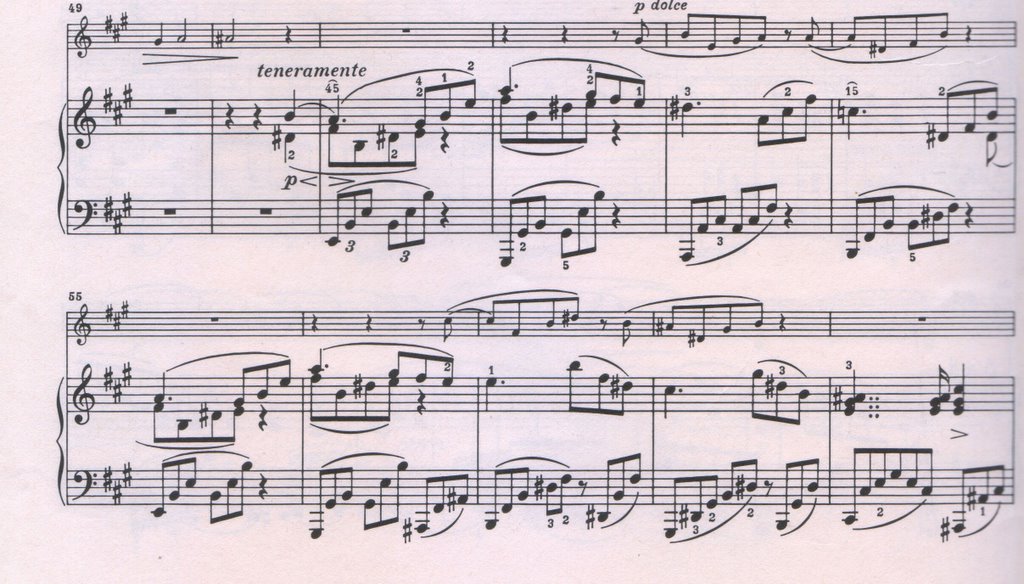
A lot of the musical climaxes I feel squeamish about are about "pouring over," about excessive enjoyment; they "cling." Sometimes they outlive their moments, they outstay their welcomes. And they are focused to a point, like a lens: a few measures of unbelievable volume or intensity, against which all other points in the piece can be measured. But there are other kinds of climaxes, more like Sebald's goose. I am thinking right now of the Schubert Sonata, Op. 143 (which I warily remind myself I must play in Washington in April, alongside Winterreise): the exposition of the first movement. This piece begins in a very serious, overtly tragic "A minor mood," almost too much so, like someone who makes a show of his sadness, (like Austerlitz), in fragmented, lamenting phrases strangely suggestive of Russian Volga boat songs. These tragic fragments seem to not quite know what to do with themselves (like Austerlitz), they keep ending up in this rather unremarkable tag:


Can this tag become a climax? It tries to hoist itself up, but fails; there is a great deal of ominous, boiling rhetoric; tremolos, slippages, a loud explosion; then two soft chords, and then ... then the unbelievable happens:


Unbelievable because Schubert caused us not to believe in E major until this moment. The piece, to this point, has resided convincingly in a certain sound-world, an emotional province; though we may not have noticed, its boundaries have rigorously excluded certain kinds of voicings, nuances (certain very "technical" musical things); have excluded a lot. And when this new theme (why do we need to call it this annoying name "2nd Theme"?) appears, with its close, tender harmonizations, its suggestion of a men's chorus, or a slow dance, or a folk tune--so many possible associations come to mind--the exclusion is lifted; and in this absence the emptiness of the previous music becomes evident, and a space is opened for something else to rush in. After the first sense of disbelief (I am always amazed by this theme), I definitely feel that rushing, the theme's web of associations, symbols from afar, an awakening. (Austerlitz's musical sense is suddenly awakened by the mysterious Eastern music of the circus troupe.) Though there are no sweeping gestures, though it is uttered quietly, inwardly, pianissimo, though not in any way traditionally climactic, this passage is a climax. It does not pour over, exude, or demonstrate; instead it draws energy into itself, retracts, concentrates.

This melody is crafted around a single note, E--the inescapable note, the immovable object. Notice the intensities Schubert can weave around this pedal, this pivot; about what he can do despite--or because of--the limitation of that singularity. (Climax as singularity, as concentration into a point.) Everything is E, we are tied to that note, all of our energies must be drawn within that circle of attention; I feel that theme, with its "limitation," as a bubble, as an enclosed space, a created paradise which Schubert, like Sebald, will destroy.

What does Sebald's goose symbolize? It knows, he says, the fates of all the people around it; these fates are probably death, dispersion, erasure; replacement by a soulless monumental library. And yet the goose looks and listens, "motionless and steadfast," its neck craning in concentration; it is a symbol not necessarily of what-is-known but perhaps just the knowing, the perceiving, itself. If the listening goose is just about the vanishing, then why tell its story at all? Why would Sebald choose as a symbol of the music (itself a symbol, and on and on in an endless chain) something which emits no sound whatsoever? I am reminded of the wonderful Ives quote "My God! What does sound have to do with Music"? Which is ridiculous but true. And also I'd add: what does volume have to do with climax? or climax with plot? or emotional closure with knowledge? All of these can be uncoupled, recoupled, rethought. Let me mail this to Oprah. I will mail her, and the Harry Potter people, that scene in Pnin where Nabokov manages a climax with one elderly man washing his dishes, alone.

In the first part of the exposition, Schubert's tragic muse keeps exploring the relationship between the tonic and the subdominant ... a common neighbor motion, become a plagal obsession. (This is part of what makes it sound vaguely "Russian.") And lo and behold, the second theme, at its outset, presents us with the same motion: I-IV, transformed. There is nothing to this. There is so little composition, so little sense of craft: just the sudden existence of this same neighbor motion, in the major key. (But so beautiful!) So that I have the feeling that Schubert has not created this moment, but has evoked it, simply by listening, by paying attention: by "knowing the fates of the participants." I-IV is capable of tragic fates, yes, but what about ... He stares out at us, neck craning, concentrating, hearing the harmonies of the music around him, hearing the new major key take shape; at that moment he seems not to compose, not to demonstrate or perform, but instead to listen, remember, perceive.

Tuesday, November 22, 2005

Thunder, and Practice?

Thunder rolls through Manhattan, rain spatters, and only Ignaz's waltzing, promptly at 9:30 AM, stood between me and sleeping until noon. Outside, the honkers honk, displeased I am sure by weather and traffic and having woken up early to deliver goods and services; a snarled mess of roughly parallel-facing cars sits at the east end of my little corner of 91st St., and from this human and vehicular knot a recurring musical sequence emerges: long honk, followed by a series of screams. A Morse code meaning frustration. I shut my window to this aggressive music; it makes my coffee taste funny.

On my piano, behind me, sit three volumes: one is Book I of the WTC, the other the complete Beethoven sonatas. In months coming (April, and February respectively) I have to do my duty to those volumes and admittedly I feel a heavier-than-usual responsibility towards them. And with thunder and rain making the joyful streets of Manhattan a battlefield of frowns, puddles, and umbrella domes, what better time than now, in my own dry apartment? Certainly this is not the time to prance through Soho streets, admiring the beautiful people in the Apple store, lusting after $175 sneakers in Camper; it is no time to lay on the lawn of the Park, except encased in plastic; enthusiasm seems lacking as I consult my inner self for museum attendance; it seems even inadvisable to walk one block to the grocery store--there are three corners at least between here and there and at each may lurk a grayish puddle of uncertain depth through which an angry taxi may crazily swerve, sending forth fountains of sooty spray. So it appears to me from the eighth floor: a dangerous world.

But I have to admit those Beethoven Sonatas seem a bit dangerous today too, with metaphysical puddles and soot which will have to be wandered through before any "happiness" can be attained. For sure, I will run through them the first time and they will sound really good to my new ear and then will begin that magnificent erosion of self-delusion where the true difficulties of playing the piece well (for me, now, at this moment--is there any other time?) will appear, icebergs in my ocean of practicing. This fear and anticipation of the larger, difficult process plays against the desires of the moment, the lamplit pleasures of a few chords in E-flat major in my apt with a cup of coffee on the shelf in its usual place, which admittedly seem like insane, effete, aesthete, capitalist-luxurious pleasures compared to the people below trying to drive their trucks full of fish, bagels, and pipes between double-parked cars. This is my work?

All of which boils down to the same childhood classic moment. Your mother from the next room: "Jeremy, time to practice!" (in various tones, from reasonable to shrill). Your response (always whiny, unjustly interrupted, a young man with things TO DO): "Aww, mom, just a little more TV?" With the years, I have fortunately cultivated an inner mother to remind me to practice, but perhaps I have also unfortunately cultivated an inner TV, or an inner child, or an inner whine: I cannot decide which.

Wednesday, November 16, 2005

Business

I'm delighted to report not only did this blog appear in the Wall Street Journal, but has been selected at Top Ten Sources as one of top ten sources for classical music. Thanks to both. And while we're tooting our own horns (thereby causing horns of a different sort to sprout from the top of our heads), anyone in the New York area is cordially invited to Friday night's concert at Miller Theatre (Columbia campus), where I will be playing the Berg Chamber Concerto with the amazing Mark Steinberg and Reinbert deLeeuw is conducting a tremendous band of wind and brass players.

Enough of all that. Jeez.

Such is my influence in the classical music world, now: regular reader R J Keefe is apparently dreaming up pretentious things to say to his wife at the Dec. 3rd Carnegie concert, so that I can overhear them and write about them disparagingly! I advise all attenders to keep their ears perked, and not solely to the performance. An update: he was not the person I overheard, so I issued an unnecessary apology for offending someone else; but I stand by my weaselly retraction. So there.

The question remains: do I have something to say of substance in this post? Or am I just wasting pixels? Well, yesterday I came out of the gym at around 9 PM, having turned the Stairmaster up to an unprecedented level 12, and my brain was awash with nearly hallucinogenic inspirations. I had this vision of myself beginning Op. 111 Beethoven (the thousands? of times I have begun it), and all the different mental states and types of attention I have brought to it. It was an image hard to hold in the hand, with immense variety of scale: sometimes just a flea, trying to mentally get myself squeezed in the space between the fingertip and the key, trying to calibrate those micro-motions, and sometimes telescoping out, not just to the whole piece, not just all of Beethoven, but trying to take in all of Western music--since Op. 111 kind of stands out as a landmark in it somewhere, perhaps on the edge of a cliff.

As I was walking home I was thrilled by the idea of somehow capturing in writing, seizing with the pen, my sense, all at once, of this "total 111 experience." No, I don't think any one, even unbelievable, performance, can capture this total experience... an individual performance is not a sufficient place for all your past learnings to take shelter. Each performance is partial, part of a larger text, which you write within yourself, which you gradually compose. If only you could pour out that larger text onto an audience, how wowed they would be! But they are busy composing their own texts.

So this all-at-once vision is impossible. But when I reach into my brain to find it, this impossible entity, I come back with things. What I saw mainly when I was trying to find my total 111 was much closer to forgetting, closer to a series of false starts, than to any integral, faithful memory. The piece for me, more and more, is a million (now a million plus one) fragments, and each performance is like a desperate attempt to reassemble. I know too much; luckily the piece seems partly to be about knowing too much. (Beethoven has seen so many sonata-allegro movements, so why not dispense with some formalities? Condense matters? But perhaps we miss them?) When I reach in, I get a strong vision, for example, of practicing it in my friend Evelyne's living room in Bloomington, while she was working in the next room, and what I remember was enjoying the very grain of C major, how beautiful it was, in the live acoustic of that wood-filled room, and how I wanted to prolong and understand simply the consonances, the thirds and sixths, and partly to eliminate anything that intruded on the C major, on the sensual satisfaction of it. But the piece is full of things that must intrude on this sensual satisfaction... therefore my love for it at that moment was in part a reduction, a disservice. But Evelyne came in and we were talking about how beautiful it was, and it was a sincere moment of communication about music (reasonably rare) in which both of us seemed to understand the terms on which our tentative statements were based. And then there is the moment where I played it at a noontime concert in Spoleto, Italy, after a jetlagged night of absolutely no sleep, and all I remember is a really wild jazzy variation in the second movement, a sense of total technical command and lack of fear for that moment.

All day long we dredge into our brains to solve some impossible problem ... we ask it "What is my total experience of 111?" or "What do I want to do with my life?" etc. etc. and somehow the brain is not a computer that freezes up or crashes in the face of impossible demands but bravely offers SOMETHING, anything, temporarily even, to make its owner (?) happy. And I find it fascinating to see what my brain offers me about that piece right now: what comes up from the murk and says hello, why is it important to me, what do I take for granted and what is missing. This little collection of memories, fragments of intense moments I shared with the piece (including a night when I practiced the opening trill the "wrong way," a night when I was cramming the piece for a concert that was too soon, an exhausting evening in Bloomington after a long day playing it in Indiana Univ., etc.), these come up, and I extract from each some insight about the piece, something to add, something once ventured and never found again.

Not to belabor the point, but I feel like Beethoven's compositional life must have been, at some point, like that. Asking his own brain an impossible musical question. Reaching into the murk (the world of compositional possibility) for one thing, one idea, change, something your brain offers you to do different; then so many consequences following on these little revolutions. Which is partly why we think of the searching, heaven-storming Beethoven, the questioner; which is not just the questioner of musical "tradition," but the questioner of musical language, of expression itself, of how to attach ourselves onto some end of the impossible infinity of the questions we ask ourselves.

Monday, November 14, 2005

Nothing

The Berg Chamber Concerto ends with four notes, F-G-A-B... I should say, it doesn't end with those notes, but with their reverberation: a fading memory of those notes, what they used to sound like. The final scattered, scattering, disintegrating events of this piece are in fact directed by the composer to be timed to the pace of that fade; they need to be attuned to that slow vanishing. A series of quick running gestures throw themselves away into that persisting chord; against the very, very slow process of the sounds diminishing in the piano, we hear these ephemeral, ever shorter, fragments; a weird, disturbing disjunction of quick and slow; the slow gesture is, as always, more "powerful;" and so the last fragment "conforms," does not fight the piano's stubborn but softening pitches; the violin simply plays the same F-G-A-B, quickly, which we then barely still hear, as if an echo or shadow, in the piano (are we sure we still hear it? do we imagine it?) ... an odd gesture, full of uncertainty of perception, for the final moments of a piece.

Those notes, as far as I can tell (and I do anticipate/dread corrective acidic commentary from theorists galore) first truly come to our attention at the beginning of the slow movement. Though I don't play the slow movement I look at it with longing. I have played through its opening bars hundreds of times just for the pleasure; a mixed, intense pleasure; suffice it to say I often feel the need for a cold shower or cigarette afterwards. It is that good. Yet again Berg proves that the moment when the pianist stops playing is the best. I do not relish being replaced by such beauty.

Again, back to those notes, in proper order G-F-A-B. They emerge, cleverly, as if having been played for some time, out of the chaotic, accelerating waltz of the end of the first movement. There can be "no solution" to the circling and re-circling wildness of the first movement, no solution in that direction anyway; only the violin, entering from a totally different direction, can answer it, can make any progress. The switch of instruments is a metaphor for a different world, a voice "from the wilderness."

To be technical (bear with me), the four notes the violin plays are separated by whole steps. Then it plays an ascending, sensual gesture of all the remaining eight pitches (only those damned 12 pitches in all of our Western music); a gesture which means anything which is NOT G-F-A-B; then it returns to the "motto" G-F-A-B. It keeps returning to these four, a broken record; this returning is its meaning; it is an answer, a refrain, a cipher. Its "whole-step-ness" (another made-up word which I stand by) is essential, and not just as a technical name, of course, but as a sign. Debussy is of course famous for tearing down the Western tonal structures of meaning with the simple whole-tone scale. Instead of directed dissonances and half-steps, instead of asymmetry and territory, there is the evenly spaced, "unbiased" world of notes all equidistant. It is as if he wanted to wipe the slate clean, to start fresh with sound. How else can you counteract the powerful German narratives, the tonal imperative? In this very German work of Berg, dissonances of course abound; it is a massive architecture of leaning and resolving half-steps; but these four notes G-F-A-B, without half-steps, represent therefore something separate, something uncontaminated by dissonance, resolution, direction. Which it is why it is so powerfully affecting that the violin keeps coming back to them, keeps seeking out the whole-steps, that "blank" sound. That is it for me, the sign: these notes, and I am influenced for sure in this by the fact of their being all "white keys" on the piano keyboard, are a blank, an absence. The piece keeps wanting to retreat, to come away from itself and its contrapuntal, functional madness, to find shelter in this nothing. And so, when you hear these same notes, persisting at the end, as a recurring answer to the little fragments, it is like an existential non-answer to all the piece's questions, all the more powerful for the fact that the pianist need not replay the notes but simply let them resound, with the pedal (the piano stands by its earlier statement, nothing, no matter what you have to say about it). I don't know whether to take comfort or not...

I'm reminded of these lines of Montale (trans. Jeremy Reed):

Then obliterate if you wish
the errors of a life,
as a sponge erases
the chalk marks on a blackboard.
I need to re-enter your circle,
find help in my fragmentation.

Sunday, November 13, 2005

Mary Quite Contrary

I eased the seat back a few degrees, gazed fondly at the crumbs of my now-departed muffin, sipped at my piping coffee-of-the-day, and savored the accelerating embrace of the train as it sailed up the west side of Manhattan, up the Hudson. Soon I would be in Bard, fulfilling my duties to some aspiring pianists. Meanwhile, as in life: enjoy the ride. To that end, I picked up my book, which I had chosen in a time-honored manner, rooting around the crowded shelf while putting on socks, shoes, looking frantically around the apartment for keys, etc.: an impulse read. And in the book, a college president was lecturing a prospective faculty member:

... we don't punch a time-clock here, Miss Rejnuev, but we must ask you, in all conscience, not to emulate Bard and Sarah Lawrence and treat us as if you were a commuter...


I swear, I looked around the train guiltily. (Perhaps for some perching ghost of Mary McCarthy? for some accusatory fellow passenger?) I, commuter I, had been BUSTED by my own book. At least, I mused, some things never changed (the book written in 1951). How had it known, how had it schemed to be picked off the shelf?

But never mind, I managed to forget this eerie coincidence with the following hilarious passage about a French professor taking his students abroad:

As he sat sipping his vermouth and introducing himself to tourists at the Flore or the Deux Magots, the boys and girls under his guidance were being robbed, eloping to Italy, losing their passports, slipping off to Monte Carlo, seeking out an abortionist, deciding to turn queer, cabling the decision to their parents, while he took out his watch and wondered why they were late in meeting him for the expedition to Saint-Germain-en-Laye. Returning home, usually minus one student at the very least, he always deprecated what had happened, remarking that there had been "a little mix-up" or that the Metro was confusing to foreigners.


All of Mary's wry, caustic appraisal of academic politics, her magnum opus of the faculty meeting, her "Tenure Lost", did not however spoil for me the scene on arrival in Bard, which seemed a sincere, ideal "quiet Saturday." The students seemed quelled, pacified, content with their hangovers; I spied a girl in torn jeans on sunlit dorm steps with a notebook open, a pen, a serious grappling look on her face... ignoring the alluring sunny outspread November early afternoon ... I walked to the music building through breezes, empty campus roads, students scattered widely, dispersed, their voices from afar, laughing. I felt so jealous of the girl with her empty notebook, though I often stare at empty notebooks myself. I wondered what she would write.

On the train ride home I was forced to watch the sun of that afternoon set, to experience piece by piece, in dimming red-orange light, the close-parenthesis of the day. In the train you cannot evade the light and the ending of that day was sad; it had been so beautiful, so opportune.

In Berg's Chamber Concerto, towards the end of the final, very complicated movement, a rondo, Berg prunes away the complexity for a few clear glimpses of the preceding slow movement. It is a hackneyed maneuver--the "reminiscence"--and easily (in some works of Liszt, say) falls into bathos. Perhaps it is a question of how the reminiscence is approached, how it is "justified." In this case they are not surging re-arrivals but something like removals (like dimming light). Every time I hear these moments, or play over their chords at my beautifully rebuilt piano (which seems particularly to "take to" the harmonies of this sunset piece), I get a fresh ache. Did Berg mean for the rest of the movement to sound, at that moment, like insane modern chatter, like the "wrong answer"? (The piece refutes itself). I thought to myself, while hearing this moment on my stereo: yes, the modern world IS numbing. I had no idea how numbing, until now. Relief and overwhelming sadness simultaneously, a wonderfully Viennese, heartbreaking contradiction ... a piece definitely for the evening, not for perusal over a muffin in the morning, a piece for when you are slinking down the Hudson in the last reddish moments of a beautiful day and about to emerge into fluorescent light, into the crowded, anonymous no-man's-land of Penn Station. Forgive me my metaphors.

Thursday, November 10, 2005

Berg Reception

I should probably create a whole separate blog to catalog reactions to my practicing of Berg's Chamber Concerto. The elderly lady living down the hall from me, though often friendly, merely scowls these days when we meet by the elevator; she sullenly awaits more euphonious days. I am offending her, personally. But another young fellow's mixed reaction was quite enjoyable. I closed and locked my door, and found him standing there, and he said "you're the guy playing the piano all the time right?"

There was no denying it. I was caught red-handed. Only seconds ago I was retrograde-inversioning away (quit your quibbling, it's close enough to a real word). I nodded.

It's funny how some people feel the need to reassure you, without knowing you, that you are actually capable at your craft. As a musician, I suppose, you are by definition "handicapped," provisional. He said, channeling Ward Cleaver, "You know it's pretty good. Good work." (Pregnant pause) "There's some pretty strange stuff you're playing though, pretty disjointed..."

I beamed at him. "Yes, isn't it wild?"

He slowly asked, "Ummm. What is it?"

My best, enthusiastic, used-car-salesman smile: "It's Alban Berg." (No recognition) "One of those German Expressionists." (Vague glimmer)

My enthusiasm caught him by surprise. He assumed (perhaps?) I was playing it out of obligation. My smile, the sense of delight in Berg I was trying to communicate to him, changed the expression on his face, from assurance to concern; he suddenly looked like the court psychiatrist in Law & Order assessing the competence of a mass murderer. Our downward elevator ride thus passed in uneasy silence, with several sidelong glances. To exacerbate the situation, I started humming one of the piece's many disturbed waltz-tunes (I find myself wondering: can other dances be doomed? Or only waltzes?). I smiled at him again, especially wide, as he exited the elevator and (is this my imagination?) ran for the exit: 91st Street, escape.

And today, in Logan, Utah, I was practicing wildly in a very nice member of the faculty's studio (and I had just finished proudly scrawling "Arnold Schoenberg" over a particular phrase); but his students were gathering outside for their impending studio class. At some point, they decided enough was enough, and a firm knock was heard. And in flounced perhaps seven girls, mostly blonde, smiling, and apologetic to interrupt me, but they had to have studio class. "It sounds good, though," one said, as if I might think they were giving me the hook. They looked at me sympathetically. I smiled again, a complicated smile this time, and packed my things. The same one piped up, "that thing you were practicing, that's really ... interesting." The others nodded, oddly. "What is it?" I rattled it off, "The Berg Chamber Concerto, for Piano Violin and Winds." As so often happens, they were bored with the answer, perhaps a bit annoyed by its exactitude. I'm not sure what I should have said instead, how I should have played it. As it was, they looked confused, their eyes variously averted around the small studio, and I made my exit... No no I wanted to tell them, this is one amazing piece. But the door shut behind me and I had to walk back in the Utah sunshine singing doomed dances to myself.

Monday, November 07, 2005

Another

With two glasses of Chardonnay and an unknown but considerable quantity of Rigatoni Bolognese under my belt, I made the lazy choice and allowed a cab to carry me home. In a novel, perhaps, this scene would be omitted: "I grabbed a cab home, and it was only when I opened the door to my apartment that I realized ... " (whatever). But in my life, at once more real and surreal than any novel, this scene was the most vivid of the day. I realized it was part of a trend: the northward trips up 10th Ave. (subsequently Amsterdam) have been getting more charged over the years I have been living in this apartment; they are not habitual commutes; they are not worn with time; they are getting newer with age. These moments--when I am meditating on whoever I just met for a dinner, drink, concert, or movie, on the events of the day--well let me say my meditations are not local, but express... they range particularly wildly as we (me and the cabbie) hurtle uptown.

It is always the same street, the same stores. A city built in an impersonal grid, a series of numbers, with retail locations that shift and vanish, would seem to perversely discourage affection and attachment. But there is just enough persistence. For example: one night five or six years ago, I learned that my wonderful teacher Gyorgy Sebok had died, after a sudden illness. I was (obviously) very upset, and I sat in this very apartment playing some of his old recordings; my then-significant-other came by, and I was telling her what had happened, when the music came to the second theme of the A Major Brahms Violin Sonata (with Grumiaux):


I shudder at the prospect of "characterizing" his playing, which was always semi-miraculous to me, impossible, superhuman; he also cultivated this otherness, a kind of mystical distance. Of course this comes to you through the lens of a student's awe (still a student when I think of him). But many other, even skeptical, students also felt this same awe, for example, when he played the opening chords of the Franck Sonata; he could draw on irreproducible colors; make even this (!) common piece sound like a spiritual quest. But against this otherness, and against his search for beauties in the simplest melodies, his playing posed a tremendous restraint; he was always careful not to do "too much," according to stylistic antennae he kept well-honed; I don't want to say "classical" and yet a certain proportion was always important to him; he had an allergy to excess.

And so this theme of Brahms sprang upon me like a trap. It is the place in the rather traditional, classical movement... coming after some rather "stodgy" (forgive me, Johannes) transitional material, where Brahms chooses to soar, or release; the theme sits at the edge of sentimentality; it is just Romantic enough. It is so beautiful, but, because Brahms must, he preserves almost against its beauty some compositional craft: the hemiola of the melody against the prevailing 3/4; the dialogue with the little countermotive; the carefully plotted bassline; the rests in the left hand in each measure, preventing the triplets from total motion, keeping the melody to some extent in fragments: not utterly letting go. It seemed, in a way, as must be clear, almost a musical portrait of Mr. Sebok, and the way he was playing it, to my bereaved ear, was like a man looking in a musical mirror. It was pure, you heard all the intervals, all the bass notes, precise but tender; and I saw him again in his little studio, with portraits of Bartok and Liszt, looking at me with disappointment, lifting my left arm to find its independence, trying to pry my single-track student's ear open.

Brahms lets go, this time he lets the triplets continue, and the tender phrase surge:


The recording continued: my teacher didn't hold back, he surged as Brahms did, not superhuman at all but now really really human, and (wonderfully) rushed, and with his tremendous control, with a left hand of granite, played a shattering climactic note. And that was it for me, exactly, precisely that note (possibly the saddest note in this joyful piece); I broke down just then, mid-explanation, and the CD player was turned off and my T-S-O sat with me for a long time, until I was relatively quiet, and eventually she wanted me to eat something, and we agreed to go to Popover's Cafe, several blocks down from me on Amsterdam. And for a couple of hours I ate a steak and stared across the table at her and talked slowly. And I have not been back to Popover's since.

But, every time I come up Amsterdam in a taxi, it is there, on the home stretch to home. Sometimes it is late enough; the place is dark. But sometimes of course it is still open, well-lit, and I can see some other couple sitting at that table talking about whatever.

This is just the most intense of my Amsterdam landmarks. There are so many more, places where I forgot, met, said goodbye to... reminders, warnings, any number of verbs and moments; there is the restaurant owned by the weird guy's mother; the bar where I read Proust; the place you met the person you never see anymore; etc. etc. and the tornado set up by these associations is getting stronger by the year, so that I spend the entire bumpy ride in an emotional state, buffeted, overwrought. Also, my building is going condo. Perhaps the confluence of these two signs: time to move? I could cab back home down unfamiliar streets; I could impose my memories on other, unsuspecting, restaurants.

Saturday, November 05, 2005

Positivity

Friend and faithful reader D. suggests I make my blog more controversial, more "opinionated." But friend and faithful reader T. praises its persistent "positive attitude." Between these two devils, perched on opposite shoulders, I often know not what to choose. My blog head goes agog.

Yesterday, I followed Alex Ross' link to Greg Sandow's book-in-progress. I felt the hair on the back of my neck begin to rise, as I poured boiling water over coarsely ground Arabian Mocha Sanani. It is (sigh, another) book on "what ails classical music," and I admit it, I can't help being defensive when the diseases of my career are enumerated. I am the patient on the table; I am not totally anaesthetized; but the doctors are speaking as if I can't hear anything. Don't disturb the pianist; he's practicing. But what is he practicing for? The market vanishes; the audience declines; I am a delusional psychotic, living in a make-believe world.

I wrote down some very argumentative comments but I slept on them and they don't seem valid in today's foggier light. Yesterday my demons were active (my inner D.) and I said enormously rude things to people in rehearsal, so I knew well enough not to blog. (Instead I practiced Berg's Chamber Concerto and watched South Park, both excellent outlets for rudeness). For example, I second all complaints about the lack of rhythmic freedom in modern classical performance... Greg Sandow and I agree about this, and how important it is to restore it... and yet somehow I wanted to find a dispute?

I would like to address one important point, however, at the intersection of language and substance. Mr. Sandow expresses a desire to write about the culture "outside" of classical music (already, you see? the power of language? we are "insiders," a clique, an elite), and so he contemplates the Cuban singer Beny Moré. According to Mr. Sandow, Beny Moré "[paces] the song any way he wants to, [takes] us with him, no questions asked, anywhere he goes." He "grabs the music."

Moré is a rhetorical device here, a foil: what classical music is NOT. Let us admittedly go further than Mr. Sandow would, and pursue the connotations of these seemingly innocent, descriptive sentences. Classical music is not grabbed, or grabbing; its performance is passive, not active (simply reproductive). Classical music is not about "want;" it is foreordained, fated, not-free; it is not "any way" but obsessed with correctness, legality. There are things classical music "can't do," Mr. Sandow points out, omitting the things that Moré's singing cannot do (suggesting nothing is beyond his freedoms); the can't is subtly but completely appropriated to classical music's side (how we "wish" classical music could be more like X, over there in the greener grass).

The narrative these connotations create is familiar. These statements seem so obvious, so engrained, so common-sense, so unarguably true, that their essential emptiness can be forgotten. This sounds harsh; I apologize. But how do I mean emptiness? These are clichés that promise more than anyone can deliver. Beny Moré does not "pace the song any way he wants to," he paces in very specific rubato-laden ways: he chooses, like the rest of us. (The question is does he choose beautifully or not? Do we wish to emulate his choices?) According to Sandow, we listeners will follow him "anywhere he goes;" he calls up metaphors of unlimited freedom; but there is no such thing; his freedoms are specific (or else they are nothing), like ours; he must make choices which omit other possibilities. Every performance is a set of choices, and therefore also a set of omissions. (There is no "absolute freedom" in performance). Mr. Sandow's use of language posits Mr. Moré, in a sense, Romantically, before choice, before the notes are placed on the page, before the tape is rolled, before a note is struck... in the hush before the concert, in this charmed preliminary state. It's not a fair fight; it is semiologically rigged.

I detect similar dangers in this ensuing passage:

For classical musicians, to sing or play like this would be illegal. You have to learn the proper style for everything you play—Bach goes like this, Mozart goes like that. And then you work within that style. But for Beny Moré (or for any pop or jazz musician, especially the great ones), style is anything he wants to do. He makes his own style.


Again, a metaphor substituting in for Moré's style, an alluring mirage: "anything he wants to do." Bach and Mozart function in this paragraph not as homo sapiens but as brand names, like Xerox or Kleenex; I am not suggesting remotely that Mr. Sandow wants it to be that way, simply that certain kinds of sentences have that power. The idea that they created their own styles (no, really, they lived and breathed and chose!) is missing, because it would blur the prevailing dichotomy. Again, following connotations but going further than Mr. Sandow's intent: Bach and Mozart are pools from which we draw rules, prisons in which we classical musicians lock ourselves, icons of obligation. Ahh, the damning words "proper style"! We are stuck with prefabricated styles while those great pop and jazz musicians can make their own. As if there weren't an infinite number of styles of playing Bach or Mozart... as if jazz musicians are not in some ways burdened by choice. (Here the patient miraculously gets up off the table and starts arguing with the doctors.)

I would also like to quibble with one statement:
From descriptions of long-ago performances, we can learn that classical pianists used to let the melodies they played with their right hands float apart from the accompanying rhythms that their left hands shaped.

I invite Mr. Sandow to my apt. any morning at roughly 8 AM when my CD alarm clock goes off, and Ignaz Friedman's left and right hands happily and messily diverge. We do not need "descriptions;" numerous recorded examples of an older rubato tradition exist, and are ignored, why? An interesting cultural question, of evolving or devolving classical music taste, perhaps one in which reviewers are not entirely blameless? No, no, I didn't say that. That was the Jeremy of yesterday.

The Jeremy of yesterday, a devil yearning for sainthood, found an antidote to several hours of Berg in a 30-minute battle with the Stairmaster and some truly evil animation. The orgy of abuse to which the South Park folks subject poor Sally Struthers is appalling. Two men have a stilted conversation in front of a door, complaining about "rude shows which make fun of people for being fat," how "cruel and unfair" that is, which all makes it very clear that the cruellest, most unfair, wrongest mockery yet is lying on the other side of that door: and indeed, jackpot! we behold Sally Struthers now transformed... into Jabba the Hut, speaking in tongues, with subtitles (hilarious subtitles!), crumbs falling out of her twisted monstrous mouth. It was wicked; I laughed incredibly hard while my good side looked on despairingly; I turned off the TV and fell instantly into a long, peaceful sleep (the sleep of the damned), only to be awakened by rubato, by a pianist doing "anything he wanted to do."

Tuesday, November 01, 2005

Reading Updates

Recall my earlier paean to Bellow? Well I must admit to a personal failure: I lost steam three quarters of the way through Humboldt's Gift, and it is lying neglected on my dresser. So, too, Stephen Greenblatt's biography of Shakespeare (someday?): adrift and crinkled in the bathroom. However, I raced right through Cesare Pavese's The Moon and the Bonfires (which now bakes on my radiator) perhaps because it is just short enough to be consumed in a couple train rides... I picked it up partly on the advice of the late Susan Sontag, who called him "essential," and--may I address her across the great divide?--thanks but no thanks Susan, he's not so essential for me. Summarizing:

In Italy, in the old days, we had the seasons, and everyone was poor and miserable. This, however, was all good, and I was happy. And since then things are even worse. In America, where I made my miserable money, there are no seasons, or roles, or festivals, nothing nifty. So I'm back home in Italy, where there are seasons. Many people have killed each other, and life is a horrible cycle of decay and death but I like it that way. See: death. Also: unhappiness, insanity, poverty, desperation. Did I mention about the seasons?


I feel sure irate Pavese fans will now be writing me in droves. Susan Sontag will rain destruction from above (or below). Surely they cannot dispute my essential point: the novel's a downer; the introduction by Mark Rudman concedes that in this novel, "the only absolute is sadness." Forgive me my impatience. If you, dear reader, are a consumer of the glum, then step right up; you may buy it here in bulk; it is a virtual Sam's Club of depression. Personally, I prefer my glumness mitigated.

For example, a very sad story: a painter who has a car crash and loses his ability to see colors. Oliver Sacks manages to concentrate the desperation of this loss in just a couple devastating sentences:

He would glare at an orange in a state of rage, trying to force it to resume its true color. He would sit for hours before his dark grey lawn, trying to see it, to remember it, as green.

Well done, Oliver: I get it. But as was the case in Awakenings, Sacks transforms the loss; he does not obsessively paint on added colors of misery, but finds a release in the patient's release, in the creation of alternative perceptions and frames of understanding:

At once forgetting and turning away from color ... Mr. I, in the second year after his injury, found that he saw best in subdued light or twilight, and not in the full glare of day... He started becoming a "night person," in his own words, and took to exploring other cities, other places, but only at night. He would drive, at random, to Boston or Baltimore, or to small towns and villages, arriving at dusk, and then wandering about the streets for half the night, occasionally talking to a fellow walker, occasionally going into little diners: "Everything in diners is different at night, at least if it has windows. The darkness comes into the place, and no amount of light can change it."


Yes, it is still quite sad; but I find myself shivering each time I read it, a shiver which includes pleasure. Am I, exploiter I, taking pleasure in Mr. I's tragedy? As I read it, though, it is a mixed bag: he is not passively shutting himself in, but heading out on his own terms to reencounter the world, to redefine it for himself, in his rare sad condition. He is not the barefoot-in-snow sufferer of the end of Winterreise; no nihilist. I adore this image of him wandering off to explore at night (when everyone "normal" is in bed, shut in), a tourist of shadows, exploring paradoxically when there is "nothing to see," and then randomly striking up conversations... looking for contact, finding comfort in diners, which I ordinarily think of as being lit with a horrible fluorescent glow--but no, he's right, the darkness of night is part of the lighting of a diner, is part of its wan appeal: to feel the surrounding darkness as the comfort of a lit room.

To discover your own places, the methods and moments for your own perceptions and pleasures, is so much better than to stare at an orange in a rage, wishing it were orange. Take that, Cesare Pavese.

Monday, October 31, 2005

Chief

It is hard to choose a chief sin of the modern Hollywood film; there are so many, the seven deadlies hardly suffice. But for me, one reigns: forgettability. How many times I have walked or subwayed down to Loews Lincoln Center only to return, two and half hours later, with only a vague sense of what intervened... The look and feel of the "down" escalator, the click of the double exit doors onto 67th (?) Street, the sense of emerging late onto a barren sidewalk (the accompanying sense that I have been "digested" by the movie theatre, processed in and processed out), the glare from the Food Emporium across the street, always meeting me there, somehow, with a reminder of stale, unwanted groceries: these sensory, homely, homemade data, repeated over years, are more vivid and lasting than almost any of the lavishly constructed images I came and paid money to see. If the reasoning is escapist, as it often is for me--why not see a movie and forget about everything for a bit?--the bargain is Faustian. It seduces you to forget life for two hours, but conceals its condition: that those two hours are lost, that you forget them too.

I saw three excellent films in the last few weeks, two of which are still, sadly, forgettable. Capote, for instance, a movie I would not dare to impugn, except, except... honestly, what did I take from it? I realized its most vivid moment for me came when Truman was reading excerpts from his book: not the scene, nothing of its filmic content, actually the prose itself, what he was reading! It was so far, in artistic quality, above any part of the film that it constituted an (unintentional, obviously) shattering indictment of film-as-art. Truman reads about the heads of the Clutter corpses concealed in cotton; we have seen this image--literally, enacted--in the film, but our glimpse of it onscreen is child's play compared to its prose rendition, chilling and magnificent. And I went also to see Good Luck, and Good Night, or however it's titled... I can't even remember the title. What I took from that viewing (again being savagely honest with myself) was mainly the opening scene, where the camera passes over faces in black-and-white, at a glamorous party, smoking and chatting, smiling in complicated ways, faces that are slightly worn, made up bravely beyond our present-day standards: a whole ethos of appearance heartbreakingly different from our own, the acceptance of wrinkles and edges and severities and strains, and all of them observed by the strangely modern camera, while wonderful Jazz Era music plays... Ahh, I thought, settling into my seat, sipping my 7-Up, this is great, but at no further point in the ensuing short film was I so satisfied. If the film had been about the substance of all of those bit characters' personal lives, about whatever they were discussing while the camera panned over them, I would have probably died of pleasure; instead it was about journalistic integrity. The transposition of Truman Capote from bleak snowswept Kansas to bleak rainswept Manhattan seemed a stage shift, not a life-shift (ah yes the noble trains criss-crossing wide, savage America), and both of these locations, even, seemed blessedly real compared to the Spanish villa where Truman and his lover get away, and eat perfectly set breakfasts against blue, cloudless Mediterranean backdrops; a drama played out in film terms, in "locations," in "scenes." So, too, the anxious newsmen fretting in the booths of CBS, the heroic frowns, the conjured banter of men with writers.

Both very good films. But in relation to the other very good film I saw in this period: fakes. Sadly--or perhaps not that sadly--this other film, Garcon Stupide, is very hard to see (playing in "alternative" venues according to an exceedingly limited schedule); and also I cannot recommend that squeamish viewers venture it, either; it is not a film for Grandma, unless she is terribly tolerant, and I'll leave it at that.

I needn't lie to myself to say it was good; I needn't force myself to remember anything; a clamorous group of images pops up in my brain, demanding attention, whenever I call the film to mind. For example, a scene where the main character goes up to the top of a mountain, to its pure overwhelmingly white snow: the film is washed out by the light, you feel that even your viewing experience is "threatened," seared away, and a surge of unexpected music merely confirms a tremendous release from the dark, indoor, night-filled, pasty, fluorescent, seedy scenes we suddenly realize we have been watching non-stop. And all he needs is that metaphor, that confluence, that departure; the filmmaker lets it go at that; there is no need to hammer in what the metaphor "means," it radiates all kinds of possible meanings in every direction; just as he merely needs to follow the glance of the 20-year-old, for a few seconds, around the little artifacts of his boyhood room to encapsulate all the traversed loss. But what is the boy feeling as he looks around? Thank God, there is no way of knowing. (Whereas in Good Night & Good Luck you always know that Murrow is stressing about the consequences of his aggressive journalism, about ideals, standards)... A conversation in the parking lot of a McDonalds; a drive-through order; cars passing through traffic circles at night; half-conversations in front of the numbing TV; Garcon Stupide is full of all kinds of authenticating, depressing realities; and yet I didn't find myself resentful at being dragged from my escape into life; I was grateful to be reminded of things I see every day: grateful to be reminded not to forget them.

Always be suspicious of people who tell you that something is "real," and something else is not. That I suppose includes me in this blogpost. I have my own agendas. I don't want to make a case for reality, however, so much as for memorability. I should add to the list of this movie's virtues that it rekindled in me an appreciation for certain aspects of Rachmaninoff (for that is what I have been told the music is)... perhaps I will finally buy that recording of Weissenberg playing Etudes-Tableaux. But Garcon Stupide has that rare asset: a director who seems to understand something about music. The concluding two minutes of the film seem musical, not by accident, but in essence. The onscreen events are reticent to declare themselves ("I am a happy ending" or "I am a sad ending," or even "I am an ending at all"?), and they take refuge therefore in the music (which cannot really declare itself either); the two enigmas are tied to each other, timed as a gradual release and disintegration, an unfolding of images and motives.

And instead of the usual spitting out down the escalator, out the corporate downward ladder, I found myself shaking, walking down the sidewalk in the Village, in no mood for bulls*** statements or any kind of interpretive crap. That means I really liked it. In this case a different bargain was made; I left with more time than I came in with; I had not sold my soul to the cinema, but instead it had sold mine back to me.

Friday, October 28, 2005

SWM, Seeking Fortune

I had just finished my tangerine peel chicken at the China Rose restaurant in Rhinecliff, New York, when three fortune cookies arrived, perched atop the check. I was waiting out a train delay. My dinner companions were accidental, or serendipitous; they have just now detrained at Poughkeepsie, and their continuing fates, other than the putative fortunes they received in Rhinecliff, will most likely be unknown to me forever.

But at that moment we were briefly together. I handed them their cookies, unwrapped mine, cracked it open, and read:

"The fortune you seek is in another cookie."

I laughed my most natural laugh, with only a dash of irony. Indeed: if only I knew in which cookie to look! How many cookies would I need to eat in order to find the fortune I seek? The question was intriguing... I loved the self-referential nature of the fortune, its void where meaning or guidance should be, its promise of an infinite, futile, sweet future. It was more a implied description of its recipient than a prediction of his future; it leaves open the possibility that my desires will always be in another cookie (my pessimistic reading), or may simply be found in some Nestle Tollhouse in February, some Petit Ecolier tomorrow.

Sometimes koans are too much for me, in their cutesy-pie profundity: just too elusive and silent to appeal to my gregarious Western mind. I like this one, though: a Mandarin fell in love with a courtesan, who told him "if you will sit outside my window for 100 days, I will then be yours." And the Mandarin placed a stool outside her window and sat for 99 days, whereupon he got up, picked up the stool again, and left. I feel this is related to the fortune I received in Rhinecliff somehow. And has wider resonances for my life these days.

My chamber group at the new Bard Conservatory just posed me a musical koan: "How do you rehearse?" I stared dumbfounded at the question. But they genuinely wanted to know. I suppose you may as well ask, "How do you speak English?" Do you have a little time? But, oddly, I had the attack of a desire to answer this question somehow ... and began talking, without any plan, and found myself interestingly circling around the topic of individual desire--rather than the more intuitive, obvious chamber music issues of listening, cooperation, sharing, interaction. It has seemed to me lately (and I think it is fair to say I play a fair amount of chamber music!) that sharpening or making more vivid what I bring to the table--purely in terms of my playing, on its own--is the most reliable way to improve a chamber music performance, and may be possibly thousands to millions of times more effective than any verbal comment I may make to my colleagues. In other words: look after your own house. I may have gotten this idea, or at least the clear expression of it, from Peter Wiley, who was (and surely still is) always asking his colleagues to play it how they want it, asking them to lead. And then, as you ineptly lead, you figure out you're actually the problem.

But as I was describing it to these coachees of mine, finding some way to verbalize my concept of an ideal rehearsal (when they probably just wanted something simpler, a flow-chart perhaps), it found its expression not so much in leadership but in the idea of communal imagination. As in, everybody imagines things about their parts, and brings these imagined concepts into the forum, and tries to make them understood to others--to express something truly imagined is difficult. The rehearsal is, therefore, not a place to smooth out differences but to let difference speak. Realizing that disagreement can be the least of a group's problems. I would say chamber music most often suffers from too much agreement. (Too "easy" an agreement, both with each other and with the music.)

Of course the imagined ways of playing things butt up against realities, impossibilities, personalities, etc. etc. Rehearsal, like practicing on one's own, is shot through with the tension of the desires/realities (cookies of tomorrow, unattainable cookies) and can only be truly productive if everyone perceives and accepts this tension. If I let myself become the obsessive practicer that lurks inside me somewhere, at some point things go awry; if I want to cross every T and dot every I, I find that new T's and I's start cropping up, making a mockery of my diligence. My dream of completion is a trap. Sometimes it is better if I leave on the 99th day... then the hundredth day of sitting somehow happens "by accident."

Well my train is hurtling down the Hudson, and I am babbling like the Dr. Phil of chamber music, arrgggghhh. I look around, and the fellow next to me catches my eye, and then feels weird about it, and then shakes his head more violently to the music pumping through his headphones, as if to say: "See, I'm really listening to music! Not staring at you!" And how could I have known this morning when I put on my socks and, not finding any matching pairs in my dresser, settled for one black and one blue--how could I have known then that I would have an insane desire to pull off my shoes in the overwarm train and put up my feet on the opposite bench of the cafe car and that my mismatchedness would then be evident to all passing Amtrak riders? This fortune must have been concealed in yet another cookie.

Thursday, October 27, 2005

Brahms Imperfect

Today is one of those clear days when my mind is casting about, in its freedom, for something to be unhappy about. Move on, I tell it (my mind), as if jostling someone on the subway; there is no woe here; but presently relentless motion itself becomes that cause of unhappiness which my mind had sought in stationary, obsessive contemplation. Another day, another Catch-22. I know, for example, I want to choose something to do, I am the child in the candy store, but after choosing, what then? I do not want to do the thing I have chosen.

Today's earbug is the "2nd theme" from the final movement of Brahms' Clarinet Trio. It is appropriate that it plays over and over in my head, as the theme has an imperfect subjunctive quality. I await correction of my grammatical insights here, but I believe this tense (which doesn't really exist in English) refers to things which are "repetitive, ongoing, incomplete." My wonderful Musicology prof at Indiana, Leslie Kearney, gave a riveting lecture in which she discussed the prevalence of this tense in the Russian language, its relation to Russian culture and history in general, and its applicability to Russian music. Just today, wandering around the city, I found Oblomov by Goncharov prominently displayed at the Three Lives Bookstore, which was one of my prof's pieces of cultural proof. An odd coincidence: Oblomov is the comic/tragic story of an inactive man, a metaphor for Russian apathy.

This theme I am thinking of, the one from the Brahms trio, is an odd bird. It begins with four singing notes, which could be the beginning of any melody at all. Stop. Then a second, more active, idea is tried; this idea is reworked. No overall arc is yet evident. Then just the beginning of this second idea is tried: stop. Again, the beginning of the second idea: stop. As if unable to continue. Finally, on the "third second thought," the theme finds an ending, sort of. (And begins again). It is full of unquiet rests, open-ended, frustrated phraselets. Each part of it, even the ending, seems like a new beginning, like a struggle to keep singing. And though the notes change, the theme seems to keep trying to say the same thing--not one long thing, but whatever is hinted at in each fragment as it ends.

It hangs in the brain heavily; I was singing it over and over to myself on the streets of New York, and though I was on solid Manhattan ground, I felt seasick from its fragmentary heaves. My brain was woozy; I bored myself singing it; and yet I kept on. Though it seems to get somewhere, and though it seems to have the phrase structure of a "normal theme," it is definitely not normal. It is repetitive (obviously), ongoing (it constantly wants to go on, to find the next phrase), and incomplete: though the melody has a cadence and a structure, it is hard to grasp it all in the hand or mind at once; it is made up of fragments, and these fragments "contaminate" the whole.

Brahms, perhaps, had a clear day like mine? This melody is "casting about," also; in its perpetual, searching motion it finds something reflection and stasis would not. I know my mental pacings will release themselves in some future directed energies, and this makes me want to (with your permission) add to the quasi-grammatical metaphor of imperfect subjunctive the quasi-scientific metaphor of potential energy. The Brahms theme is full of potential energy (try saying that in rehearsal at Marlboro, sometime), which becomes kinetic energy in the ensuing "gypsy" passages.

It would seem, with these kinetic energies of the virtuosic, sweeping coda, that the movement finally addresses and fulfills these lurking, dangerous potential energies of the second theme. I'm not so sure. Though the coda is full of valves to release tension, do any of them finally work? When performing it, at the moment when the audience begins applauding, I find myself looking back over the last line of music, searching for something. I skip back past the last two measure of A minor chords, and also past the two measures before that (the rather conventional cadence I-IV-V-I), in other words past the releases to what must be released: a held D minor chord in the piano. This chord for me quivers with energy, and encapsulates the horrible helplessness of the pianist; how I wish I could "do something" with that chord, rather than just play it and sit there! Once I have chosen how to play it, I must live with it; sit and wish and want is what I must do. I am powerless at this moment of great musical power. I realize as I look at it (and as they applaud, and as I get up to bow with my colleagues) that the F at the top of the chord is a dissonance against the E from the beginning of the melody--with two upward sixths, E-C, A-F, Brahms takes us up this dissonant ninth--and that temporally displaced contradiction is part of what I feel: the D minor chord, though uncontradicted in its moment of existence, though standing alone, defiant, for two and a half measures, is actually in the larger scheme irreconcilable, charged with unstable energies.

As to the final, resolving measures I often feel so what? This is how the great Brahms Clarinet Trio ends--after all its inexpressible longing--with a I-IV-V-I? I long again for the defiant, impossible D minor chord. And I wonder if that is how Brahms intended me to feel.

Monday, October 24, 2005

Regrets and Bumps

Every performance is a regret to be assuaged (and celebrated) at the next. This is not a pessimistic statement. Yesterday I was playing Beethoven's Op. 111 and had this familiar experience: just as I was playing, at that very moment, I began to realize what I really wanted to say...

What I noticed (and what it was therefore too late to express) was a specific quirk of the organization of the variations. I have often felt impatient, at chamber music coachings and lessons, when the coach insisted on dealing at length with the timing of the transitions between variations. (No, wait a little longer here. Try to end this variation "up in the air," but more finality after the next one, etc.) It always seemed to me a bit of musical "bean counting," where one focused too much on the bread and not enough on the meat of the sandwich, so to speak. But yesterday, the joints were "all up in my face." There are several very odd connections, in which Beethoven seems to deliberately introduce a disjunction at the transfer... (at the moment when you would think he would want to "smooth things over") ... just as it seems when I walk from one car to another of the Amtrak train I am in now, the connectors between cars are bumpier, wobblier, and I am more likely to spill my decaf coffee on the way back from the cafe car. Not a very transcendent metaphor.

Between the first half of the theme, for instance, and the second, there is this one barren note, E. It is the only unison (unharmonized) note.


Now, I don't find the theme "sad" as a whole--its overall emotional state is wonderfully abstract--but the A minor to which this unison note leads is to my mind quite desolate. I am always struck, whether practicing, performing, or listening, at this moment: how unusual (how powerfully still) the A minor sounds, how perfectly it represents its own harmonic identity. If I am performing it, I often feel a kind of inner deflation, a call towards listening and reflection rather than playing and communication. It is deeply opposed to the raging, searching C minor of the first movement, it is not at all the same kind of minor: this A minor seems a kind of negative, exhausted mirror image--a sadness now past. These few bars of A minor are absorbed within the theme, like a bubble of minor floating in the major; each subsequent variation perpetuates this (essentially emotional) architecture, revisits the minor only to "reconvert" it to major. So, too, the moment of despair in the larger scheme of the movement, the chromatic wandering moment, the slippage, is absorbed in a larger transcendence and affirmation. I shouldn't say "despair" as Beethoven so carefully rides the line; the sadnesses in this movement are so beautiful that you cannot really get depressed about them. (Not everyone who is lost is sad.)

To return to this one unison note, E: I love it. It has its own color: dark, unmoored. It does not belong. The framework, the certainty of the previous C major is removed, but not absolutely. It is simply a pivot, the very minimum possible of transition: any more harmonic "explanation" would ruin it, would make the transition too obvious; its enigma is its meaning. Also: its short duration. It is like a vacant moment in the narrative (hollow is the word I keep coming around to in my head), a hiccup during which something is perceived.

At other junctions Beethoven introduces different kinds of hiccups. I have spent a lot of time trying to figure out how to "fit in" all the interesting voice-leading happening in the first two variations of this movement--particularly the voice-leading between halves. A lot happens. How can I give all this beautiful stuff its due, without slowing down, without losing proportion?

Let's take the first variation for an example. Things are going along fairly smoothly, according to a certain pattern of filling in the notes:


But towards the end of the first phrase the activity level jumps, the pattern is extrapolated, stretched: the chromaticism spikes. It is hard to put one's finger on it, but Beethoven introduces new, "unnecessary," complications at these cadences (A-flat, A-natural, B-flat, B-natural):


The music becomes thornier, harder to follow, a labyrinth of near-resolutions. It is as though something is building up, some excess of meaning, and Beethoven has to "cram it in" at the ends of the phrases, has to make things denser, more compressed, more fraught.

Interestingly, the transition to the A minor in the first variation is particularly fleshed out--"explained"--here a whole series of chords "stands in" for the one enigmatic E.


Precisely where the theme said the LEAST, this first variation says MOST. Beethoven is thinking end-heavy; the piece is tending towards profusion (not simplicity) in general, or at least towards an uneasy truce between profusion and simplicity, and these halves of the variations, in microcosm, tend to mirror this macrocosmic crescendo of activity.

Thomas Mann, in Doctor Faustus, has a wonderful passage about Beethoven Op. 111 and he focuses on something I had hardly noticed... he concentrates on a C C# D G at the end of the movement, and the emotional importance of the introduction of the C# passing tone: which, in music theory speak, might be referred to as ... the lingering on, and complication of, the cadence.

But when it does end, and in the very act of ending, there comes--after all this fury, tenacity, obsessiveness, and extravagance--something fully unexpected and touching in its very mildness and kindness. After all its ordeals, the motif, this D-G-G, undergoes a gentle transformation. As it takes its farewell and becomes in and of itself a farewell... it experiences a little melodic enhancement. After an initial C, it takes on a C-sharp before the D ... and this added C-sharp is the most touching, comforting, poignantly forgiving act in the world. It is like a painfully loving caress of the hair, the cheek--a silent, deep gaze in the eyes for one last time. It blesses its object ... with overwhelming humanization...


Mann's effusion gives me some comfort, some assurance that I am not the only one out there waxing perhaps over-poetical at times... But as the musical examples above show, this C-C#-D is not a new event at the end of the piece... these little, complicated, transitions at the end of the theme halves that I have been obsessing about, these disjunct moments of crammed meaning, are intended to introduce and develop that very motive, that "most poignantly forgiving act in the world." (Did Mann make a mistake? Not look hard enough? Or did he not care?)

The "reason" why Beethoven fills out that simple E (destroys its simplicity) is to readdress this melodic idea... essentially the creation of a new mini-theme, a new object of concern, a "theme of variation." Something that happens, interestingly, only at the ENDINGS. The theme is somehow "not enough," somehow does not stand on its own... unlike in Op. 109 where the theme, in all its simplicity, proves to be plenty, and is reiterated at the piece's conclusion. Op. 111 dissolves into profusion, fragments, second thoughts.

This commentary on the theme becomes like a cameo role that steals the show. As I was playing yesterday I began to feel this second entity, its eruption at the ends of the phrases, its emergence as a competing, asymmetrical force. And I wanted to feel it much, much, more. I wanted to rewrite the piece in my head, so to speak, giving this cameo its true, central role. It was too late of course for that particular concert, but how could I regret my illumination?

Another hiccup I found irresistible yesterday as I was playing the Sonata through was the little soft half-measure at the end of the second variation, before the forte explosion of the third ("jazzy") variation:


There it is: a tiny expression of the dominant between tonics. Beethoven insists on creating another registral space (bass-free, "inessential") for this essential chord; he makes the transition parenthetical, a non-event. (Just business.) Partly this allows the new variation to explode into being, rather than to simply occur... it complicates the transition quite a bit, like a musical "double-take," (it's loud, no it's soft, no it's loud again; it's tonic, it's dominant, no, it's tonic again!): a little flurry of activity, compressed switching of mood, register, etc... I felt yesterday as I played it that I had not yet found the right joy for that moment, the right twinkle in Beethoven's eye, and it is hard, because it goes by so quickly that, like a rural town, if you blink (or if someone in the audience coughs) you'll miss it, and yet I had the feeling as in the other transitions that it was essential, that a lot of meaning lay there in the elusive nanosecond. Many musical moments are more important than their duration would suggest.

The gradual emergence of wit from this transcendent movement is one of its most fascinating (bizarre, unexplainable) elements; yesterday as I played it, I began to feel the evil urge to let its silliness loose (sacrilege, the elephant in the china shop) but I think it lovely that Beethoven managed to sweep that aspect of the cosmos in too; the first movement has not a silly bone in its body, and the overall message of the second movement is not silly either, to say the least; but in decorating this theme, some element of the outrageous, the unassimilated, the ridiculous, creeps in and Beethoven did not, like some too-serious artists, want to let that part of existence go.

The bumps at the connections, the omission or cramming in of meaning at the ends of things; in his supreme control over materials, obviously a conscious desire not to be too smooth. "Slick" is the dangerous thing that smooth leads to; it lurks at the bottom of smooth's slippery slope. Not slick at all, this Arietta; my urge to be a "great interpreter" and sweep all the notes together in one vast arc is counteracted by Beethoven's interspersion of craggy details; and I have the feeling Beethoven wants me to continually cross-refer, from macro to micro, to constantly wonder why certain things happen, what principles they manifest, and to struggle to fit everything in, and to always feel, as I do when packing my suitcase or contemplating my schemes for life or trying to understand another person, that something, some stubborn strange something, has been left out.

Friday, October 21, 2005

Shouldn't

Apparently I have underjudged the readability of my blog, as I think (though it is subject to doubt) the very person who I rather unpleasantly depicted in my last post seems to have written me a rather clever comment... and I suppose I should take into account that the target demographic of my blog would tend to include people who regularly go to Carnegie Hall (and ranges, perhaps, not far beyond). Though too little too late, I should stress the unfairness of depicting someone on the basis of a few words uttered in a concert hall (which he, if it is he, suggests to be misquoted), and my own painful eagerness to rant on occasion, and also (most importantly) the irony and hypocrisy of my ranting about disliking musicological discussions when my own doctoral document, shamefully, was entitled "Studies in Musical Continuity: Towards An Alternative View of Analysis and Form." Mea culpa. Let he who is without annoying concert-hall comments cast the first stone. Particularly I apologize for the snarky comment about "minutes immersed in music appreciation textbooks," which was a selfish, peevish gratification and little else.

However, there is a silver lining to my shame. He signed his comment "Structure Man," which gives me a whole new wonderful idea, sort of Musicology as a comic strip, with battling, macho superheroes: Structure Man vs. Moment Man!!!! How many delightful aspects of music could be covered in their battles!! More later, perhaps I will find a friend to illustrate a strip for me on Beethoven Op. 111...

My friend D. insists that I am an "unreliable narrator," (i.e. liar) in that really I'm a structure man--perhaps "wishing" I were a moment man? Perhaps I'm compensating? People often say to me after performances that my playing revealed the big structure, etc., was "all of a piece," or whatever, and I can't help wondering on these occasions if that's actually a good thing. Wait! Didn't you like the details? (Ah, the endless ingenuity of a performer's insecurities!) D. however does not dispute the likelihood of moldy dishes in my sink.

Thursday, October 20, 2005

Molds

Happy birthday, Charles Ives! If I had a dollar for every sour look I have gotten when I have mentioned a work of Ives, or simply his name... Perhaps the Greatest Sour Look Award must go to pianist Andras Schiff, who pronounced the name with an unforgettable, Grinchian sneer which seemed to want to rob not just me, but every citizen of planet Earth, of any joys I or they might now or later find in his work. Luckily the looks always wear off. The scores themselves give much more powerful, long-lasting looks, and I look back at them, with amazement and love. And so just now, just playing the simple "Alcotts" in my living room--as a birthday tribute--I found myself touched again by something that is only a hair's-breadth away from hackneyed Americana... "common" beyond belief, deeply and embarrassingly sentimental; something that is not really at all of my experience, which dredges up an America utterly different the one I know; how can I associate with transcendentalism, hymn-tunes and marching bands, while watching Seinfeld and eating Baked Cheetos? (I don't know which is more cynical, the show or the snack.) It definitely drove home for me how much America has changed: culture's drifts and trends, our post-post-modern predicament...

Anyway.

The other night I was sitting with my friend in Carnegie Hall (that American cathedral of music), preparing to hear Richard Goode and Orpheus play a truly astonishing Beethoven C minor Concerto, when a man in the row behind me piped up. "The piece we're about to hear," he said, "is the fulfillment of the piece we heard on the first half." He was referring to Mozart's K. 271. He went on: "In the first three concertos, Beethoven stuck with the classical mold; in the last two, he broke the mold... this piece does not break the mold, it fulfills it." He was quite audible and so I was able to commence my listening experience with delicious thoughts of fulfilled mold. Need I say?--the comments were offered in a fairly tendentious tone, bespeaking minutes immersed in music appreciation textbooks. I wondered: did his companion find these comments helpful? Did she (or he, I couldn't see) listen to that menacing, dark opening tutti, attuned solely to how Beethoven conformed to the mold? Or did she/he just go with the flow, let the mood carry her? Or (option three): did she/he just sit there, unable to listen, stewing about how annoying her companion was for talking mold right before the piece was about to start?

Later that evening, at the Redeye Grill, over a Sierra Nevada, having managed to survive the whole backstage deal, I let my true feelings fly to my friend. He felt the arrogance of the tone of the speaker was the chief irritant, but I had other fish to fry. For example (Rant #1): so K. 271 needs to be fulfilled?!??!? Like that perfect, joyous masterpiece of Mozart was just sitting around, waiting for Beethoven to fulfill it, to make it bigger, badder, better? And Rant #2 had more to do with a general aversion to talk of structures, esp. "in the moment." Like whipping out an anatomy diagram before sex, for instance. Rant #3 was more sober, and analytical (ironically): I debated whether the 4th and 5th Concertos were actually less classical than #3... Though there are good arguments on either side, the Third has plenty of derring-do, plenty of foreshadowing, plenty of nineteenth-century passion; and the way Richard played the cadenza was totally electrifying, with harmonic outbursts, cries of the heart, staggering virtuosity, impetus--i.e., Romantics need look no further. The third has always been my sentimental favorite, and this performance fulfilled something in me that was not a mold at all, and my friend and I looked at each other after the first movement with wonderful smiles--elated, wowed smiles. I was breathless, and forgot I was a pianist in my pleasure. Which is hard to do. The Beethoven was so dark, angry, searching... and yet we found ourselves happy... there is always some mixture of elation in hearing a great performance, even of the saddest work.

I've been thinking about this lately, and as much as I love talk of molds and patterns and structures (and I gotta admit they matter), I'm really a moment man. That's what got me into this whole business, some beautiful short phrases, melodies, whatever, and I guess I would say that its the ability to fuse, weld, a whole bunch of amazing moments into a giant supersized moment... that is what keeps me coming back to the compositional buffet. And indeed the performance had that quality -- or, more accurately, I had that quality while the performance was ongoing -- of hanging in a moment, like in a drop of some fantastic fluid, and I was still hanging there at the Redeye, and only maybe later, after the cab dropped me off at 91st and Broadway, and after a quiet 10-second elevator ride, and some minutes staring out of my window and at the dishes in the sink (some of which were quite moldy), did the drop finally fall and splash.

Tuesday, October 18, 2005

Alumnus

As an Oberlin grad, I was touched by this mention in Slate:

As Special Prosecutor Patrick Fitzgerald mulls possible charges in the Valerie Plame investigation, the gloating in liberal enclaves like Manhattan, Oberlin, and Arianna's dining room has swelled to a roar.


I went to Oberlin and live in Manhattan, but have never been to Arianna's dining room.

But seriously

What can you take seriously? This morning on Amsterdam Ave I saw a young man dressed like a catalog, in chic-prep regalia, being dragged back and forth on a leash by a small brown dog. The gravitas of his uniform was seriously undermined by this paradoxical power struggle, and other persons than me found it amusing, laughed as he passed; he was a spectacle. By his dress he seemed to take himself seriously, but life, at that moment, did not.

In assaying my various moods of the last seven days, chronicled in part on this site, my ability or desire to take things seriously has been a fascinating index. Staring out at the clouds of last week (which seem impossible on this sunny morning), I finally roused myself from the last cold dregs of a bowl of oatmeal and went to the piano, where my little spherical lamp shone especially weakly. It shone its yellowish light on the first page of Beethoven's Op. 27 #1 in E-flat major, and with no particular warm-up, after just a couple desultory arpeggiated chords, I breathed and set out through the opening bars:


Though I adore this piece, I never found its opening movement to be particularly "serious" or profound; I had viewed it, I think properly, through the lens of play. The dialogue between right and left hands seemed over-simple in the manner of a Dr. Seuss rhyme, and this simplistic quality seemed like a smile, a joke, a pleasure of Beethoven, something he wants you to share his amusement with... (grammatically dubious? I welcome suggestions from blog readers.) One might even consider the movement a bit "silly."

But in my cloudy mood, that morning, I found its silliness very serious: mirth with consequences. Perhaps I needed to take happiness more seriously? So while I had always enjoyed this music, this time it was more like a slaked thirst, as if E-flat major were a vitamin I were deficient in, and I had just swallowed a supplement. The very basic left hand scales seemed very expressive suddenly, invested with meaning as they criss-crossed from tonic to dominant, and now (you see) from this point onward this extra, more serious, meaning will be absorbed into my total concept of the piece, can never be erased or forgotten--even if I cannot ever totally recover it.

I just finished this last weekend playing the Franck Quintet for piano and strings, a piece which apparently many people have trouble taking seriously. Last season I played this work at the end of a tour in Sayville or Islip (I don't quite remember) and a man afterwards said some very unkind things about the piece, in a tone of voice I cannot forgive. This kind of dismissiveness I find very upsetting. Suddenly it seemed to me the five of us had driven out in the rain in a rental car, very tired, had nearly gotten lost in Long Island, and had worked hard in an unpleasant-sounding hall to bring the piece across, and some jerk had to mouth off... I worked myself into an inner rage about this, and came as close as I ever had to yelling at someone backstage. The Franck Quintet is, anyway, the Franck Quintet; either you "buy it" or you don't. And if you don't buy it, don't take it out on the musicians...

Perhaps I could have used the time playing the piece this weekend to indulge inner passions of my own, as indeed the Franck is awash in angst, but somehow connecting my inner moods to pieces I am playing seems to be a dangerous bet. I could take the Franck seriously, when I was practicing this weekend, as music, but when I tried to use it as therapy, I could only laugh. So: I would concentrate on simply the finger attacks, the relationships between the finger attacks, in the opening phrases; I would try to make the notes relate beautifully, and try to make the phrases not die but be longing fragments; I would think about the virtue of not doing too much ritard; I would try to get interesting, unearthly voicings in particular chords in the second movement... etc. And the deeper I delved away from "life," the closer and more seriously my attention was engaged. The piece seemed to be laughable, as reality.

Phrases ... sounds produced at the piano ... seem to be "facts," against which the contemplations of "real life" can seem like wishes or dreams. I can take a certain harmony seriously, while in life often it is hard to know what to take seriously. But then, if you don't take certain things in life seriously, can your music making really be good? I have often wondered.

Saturday, October 15, 2005

What else? Dualities

A six-hour flight from JFK to Oakland last night proved not nearly so tedious as expected, due to a confluence of media. I had brought Joseph Campbell's book The Hero with a Thousand Faces, thinking myself sorely in need of hero-myth analysis, and meanwhile had forgotten about the saturation satellite television proffered by JetBlue.

It is hard to read one myth after another; the action goes by too quickly, is too vast and sweeping, filled with labyrinths of metaphor. And so, paragraphs of delight would be followed by long stretches where my eyes wandered over the words, searching forward, without comprehension or attachment, looking for some place to grab back on. Meaning overload.

Presently, the solution reared itself... a marathon of South Park episodes on the Comedy Channel.. and I settled into the strange routine of watching South Park and turning back to mythology only at the commercials (which I cannot abide). So there I would be, reading how

... the future Buddha only moved his hand to touch the ground with his fingertips, and thus bid the goddess Earth bear witness to his right to be sitting where he was. She did so with a hundred, a thousand, a hundred thousand roars, so that the elephant of the Antagonist fell upon its knees in obeisance ... The army was immediately dispersed, and the gods of all the worlds scattered garlands.

... that was one good day! ... and then I would head happily back to the story of Cartman leading a band of drunken Civil War reenactors on "invasions" of Topeka and Fort Sumter. Cartman, assuming the guise of General Lee (a juxtaposition of genius, I have to admit), writes tender letters back from the "front," expressing condolences at the loss of Kenny (inevitably, mythically), but never failing to mention, no matter the letter's recipient, "very very much I hate you, Stan and Kyle." Oops, commercial. Back to the Buddha:

... the conqueror acquired in the first watch of the night knowledge of his previous existences, in the second watch the divine eye of omniscient vision, and in the last watch understanding of the chain of causation. He experienced perfect enlightenment at the break of day.


All in all, time well spent. Meanwhile, Kyle is dying of a severe infected hemorrhoid; he has lost his will to live, simply because Cartman has experienced undeserved good fortune. If Cartman is happy, how can there be a God? (Another mythical question). Oddly, coincidentally, serendipitously, the writers of South Park took this opportunity to deconstruct the story of Job; they summarized its amorality deftly, cruelly, brilliantly... I was helpless with laughter... I was caught unaware in mid-sip, as God rained down ever more ruin on poor, helpless Job, and I spit up ginger ale on my book, and my aislemate glared. The connection to my now damp book of myths was peculiar, and I was reminded also that I had been taking life altogether too seriously. Compressed in a metal tube 37,000 feet up, I felt liberated; their deliberately evil humor punctured some balloon of mood that had been inflating for some time, and let my gases free. I was free to laugh about anything...

The happy ending of the fairy tale, the myth, and the divine comedy of the soul, is to be read, not as a contradiction, but as a transcendence of the universal tragedy of man. The objective world remains what it was, but, because of a shift of emphasis within the subject, is beheld as though transformed.

Friday, October 14, 2005

Just cause

Last night I dreamed that I had the most wonderful idea for a blogpost, and this morning no amount of coffee can bring it back. Black, black coffee; grey clouds; the wind came along last night and blew my neatly piled mail into a total chaos, a tempest of notifications and receipts. Demons, tricksters, loosening my tenuous grip on organization. I blame the rain. How can one fight it? One dark, humid, drippy day after another.

I am posting this in revenge against the rain, partly suggested by darkness (the sunless week past), partly just because it's beautiful:

I experience alternately two nights, one good, the other bad. To express this, I borrow a mystical distinction: estar a oscuras (to be in the dark) can occur without there being any blame to attach, since I am deprived of the light of causes and effects; estar en tinieblas (to be in the shadows: tenebrae) happens to me when I am blinded by attachment to things and the disorder which emanates from that condition.

Most often I am in the very darkness of my desire; I know not what it wants, good itself is an evil to me, everything resounds, I live between blows, my head ringing: estoy en tinieblas. But sometimes, too, it is another Night: alone, in a posture of meditation, I think about the other, as the other is; I suspend any interpretation; I enter into the night of non-meaning; desire continues to vibrate, but there is nothing I want to grasp; this is the Night of non-profit, of subtle, invisible expenditure: estoy a oscuras: I am here, sitting simply and calmly in the dark interior of love.

...

X confides: "The first time; he lit a candle in a little Italian church. He was surprised by the flame's beauty, and the action seemed less absurd. Why henceforth deprive himself of the pleasure of creating a light? So he began again, attaching to this delicate gesture (tilting the new candle toward the one already lit, gently rubbing their wicks, taking pleausre when the fire 'took,' filling his eyes with that intimate yet brilliant light) ever vaguer vows which were to include--for fear of choosing--'everything which fails in the world.'"

--Roland Barthes


In an unrelated development, apparently we are now to seek tranquility in our dish soap:


I laughed in the aisle of the Duane Reade... The image of a tranquil dishwasher, therapized by Palmolive, smiling idiotically; smelling, scouring and scrubbing. Though the drugstore is supposedly a place one goes for health and personal care, why do I feel so often that everyone in there is up to no good? Other Manhattanites might understand my desire to re-write Dante's Purgatory, placing most of the action inside a Duane Reade; the new location on 94th Street is suggestively cavernous, looping, illogical; one has to penetrate beyond cellular service, into the bowels of the building, in order to get the simplest things (soap, paper towels); the staff seem surly guardians of a dubious salvation; I myself often feel an urge to call a friend (some temporary Virgil) to help me "get through" my visit, to explain my path back out...

You'll notice I'm in no mood to address the new Beethoven manuscript.