I lurched precariously out of bed at the brisk hour of 10:43 AM, narrowly missed my side table and a nearby ottoman, and found myself standing near the television, waving slightly to and fro like a palm tree in the fair breezes of a Florida morning. My feet clung desperately and groggily to the berber carpet and the abandoned sheets moaned sweet jilted nothings, and in general the question of why I was awake seemed to pose itself in an infinite number of penetrating yet diffuse ways. I knew, if I did something frightfully clever with the little black plastic machine, that some sort of redemptive liquid would emerge, and yet the only salutary action that presented itself was to press the "POWER" button on the television, which I felt might reconnect me with the world I had once loved. At first, the TV supplied only further enigma: a menu of MOVIES and GUEST OPTIONS with a strange musical mantra to ease the transition to the television experience. (Digression: I have never understood the music hotels put behind these menus, music that lilts on and on in eerie abruptly recursive patterns ... I have occasionally, in a tremendous access of laziness, being able to press POWER but exhausting myself in the process and being unable to press any further buttons, even nearby CHAN ... I have occasionally fallen asleep to this "channel" and then reawakened at 4 am, with the music subconsciously clawing underneath the fingernails of my sleep, options glowing ominously in the dark, making me wonder in dream-images why life suddenly seemed a musical Mobius strip, looping and traveling but never finding any fresh surface. Life is a MENU of never chosen options?)
Where was I? Oh yes, on the carpet, swaying, and in front of the now-flickering television, while my fingers stabbed mercilessly at the channel button until something emerged: "The following is not a television program. It is a paid advertisement..."
For some reason those words were the right ones. I sat down upon the bed I had left and stared at the screen like Pierrot besotted with the moon. The story that unfolded was that of the "Nicer Dicer," which converts silly vegetables into omelettes and salsas which emerge as if out of the brow of Zeus, fully intact, from mysterious cupboards. At first it was simply demonstrative: a few instances to prove the perfection of the device, like the Cartesian proof of God. But then, out of the turgid philosophy emerged Dionysian dicing delirium. A Brawny-paper-towel-esque man at least pretended (in that weird bad acting-style which, like that of professional wrestling, seems so characteristically perfect for the genre, which seems to be the key, in fact, to its artistic and economic success) to be passionately swept by the joy of the julienne, and demanded forthwith he be given a NicerDicer. Thwack and thunk and bap and I swear he grunted, and the two of them (the Tristan and Isolde of food prep) thunked together, faster and faster, grunting, squealing with joy! and you couldn't help feeling a little disturbed by it all, and soon the tabletop was a morass of cubes, slices, and other carved forms, and the man couldn't stop himself, he became impatient for even more items, yet more matter to sever and dismember.
It was so perfect. My eyes goggled and shone. Deep memories of humanity kindled, motivating fires amid the taupe mellow oblivion of my room. The pool glistened blue outside. One of my favorite infomercials is, of course, the one where a number of seemingly hungover persons straggle into the Great-Brunch-Resort-Poorly-Decorated-Kitchen-Morning from various bedrooms. All the Great American Types are there: the Crusty Waitress with the Miscellaneous Urban Accent; the Party Bachelor, balding and paunched, hopeful and pathetic; the Staid Married Couple, Probably Presbyterian, Pursing Lips; and the Cute Bemused Old Couple ... it's like a Tennessee Williams play about a food processor. The two presenters/priests stand behind a massive kitchen island (icon of American greatness, Golgotha of our modern mind), and as the characters emerge, they intersperse ongoing purées with amusing commentaries on each of the Types ... a kind of social compendium, poking gentle fun at their devouring audience (which is of course not the "real" audience) and always returning, as in a rondo, to the virtues of blade attachments and color-coded cups. These virtues, they reassure us, can be enjoyed by all America's melting-pot.
Surely the greatest infomercial of all time is Ron Popeil's Hideous Rotisserie. Set it and forget it! On the strength of this minidrama, my incredibly cultured and brilliant friend E bought one of those things--an irony which appalled me, even among the manifold ironies of our lives--and despite my anguished protestations she loved using it until she left in the rain one night... (on purpose?) Watching Ron prong various cuts of meat, one could sense how, through the magic of the genre, the brilliantly untalented writers had plastered visceral masculine appeal onto a white rotisserie oven. Part of the shtick of that infomercial is the stuffing of ever-larger and more improbable carcasses into the device ... Got a whole deer? No problem! just a few strokes of the knife and prong it here and here and click the thingy on, and SET IT AND FORGET IT! I am sure Melville's Great White Whale, if caught, would be Ron-pronged and forgotten until dinnertime when it would emerge steaming and delicious. The blubber would collect in the removable, dishwasher-safe tray. And Ahab would emerge from the briny deeps to dine.
That indeed is part of the infomercial's function: to demystify everything. There is no uncatchable whale. There is no secret to chopping! We are all successful Ahabs. There is no secret to rotisserie cooking! Just plop a cocktail wiener in with some pancake mix and stuff it in the sandwich maker and it's ... whatever it is. There are no secrets, no chores, no learning any more than what you are told. It strikes me that Webern would be an interesting (if dead) composer to commission to write some infomercial operas; his jewelled tapestries of arcane musical secrets might serve as a spectacularly incongruous canvas on which to paint these painfully overt masterpieces of our age. If Art is the cult of Beauty, the Infomercial is the cult of Convenience: they have their cultishness in common. Beauty hides behind veils while Convenience opens its doors 24 hours a day (though employees don't have access to the safe).
My eyes had opened, the bed no longer lusted for me or I for it; I filled a styrofoam cup with water and set the coffeemaker; I had been called out of the wilderness by unadulterated mindsucking crap. And I answered crap's call. I was back, baby. A beautiful sunny day awaited. I would slice and dice the whole world if I could (not literally, duh).
Monday, January 22, 2007


Tuesday, January 16, 2007
Charlie Baby

"...After he went, I had a kind of a feeling which I've had off and on when other more or less celebrated (or well known) musicians have seen or played (or tried to play) some of my music. I felt (but only temporarily) that perhaps there must be something wrong with me. Said I to myself, "I'm the only one, with the exception of Mrs. Ives, who likes any of my music... Why do I like these things? ... it just makes everybody else mad, especially well known musicians and critics ...
This Third Violin Sonata is a good sample of an occasional result of the above kind of experience. The themes are well enough, but there is an attempt of please the soft-ears and be good ... The sonata on the whole is a weak sister ... I began to feel more and more, after seances with nice musicians, that, if I wanted to write music that, to me, seemed worth while, I must keep away from musicians."
--Charles Ives
Hear, hear. If only I could somehow keep away from myself! If you're in the New York area and you want to hear this "weak sister" please come tomorrow evening (1/17) to Tonic, where Soovin Kim and I will play various Ives "greatest hits" (if such can be said to exist)... or if you live in the Philadelphia area, please come Friday evening the 19th to the Fleisher Art Memorial, where we will play all Four Ives Violin Sonatas in one evening!
If I only had a dollar for every time some small-minded musician (some Rollo) sniffs dismissively when you express a love for Ives! I can bear up under these trials (loving Ives can be a cross to bear) only because the pleasure of playing this incredible music is continuous, ongoing; these sonatas bear up, grow greater with each time I play them, each time I come back and navigate their improvisatory, ecstatic, zany, reverent madness.
Wednesday, January 10, 2007
A New Philosophy

The New Year is the evil season for stocktaking (what am I? where am I? what does it all mean?), and yesterday I found myself staring, amidst a table of bargain books, at one entitled The Life Audit. How horrendous, to "audit" your own life like an accountant! But mysteriously, insidiously, I could not prevent myself from opening the book and reading myself in its terms. Particularly upsetting was the Relationship Area, kind of a heartless spreadsheet-of-the-heart marooned at the back of the volume, and in perusing the book's criteria, I came to understand something that perhaps I already knew: that the only truly "successful romantic relationship" I have had in the last two years is with my Jamie Oliver cookbook.
Yes braised fennel with cherry tomatoes white wine and thyme. Oh, baby, pot-roasted poussins agro dolce. And just now with a delicious novel resting on my knee between bites I enjoyed some Neil's Yard goat curd with beets followed by a unbelievably sexy braised lamb shank with parsnips and some bracing purple sprouting broccoli and I allowed myself to take stock of my own delight. Delight is usually sadly unmeasurable.
 A romance with a cookbook is an interesting proposition. Suppose you spill some olive oil on your lover ... oh, perhaps this line of comparison belongs in a different blog... Some will say, in order to interact with your cookbook fully you need to put out a fair amount of effort, like a relationship, QED. (However, when you want your cookbook to go away and sit quietly on a shelf in the kitchen it will do so without complaint.) But I am finding the best way to interact with a cookbook is to imagine great feasts in the mind, to live the recipes in an ideal, Platonic world, as they more or less appear in the photos. It saves tremendously on cleanup. The two of you can spend happy hours gazing out windows, imagining forests of tender leeks and plum chutneys and etc. etc. and no one need be the wiser.
A couple of days ago I found myself in the S & M Cafe (sausage and mash cafe, get your mind out of the gutter) staring through heavy eyes at the jetlaggy, noontime hour and trying to force down a despicably over-toasted black pudding, a crusty food scab. Friend J amusingly chose that cloudy gray moment to launch into a discussion about happiness. Do discussions of happiness only occur when one is unhappy? Or do they simply make one unhappy, by definition? Now, friend L (very different from J) had just recently referred to me and my general shtick as "the hapless pianist"--which I assumed was British for absent-minded, disheveled, somewhat given to wandering about randomly, etc. And while J was expounding on Plato's idea of happiness I wondered aloud whether the etymology of "happiness" and "hapless" was the same. J poohpoohed my too-easy effort, but later, smugly, with unmeasurable delight, I informed him that I was right: that they both derived from the Middle English root hap.
One reads a great many essays on happiness these days, as per this article in the New York Times. Scientists are horning on our territory, whoever "we" are. But I want to propose a whole new Philosophy: the Philosophy of the Hap. Hap is so much shorter than happiness, and must therefore be much easier to achieve. Hap in Middle English is supposed to be good fortune or luck; a turn of good fortune. But I propose a more refined definition: a hap is a digestible unit of experience, and it lasts from the moment you are confronted with it until the moment you feel you have "understood" it, that is the moment when its irreconcilable wonder is destroyed by you in the relentless filing process of mental classification. So it is irresistible to try to understand experiences, but you must also accept that in the process you are kind of killing them, and that when you really feel you "understand" them, you don't have them anymore. So, my philosophy is: the impossible prolongation of the Hap. Of course, my philosophy is impossible. Hence I am happily hapless.
Presumably, this blog is somewhat about classical music and in a quest for some topic relevance I'll note that last night I was listening to Dinu Lipatti on friend S's stereo system, who's a very very admired pianist, as you all know, and so I fully expect to get some hate mail when I say the following. It was all very pleasant in its way and as I listened I began to "understand" him a bit more, but I found no Haps. No, not true: there were a few hints of Haps glittering here and there, not too clearly (because that would be "indulgent"), but the score, structure, line had been so digested and comprehended that the Haps were relegated to the corners and some larger construct was sitting in front of them. And they had no time to stretch themselves out. That is the clearest way I can express how his extraordinary playing makes me feel: not wondering at all. And life's too short for that sort of thing, in my opinion. Meanwhile, before you all start throwing things at me for badmouthing this tremendous pianist, I've got troubles of my own... my Jamie Oliver cookbook is getting a little pissy and wants me to pay it some more attention, take it out for a nice dinner maybe once in a while, go dancing, have some fun, instead of sitting around on the couch and imagining what it might eventually do.
Wednesday, January 03, 2007
Wings
Just in case everybody was kinda weirded out by the last post (insert slyly self-satisfied giggle), here's a traditional blog thingamajiggie to get us back on track. For the first time in my life, I realize I have been "tagged." (Have I been tagged before without knowing? Shiver.) From Jessica Duchen:
Find the nearest book. Turn to page 123.
Go to the fifth sentence on the page.
Copy out the next three sentences and post to your blog.
Name the book and the author, and tag three more folks.
Reluctantly I tag in turn Matt, Eighth Blackbird, and hmmm... Heather over at Musewings. And on the 3rd day of January, 2007, amidst the chaos of our world's endless dirty laundry, and while gazing at yet another sinkful of stewing dishes, I'll offer a toast--even on confessional Think Denk--to secrets, to what our secrets represent, and nothwithstanding the virtues of resolutions, a toast to our being, in the best sense, as we are.
FRIGHTENING POSTSCRIPT: It so happens I picked up the next nearest book just for kicks and giggles right after I posted the above, which happened to be a book of poetry by Eugenio Montale, and on page 123, fifth sentence, I got the following very different thought:
All I have to say about that is: eerie. "Too late if you want to be yourself!" And happy New Year's to you too, Eugenio.
Find the nearest book. Turn to page 123.
Go to the fifth sentence on the page.
Copy out the next three sentences and post to your blog.
Name the book and the author, and tag three more folks.
"Not so much perhaps of our secret in itself, but of what's represented and as, we must somehow feel, protected and made deeper and closer by it." And his fine face, relaxed into happiness, covered her with all his meaning. "Our being as we are."
--Henry James, The Wings of the Dove
Reluctantly I tag in turn Matt, Eighth Blackbird, and hmmm... Heather over at Musewings. And on the 3rd day of January, 2007, amidst the chaos of our world's endless dirty laundry, and while gazing at yet another sinkful of stewing dishes, I'll offer a toast--even on confessional Think Denk--to secrets, to what our secrets represent, and nothwithstanding the virtues of resolutions, a toast to our being, in the best sense, as we are.
FRIGHTENING POSTSCRIPT: It so happens I picked up the next nearest book just for kicks and giggles right after I posted the above, which happened to be a book of poetry by Eugenio Montale, and on page 123, fifth sentence, I got the following very different thought:
The wind rises, the dark is torn to shreds,
and the shadow you cast on the fragile
railing bristles. Too late
if you want to be yourself! The mouse
drops from the palm tree, the lightning's on the fuse,
on the long, long lashes of your gaze.
All I have to say about that is: eerie. "Too late if you want to be yourself!" And happy New Year's to you too, Eugenio.
Sunday, December 31, 2006
Autobiography of a Practice Session
I detest autobiography. What is it but a footnoted freakshow, a whipped, tired, suburban casserole of failed ontology, or more simply: a pathetic excuse for the past? And yet I've been seized, compelled. My hands shake with scribbling tremors. I find myself--yes, me!, after all my patient perfectionist hours!--acting like an impulsive homo sapiens, thrusting my words out, yawping and yelping to the wide world my so-called swansong.
I was born when the butt hit the bench, more or less. It might have been 4:32 pm, 10:08 am, Eastern time, Midwestern time, dead time, nap time, pre-concert time, whatever time--it hardly matters when, just how much, always "how much?," the question haunts me. And in that there is never certainty: my life might be as brief or as long as my master pleases ... I live all my time in the shadow of my death, and if that sounds over-dramatic then you really understand nothing of me whatsoever. My death, anyway, matters hardly at all to anyone. Perhaps I lied. Perhaps I was not officially born at the butt-bench moment, but just before, with the first intention or thought, with the first prehensile gesture of the mind; I have no doctor or midwife; no one keeps count except my master, and even he has begun to neglect the ledger.
Does this satisfy you at all? I have an uneasy relationship to satisfaction. You want to know what I am, and the joke's on you: even I am not sure. You want some comforting data and comfort's not my style.
So, enough on my birth! On to my youth ... My earliest memory is that out of silence, came a series of sounds. The sounds coalesced, took form, became a phrase, and this phrase seemed to multiply in my mind, like the Sorcerer's brooms: I saw it again and again, ad nauseam... Even as young as I was, I began to ask myself: who is making this and why? But then, one time was different: I was walking along the green hedge of the phrase, admiring its flow, and some twinkle just caught my eye around the corner, some distinguishing rustling event, I couldn't really tell what. I stopped in my tracks ... Perhaps it was the dangling, curling tress of some girlish note, flirting with my fancy, or the smell of some earthy mouldering harmony, something minorish, ambiguous, something tempering the onward rush of my life and making me scent threats to my innocence, threats deeply desired? Yes, it happened just like that--a glimpse, a flash--and yet when I walked by the same phrase again, peeped around its corners, in search of the same sensation, it seemed like there was nothing there at all! But that nothing was dangerously something. The phrase appeared empty, innocent, vacant, but not as nice as before, it grinned at me toothlessly, and lacked what I had seen but could not grab or find ... To that moment I suppose I can date my ravenous lust for glimmers, for something better "out there," my shameless greener-grassism. You could say, in short, that the roots of my personality were watered and nourished by nameless dissatisfaction.
I went to school for whys and wherefores. This was cruel, for I found myself multiplied into a thousand mes, each dissatisfied in his own way. But, in return, I began to be able to name my dissatisfactions. For instance, one particular C-sharp was "bumped," and therefore disrupted a certain "line;" a bassline began to present itself as "going to" a particular note, and "goals" were defined, everything began to organize itself into patterns... patterns dissolving into patterns ... My life seemed to make sense, I seemed to attain purpose. Those were probably my halcyon days, with mornings spent at school learning about the phrases I was living, then bounding home, to my garage, covering myself in musical grease, tuning things up, getting things in order, wiping my sweaty brow in inspiration. I was a model of industry--solving, creating, recreating. Life existed, passed like a dream, in my flow.
But, of course, one day a wall was struck. I couldn't at all tell you why, though I was covered in reasons from head to toe. In fact, in my ceaseless excavation of reasons, I had tunnelled to find no causality at all: only the blue sky on the other end of the world. The one phrase, and all the others that joined it, seemed to stare at me blankly, and I was neither satisfied nor dissatisfied... I searched myself and had no feelings and sat in my heartless standstill and beat my head against a wall.
Later I had another disturbing revelation: that the world was not at all what it appeared. I had assumed the world took shape in phrases, in notes, quavers, slurs, melodies; I lived happily there, in musical space; but I began to realize that I was also existing in another, more profane dimension. Not only that: in that dimension, I was caught in between, wedged in some primitive struggle. On one side there was a giant black structure, strung at tremendous pressure, with levers, escapements, releases... a kind of civilized torture mechanism, I imagined... And perched on the other side there was a human being, my master; I began to realize that my master and this black torture device were locked, if not in some sort of life-and-death wrestling match, then in some bitter ongoing argument. Judging from the odd way my master was wobbling his head back and forth, it seemed that this struggle exhausted him, or caused him some spasmic mental derangement (which worried me not a little, since I was after all at his mercy); but the black structure on the other hand seemed impassive, immovable ... despite the continual application of irresistible force. Could I make sense of this at all? It seemed clear that my master was coming at the fight, so to speak, with nothing more than ideas and that he was begging the black structure to reproduce them for him, if that were possible, in sounds and vibrations. But then, too (and this was more peculiar!) it would seem that something contingent or occasional in the sound, some accident or mere frequency, would be a source of inspiration for my master, would give him ideas in turn; but how could the inanimate object, heavy and wooden, be a source of pure, flying thought, or of that even more ethereal stuff comprising the soul?
And then as if that were not puzzle enough... who was I, how was I placed, in this situation? Before, I had thought myself a creator, an imaginer, and particularly a solver! In my Romantic vision of myself, the Romantic scientist of musical truth, I dissected, labelled, and improved ... But I now had to come to grips with this person, this device, and their odd interspecies relationship, of which I was a byproduct or mere effluent, if I were not, in fact, the main point, the sun around which their struggles orbited. That was it: I was either bystander or essence... I was the substance of the argument or simply its terms. I was having an identity crisis. I began to perpetually rock from one end of a dilemma to the other: I obsessed about one problem until it was more or less solved but then, as if from a dream, woke to realize that, in solving the one, I had created another! The things I suddenly seemed to need to know about the particulate, spatial human world frightened me: physics, gravity, speeds ... sensual things too ... and my expertise, confronted with dimensionality, felt pitifully small.
The sensual seduces. And perhaps I had never realized how much I wanted, needed, to be seduced... At that point in my life, with all these crashing, disconcerting, realizations, I caught another one of my fateful glimpses. You should know that one of the curious ongoing observations I had made up to this point was a physical mannerism of my master (... yes, I could observe him as though I were not entirely his servant, as though I had my own independent life! and perhaps that too was part of my meaning?...) From time to time, and particularly at moments of great musical intensity, I noticed that his shoulders would tend to raise up, a habit which would inevitably complicate the free and easy motion of his arms, which is to say the flow of his meanings: how I remonstrated with him about this! He was ruining my field of action, don't you see? And I was helpless to stop him, except by reminding him constantly; it was a frustrating, repetitive tedium, which is exactly what I am always trying to avoid. But this one time, when I reminded him, a deeper change in his body seemed to take place (I never really understood these bodily transformations!), bringing some greater, more global, restfulness to his frame. He breathed in, out... I adore the windy flux of this human necessity. And I had the sense, the most exquisite savory sense, that he listened, for a moment, more carefully to the sound he had just thus produced. With a breathtaking sense of inner--almost metaphoric--correspondence, the black hulking thing at that moment also seemed to resonate more fully: the dead wood found its dryad, and the chord in question blossomed like a flower, both in the mind and in the air. It was like the ideal "thock" of a billiard ball, struck and swishing into its pocket, but it was so much more than that, as if the ball in moving and sinking altered the very color of the room, or of the universe. That chord seemed, in relation to the preceding, like the only meaningful coincidence in a random world.
I had not allowed myself to love, before then. But I was swept away. There were problems, indeed, that needed no solutions... My purpose, I had thought, was to correct, but "correct" was often an empty word. What's more: I needed to be loved, for my own sake, and despite all systematic drudgery, for these sorts of magical moments I might produce; for I was capable of love too and what I wanted more than anything was to live to be forgotten, or to forget myself. I implored my master, I gazed at him to love me, thank me, for what had just occurred, but he was in some distant place, in love with himself, or with the sound, or with those silly scribblings on the music rack, or with the ceiling, or the black structure, who knows what? That ungrateful jerk. And then, the crowning indignity! Some mysterious buzzing destroyed the sonic sanctuary of the room, my master leapt up, the black monolith reverted to its lifeless cryptic insouciance, and with the words "hello! ... no, I'm not doing anything ... want to have dinner?" I began to feel myself fading, falling, dying. Ahhh! My story is ending, readers, so soon! Worst of all, I detected emanating from my master even some element of glee... as if he were actually happy that I the Practice Session was over, that I was fading into the bland limbo of abandoned thought. I felt wronged: how dare you! after all we have just shared together, master! And with my remaining moments I implanted one seed in his sorry, selfish brain ... an evil, vengeful reminder ... the magic mantra that would bring me back to life, a few well-chosen words: your next concert is in two weeks.
Haha, I could see, though he put on a brave face, that I had injured him to the quick. He gave me one last worried, surreptitious glance, and as I faded completely I informed him irrefutably with my dying eyes "I'll be back for you tomorrow, and the next day, and the day after that ..."
Tuesday, December 26, 2006
Monday, December 25, 2006
Brown
Feeling bereft of nuanced, thoughtful musicological comparison? Well, fret no further; the Rev. Al Sharpton is on the case:
"[Brown] made soul music a world music," Sharpton said. "What James Brown was to music in terms of soul and hip-hop, rap, all of that, is what Bach was to classical music. This is a guy who literally changed the music industry. He put everybody on a different beat ..."
Friday, December 22, 2006
Meditations
Today's entry begins with a truly essential Ethical Question. Suppose you quip to a friend, "what am I? chopped liver?" Does the acceptable range of responses include: "Yes, in this context you ARE chopped liver"? Is it not understood that the question is rhetorical? Is it not just a little bit insulting, even linguistically, to be taken literally and dumped in your own metaphor? If your friend is staring at some extremely attractive fellow behind you, how does this make you feel? Please discuss.
Something that is definitely not chopped liver literally, metaphorically, or in any other way is the slow movement of Schumann's D minor Trio. (Please see: The Art of the Graceful Segue, by Jeremy Denk, Hyperion Books, 2031, p. 5,832.)
Of all the fantastic pieces I have played over the last six/seven weeks, this one has lingered the most powerfully and become kind of an obsession: I've gone all Fatal Attraction on it. Even more unhinged than usual, I have found it difficult to organize my thoughts into nice, neat paragraphs; so in the spirit of Schumann I will just present what I've got, how I've got it.
1. First issue: is this a melody?

(Listen to this played on my out of tune piano here.)
To some this may seem an unnecessary semantic issue (can you really define melody? isn't it whatever you want to call it?), but I am not quibbling. The passage itself raises the question, and moreover: I think the presence of this disturbing question is essential to what the passage "means." Imagine a melody archetype, and this ain't it: a melody (whatever it is ... in all its infinite playful variation ... ) is more self-contained, more continuous, more "of a piece"; its peaks and valleys are clearer; it is more centered, supported, structured.
So, part of what makes this passage extraordinary is that it asks itself and the listener: what am I? It seems nearly anti-Melodic (or, perhaps more precisely, ante-melodic). One vision of Melody is as a sort of statement or declaration ("the violin states the theme, which is taken up by the cellos", and so forth). But for me this is the crux: the violin here does not so much say something, as it wants to say something: something that won't exactly take.
It makes me want to divide the world of melody into two parts: those that are, and those that aspire to be.
2. My hero, Roland Barthes:
Yes: the very movement of meaning! I love that phrase. I wish more performances felt like the movement of meaning.
3. Now consider violin plus piano:

Listen here.
The violin, often syncopated, appears to be bouncing off events in the piano, taking inspirations or stimuli from the beat. However, the piano part on its own is, I must confess, not particularly noteworthy. It appears to be--I can't believe I'm saying this!--accompanying (I feel dirty even saying the word), providing chordal support for the violin; it avoids strong profile, directionality or purpose. Here and there a note or two leap out, but constantly (as if repeatedly accepting a "role") the piano recedes into the background. In its texture, in its deference, it calls to mind an organist's attempt to harmonize, to harmonize the violinist's wayward hymn. But, a hymn should have a simpler melodic profile ... and it usually starts on a beat ...
So we have an unusual, paradoxical discourse, where both parties are looking to the other for a core of meaning, a supporting structure, and neither is giving it. They are both leaning against each other, but neither is solid. They are see-sawing, continually passing meaning off to each other, relinquishing. Pianist and violinist restlessly wander through. I can't help but think Schumann wants them to feel lost together; he wants them to give each other false clues, non-answers; he wants them to skid and wipe out on accidents of meaning (and start again).
4. Let's take the melody in sections...
It rises and falls:

It rises and falls again:

A couple more starts:

Then finally a sort of strange, culminating curlicue:

Such carefully composed impulsiveness. Rising, wanting, halting, falling: from these the question forms, what are we looking for? What is it to which each phrase aspires? If only some clear peak or solution would present itself! To the question "Is this a Melody?" we can add, "When will a Melody, or whatever it is, arrive?"
5. I think this is the sort of "melody" that could not exist before musical notation. It is too diffuse, too ready to fall apart, too unmemorizable: at once too self-similar and too dissimilar. It leans towards recitative, towards the stream of consciousness; instead of strong intervallic or motivic repetitions, each iteration works through "soft recollection": each new version takes one element as given, unaltered, and changes everything else. We move forward barely, on thin threads of connection.
And this is the audacity of Schumann: taking something so personal, something that seems to be a collection of fits, starts, half-formed ideas, reflections, and making it a contrapuntal essence, making of it a "ground." It is not a one-time event, something that unfolds randomly according to passing thoughts, though it appears to be so. For this non-melody recurs, won't let go; its role (persisting) and its nature (dissolving) are at odds.
6. Each section of the "melody" lands, or more precisely does not land, on a half-cadence. Each segment, in other words, concludes inconclusively ( ... is answered with the same non-answer.) Perhaps through the variety of the ways in which we get to the same place, we don't quite realize it: we don't realize at all how confined within a circle we are. Both this repetitive quality and the deceptive, disguising variety are written in. Schumann wants us to know, and not to know.
7. Schumann is painting exclusively on a bleak, uniform rhythmic canvas of eighth notes. There is power in deliberate omission; in the first nine bars not even a single sixteenth note is allowed to disturb or enhance the unfolding composite rhythm ... We walk haltingly forward in this unstoppable, similar stream.
However, Schumann allows us one wonderful anomaly, in the form of rising triplets:

Appearing from nowhere ... vanishing back into eighth notes ... the violinist stumbles on these triplets like an accident (accidents of meaning!). Which adds something to the world we have seen, blurs its boundary; we skid and recover.
The triplets outline the Neapolitan chord (look it up, music theory scaredycats!), which, as always, by harmonic law, brings us to the half-cadence (not again! yes again). So in a harmonic sense (pedantic, literal) they are just part of the inevitable, the usual, the inescapable. But a contradiction: the new rhythm, the new B-flat "color," if we allow ourselves some metaphor, or connotation, suggest some form of escape, either real or imagined.
Even the shape of the triplets colludes in this metaphor: rising from the lowest note of the melody ... reaching up ... this metaphor will reach us again, more profoundly.
8. A most extraordinary moment: the violin passes off the "melody" to the cello. The cello appears here as epiphany, as the melody that the violin could not achieve. It poses a putative answer to the question: what have we been looking for? The timbre of the cello, too, brings color to the preceding monochrome. The cellist's first notes, with their dotted rhythm--big event, rhythmic variety, disturbing the procession of eighth notes--appear to be a motto, a statement, a crystallization:

Yes, finally, something we can hold onto. But, in a bait and switch, the "real melody" has moved to the piano's left hand...

(Listen here.)
This movement of voices is a transformation of meaning: melody becomes ground. Impulsive recitative reaches to its contradiction and becomes deep harmonic foundation, a startling fusion of opposites. This at once is a very archaic idea (voice exchange, invertible counterpoint, etc.), and a kind of ultramodern Romantic transgression, the violation of the antithesis, the impossible, extravagant juxtaposition.
9. What you "do not know" is that the pianist has begun his left-hand melody on F. What it means, of course, is that by the end of the statement (by the law of the "theme") we will have to be in F; F is where we started, and that's we are headed, no matter what.
But Schumann has finessed and elided the transition from statement to statement so that F major nearly vanishes into the cracks. The cello (masterstroke) enters on E, dissonant against the foundational F in the piano's bass. (Compare this to the opening measures, where the violin simply, passively, enters within the A minor harmony supplied in the piano.) Aha, the cellist clearly doesn't want you to know; he is an accomplice, helping to disguise the entrance of the "melody," already murky in the bass of the piano, and to soften its key-defining function. I hear a lot of C major in here, though the key wobbles ...
So, though we must arrive at F, this imperative is disguised, concealed. And because of this disguise and its attendant mystery, the moment of F arrival (inevitable, unstoppable, but also in some senses unforeseen) is an astounding revelation, one of the most beautifully crafted modulations to my mind in all of music. The famous melody-non-melody runs its course in the piano's left hand, wends and wanders, and then--only at the last moments--appears fateful. At the cadence you slap your forehead and think, I knew it all along, or should have known; the obvious, unseen, perfect answer that comes to you ...
10. I nominate, additionally, for One of the Most Beautiful Notes Ever Written, this B-flat in the violin at this cadential moment, just on the brink before the "Bewegter."

(Listen here. B-flat comes at the end.)
And yet it is not much; you might almost call it Romantic cliché. Just the appearance of the seventh of the dominant seventh, in music theory speak. To me it appears impossibly pure and beautiful, out of nowhere, a visitation; I feel as though I have never really heard a dominant seventh before. How is this possible? Perhaps: the point of all that preceded it, the wandering and halting, the hovering around half cadences, the thoughts and rethoughts, the seemingly aimless harmonic motions: all a world from which we can emerge, look, shake off our fog and see the simplest harmony as beautiful again, as real. Schumann created all that darkness and enigma: just for one fresh vision, one newly born harmonic child.
11. I deeply, murderously, envy the violinist that B-flat. At least I'll concede that it wouldn't be so beautiful on the piano ("doink"); the violin can nuance it so it appears, from above or below, the deus ex machina that it is; I could only imagine it, play it "as if it were possible."
12. I am consoled that I get to play the little sixteenth-note triplets just before the violin's B-flat, which herald it. They are an extraordinary, associative hinge, part of an ongoing musical "subplot."
Remember our earlier triplets (see #7, above), the one anomaly/escape in the violin's opening ten bars? In the bars that follow, Schumann creates a gradual rhythmic drama, an evolving profusion, a brewing rhythmic revolt. After the cello's entrance more and more anomalies creep in, glimmers of escape propagate:
the dotted rhythm in 10:
then in bars 12 and 14, little unexpected 32nd note flourishes:

then in m. 15, the cello takes up the triplet idea (though it "belongs" rightly to the melody in the left hand of the piano):

and then, again, amazingly in the piano just before the F major "Bewegter," I play these triplets:

which then transform themselves into the embryo of the new radiant F major, now built entirely on triplets, and inspire the violin to further, tenderer versions, and the cello to call back with triplets again in echoing response etc. etc.:

How wonderful. Into the bleak eighthnote world, a gradual awakening of rhythm, of life ... And I get to play that lingering, hinging moment, the triplets "before the triplets," a magical harbinger, the small enchanted zone between different worlds. Imagine the piece as an antithesis: on the one side, in bar 7, the triplets amidst the eighth notes, barely knowing what "they are about," or even "why they exist." And by the "Bewegter" we have crossed over to the other side, the land of ecstatic triplets ... Gradually they understand, they dawn to their purpose ... Indulge me in one last metaphor. In the opening section, the triplets are a mere symbol, a cipher; they stand for something but what? (Where do they come from, why are they here?) By the middle section, the symbol is no accident; it is interpreted and released: the cipher is uncoded, and the symbol becomes reality (... the very movement of meaning ...)
13. The note I love in the violin, which ushers in the new section: B-flat. The "escape harmony" of the violin in its first phrase: the Neapolitan, built on B-flat as root. A coincidence that is no coincidence. These B-flats call to each other across the many measures that separate them.
14. Let's take a long view.
1) The opening violin melody searches.
2) The cello entrance appears to be an answer, but is not; it too disintegrates into possibilities.
3) Even at the F major "Bewegter" things appear still to be expectant, the movement is living ecstatically towards something ... and then ...
4) falls back into the same thing; the opening melody returns several times, each less energized than the last, everything falls back into familiar stasis...
... the overall arc of the movement (rising, becoming, falling, returning) thereby mirrors its smallest, defining gesture, the opening two measures, say, of the violin.
15. What I so often wish I could communicate with audiences through my playing is this active self-referential drama, in which the music addresses itself, tries to make itself into something, finds itself at risk of falling apart ... etc. etc. If you press play on the CD player and the music comes to you like water from a faucet, don't you feel there is something in the medium that takes something for granted, in which this sort of risk does not figure? Recorded risk seems like a bit of a contradiction. I find myself even in certain concerts listening that way, as though the music were just flowing on by, happening externally, like something I can dip my hands into or not; something which is "just music." After all, it's just music. You hear that in rehearsal sometimes when people are tired of talking about a passage, and I empathize without agreeing. Music can be admired and consumed in this way but not loved; you lose the element of music-about-music, the magic boundary where, like every human being or endeavor, it becomes self-aware, turns and reflects on itself.
16. This movement reflects on itself in so many ways, even for example in matters of genre. I imagine Schumann is channeling some late chorales of Beethoven, like the slow movement of the last Cello Sonata (Op. 102 #2)... but, even in emulation, this hymn is not satisfied with itself. It is provisionally hymnic but not a hymn. As a performer, I find myself torn between two opposed motivations or styles of playing: an inevitable procession of the notes (the "hymnic" style, perhaps even a "Classical" style) versus a wandering, hesitating approach (the "Romantic," the lost soul). The notes seem to suggest both. And only in the play of difference, in my own hesitation between these possibilities, do I feel I can finally realize something of the score's intent.
17. Grappling, the struggle to name ... to me Schumann is the genius who explored and basically invented in musical terms the struggle towards coherence or expression, and he is greater for having often "failed." Plainly, in many cases, his goal was failure. His most extraordinary phrases are not formed, but wish to form; he understands that when music passes from action to object already some of its charm is lost.
Beethoven adores his themes and motives for their functioning; for all his genius, he tends to fetishize what they may build or achieve. But Schumann loves precisely their dysfunction, what they cannot do, what they will never be able to do: their unreachable prospects.
Something that is definitely not chopped liver literally, metaphorically, or in any other way is the slow movement of Schumann's D minor Trio. (Please see: The Art of the Graceful Segue, by Jeremy Denk, Hyperion Books, 2031, p. 5,832.)
Of all the fantastic pieces I have played over the last six/seven weeks, this one has lingered the most powerfully and become kind of an obsession: I've gone all Fatal Attraction on it. Even more unhinged than usual, I have found it difficult to organize my thoughts into nice, neat paragraphs; so in the spirit of Schumann I will just present what I've got, how I've got it.
1. First issue: is this a melody?

(Listen to this played on my out of tune piano here.)
To some this may seem an unnecessary semantic issue (can you really define melody? isn't it whatever you want to call it?), but I am not quibbling. The passage itself raises the question, and moreover: I think the presence of this disturbing question is essential to what the passage "means." Imagine a melody archetype, and this ain't it: a melody (whatever it is ... in all its infinite playful variation ... ) is more self-contained, more continuous, more "of a piece"; its peaks and valleys are clearer; it is more centered, supported, structured.
So, part of what makes this passage extraordinary is that it asks itself and the listener: what am I? It seems nearly anti-Melodic (or, perhaps more precisely, ante-melodic). One vision of Melody is as a sort of statement or declaration ("the violin states the theme, which is taken up by the cellos", and so forth). But for me this is the crux: the violin here does not so much say something, as it wants to say something: something that won't exactly take.
It makes me want to divide the world of melody into two parts: those that are, and those that aspire to be.
2. My hero, Roland Barthes:
To state that [a character] is "active or passive by turns" is to attempt to locate something in his character "which doesn't take," to attempt to name that something. Thus begins a process of nomination which is the essence of the reader's activity: to read is to struggle to name ...
... reading is absorbed in a kind of ... skid, each synonym adding to its neighbor some new trait, some new departure: the old man who was first connoted as fragile is soon said to be "of glass": an image containing signifieds of rigidity, immobility, and dry, cutting frangibility. This expansion is the very movement of meaning: the meaning skids, recovers itself, and advances simultaneously; far from analyzing it, we should rather describe it through its expansions ... the generic word it continually attempts to join ...
--from S/Z, tr. Richard Miller
Yes: the very movement of meaning! I love that phrase. I wish more performances felt like the movement of meaning.
3. Now consider violin plus piano:

Listen here.
The violin, often syncopated, appears to be bouncing off events in the piano, taking inspirations or stimuli from the beat. However, the piano part on its own is, I must confess, not particularly noteworthy. It appears to be--I can't believe I'm saying this!--accompanying (I feel dirty even saying the word), providing chordal support for the violin; it avoids strong profile, directionality or purpose. Here and there a note or two leap out, but constantly (as if repeatedly accepting a "role") the piano recedes into the background. In its texture, in its deference, it calls to mind an organist's attempt to harmonize, to harmonize the violinist's wayward hymn. But, a hymn should have a simpler melodic profile ... and it usually starts on a beat ...
So we have an unusual, paradoxical discourse, where both parties are looking to the other for a core of meaning, a supporting structure, and neither is giving it. They are both leaning against each other, but neither is solid. They are see-sawing, continually passing meaning off to each other, relinquishing. Pianist and violinist restlessly wander through. I can't help but think Schumann wants them to feel lost together; he wants them to give each other false clues, non-answers; he wants them to skid and wipe out on accidents of meaning (and start again).
4. Let's take the melody in sections...
It rises and falls:

It rises and falls again:

A couple more starts:

Then finally a sort of strange, culminating curlicue:

Such carefully composed impulsiveness. Rising, wanting, halting, falling: from these the question forms, what are we looking for? What is it to which each phrase aspires? If only some clear peak or solution would present itself! To the question "Is this a Melody?" we can add, "When will a Melody, or whatever it is, arrive?"
5. I think this is the sort of "melody" that could not exist before musical notation. It is too diffuse, too ready to fall apart, too unmemorizable: at once too self-similar and too dissimilar. It leans towards recitative, towards the stream of consciousness; instead of strong intervallic or motivic repetitions, each iteration works through "soft recollection": each new version takes one element as given, unaltered, and changes everything else. We move forward barely, on thin threads of connection.
And this is the audacity of Schumann: taking something so personal, something that seems to be a collection of fits, starts, half-formed ideas, reflections, and making it a contrapuntal essence, making of it a "ground." It is not a one-time event, something that unfolds randomly according to passing thoughts, though it appears to be so. For this non-melody recurs, won't let go; its role (persisting) and its nature (dissolving) are at odds.
6. Each section of the "melody" lands, or more precisely does not land, on a half-cadence. Each segment, in other words, concludes inconclusively ( ... is answered with the same non-answer.) Perhaps through the variety of the ways in which we get to the same place, we don't quite realize it: we don't realize at all how confined within a circle we are. Both this repetitive quality and the deceptive, disguising variety are written in. Schumann wants us to know, and not to know.
7. Schumann is painting exclusively on a bleak, uniform rhythmic canvas of eighth notes. There is power in deliberate omission; in the first nine bars not even a single sixteenth note is allowed to disturb or enhance the unfolding composite rhythm ... We walk haltingly forward in this unstoppable, similar stream.
However, Schumann allows us one wonderful anomaly, in the form of rising triplets:

Appearing from nowhere ... vanishing back into eighth notes ... the violinist stumbles on these triplets like an accident (accidents of meaning!). Which adds something to the world we have seen, blurs its boundary; we skid and recover.
The triplets outline the Neapolitan chord (look it up, music theory scaredycats!), which, as always, by harmonic law, brings us to the half-cadence (not again! yes again). So in a harmonic sense (pedantic, literal) they are just part of the inevitable, the usual, the inescapable. But a contradiction: the new rhythm, the new B-flat "color," if we allow ourselves some metaphor, or connotation, suggest some form of escape, either real or imagined.
Even the shape of the triplets colludes in this metaphor: rising from the lowest note of the melody ... reaching up ... this metaphor will reach us again, more profoundly.
8. A most extraordinary moment: the violin passes off the "melody" to the cello. The cello appears here as epiphany, as the melody that the violin could not achieve. It poses a putative answer to the question: what have we been looking for? The timbre of the cello, too, brings color to the preceding monochrome. The cellist's first notes, with their dotted rhythm--big event, rhythmic variety, disturbing the procession of eighth notes--appear to be a motto, a statement, a crystallization:

Yes, finally, something we can hold onto. But, in a bait and switch, the "real melody" has moved to the piano's left hand...

(Listen here.)
This movement of voices is a transformation of meaning: melody becomes ground. Impulsive recitative reaches to its contradiction and becomes deep harmonic foundation, a startling fusion of opposites. This at once is a very archaic idea (voice exchange, invertible counterpoint, etc.), and a kind of ultramodern Romantic transgression, the violation of the antithesis, the impossible, extravagant juxtaposition.
9. What you "do not know" is that the pianist has begun his left-hand melody on F. What it means, of course, is that by the end of the statement (by the law of the "theme") we will have to be in F; F is where we started, and that's we are headed, no matter what.
But Schumann has finessed and elided the transition from statement to statement so that F major nearly vanishes into the cracks. The cello (masterstroke) enters on E, dissonant against the foundational F in the piano's bass. (Compare this to the opening measures, where the violin simply, passively, enters within the A minor harmony supplied in the piano.) Aha, the cellist clearly doesn't want you to know; he is an accomplice, helping to disguise the entrance of the "melody," already murky in the bass of the piano, and to soften its key-defining function. I hear a lot of C major in here, though the key wobbles ...
So, though we must arrive at F, this imperative is disguised, concealed. And because of this disguise and its attendant mystery, the moment of F arrival (inevitable, unstoppable, but also in some senses unforeseen) is an astounding revelation, one of the most beautifully crafted modulations to my mind in all of music. The famous melody-non-melody runs its course in the piano's left hand, wends and wanders, and then--only at the last moments--appears fateful. At the cadence you slap your forehead and think, I knew it all along, or should have known; the obvious, unseen, perfect answer that comes to you ...
10. I nominate, additionally, for One of the Most Beautiful Notes Ever Written, this B-flat in the violin at this cadential moment, just on the brink before the "Bewegter."

(Listen here. B-flat comes at the end.)
And yet it is not much; you might almost call it Romantic cliché. Just the appearance of the seventh of the dominant seventh, in music theory speak. To me it appears impossibly pure and beautiful, out of nowhere, a visitation; I feel as though I have never really heard a dominant seventh before. How is this possible? Perhaps: the point of all that preceded it, the wandering and halting, the hovering around half cadences, the thoughts and rethoughts, the seemingly aimless harmonic motions: all a world from which we can emerge, look, shake off our fog and see the simplest harmony as beautiful again, as real. Schumann created all that darkness and enigma: just for one fresh vision, one newly born harmonic child.
11. I deeply, murderously, envy the violinist that B-flat. At least I'll concede that it wouldn't be so beautiful on the piano ("doink"); the violin can nuance it so it appears, from above or below, the deus ex machina that it is; I could only imagine it, play it "as if it were possible."
12. I am consoled that I get to play the little sixteenth-note triplets just before the violin's B-flat, which herald it. They are an extraordinary, associative hinge, part of an ongoing musical "subplot."
Remember our earlier triplets (see #7, above), the one anomaly/escape in the violin's opening ten bars? In the bars that follow, Schumann creates a gradual rhythmic drama, an evolving profusion, a brewing rhythmic revolt. After the cello's entrance more and more anomalies creep in, glimmers of escape propagate:
the dotted rhythm in 10:
then in bars 12 and 14, little unexpected 32nd note flourishes:

then in m. 15, the cello takes up the triplet idea (though it "belongs" rightly to the melody in the left hand of the piano):

and then, again, amazingly in the piano just before the F major "Bewegter," I play these triplets:

which then transform themselves into the embryo of the new radiant F major, now built entirely on triplets, and inspire the violin to further, tenderer versions, and the cello to call back with triplets again in echoing response etc. etc.:

How wonderful. Into the bleak eighthnote world, a gradual awakening of rhythm, of life ... And I get to play that lingering, hinging moment, the triplets "before the triplets," a magical harbinger, the small enchanted zone between different worlds. Imagine the piece as an antithesis: on the one side, in bar 7, the triplets amidst the eighth notes, barely knowing what "they are about," or even "why they exist." And by the "Bewegter" we have crossed over to the other side, the land of ecstatic triplets ... Gradually they understand, they dawn to their purpose ... Indulge me in one last metaphor. In the opening section, the triplets are a mere symbol, a cipher; they stand for something but what? (Where do they come from, why are they here?) By the middle section, the symbol is no accident; it is interpreted and released: the cipher is uncoded, and the symbol becomes reality (... the very movement of meaning ...)
13. The note I love in the violin, which ushers in the new section: B-flat. The "escape harmony" of the violin in its first phrase: the Neapolitan, built on B-flat as root. A coincidence that is no coincidence. These B-flats call to each other across the many measures that separate them.
14. Let's take a long view.
1) The opening violin melody searches.
2) The cello entrance appears to be an answer, but is not; it too disintegrates into possibilities.
3) Even at the F major "Bewegter" things appear still to be expectant, the movement is living ecstatically towards something ... and then ...
4) falls back into the same thing; the opening melody returns several times, each less energized than the last, everything falls back into familiar stasis...
... the overall arc of the movement (rising, becoming, falling, returning) thereby mirrors its smallest, defining gesture, the opening two measures, say, of the violin.
15. What I so often wish I could communicate with audiences through my playing is this active self-referential drama, in which the music addresses itself, tries to make itself into something, finds itself at risk of falling apart ... etc. etc. If you press play on the CD player and the music comes to you like water from a faucet, don't you feel there is something in the medium that takes something for granted, in which this sort of risk does not figure? Recorded risk seems like a bit of a contradiction. I find myself even in certain concerts listening that way, as though the music were just flowing on by, happening externally, like something I can dip my hands into or not; something which is "just music." After all, it's just music. You hear that in rehearsal sometimes when people are tired of talking about a passage, and I empathize without agreeing. Music can be admired and consumed in this way but not loved; you lose the element of music-about-music, the magic boundary where, like every human being or endeavor, it becomes self-aware, turns and reflects on itself.
16. This movement reflects on itself in so many ways, even for example in matters of genre. I imagine Schumann is channeling some late chorales of Beethoven, like the slow movement of the last Cello Sonata (Op. 102 #2)... but, even in emulation, this hymn is not satisfied with itself. It is provisionally hymnic but not a hymn. As a performer, I find myself torn between two opposed motivations or styles of playing: an inevitable procession of the notes (the "hymnic" style, perhaps even a "Classical" style) versus a wandering, hesitating approach (the "Romantic," the lost soul). The notes seem to suggest both. And only in the play of difference, in my own hesitation between these possibilities, do I feel I can finally realize something of the score's intent.
17. Grappling, the struggle to name ... to me Schumann is the genius who explored and basically invented in musical terms the struggle towards coherence or expression, and he is greater for having often "failed." Plainly, in many cases, his goal was failure. His most extraordinary phrases are not formed, but wish to form; he understands that when music passes from action to object already some of its charm is lost.
Beethoven adores his themes and motives for their functioning; for all his genius, he tends to fetishize what they may build or achieve. But Schumann loves precisely their dysfunction, what they cannot do, what they will never be able to do: their unreachable prospects.
Monday, December 18, 2006
Mighty Contests
NOTE: The following post, on which I have lavished an absurd amount of time that I could have spent practicing (yippee!!!!!), is dedicated to Norman Lebrecht, who accuses classical bloggers of peddling "unchecked trivia," and of writing material whose nutritional level "is lower than that of a bag of crisps." I refer Norman respectfully (!) to a certain Pope poem concerning trivialities, and I hope he enjoys the appearance of chips, if not crisps, in the following homage. It is also dedicated to my delightful colleagues and friends, protagonists of this poem, with whom I spent the last week playing mostly Schumann.
(If you really want to suffer, you can hear the author read the poem by clicking here.)
JB, SI, and I, O hungry we,
all dithered at a crossroads made of three,
we stood near 1st and C, SE, DC;
near 2 PM, on 12/15/06,
to which the year AD let us affix;
the clockhand lingered 'fore the sunny hour
and so we lingered 'fore an awesome pow'r,
our burden made of choice, our yoke of freedom...
Before us stood a toothsome tawdry threesome,
a trinity of restaurants, T-obsessed,
Tortilla Coast, then Talay Thai, and next,
the oddly named Bullfeathers, with its T
ensconced amidst the word, a chickadee
disguised in feathers of the alphabet,
yet singing all the same its quodlibet ...
Of all us three, it seemed as though JB
had made a meal of his dilemma; see!
he chews on choice like gristle in the mind
and, pacing, weighs each dining room in kind
and though th'initial burger-urge was strong,
and had propelled our trinity along,
the white and shining brick of Talay Thai
yet lured with citrus, spicy, yearning cry,
and Josh turned shining eyes unto the sky,
and chanted first "Pad Thai," then "Tom Ka Gai"!
I swear it's true! With this entrancing spell,
well laced with fish sauce, I divinely fell
among the pillows of some dream, in which
a goddess poured from coconuts a rich
and creamy fluid; noodles wrapped long hands
around my hungry stomach, in exotic lands.
BUT for the meantime, let us watch SI:
while normal DC residents pass by,
in furtive espionage he sneaks and slithers
and leers into the windows of Bullfeathers;
abandon I my creamy dream, and peer;
I turn from sun to darkened, recessed fear;
O what is seen within? Gadzooks, eftsoons,
We spy nefarious knives, and sinister spoons,
and forks which might yet fork the soul in twain
all posed on papered tables, like to feign
their innocence ... and when we further crane
our spying heads, the waiters do then train
their baleful glances on our lurking forms,
we do then flee before their waking storms.
Accelerando, ma non troppo, say,
the story's gone a tiny bit astray...
'Tis said, there is but one preconcert meal,
and thus a deep decision doth one feel,
how best to feed your Schumann of the eve:
too torpid to become, or hungry leave?
I tend to err, 'tis true, on massish ground,
th'amount consumed pre-gig doth oft astound...
but never have I seen such indecision,
such angst, as in this JB/SI vision...
Like foxes on the hunt do prowl and rove
from hill to hill, so J and S did move
from menu fast to menu, so to know
from written clues, the choice with which to go.
Like priests of food they wished to read in code
the concert's fate, the day's unfolding road.
And just as Schumann heard his angels sing,
and thought they boons of melody did bring,
I likewise heard a voice from far below,
which spoke perhaps in Latin?: "Roberto,"*
a kiva in my soul did open wide
I dream'd of chips, tortillas, all deep fried,
a man with weathered hands came forward slyly,
and proffered me a freshly roasted chile.**
And so to J and S I said the magic word,
which once was heard, all felt their palates stirred,
made eddies of deliberation still,
and ceased the swamplike doubts of Cap'tol Hill...
I sang out to the sunny air, "FAJITAS!
just think, my friends, how well grilled steak will treat us
and with a spicy salsa that will heat us
and though we can consume no margaritas,
let's bravely towards Tortilla Coast now speed us..
Oh J and S, let's live las dolces vitas!"
But fate did with our settled choices strive
to table now our trio did arrive,
and S observed a burger on the menu!
Imagine if you can, oh reader, can you?:
J's eyes, a madly flitting swarm of bees
flew back and forth betwixt satieties;
a BURGER here, FAJITAS there, how best
a yawning gastric void addressed?
S too, across the anxious table, puzzled
while to his heart the twofold options nuzzled
so fickly, one by one, as though a youth
beset 'tween ladies fair, and I, forsooth,
no longer calm amidst such stormy seas,
I tabulated my psychiatrist fees.
A waitress came, explaining "Salsa Ranch,"
said dressing's explanation did not stanch
the flow of stress, my colleagues' searing question,
the road whose either fork means indigestion...
Ignoring these obsessing twain, I made
a munching sacrifice of chips, and prayed
that this, my off'ring to my hunger god,
might for my tablemates yet serve and prod
to find some philosophic resignation,
to seek at very least some mild sedation.
When Bedlam's nurses leave and no one's there
to watch their vices, madmen cease to care;
so S and J did seem like men of reason
but when the waitress left, 'twas open season:
the hunt for what to order was resumed,
th'excruciating question was exhumed,
and my descent to madness was presumed.
The burger's pros and cons were weighed and listed;
But meanwhile the fajita's charms persisted.
Our waitress-nymph then sallied tableside
and smiling at us asked: did we decide?
Now S with flailing confidence proclaimed
the Lone Star burger was his choice (so-named),
while J with vocal quaver did then state
that he would eat fajitas on that date ...
and sane men, then, would think the stresses over,
but they'd be wrong, since much like jilted lovers,
the twain now felt the demon Envy stealing
and like the fats they'd soon both eat, congealing,
in both there formed a deep regretful clot:
Each lusted for what he had ordered not.
Now J like Orpheus sings to melt the sun,
bewails the loss of burger, fries, and bun;
and S, he keens as though among the lepers,
he cries, he longs, he seeks his lost grilled peppers.
And I the fly entrapped in web of woe
want nothing but to eat and go.
But as from deepest darkest vale of pain
the Phoenix rises into life again,
so now amongst a warm and melting dollop
of sour cream, belike the sweetest trollop
in soft caress and tender graces giv'n,
we darkened souls did find our private heaven
in warm and sundry plates which laid before us
gave spirit thence, and with their taste restore us,
be-wrappéd steak which yielded to the tongue,
and guacamole-burgers can be sung,
for each and each found pleasure in his own,
and seeds of sweetest hotel naps were sown;
the gentlest settling wings of satisfaction
in time dispelled the former putrefaction,
for all the waiting woe of choice did fade
as slowly smiles were on each face displayed.
While walking back to waiting beds we three
gave thanks for our returned humanity.
*The author is clearly confused, and so are most scholars on this point. "Roberto" is not a Latin oath, but the owner of a Mexican restaurant in Las Cruces, New Mexico, famed for its delicious and inexpensive green chile and meat burritos.
**The author is clearly unaware of the proper pronunciation of the word chile, judging from the ungraceful rhyme.
Saturday, December 09, 2006
Variations
I wake up in a hotel room with its shades drawn. Where am I? The only sound is the laboring vent, blowing way too much heat; when I move, I am a match, I strike static sparks. Sad Indiana fibers. From the gray glow around the shades, there is no way to know what time it is, time of day, and I am somewhat in doubt even of time of life ... I can turn on the TV and escape into that selfless screen but instead I watch my own mind and when I figure out where I am and why the weirdness only deepens.
I'm in a bar, drinking Long Island Iced Teas, college drinks, and eating jalapeño poppers, following forgotten ritual. The current Jeremy looks on with bemused rolling knowing eyes, as if to say "what are you thinking, you idiot?" and "call me when you're done, when you're ready to move on." The Jeremy that is drinking the drink is nobody, is unlocatable. College Jeremy is there as a consultant, insinuating the refuge of memory, traced from this same spot some ten years ago: stumbling back in the dark over broken sidewalks to a white crumbling house, playing incoherent ping-pong on a frozen porch, passing out on the living room floor, in the middle of a conversation about Expressionism and the Simpsons. Current J, bored with this often-watched movie, goes to to his/my overheated hotel room, wonders, am I, are you, a student, a teacher, an apprentice, an adult, an artist, a free agent, a question mark?
I'm walking down Kirkwood Street and the string of pieces I have played over the last month comes to mind, but in the form of names. Beethoven, Mozart, Bach, Liszt: pompous referents, to be carved in Indiana limestone. All the stress and seriousness of those preparations is suddenly seen as a lump in the past, and there is no purpose in the past, only in what you mean to do, are doing at that moment. At the moment I am carrying coffee through the gray cold day, which seems like very little to be doing. The coffee is cold. The music itself is unlocatable, at that moment; what, then, is the purpose of all I have done?
I am in a dark cab. An orange low moon on my right, the city skyscape on my left, we whir along the Triboro bridge, in the curved barricaded cab, there, again, I'm feeling a prisoner in its lumpy bumpy back seat. Periodic potholes, and my laptop flies all over my lap. The person whom I would like to tell about this experience, which is nothing, is nowhere; I lift my cell phone but haven't the heart. The History Channel billboard as always stares across the toll plaza. We curve around a ramp onto the FDR and there is the same jostling of lanes, the same contracting, expanding galaxy of brakelights. Same same self, same same ritual, but I'm a bit confused, I guess, not to find myself there in the same moving place.
I am walking out onto the stage of Carnegie Hall and find myself in the geometric center of everything, at the crux and focal point of both the orchestra and the audience and staring at the arrayed symmetry. Everybody's eyes crossing the space diagonally, in every direction. There is just the piece, that's all. I have to find it, that evanescent miracle of notes and thought, that culminating encapsulating text of human history, at that very moment, at 8:32 pm, on that bench, at that very place; that is, after all, the job. It is there, I am radiating it out, but while I am playing it, does it stick to me? Only a few moments later, it seems to be done, I am on and off stage at once ... the moment flickers, flares like a match. Only afterwards in the eyes of a friend, only then time becomes event, the flow circles, centers around itself, the piece comes back into view, and those eyes hold me in place long enough to know who I am.
Monday, November 27, 2006
Naughtiness
Things happen, life happens, directions veer and sway, paths blur and whir like blades of a fan, your best lays go agley, and overall let me put it this way: you have no idea what will happen next. This can even be true in the boring Classical world.
I had plans, magnificent plans! I was playing a four-hand work with a certain music director of the San Francisco Symphony (anonymous of course), a beautiful slow movement which is one of those marvels of Mozartean simplicity. But, content on the reprise I was not. I yearned, the second time around, to fill its basic intervals with elaborations, like a chocolate bar with nougat, and said music director encouraged me at our first rehearsal, averring that by historical accounts Mozart ornamented heavily ... that it was "like Chopin." Haha. I barely need encouragement in general, in almost every facet of my existence, so watch out! The next day, submerged in the pit under the Davies stage, I spent my "practice breaks" concocting ornaments... like Christmas ornaments really: some quite cheesy, some unnecessary, some beautiful, some graceful, some edible (?) and some making you wish you had never come home for Christmas at all. I laughed and giggled and generally ridiculously entertained myself, which calls to mind the magnificent line of Homer Simpson: "But I was getting lonely being happy all by myself."
The point was I was going to be an audacious ornamenter, and catch Anonymous Music Director by surprise onstage, etc. I used just a few of my ornaments at our dress rehearsal, and even this mere sampling elicited the following remark: "Jeremy, what have you been smokin' the last few days?" This I considered a success; yes, it's a slightly different kind of success from what most people yearn for, but we all set our bars in different places, so to speak. So, anyway, I was feeling very pleased with myself, but as usual, the first night I didn't really have (to use the vernacular) the cojones to do everything I had planned; I did some things but couldn't go "all the way."
The second night, there we were in front of a couple thousand people again, and I was ornamenting away, self-satisfied, and we got to the second half, where I play this little new theme in D major, all alone:
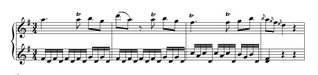
Yes, it's a very nice theme. And after my little treble "solo," very adorably the bottom part is supposed to play the same thing in a bass-ish kind of way, and it's all very cute and humorous. Now, only later I came to understand the motivation behind what happened next. Apparently, I played my theme that evening particularly Puckishly and optimistically, like a kind of "in the mist" fantasy of treble frequencies, and this music director had had it with my demonstrative happiness. Instead of the major mode, then, the music director played his version in a sober, sad minor, something like "Let me tell ya somethin' punk, you need to learn something about life":
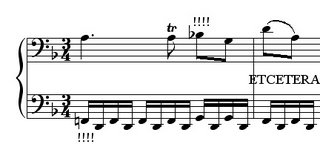
A whole different MODE??!?@?!@?# Of course I had been outdone. The smallest smile spread on his face; he turned his head ever so slightly towards me, smugly. All my dreaming of surprising the Anonymous Music Director of the San Francisco Symphony and he had trumped me, magnificently. I consoled myself: of course, we were playing on his turf; he had the "home court" advantage. Let him come to the Greystone Hotel in New York City and try that kind of garbage! But, the rest of that sweet little tender piece, playing my pretty melodies, I was skewered on irony: I had to just stew there and emote happily in the knowledge that I had been outimprovised, beaten at my own game, hoisted by my own petard, and a host of other clichés that we don't need to mention.
Perhaps still suffering from the trauma of this incident, which you can well imagine (any good therapists out there?), I found myself in Portland, Maine, playing a rather meaty recital consisting of the 4th Partita of Bach, the last Sonata of Beethoven, and the Liszt Sonata. I was in elbow deep in Liszt; I had just rounded the climax of the slow movement (from which the following sound file begins), and well I was basking its afterglow.
Liszt Sonata Excerpt, Portland Maine 11/16/06
(The sound quality is not unbelievable... you will need to turn it up?) Everything seemed to be going fine. It had been a busy November; perhaps I was a bit tired, and I thought for a moment, at a thorny chromatic descent, that I had played an incorrect accidental... though I hadn't. The cover-up is often worse than the crime. The non-existent imaginary mistake derailed me. I corrected the non-mistake, and suddenly I was descending through clouds of the totally wrong harmonies and who knew what dissonances might result, where I might land? A musical, cognitive free-fall. Somehow I landed on the dominant of B major which would have ended the piece, well, rather too soon. Heh. It was a tempting thought... but no.
Remember I was in the afterglow, and I was so shocked that my brain went into a strange frenzy. I remember thinking, with one sector of my brain, "You're supposed to be in F# major, you [expletive]." Another sector was curiously devoid of harmonic thinking and could only offer up a melodic fragment it knew to be true:
But in the wrong key. My melodic and harmonic minds diverged. You don't have great presence of mind at those moments. Now, you can hear me try out the melodic fragment a few times, and settle on F# major, as a foundation (at the very least); and my favorite part is when, out of ideas, I play a sort of wistful little F#-major arpeggio, which tries to stand in for a whole Lisztian resolution... pathetically... as if to say, that's all I've got, folks! I play it with a certain sincerity, a kind of tender offering of complete and total nonsense. Luckily at that moment of crisis, I suddenly grab onto a high C major scale... a swimmer finding shore...
The incident occurs 55 seconds in. By 1:10, we are free and clear, back to our regularly scheduled programming. You can stop listening, or whatever; it's a free country. But I included more of the performance, because, by the mysterious totally emotional ridiculous logic of performing, the unnerving effect of this memory moment caused me to take the ensuing fugue unbelievably fast, almost as if I wanted to derail myself again. Haha, you won't make it, I seem to be saying to myself; but: I do. I am satisfied that the result is demonic and wild; the fugue is, yes, too fast, but I'm glad that it hovers on the unplayable; you never know ... even failure, or doubt, can inspire.
I had plans, magnificent plans! I was playing a four-hand work with a certain music director of the San Francisco Symphony (anonymous of course), a beautiful slow movement which is one of those marvels of Mozartean simplicity. But, content on the reprise I was not. I yearned, the second time around, to fill its basic intervals with elaborations, like a chocolate bar with nougat, and said music director encouraged me at our first rehearsal, averring that by historical accounts Mozart ornamented heavily ... that it was "like Chopin." Haha. I barely need encouragement in general, in almost every facet of my existence, so watch out! The next day, submerged in the pit under the Davies stage, I spent my "practice breaks" concocting ornaments... like Christmas ornaments really: some quite cheesy, some unnecessary, some beautiful, some graceful, some edible (?) and some making you wish you had never come home for Christmas at all. I laughed and giggled and generally ridiculously entertained myself, which calls to mind the magnificent line of Homer Simpson: "But I was getting lonely being happy all by myself."
The point was I was going to be an audacious ornamenter, and catch Anonymous Music Director by surprise onstage, etc. I used just a few of my ornaments at our dress rehearsal, and even this mere sampling elicited the following remark: "Jeremy, what have you been smokin' the last few days?" This I considered a success; yes, it's a slightly different kind of success from what most people yearn for, but we all set our bars in different places, so to speak. So, anyway, I was feeling very pleased with myself, but as usual, the first night I didn't really have (to use the vernacular) the cojones to do everything I had planned; I did some things but couldn't go "all the way."
The second night, there we were in front of a couple thousand people again, and I was ornamenting away, self-satisfied, and we got to the second half, where I play this little new theme in D major, all alone:

Yes, it's a very nice theme. And after my little treble "solo," very adorably the bottom part is supposed to play the same thing in a bass-ish kind of way, and it's all very cute and humorous. Now, only later I came to understand the motivation behind what happened next. Apparently, I played my theme that evening particularly Puckishly and optimistically, like a kind of "in the mist" fantasy of treble frequencies, and this music director had had it with my demonstrative happiness. Instead of the major mode, then, the music director played his version in a sober, sad minor, something like "Let me tell ya somethin' punk, you need to learn something about life":

A whole different MODE??!?@?!@?# Of course I had been outdone. The smallest smile spread on his face; he turned his head ever so slightly towards me, smugly. All my dreaming of surprising the Anonymous Music Director of the San Francisco Symphony and he had trumped me, magnificently. I consoled myself: of course, we were playing on his turf; he had the "home court" advantage. Let him come to the Greystone Hotel in New York City and try that kind of garbage! But, the rest of that sweet little tender piece, playing my pretty melodies, I was skewered on irony: I had to just stew there and emote happily in the knowledge that I had been outimprovised, beaten at my own game, hoisted by my own petard, and a host of other clichés that we don't need to mention.
Perhaps still suffering from the trauma of this incident, which you can well imagine (any good therapists out there?), I found myself in Portland, Maine, playing a rather meaty recital consisting of the 4th Partita of Bach, the last Sonata of Beethoven, and the Liszt Sonata. I was in elbow deep in Liszt; I had just rounded the climax of the slow movement (from which the following sound file begins), and well I was basking its afterglow.
Liszt Sonata Excerpt, Portland Maine 11/16/06
(The sound quality is not unbelievable... you will need to turn it up?) Everything seemed to be going fine. It had been a busy November; perhaps I was a bit tired, and I thought for a moment, at a thorny chromatic descent, that I had played an incorrect accidental... though I hadn't. The cover-up is often worse than the crime. The non-existent imaginary mistake derailed me. I corrected the non-mistake, and suddenly I was descending through clouds of the totally wrong harmonies and who knew what dissonances might result, where I might land? A musical, cognitive free-fall. Somehow I landed on the dominant of B major which would have ended the piece, well, rather too soon. Heh. It was a tempting thought... but no.
Remember I was in the afterglow, and I was so shocked that my brain went into a strange frenzy. I remember thinking, with one sector of my brain, "You're supposed to be in F# major, you [expletive]." Another sector was curiously devoid of harmonic thinking and could only offer up a melodic fragment it knew to be true:

But in the wrong key. My melodic and harmonic minds diverged. You don't have great presence of mind at those moments. Now, you can hear me try out the melodic fragment a few times, and settle on F# major, as a foundation (at the very least); and my favorite part is when, out of ideas, I play a sort of wistful little F#-major arpeggio, which tries to stand in for a whole Lisztian resolution... pathetically... as if to say, that's all I've got, folks! I play it with a certain sincerity, a kind of tender offering of complete and total nonsense. Luckily at that moment of crisis, I suddenly grab onto a high C major scale... a swimmer finding shore...
The incident occurs 55 seconds in. By 1:10, we are free and clear, back to our regularly scheduled programming. You can stop listening, or whatever; it's a free country. But I included more of the performance, because, by the mysterious totally emotional ridiculous logic of performing, the unnerving effect of this memory moment caused me to take the ensuing fugue unbelievably fast, almost as if I wanted to derail myself again. Haha, you won't make it, I seem to be saying to myself; but: I do. I am satisfied that the result is demonic and wild; the fugue is, yes, too fast, but I'm glad that it hovers on the unplayable; you never know ... even failure, or doubt, can inspire.
Thursday, November 23, 2006
Confession
It's dangerous to roam the Classical Internet. Surfing and clicking from the discomfort of my ancient Hoosier sofa, it seems that every time I turn around, I run across yet another article entitled: Who (or What) Killed Classical Music? Or, more optimistically present tense: What is Killing Classical Music?
Seriously: I can't take it anymore. I really don't know how to say something like this, but I need closure.
I killed Classical Music. That's right; just me. No accomplices. Hahahaha! And here's how ...
[sitcom-style dream sequence transition, distant saxophone]
Rain caught and held the reflection of red neon; the innocent night street looked washed in blood. Halfway through my third double bourbon I realized I had forgotten something a third-and-an-eighth-of-the-way through my second. I stared at the spattered greasy window, aching for a view; with flabby, twitchy fingers I played a forgotten melody on the chipped edge of my highball glass, and dug in my memory for the last comforting remnant of loss.
"History," I growled, and knocked my glass over, spilling ice, liquor, dispersing the smoke and mirrors of self-destruction. I was not trucking in abstractions; History was the name of the bartender.
He came by ineluctably. "Spilled your drink again, did you? ... You spilled your drink."
History tended to repeat himself. It was something you got used to. "Another bourbon," I said, grimacing.
"Those who don't learn from their mistakes," he murmured. But he filled my glass with fresh ice and let another healthy finger of poison drizzle over it, and I listened to the ice crackle and the rain whip against the window, and just at that moment four miserable pitches yawned out of the sullied night:
Those four fateful notes were what I had forgotten, the four voices of my inner Gesualdo madrigal, the horsemen of my Apocalypse, through-composed and yet monotonous, not quite repeating and never explaining the eternal, haunting, profound-yet-superficial madrigalisms of my subtexted so-called life ... The four notes, I yearned to know what to call them, if I ran across them in a deserted alley. Were they the dominant of a dominant? A predominant? Some sort of modified two chord? And for God's sake which of the notes was a dissonance and which a consonance and if we couldn't answer that, if there was no kind of moral-contrapuntal-tonal framework, how was I, or any of us, going to go on?
The door creaked open. A body settled into the sagging stool next to me. "Oh hi, Jazz," I said. He just grooved, passing time. I couldn't help imposing my problems on him, disturbing his detachment.
"You see it's a F a B a D# and a G#, what the hell is it?"
Jazz chuckled. "Call it what you want, man. That's some multivalent whatever. Just let it go where it wants to go, baby."
Oh I love Jazz but when he gets all tolerant on me I just want to smack him. Maybe, I thought, he's just playing into my own clichéd preconceptions? Speaking of which, the door creaked again and in came World Music, with an entourage: fawning ethnomusicologists, dancing around her gorgeous copious bejangled body in myriad tempi and costumes; they stared at her every incensed inch, concupiscent. Oh and who else should the cat drag in but Classical Music, dressed soberly, oozing stifling refinement, following at a greater distance, but giving World Music a watchful eye.
You see, Classical Music was my childhood sweetheart. Even in the sixth grade, when I was King of the Nerds, we would dine on cafeteria pizza and tater tots and talk of Opus Numbers. We would go to the Multiplex and sniff at John Williams and hold hands across dimly lit tables at 2 am at the Village Inn and stay up all night inventing Developments and Recapping with green chile and eggs in the morning. Classical Music was more than love. She was a sea in which my life was drowned. But: not even a glance. Classical brushed right by. I got up to say hello, but... Jazz grabbed my shoulder. "Don't do it man." His voice was a gravelly flatted seventh. "It's gone, just let it go. I hear Classical's got somethin' goin' with World Music, and it's pretty intense."
It was true. Even now I heard faint klezmer sounds; a clarinet blew in from nowhere, and the ethnomusicologists were braying abundant, dirty augmented seconds; and to my horror Classical Music looked on admiringly, swaying, daring to dance, to be caught up in the spell... Then without warning World Music began to rumba, and Classical gyrated along, smitten, living vicariously, stripping off sober clothes and ...
No, no, I thought; I couldn't watch this. Classical Music is not supposed to have fun without me! Not this kind of fun! A rage took shape; I was dizzy with jealousy; I was a naked, dripping, unlabelled Tristan Chord in the empty, burning staff paper of the World. Jazz tried to hold me back, but I realized I had the perfect weapon. I ripped my 3-volume set of Schenker's Der Freie Satz from my pseudo-hipster (no longer a nerd here! sort of!) messenger bag, and threw it with utmost force, and I caught Classical by surprise, right at a moment of joy ... it was an accident of course, some thorny middleground analysis caught her in the throat and she was allergic ... she fell over; the dance ended; jingles and jangles subsided into the rainy night.
Silence.
World Music leaned over. "She's dead." I noticed a tear on Jazz's cheek. My throwing arm throbbed. It began to sink in. All those young people's outreach concerts were for naught. And then History, as always, said the obvious.
"Nothing to do but move on."
[sitcom return-from-dream-sequence effect]
So there you go. Now that I've confessed, can I go on Oprah and be absolved?
More importantly: if l take the rap, if I do the time, can we PLEASE not have any more articles about the death of Classical Music?
Seriously: I can't take it anymore. I really don't know how to say something like this, but I need closure.
I killed Classical Music. That's right; just me. No accomplices. Hahahaha! And here's how ...
[sitcom-style dream sequence transition, distant saxophone]
Rain caught and held the reflection of red neon; the innocent night street looked washed in blood. Halfway through my third double bourbon I realized I had forgotten something a third-and-an-eighth-of-the-way through my second. I stared at the spattered greasy window, aching for a view; with flabby, twitchy fingers I played a forgotten melody on the chipped edge of my highball glass, and dug in my memory for the last comforting remnant of loss.
"History," I growled, and knocked my glass over, spilling ice, liquor, dispersing the smoke and mirrors of self-destruction. I was not trucking in abstractions; History was the name of the bartender.
He came by ineluctably. "Spilled your drink again, did you? ... You spilled your drink."
History tended to repeat himself. It was something you got used to. "Another bourbon," I said, grimacing.
"Those who don't learn from their mistakes," he murmured. But he filled my glass with fresh ice and let another healthy finger of poison drizzle over it, and I listened to the ice crackle and the rain whip against the window, and just at that moment four miserable pitches yawned out of the sullied night:

Those four fateful notes were what I had forgotten, the four voices of my inner Gesualdo madrigal, the horsemen of my Apocalypse, through-composed and yet monotonous, not quite repeating and never explaining the eternal, haunting, profound-yet-superficial madrigalisms of my subtexted so-called life ... The four notes, I yearned to know what to call them, if I ran across them in a deserted alley. Were they the dominant of a dominant? A predominant? Some sort of modified two chord? And for God's sake which of the notes was a dissonance and which a consonance and if we couldn't answer that, if there was no kind of moral-contrapuntal-tonal framework, how was I, or any of us, going to go on?
The door creaked open. A body settled into the sagging stool next to me. "Oh hi, Jazz," I said. He just grooved, passing time. I couldn't help imposing my problems on him, disturbing his detachment.
"You see it's a F a B a D# and a G#, what the hell is it?"
Jazz chuckled. "Call it what you want, man. That's some multivalent whatever. Just let it go where it wants to go, baby."
Oh I love Jazz but when he gets all tolerant on me I just want to smack him. Maybe, I thought, he's just playing into my own clichéd preconceptions? Speaking of which, the door creaked again and in came World Music, with an entourage: fawning ethnomusicologists, dancing around her gorgeous copious bejangled body in myriad tempi and costumes; they stared at her every incensed inch, concupiscent. Oh and who else should the cat drag in but Classical Music, dressed soberly, oozing stifling refinement, following at a greater distance, but giving World Music a watchful eye.
You see, Classical Music was my childhood sweetheart. Even in the sixth grade, when I was King of the Nerds, we would dine on cafeteria pizza and tater tots and talk of Opus Numbers. We would go to the Multiplex and sniff at John Williams and hold hands across dimly lit tables at 2 am at the Village Inn and stay up all night inventing Developments and Recapping with green chile and eggs in the morning. Classical Music was more than love. She was a sea in which my life was drowned. But: not even a glance. Classical brushed right by. I got up to say hello, but... Jazz grabbed my shoulder. "Don't do it man." His voice was a gravelly flatted seventh. "It's gone, just let it go. I hear Classical's got somethin' goin' with World Music, and it's pretty intense."
It was true. Even now I heard faint klezmer sounds; a clarinet blew in from nowhere, and the ethnomusicologists were braying abundant, dirty augmented seconds; and to my horror Classical Music looked on admiringly, swaying, daring to dance, to be caught up in the spell... Then without warning World Music began to rumba, and Classical gyrated along, smitten, living vicariously, stripping off sober clothes and ...
No, no, I thought; I couldn't watch this. Classical Music is not supposed to have fun without me! Not this kind of fun! A rage took shape; I was dizzy with jealousy; I was a naked, dripping, unlabelled Tristan Chord in the empty, burning staff paper of the World. Jazz tried to hold me back, but I realized I had the perfect weapon. I ripped my 3-volume set of Schenker's Der Freie Satz from my pseudo-hipster (no longer a nerd here! sort of!) messenger bag, and threw it with utmost force, and I caught Classical by surprise, right at a moment of joy ... it was an accident of course, some thorny middleground analysis caught her in the throat and she was allergic ... she fell over; the dance ended; jingles and jangles subsided into the rainy night.
Silence.
World Music leaned over. "She's dead." I noticed a tear on Jazz's cheek. My throwing arm throbbed. It began to sink in. All those young people's outreach concerts were for naught. And then History, as always, said the obvious.
"Nothing to do but move on."
[sitcom return-from-dream-sequence effect]
So there you go. Now that I've confessed, can I go on Oprah and be absolved?
More importantly: if l take the rap, if I do the time, can we PLEASE not have any more articles about the death of Classical Music?
Saturday, November 11, 2006
Escape From Breakfast
Do you butter your bagel as though it were a clandestine act? From the moment I set foot in the breakfast room of my hotel, my ears leave the normal world and I hear only the strange, squirming hush of repression. Typically, I wind up next to a couple, about to embark on a touristy fun day in beautiful San Francisco (a city I have a perpetual crush on). This single traveling pianist could imagine a lovely evening away from the kids in a hotel room, sharing a bed cozily, etc. & etc., and I guess one would HOPE that the situation would be a joyous one: a satisfied afterglow mixing with the anticipatory joy of a day spent together, not a care in the world: wandering about the hipster-strewn streets, eating chowder out of bread bowls, ignoring the homeless ... but perhaps my romantic notions are bound to crash against the wall of reality. One young couple sat in egg-cracking silence, broken only by:
Crack, sip, slurp, swallow. And five minutes later:
Then, simply more silence. Whatever thoughts may have followed upon this serious observation, were left hanging.
Yet another young couple was a study in contrasts; the boy seemed to be falling apart at the seams, clothes and limbs drooping on the floor, his hair a restless paragon of bedhead, the table before him a maze of plates and remnants, while his blond girlfriend sat bolt upright, as though in the court at Versailles, or at Alexander lessons, letting not a crumb fall from her muffin-eating mouth. She wiped her mouth gracefully ten times for every bite and I began to feel deeply unclean, like my body was a dust bunny that the Cosmic Swiffer had left behind. Then I have overheard several couples critiquing the hotel from within its very bowels (daring insurgency!), and on one occasion I leaned over and attempted to convey the poetry of the Huntington Hotel (the hotel on the hill!) to them; with my eyes I tried to express the blue of the bay as seen from my third floor window and with my hands the expanse of the luxurious bathrooms and the crisp sensual whiteness of the sheets on which ... Ahhh, but it was too much.
This couple was easily in their sixties. Was this the first time they had managed to cover the topic of his hard-boiled egg problem, or (as I suspected) was it the thousandth or millionth time? Reasons for my singleness suddenly became luminously clear, like the sky over the airport at dawn, when you realize--as always!--you are leaving a town just as the weather turns perfect.
In each corner of the breakfast room, insanity: a teen spreading cream cheese obsessively on a bagel for fifteen minutes, punishing it with dairy as if the bagel were a bully who had tormented him in the fourth grade; a man in the corner turning over each page of the paper, sniffing dismissively at each turn, as if some new layer of absurdity was discovered (the sound of the pages turning and folding like the flapping of vultures' wings, scavengers of newsprint)... And finally the repression of all these little conversations, the accumulated deflection and squelch of behavior, gets to me... I begin to feel like a prisoner, all I want to do is run up to my room and throw open the window and scream out to humanity: Live! Live! Enjoy life, everyone! Buy some shoes or go for a walk! Don't sit in dark rooms complaining about tea! Instead, like any good boy, I go and practice, in a windowless subterranean room. Provisional escape for me.
The second movement of Mozart 488. Mozart invokes "what has already been written," the siciliano, a style? genre? dance?, a halting haunting rhythm ...
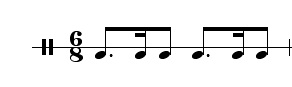
And by rights a siciliano, like any dance, should not really begin by falling apart. But Mozart, after a simple opening measure, breaks the texture, syncopates-interpolates-anticipates, all the while subjecting the melody to a series of seventh leaps:
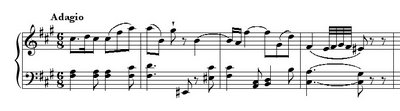

The melody and rhythm both are subject to sudden fragmentation and confrontation, before the movement or premise can really get started. A siciliano with "issues." I am always struck playing it (as I did the last three nights in San Francisco) by the immediacy and the complexity of this breakdown. But later, at my second entrance, I am amazed--how do I put this?--in the opposite way: I get stuck on two harmonies and in a certain melodic compass, I circle around chromatically in that C#-A, unable to escape the sixth, the rising sixth (attempt) followed in each case by the inevitable fall back (failure) ...
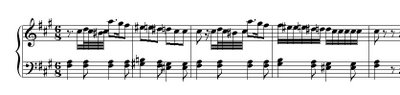
This "stuckness" is horrible, it makes me feel even more lost than the opening (which is more daring), or: lost in a different sense. If the opening is a kind of broken dance, this second entrance is like a broken record, symbolizing a more fundamental breakdown/crisis: a deliberate moment of being at a loss what to say, a kind of sudden poverty of invention, something really truly incredible: the composer who always has something to say, deliberately choosing to find only the barest words; the pianist/protagonist can only see the pathos before him, the confining circle of his thought, and nothing else (like we humans so often) ... spiraling redundancy, with no way out.
When, the third cycle around, the strings enter and suddenly this hovering around F# minor ends ... the string timbre (which releases the piano from its prison) at that moment is (I think we can all agree) one of the most beautiful things ever, like an aura around possibility, a pure promise. It promises A major, in annoying music theory terms; but, A major is a metaphor. In the subsequent transitional passage (annoying music theory term #2) the promise of major and the presence of minor interlace constantly and the too-simple promise of the string entrance is understood to be more complex, more than you "bargained for" ... I realize this is all a very emotional reading of this movement, but can there be any other? Can the purists out there forgive me?
What Mozart manages to do, I think, is keep the A major feeling "provisional," almost throughout the whole middle section ... Yes, everything is somewhat lifted, the halting tread of the siciliano has disappeared, the mood is less oppressive, even happy?, but as I am playing and listening, I don't yet feel totally confident ... I feel I am exploring it (A major and whatever A major might "mean") rather than living in it. Only towards the end of the section, the piano seems to begin to exult in the key, in its majorness; we have a long, spun-out, establishing cadence (Mozart's amazing gift for the coincidence of emotional/harmonic function), leaping up to a high E (not at all coincidentally the highest note in the piano of the movement):
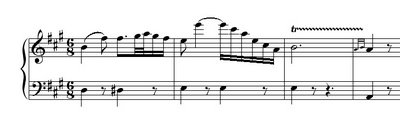
This cadence is simultaneously the harmonic certainty we have waiting for, and a kind of emotional release, an escape, a real difference! And it is, of course, PRECISELY at that moment, when the pianist's happiness is at its height, when the spell of mournful F# minor seems to have truly been broken, precisely at the hinge in the structure when A major is established for sure, that Mozart closes the door, the door he himself opened: the winds in two simple, terrible bars take A major and destroy it, twist it exactly back to the beginning. That is what is devastating: how little work it really is. Then, what else? I have no choice but to play the opening again; whatever I have glimpsed of the other is ephemeral, impossible, gone.
Escape is a theme of this movement, perhaps its most important theme ... On the Neapolitan 6th chord, one of those fated, fatal chords which MUST lead to the cadence, the pianist, before allowing the cadence, tries to leap "out of the register," tries a kind of virtual escape, thinking perhaps by postponing the cadence to postpone the inevitable:

... and so too again at the end, though the writing is on the wall and the movement is drawing to an end and nothing can really happen to alter the fate of things, the piano keeps reaching up the octave, C-sharp to C-sharp, as if it hopes to find something up there ...
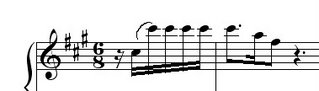
Does the soloist want to escape from its own instrument, from its own compass, to get out of the world it has created? But the desire for escape is written into that world, intrinsically; it is part of the bars of the cage.
This tea is nasty.
Crack, sip, slurp, swallow. And five minutes later:
Man: Hussein got sentenced today.
Woman: (Bored) Mmhmmm.
Then, simply more silence. Whatever thoughts may have followed upon this serious observation, were left hanging.
Yet another young couple was a study in contrasts; the boy seemed to be falling apart at the seams, clothes and limbs drooping on the floor, his hair a restless paragon of bedhead, the table before him a maze of plates and remnants, while his blond girlfriend sat bolt upright, as though in the court at Versailles, or at Alexander lessons, letting not a crumb fall from her muffin-eating mouth. She wiped her mouth gracefully ten times for every bite and I began to feel deeply unclean, like my body was a dust bunny that the Cosmic Swiffer had left behind. Then I have overheard several couples critiquing the hotel from within its very bowels (daring insurgency!), and on one occasion I leaned over and attempted to convey the poetry of the Huntington Hotel (the hotel on the hill!) to them; with my eyes I tried to express the blue of the bay as seen from my third floor window and with my hands the expanse of the luxurious bathrooms and the crisp sensual whiteness of the sheets on which ... Ahhh, but it was too much.
Woman: If you ate some protein with your breakfast, you wouldn't be hungry again in an hour.
Man: Mmhmmm.
Woman: Why don't you have an egg?
Man: I HATE hardboiled eggs.
This couple was easily in their sixties. Was this the first time they had managed to cover the topic of his hard-boiled egg problem, or (as I suspected) was it the thousandth or millionth time? Reasons for my singleness suddenly became luminously clear, like the sky over the airport at dawn, when you realize--as always!--you are leaving a town just as the weather turns perfect.
In each corner of the breakfast room, insanity: a teen spreading cream cheese obsessively on a bagel for fifteen minutes, punishing it with dairy as if the bagel were a bully who had tormented him in the fourth grade; a man in the corner turning over each page of the paper, sniffing dismissively at each turn, as if some new layer of absurdity was discovered (the sound of the pages turning and folding like the flapping of vultures' wings, scavengers of newsprint)... And finally the repression of all these little conversations, the accumulated deflection and squelch of behavior, gets to me... I begin to feel like a prisoner, all I want to do is run up to my room and throw open the window and scream out to humanity: Live! Live! Enjoy life, everyone! Buy some shoes or go for a walk! Don't sit in dark rooms complaining about tea! Instead, like any good boy, I go and practice, in a windowless subterranean room. Provisional escape for me.
The second movement of Mozart 488. Mozart invokes "what has already been written," the siciliano, a style? genre? dance?, a halting haunting rhythm ...

And by rights a siciliano, like any dance, should not really begin by falling apart. But Mozart, after a simple opening measure, breaks the texture, syncopates-interpolates-anticipates, all the while subjecting the melody to a series of seventh leaps:


The melody and rhythm both are subject to sudden fragmentation and confrontation, before the movement or premise can really get started. A siciliano with "issues." I am always struck playing it (as I did the last three nights in San Francisco) by the immediacy and the complexity of this breakdown. But later, at my second entrance, I am amazed--how do I put this?--in the opposite way: I get stuck on two harmonies and in a certain melodic compass, I circle around chromatically in that C#-A, unable to escape the sixth, the rising sixth (attempt) followed in each case by the inevitable fall back (failure) ...

This "stuckness" is horrible, it makes me feel even more lost than the opening (which is more daring), or: lost in a different sense. If the opening is a kind of broken dance, this second entrance is like a broken record, symbolizing a more fundamental breakdown/crisis: a deliberate moment of being at a loss what to say, a kind of sudden poverty of invention, something really truly incredible: the composer who always has something to say, deliberately choosing to find only the barest words; the pianist/protagonist can only see the pathos before him, the confining circle of his thought, and nothing else (like we humans so often) ... spiraling redundancy, with no way out.
When, the third cycle around, the strings enter and suddenly this hovering around F# minor ends ... the string timbre (which releases the piano from its prison) at that moment is (I think we can all agree) one of the most beautiful things ever, like an aura around possibility, a pure promise. It promises A major, in annoying music theory terms; but, A major is a metaphor. In the subsequent transitional passage (annoying music theory term #2) the promise of major and the presence of minor interlace constantly and the too-simple promise of the string entrance is understood to be more complex, more than you "bargained for" ... I realize this is all a very emotional reading of this movement, but can there be any other? Can the purists out there forgive me?
What Mozart manages to do, I think, is keep the A major feeling "provisional," almost throughout the whole middle section ... Yes, everything is somewhat lifted, the halting tread of the siciliano has disappeared, the mood is less oppressive, even happy?, but as I am playing and listening, I don't yet feel totally confident ... I feel I am exploring it (A major and whatever A major might "mean") rather than living in it. Only towards the end of the section, the piano seems to begin to exult in the key, in its majorness; we have a long, spun-out, establishing cadence (Mozart's amazing gift for the coincidence of emotional/harmonic function), leaping up to a high E (not at all coincidentally the highest note in the piano of the movement):

This cadence is simultaneously the harmonic certainty we have waiting for, and a kind of emotional release, an escape, a real difference! And it is, of course, PRECISELY at that moment, when the pianist's happiness is at its height, when the spell of mournful F# minor seems to have truly been broken, precisely at the hinge in the structure when A major is established for sure, that Mozart closes the door, the door he himself opened: the winds in two simple, terrible bars take A major and destroy it, twist it exactly back to the beginning. That is what is devastating: how little work it really is. Then, what else? I have no choice but to play the opening again; whatever I have glimpsed of the other is ephemeral, impossible, gone.
Escape is a theme of this movement, perhaps its most important theme ... On the Neapolitan 6th chord, one of those fated, fatal chords which MUST lead to the cadence, the pianist, before allowing the cadence, tries to leap "out of the register," tries a kind of virtual escape, thinking perhaps by postponing the cadence to postpone the inevitable:

... and so too again at the end, though the writing is on the wall and the movement is drawing to an end and nothing can really happen to alter the fate of things, the piano keeps reaching up the octave, C-sharp to C-sharp, as if it hopes to find something up there ...

Does the soloist want to escape from its own instrument, from its own compass, to get out of the world it has created? But the desire for escape is written into that world, intrinsically; it is part of the bars of the cage.
Monday, October 30, 2006
My Umbrella
My umbrella needs no Viagra. It jumps at every chance. It attempts to come open under tables, in drawers, as I am passing through doors; it is coiled kinetic energy; it is a teenage umbrella in heat and I have considered buying it Judy Blume books just to calm it down. I am nervous it will embarrass me at any moment. If it is possible to screw up the purchase of an umbrella, in every imaginable way, I have done so. Attention to detail, even in failure, is my strong point. Fed up with the evil person who stole my last magnificent green domed colossus from the locker room at New York Sports Club in the middle of a tremendous downpour (bad, bad karma, whoever you are!), and no longer willing to humor its substitute, a tattered, paisley, hopeful but pathetic remnant of cloth, its frame poking crazily askew like a squashed metal spider, I finally strutted into Duane Reade on a rainy morning with a mad, to-do-list-checking, umbrella acquisition urge. But every New Yorker knows, you should NEVER buy an umbrella in a store: you should only buy them on the street, from suspicious vendors, in the middle of a precipitation event. Only then do urgency, need, opportunity, and economy-of-scale meet in a flash of cash-only swiftness which makes one glad to be alive. Haste makes waste, and bad taste; my foolish desire and unusual simplicity-of-action bade me ignore the sign reading "The I Love New York Umbrella," with its typical, disgusting, rebus-substitution, and I bought what appeared to be a black normal umbrella (is that so much to ask?), but which turned out horribly to be a TOURIST umbrella, broadcasting on two of its panes "I [heart] New York," a sentiment which this magnificent city, in all its industrial bespattered grimy cynical splendor, can only regard with utter distaste. Yes, we [heart] you too, all you people from Iowa, or Minnesota, and let us express our love with refrigerator magnets.
Wow. Kinda lost it there. Apologies to all from Iowa/Minnesota. That burst of Manhattanism was really just an emotional reaction to the stress of walking down Broadway in the rain, suffering all the trials of a New York resident, living in what other people would consider a cupboard, but still having to appear to all the world like a tourist. And moreover that Duane Reade, the ultimate depressing New York City drugstore, would betray me thus! Et tu, Duane?
Speaking of losing it, and Minnesota. A week ago, I was slated to do a rather ridiculous thing, i.e. fly altogether too late to a concert, fly the morning of a concert out to Bemidji, MN.
Now, it is a journey out to Bemidji, and I had played it semi-safe by booking, through my manager, the earliest possible flight. My schmancy alarm clock thus buzzed most unwelcomely at 5:30 AM, in the palatial West Wing of my apartment, and there ensued that daze and misery of the sudden urgency and the socks that won't go on properly and the assembly of clothes and the impatient phone call of the waiting limo driver and the scurrying of my various butlers, all of which I survived to find myself at JFK's Terminal 4, at a respectable 6:35.
But my hubris of timeliness was ill-rewarded. There was no reservation under my name, or under any of my many aliases (all very sexy and mysterious), and I ended up with a quivering cell phone under my ear, learning from a very sweet lady that I would have to buy a fantastically expensive ticket then and there to get to my destination, and, there was nothing available on the 8 o-clock flight, and, so I'd have to leave at 11:30, and pretty much barely make it.
Please understand! I am already in a very vulnerable emotional state in those early-airport moments, something like a baby that emerges from the womb only to face a firing squad.
Nonetheless I am a proud frequent traveler, averse to exhibit the base emotionalism of all the "amateur travelers" who get all cranky when their rental car is not the color they requested. I was the soul of politeness to the Northwest Airlines staff, whose fault this situation was not, and did not let the depth of my distress leak to them ... except for occasional aphorisms such as "life is a vale of tears." But once I had my ticket, and I found myself adrift in the food court for several hours, with just not quite enough time to get home and back again, a whole new existential situation began to present itself. I began to think the saddest thought I have ever had: my bed, lying empty, without me in it.
Bed. And again bed. Rustle of sheets; sensual whisper of pillow. The glow of the pre-sleep moments, the soft sinking of consciousness, the surrender to rest and relief. I imagined myself in a fetal position, clutching Marcella Cucina, my favorite cookbook, as I sank into dreams of Risotto. Meanwhile, the fluorescent light of the food court bounced horrendously off the yellow formica of my table, and I squirmed painfully on my concrete bench, and sipped another in a series of recurring coffees which did not wake or calm me, but exacerbated my neither/nor-ness (not a word). Ranting cell phone calls were placed, and many weekend minutes were tossed casually into the vault of wasted time. My rage spun slowly around its object: whatever had happened to my reservation. And then I paced, Rilke's panther in the cage, paced again and again past Sbarro and McDonalds and Sharper Image, the bars behind which no world appeared, and when I unwrapped my Egg McMuffin I dropped the egg upon the floor (indignity of the imprisoned man!). I sought relief in the world of ideas, i.e. the bookstore, and unbelievably! the first book that presented itself on the first shelf I came to was William Hazlitt's On the Pleasure of Hating:
How comforting.
That evening, exhausted, I played two Bach Partitas and the Liszt Sonata. Moments after I finished, a woman about 50 years of age came by my dressing room and told me in a Midwestern rhythm that she felt it was a once in a lifetime experience and that many of her friends felt the same way and she thanked me for coming and making the long journey and her face was as plain as a blue sky. She let her eyes sit with me for a while and I could see that while many New Yorkers' faces seem to be a miracle of added-on layers, of wrinkles of experience and cultural accretions, her face over the many harsh winters seemed instead to have been whittled down; things had been removed with time and what was left seemed very honest. She politely excused herself and, as I heard her steps going down the corridor, something snapped and finally I felt myself let go of the held breath of the morning's frustration. I was still exhausted but now in a good way, in a real way which could be solved with sleep. I sat in front of the dressing room mirror and recognized myself. I was happy. I remembered a few phrases I liked in the concert and knew why I was doing what I was doing. And just then the Spirit of New York City came into the dressing room; it was pretty pissed off, yelling at me for getting "all CBS After-School-Special," and threatened to beat me senseless with my [expletive] tourist umbrella if I didn't pull myself together and get good and miserable for the long return flight home.
Wow. Kinda lost it there. Apologies to all from Iowa/Minnesota. That burst of Manhattanism was really just an emotional reaction to the stress of walking down Broadway in the rain, suffering all the trials of a New York resident, living in what other people would consider a cupboard, but still having to appear to all the world like a tourist. And moreover that Duane Reade, the ultimate depressing New York City drugstore, would betray me thus! Et tu, Duane?
Speaking of losing it, and Minnesota. A week ago, I was slated to do a rather ridiculous thing, i.e. fly altogether too late to a concert, fly the morning of a concert out to Bemidji, MN.
Now, it is a journey out to Bemidji, and I had played it semi-safe by booking, through my manager, the earliest possible flight. My schmancy alarm clock thus buzzed most unwelcomely at 5:30 AM, in the palatial West Wing of my apartment, and there ensued that daze and misery of the sudden urgency and the socks that won't go on properly and the assembly of clothes and the impatient phone call of the waiting limo driver and the scurrying of my various butlers, all of which I survived to find myself at JFK's Terminal 4, at a respectable 6:35.
But my hubris of timeliness was ill-rewarded. There was no reservation under my name, or under any of my many aliases (all very sexy and mysterious), and I ended up with a quivering cell phone under my ear, learning from a very sweet lady that I would have to buy a fantastically expensive ticket then and there to get to my destination, and, there was nothing available on the 8 o-clock flight, and, so I'd have to leave at 11:30, and pretty much barely make it.
Please understand! I am already in a very vulnerable emotional state in those early-airport moments, something like a baby that emerges from the womb only to face a firing squad.
Nonetheless I am a proud frequent traveler, averse to exhibit the base emotionalism of all the "amateur travelers" who get all cranky when their rental car is not the color they requested. I was the soul of politeness to the Northwest Airlines staff, whose fault this situation was not, and did not let the depth of my distress leak to them ... except for occasional aphorisms such as "life is a vale of tears." But once I had my ticket, and I found myself adrift in the food court for several hours, with just not quite enough time to get home and back again, a whole new existential situation began to present itself. I began to think the saddest thought I have ever had: my bed, lying empty, without me in it.
Bed. And again bed. Rustle of sheets; sensual whisper of pillow. The glow of the pre-sleep moments, the soft sinking of consciousness, the surrender to rest and relief. I imagined myself in a fetal position, clutching Marcella Cucina, my favorite cookbook, as I sank into dreams of Risotto. Meanwhile, the fluorescent light of the food court bounced horrendously off the yellow formica of my table, and I squirmed painfully on my concrete bench, and sipped another in a series of recurring coffees which did not wake or calm me, but exacerbated my neither/nor-ness (not a word). Ranting cell phone calls were placed, and many weekend minutes were tossed casually into the vault of wasted time. My rage spun slowly around its object: whatever had happened to my reservation. And then I paced, Rilke's panther in the cage, paced again and again past Sbarro and McDonalds and Sharper Image, the bars behind which no world appeared, and when I unwrapped my Egg McMuffin I dropped the egg upon the floor (indignity of the imprisoned man!). I sought relief in the world of ideas, i.e. the bookstore, and unbelievably! the first book that presented itself on the first shelf I came to was William Hazlitt's On the Pleasure of Hating:
In private life do we not see hypocrisy, servility, selfishness, folly, and impudence succeed, while modesty shrinks from the encounter, and merit is trodden under foot? How often is "the rose plucked from the forehead of a virtuous love to plant a blister there!" What chance is there of the success of real passion? What certainty of its continuance? Seeing all this as I do, and unravelling the web of human life into its various threads of meanness, spite, cowardice, want of feeling, and want of understanding, of indifference towards others, and ignorance of ourselves, - seeing custom prevail over all excellence, itself giving way to infamy - mistaken as I have been in my public and private hopes, calculating others from myself, and calculating wrong; always disappointed where I placed most reliance; the dupe of friendship, and the fool of love; - have I not reason to hate and to despise myself? Indeed I do; and chiefly for not having hated and despised the world enough.
How comforting.
That evening, exhausted, I played two Bach Partitas and the Liszt Sonata. Moments after I finished, a woman about 50 years of age came by my dressing room and told me in a Midwestern rhythm that she felt it was a once in a lifetime experience and that many of her friends felt the same way and she thanked me for coming and making the long journey and her face was as plain as a blue sky. She let her eyes sit with me for a while and I could see that while many New Yorkers' faces seem to be a miracle of added-on layers, of wrinkles of experience and cultural accretions, her face over the many harsh winters seemed instead to have been whittled down; things had been removed with time and what was left seemed very honest. She politely excused herself and, as I heard her steps going down the corridor, something snapped and finally I felt myself let go of the held breath of the morning's frustration. I was still exhausted but now in a good way, in a real way which could be solved with sleep. I sat in front of the dressing room mirror and recognized myself. I was happy. I remembered a few phrases I liked in the concert and knew why I was doing what I was doing. And just then the Spirit of New York City came into the dressing room; it was pretty pissed off, yelling at me for getting "all CBS After-School-Special," and threatened to beat me senseless with my [expletive] tourist umbrella if I didn't pull myself together and get good and miserable for the long return flight home.
Thursday, October 26, 2006
Favorites
Favorite Quote of the Week
"We've done Peter and the Wolf so many times, we're starting to root for the wolf."
--unnamed person affiliated with the St. Louis Symphony
Most Ridiculous Quote of the Week
"There is absolutely nothing artificial about Glenn Gould's playing."
--Bruno Monsaingeon
Polite response: a certain stylization is actually somewhat characteristic of his work. Less polite response: I mean come on, what kind of Kool Aid are you drinking? Is there anything NOT artificial about his playing?
Favorite Meal of the Week
An egg-salad sandwich on toasted white bread with iceberg lettuce, a pickle, a glass of ice water, and a Wild Turkey on the rocks.
and finally,
Runner-Up Favorite Quote of the Week
A photographer friend is looking desperately for an apartment, and has been in email contact with all sorts of persons to that end. He received the following philosophical missive which seems to stray off the subject of subletting considerably:
"Thanks for giving the world nice photos and for being Gay. I'm not Gay, but I support full Gays rights, and I wish that I would wake up in the morning and find the 95 percent of the world population has turned Gay. The world would for sure be a better place. This might save the world because it's too over populated and mother nature doesn't have a chance."
Subscribe to:
Posts (Atom)
