Saturday, August 26, 2006

Wholes

Music gazes at its listener with empty eyes, and the more deeply one immerses oneself in it, the more incomprehensible its ultimate purpose becomes, until one learns that the answer, if such is possible, does not lie in contemplation, but in interpretation. In other words, the only person who can solve the riddle of music is the one who plays it correctly, as something whole.

--Theodor Adorno, The Relationship of Philosophy and Music, tr. Susan Gillespie


Every since I picked up a volume of Adorno essays at my beloved Labyrinth Books, I have been going through a mild Adorno phase and I especially enjoy hauling this volume to the New York Sports Club and barely stuffing it into the little bookslot of the Stairmaster and staring smugly at my neighbors with their pitiful People Magazines. They stare back at me with empty eyes, and I must admit as the sweat begins to pour down my face that it becomes hard to concentrate on a passage like--

Hence the ontological definition of music as a language sui generis is either so abstract that it says nothing more than that between the individual musical facts there exists an articulated context that is "logical" in its own way, as Harburger, for example, has attempted to demonstrate in his book on meta-logic.


--A footnote suggests there is more to learn about Harburger, but I do not interrupt my workout to check.

Somehow that sentence about the empty eyes and the interpreter solving the riddle of the purpose of the piece made it through to my brain, despite all the distractions of the NYSC, and left an impression. I abandoned my dampened Stairmaster more pensively than I climbed it. A piece, even one you know well, can feel like you just dropped all the items in your shopping bag and they are rolling across the floor in every direction. Every day, every performance, every iteration you have to gather them again (freshly, or else). But in this case, extending the metaphor as usual ad absurdum, before you return an item to the bag you must know how it belongs with the others, and even why you wanted it in the first place: a very emotional trip to the supermarket of musical ideas. You tie them together with (hopefully) invisible thread (the act of interpretation?), which can be drawn too loose or too tight.

Adorno had put into words what I realized was one of the motivating (subconscious?) themes of my practicing: the desire to bring all the parts into a whole, or to put it another way, the desire for the whole which allows the parts to exist meaningfully. I have been feeling this process and the tugs of these desires very intensely as I prepare the 4th and 6th Partitas of Bach. The Partitas are collections of dances, pieces written in genres, in a fixed stylized order; they don't have the obvious, free literary or narrative sweeps that one is assisted by in works of Schumann or Beethoven, for instance; but despite being collections and varied and myriad and stylized and fixed they each seem to be hovered over by some sort of guardian angel, a uniting spirit. Each seems like a miniature cosmos. Without trivializing, I hope I can say that the D major feels to me like some sort of total vision of happiness (which includes melancholy and reflection). Its final gigue is a virtuosic release: the most overt, affirmative kind of joy, and it seems to sum up without needing to "answer" or "correct" or "propose" or right any wrongs that may have occurred before. (Unlike, say, the last movements of Beethoven 5th and 9th Symphonies, to name some ridiculously contrasting examples.) It is the one I find myself most passionately attached to right now. I can even discriminate between the "type" of happiness of the D major and the more extremely comic, lighter (but perhaps less profound?) happiness of the G major.

The E minor, by contrast, lies in some uneasy relationship even to the idea of emotion or mood. Its first movement seems to have an obvious "emotive agenda;" it deals with the most prevalent tropes of musical tragedy: the falling sigh motif and the descending tetrachord. The first movement explores them exhaustively, in improvisation and in fugue, then the subsequent dances are haunted by the same ideas in disguise, most remarkably in the Sarabande. But the signifier and the signified are in a strange dance around each other. After the Gigue, is it possible to feel the piece has a tragic or melancholic effect? (Even after the Toccata I am not so sure.) The minor keys in Bach so often do not seem centrally about sadness, do not seem a vehicle even for an emotion primarily; they seem to have a dual role; they evoke the tragic while simultaneously creating a pathway to daring, to intellectual adventure, to compositional wildness. I am not saying that Bach thereby drains the music of emotional content (the hackneyed charge of Bach as an "intellectual" or "cerebral" composer); but the affective content becomes a conduit and not the subject of the discourse; this kind of altered state is evident in the Gigue, which to my mind is lit by an intense fire, with its leaps and constant interplay of voices, sometimes altogether overwhelming, more intensity than "can be played." Its difficulty (aside from technical demands) lies in that there is so much going on, so much density of tension, an unbelievable compression ... But after an altered state like that, it is not so easy to say what the whole "tone" of the piece is (it represents no emotion that I know); its very daring makes it difficult to compress into a whole, to solve its riddle.

At the same time that the piece thrills you, it draws you into its strange questions, including the "useless" question: what does it all mean? Play it as a whole, Adorno says, and you the player ask: well what the *(&(*)# is that? But somehow you also know. And maybe you're sitting over a dinner plate and your friend is telling you something and it occurs to you, how to play some moment in an Allemande (some wending, wonderful moment of ambiguous arrival or departure status) and you stare at your friend with empty eyes and can't wait to get back home, you grab a cab instead of the subway and throw your keys on the floor and play it and why is it never as good as it is in the mind? (Charles Ives, a great lover of Bach, laughing in the background: "My God! What has sound to do with music!")

Thursday, August 24, 2006

Summer Clothes

Here is a picture of my closet after all the summer's dirty clothes have been piled in it, so I can walk to and from my bed relatively unencumbered:


Who among you, faced with this kind of squalor, this daunting mountain of drudgery, would not prefer to escape forthwith and tout suite into the perfect ideal world of music, into its dancing spheres and lines?


Ah, but the wheels turn and even before my first cup of coffee it occurs to me. Perhaps I create a situation in my apartment, deliberately but subconsciously, so that I will be all the more tempted, nay even forced, to get myself to the piano right away! Perhaps it is not really laziness and slobbery but the most fiendishly clever practice motivation technique ever invented! Anybody with me? Anybody buying it?

Monday, August 21, 2006

Whatever

Rats scurry into subway tunnels, teens discuss real estate with premature machismo, and airconditioners hum and drip irregularly. Sigh; all is as I left it here in New York City. It is now night and some of the edge is off. Earlier today, I sat in the backseat of my parents' rental and stared out a tinted window at the totally clear pure blue sky and dreamed of my feet over the edge of a pier, dipped in a cool northern lake. But compulsion drew me in, inexorably, out of the infinite green beauties, away from the fields, silos and flowers, into a small tight gray corner-metropolis. As I drove myself (different stage of the journey) down the Thruway, I imagined all the other people, leaving their families and vacations and the purity of the mountains and forests for Reality, Vice, Career and Corruption. It was such a cliche. How many of us there on the road were doing the same thing? Pondering their families while driving 70 miles-an-hour away from them? (Really, officer, I was only doing 65.) I thought of all the strange citythings that could and should never be communicated at the family reunion. They would not only be inappropriate; they would be meaningless there, Sanskrit scribblings. I guess reality can sometimes make these two imaginary worlds intersect, strangely. I thought about how I had to return from one world to the other, I thought of the metaphor behind the miles. Then, restless, trapped in my white rental car, I moved from metaphor to my dream--I could escape, head up to Schroon Lake for one last breather of the summer--but I turned the car south and smiled and gritted my teeth and paid the tolls and here I am.

Let the record state that a) if the Arnold Palmer is Iced Tea and Lemonade, b) the Jeremy Denk is Cranberry Juice Cocktail and Ginger Ale.

Let me address a totally different question: how does a touring musician while away down times? I sat In my Rhinebeck hotel room, surfing channels and always seeming to stop at the WB or F/X before accusing myself of vulgarity, etcetera: an endless cycle of TV self-recrimination. I am an artist; how can I watch this drivel? My reading material had run out, and off the shelf came an extraordinary thick volume: Danielle Steel's The House. Ah, yes, something even more empty than television ... Ever in search of exotic experiences, I began to read, with an odd compulsion, and then I sincerely could not stop, though I skimmed madly, in search of understanding, through its 533 large-print pages; I told myself I was a cynical visitor in quest of the key to its badness, but also I was just a plain old sentimental sop wanting to know how she would bring this train-wreck of a plot to an end. I have a little file on my computer called "first lines" where I put all the cool first lines of novels I will (probably) never write; I spend endless hours dreaming of interesting hooks to bring the reader into the worlds of these hypothetical narratives. But Danielle is not hung up on beginnings; boldly, even impudently, she dreams up the most boring imaginable first sentence, and lets it fly:

Sarah Anderson left her office at nine-thirty on a Tuesday morning in June for her ten o-clock appointment with Stanley Perlman.


I LOVE it. There's so much uninteresting detail, and so little grace. I have wracked my brain, but don't think the Tuesday has any metaphorical significance, and Danielle really wants us to know, though there is no future plot juncture depending on it, that it takes a half-hour to get from her office to Stanley's place. I suppose the sentence does convey a sense of specificity and punctuality, a kind of no-nonsense, life-is-not-about-wiffly-waffly-images kind of thing. Curious, for a romance. A pragmatic romance? Along those lines, I love her choices of names: nothing quirky, nothing off-type. The men mostly have nice masculine one-syllable names (Jeff, Phil, Dave, George) except for the French professional bachelor, Pierre. The women are a more gentle two-syllable crowd (Sarah, Audrey, Mimi) except for the uptight French wife, Marie-Louise, who needs a lot more space to be haughty. Interestingly, the money-hoarding genius at investing is named Stanley Perlman. Surely, there's no stereotype there.

Now, let us be the first to admit!: we are no strangers here at Think Denk to clumsy metaphors. But, one has to bow in reverent admiration at Miss Steel. Generally she avoids prose that is too far from naked fact, or generic account, preferring for instance:

Sarah came back to the apartment to put her dry cleaning away, and after that she went to the photography exhibit at the museum, and found it beautiful and interesting. She would have liked to share it with Phil, but she knew he wasn't crazy about museums. She went for a walk on the Marina Green after that, to get some exercise and air, and she was back at her apartment as six o'clock, after stopping at Safeway to buy some groceries.


Proust, eat your heart out. A passage like this makes me want to bring back Susan Sontag for a diatribe. But here Miss Steel goes trying out a little metaphor:

The day without him, his spending it with his friend without calling her, the way he talked about Dave's ex-wife and his girlfriend, and the exceptionally good sex she and Phil had had. All put together, it made for a puzzle where none of the pieces fit smoothly.


Aha! One tremendously awkward ("his spending it," "had had"), ungrammatical sentence, followed by an explanatory metaphor. Probably, I would suggest, "All put together, THEY made for a puzzle where none of the pieces fit smoothly." Anybody else agree on this? I'm not a stickler; plurals can become singulars and vice versa; to my mind, it's no biggie. But I sense Danielle felt she had gone too far out on a linguistic limb, that the meaning was not clear, and so she elucidates:

She felt as though she were trying to fit pieces together that showed trees, sky, half a cat, and part of a barn door.


And yet further, in case you missed the point:

All together they didn't make a picture. She knew what the images were, but none of them was complete, and she didn't feel whole, either.


Kerpow! Thud! Idea pounded into my head, for good, so hard that in fact my head hurts. Now some of you don't like it when I get too mean-spirited and snobby and stuff here on Think Denk and so you probably won't enjoy this little Danielle Steel moment. Can you forgive me? It's true, I can be a jerk. I'm just trying to show you that sometimes you can get so bored in your hotel room that in fact you will do ANYTHING, including read romance novels, and sometimes these unexpected, desperate diversions can be very diverting. I skimmed all the way to the end of The House and seriously had to know how it ended. In fact, once the heroine buys real estate, everything seems to fall into place. Her architect becomes her boyfriend, both her mother and grandmother find new husbands, the old boyfriend is revealed as a cad--

He could have been plunging into the spectacular blonde when she walked in, instead of whatever they were doing under the covers. Fortunately, it had been a cold night, and his apartment was always freezing, so they had stayed under the duvet.


--I admire the attention to climatic, and not just climactic, detail. Really a whole lifetime of growth and happiness seems to be compressed into one heavy mortgage, and I wondered if Danielle was in cahoots with the broker lobby. All my criticism is beyond useless, however; this authoress is laughing, has laughed, will continue to laugh, all the way to the bank, and if I got some laughter out of it too, and you readers do also, then who's really suffering? No one. I apologize to all Think Denk readers, in advance, who are Steel fans, and I hope Sarah and Jeff live happily ever after and I'm sure Phil will continue to be a selfish self-absorbed jerk and where's the remote?

Monday, August 14, 2006

If I Were

URGENT. Can someone PLEASE tell the programming folks at Air France that "If I Were a Rich Man?" from Fiddler on the Roof is not really classical music, per se ... though I hate to be a stickler about labels. But once the tune got into my head, sneaking in by a combination of headphone and misnomer, I was humming it all the way through customs, analyzing its phrase structure, etcetera. It was horrible. I will spare you my revelations.

MAGNIFICENT. I have been boinging around Europe with Josh (I realize I have narrowly missed a less felicitous but more suggestive turn of phrase), and in each city and country various items could be slated as gains or losses. For example, Air Iberia lost our bags for four days while we concertized in Mallorca/Menorca, and as I surveyed the baggage office in a cold sweat, I began to lose my faith in humanity's ability to combat chaos and disorder; and at that moment, I had too much of a stake in my bag to embrace the chaos as a liberating principle. In Menorca, this loss was translated into a last-minute pre-concert shopping trip for yours truly, where a loss of cash metamorphosed into the gain of some really outrageous ties. Which were totally, blissfully, unnecessary as Josh and I don't wear ties. Hah, so there, chaos. In the (tentative) gain column, somewhere around the Rhine, Josh and I picked up several bottles of wine and let me just suggest now and forever that bottles, packed in a heavy wooden box, are not precisely the ideal gift for a musician in the midst of a tour. But Josh and I were loath to part with all of them, as they promised to be delicious summery Rieslings, and off we carted them in shopping bags, hauling them onto puddlejumpers and into taxis and always carefully distinguishing them from each others', though they were identical. I enjoyed that part the most. The more airport security lanes we carried them through, the more our resentment began to grow, like a terrible Gifthorse Virus. The handles of the bags would eat unpleasantly into my fingers, and I would begin to feel numb in one or the other, and wonder how I might play that evening's gig without the index finger, for instance. We began to curse under our breaths, and over our breaths, and the phrases "that &*()#$# wine!" and "I hate the (&(#@#&*$() wine!" came like a refrain in a rondo, again and again, amusing and inevitable. Only the future promise of drinking the delicious wine, at home with friends or lovers, by candlelight, could redeem the endless misery of this recurring burden. So that when, two days before my return flight home, I began to hear reports of increased security, and it began to dawn that the wine would never be carried on the plane by me, I could only laugh and marvel and bow before fate's delicious ingenuity. At 5:07 AM, bleary and delirious, I stared at the sign at the check-in counter in Florence (not having slept since the 9 PM concert the evening barely before), a sign which read "NO LIQUIDS," and loved that it was specifically liquids that were forbidden, the ONE THING which Josh and I had persisted in carrying, and I just laughed and laughed, my inner wry laugh which can be confused by the outside observer for utter despair. I handed my bag of wine to Enzo, my very sweet driver with hilarious English (including the wonderful "keephouser"), and said "for you." And he said why? But I did not tell him why and I hope he is enjoying my Riesling right now on a Monday afternoon, before surveying yet another beautiful Tuscan sunset. Losses and gains spreading through the universe like tentacles.

Oh my I must stop, I have to run to the Hamptons. Steven Spielberg has some crisis or other that I have to deal with.

Tuesday, August 01, 2006

Verbier Dispatch

Inexplicably, the entry hall to my hotel has but two items of decor: an AC/DC poster ("Hell's Bells") and a "Pirates of the Caribbean: Curse of the Black Pearl" poster. Swiss chalet=freshman dorm? And though no one seems to work at the hotel at all, except to spread an unbelievable amount of lemon-scented cleaner on the floor around noon, making my hallway a deeply treacherous experience (perhaps this is meant to assist with the skiing?), somehow about 20 Swiss teeny-boppers found their way into the hitherto-locked entertainment room this morning (!) to have some sort of mild Euro-rave. Also this morning at 8 it was deemed necessary to move what sounded like an armored assault vehicle, slowly and scrapingly, across the terrace beneath my window; I could count the gravel bits as they were crushed under its weight. A nice touch of hospitality.

It sounds like I am complaining, but I must admit these disturbances haven't really bothered me at all; the Swiss air has made it possible for me to sleep epically, so that I feel I could have slept through the entire festival without too much incident, a Rip van Denkle. I would like to make the following astute cultural observations, cross-ocean: 1) Capri pants are in, for boys. 2) America needs to get on the crepe bandwagon, immediately. 3) We need to throw many more diva fits at American festivals, to make them interesting. 4) --which is a complex corollary to 3-- Black Audis, or black, somewhat evil-looking vehicles of any type, need to drive around ominously and importantly and pick us up at odd hours and transport us obscenely short distances; we need to put posters of ourselves in hiking gear shops, grocery stores, and other odd places; we need whole towns to make into shrines of classical music so that non-classical music people start wondering "what am I missing out on here?" etc. etc. If it is possible let's create these town/shrines in outrageously beautiful places with tremendous cheese and chocolate. The possible American candidates for this sort of thing must be limited; get to work! I think Aspen must be the closest (since they already have the crepe wagon) but like so many American locales they need to shore up their cheese credentials.

Right now I feel as if I am in a Mentos commercial. The fog is lifting off the mountain. I am on the terrace, breathing the cool fresh air. Fragments of horn calls reach me from afar, echoing off the mountainside (I am not kidding!). I am waiting waiting waiting for the waitress of the Milk Bar to come back and offer me another coffee, dammit! With all their sense of proportion they don't understand that we imbalanced Americans need more more more of everything. She will look at me funny when she finally comes back and I order a crepe on top of my croissant. But I don't care. I even get a kind of perverse pleasure in horribly fulfilling the gluttonous American stereotype; but really it's a form of cross-cultural love! it's because the crepes are so so so good and they don't start serving them until noon which is now!!!!! Are you enjoying this real time blogging experience, readers? I would give you a bite-by-bite account of my chocolate banana chantilly crepe but perhaps that might become boring. My gym membership is so far away, in New York, calling over the ocean, counting off hours of Stairmaster and Elliptical Cross-Trainer as chocolate appears on the table. Shut up you. I will deal with you when I get home, maybe. A new enemy: a vicious bee, having immersed itself in my confiture, buzzes greedily towards my crepe, it is a pitched battle, away you scoundrel, this you may not have!, as you can see I am very busy, there is no time for more blogging ...

Wednesday, July 26, 2006

Seattle Vanishing

Quietness of a blue afternoon. Cars are streaming down highway 520 in the distance and a bird honks occasionally and there are little crescendos and diminuendos of occasional sounds which all seem to build a larger sense of silence. I lie in the tiny bed, upstairs, where other children grew up and look at their wallpaper and books and rocking chairs. Curious, I pulled a child's copy of To Kill a Mockingbird off the shelf one night, and that very night, after reading a few drowsy pages I left it out by the open window. By the time I woke up the roguish breeze had scattered its yellow desiccated pages across the room, under the bed, among my clothes: pages "on tour," seeking a home elsewhere. I gathered them up and stuck them back in the cover, but did not reorder them; maybe in some future summer? The title page had a crude, scrawled inscription, "[such-and-such] is a dork and a jerk": a cruel and simple classmates' critique. I arrived on the scene way too late to console this wound, but it stung as if I myself were such-and-such. Robbing the book of completion, I threw this one page away. No one needs it. It will sit out in the green garbage container by the curb and then go somewhere else and the house will be purer, lighter.

Summer, the warm blossom of the year, my favorite season by far, has been transformed by my life into a endless summer camp without canoes or make-out sessions (for the most part). Affections, rekindled, flying wildly, for places and people and pieces, each tossed off, checked off at the rental car return, and I suppose each loss or fulfillment must make a mark on me somehow. What is the chain that holds this mess together?

I have come to realize that the corner of the year I spend in Seattle has rented a roomy room in a corner of my psyche. Short drives to coffee bars, steaming Pho for lunch, jelly beans backstage, and a thousand other particulars ... One classic Seattle thing I do, guiltily: late at night, I drive down Broadway to Dick's Hamburgers, and people-watch while I wait for my order (Dick's deluxe, fries, chocolate milkshake). Young white girls with dredlocks, in tattered clothes, hip and disaffected; pierced boys with skateboards; high school double dates, conforming to cliché, returning from movies; strung-out clubbers snacking to absorb other substances they have ingested, succumbing to layered, unhealthy indulgence: motley dissipated bunch waiting on the calmish street under a merciless fluorescent bulb which speaks truth to image. It is quiet and awkward like the moment the audience hushes before the concert begins; people by unknown consent--perhaps because of the light--don't speak loudly; they wait till they get in their cars for further misbehavior. Alone, I aim to observe people invisibly but I'm sure people must look at me too and wonder why the guy is coming, alone: what his weird tale must be, what botched date or other social encounter, or other personal frustration, must have resulted in this solitary binge. Ha, I'll never tell. I have my own strange motivations, unclear even to me. A pianist contemplating anything but music. I pull up in the driveway and sneak up the stairs to the house, like a teenager coming home after curfew, and try to undo the door quietly, and at those moments of dark stair-climbing I am very far from Beethoven.

On this my last day in Seattle, In a little strip mall, I sucked down a spicy beef noodle soup with a tremendous bricky flavor of red chili, almost New Mexican (which is the ultimate compliment), and a lighter seafood soup with eggs and a wonderful floating pool of sesame oil. These flavors had a profound effect on me. The blue beautiful Seattle sky was just icing on the cake. The night before, food spoke powerfully to me as well: I felt had been visited mournfully by the very spirit of beef as communicated through a short rib, tender and melting, atop a crumbling onion tart; pickled peppers surrounded this tower like sour sycophants. And I am just envisioning, as I sit here, next to the brown piano which the girl who grew up here practiced, the crema on top of a perfect double espresso served at the Victrola Cafe in a white porcelain cup. Symbol of a propitious happy morning, of embraces not long past? All of these images and flavors seem to cut deep, ridiculously deep, and to engage mechanisms of desire more appropriate for greater things, for causes, for relationships, for religion. What is it about the simplest sensual stimulus? And it occurs to me that many of the people here seem to have "real lives" or narratives against which festivals, and associated stimuli, are mere contrast, a kind of distraction; but I may not be able to make that distinction. For me the Festival is, or must be, as real as anything; I must either choose to live comfortably in bubbles or choose some other way.

Is this some side-effect of being a musician? Or just some Denkish anomaly? Ugh it's so hard to decide. As a last Seattle gasp, I played the Rachmaninoff Cello Sonata and there is so much sensuality in there; I must admit I have occasionally mocked it. Particularly, the second theme in the first movement has long been overshadowed by one afternoon when Janos Starker hummed it to me by way of pedagogy ("to make the theme work, you have to cut it up") and his demonstrative "la la las" have echoed in my head and made it difficult for me to take this theme seriously. But some sensual things simply find their moment to present themselves to you as tremendous inescapable facts; they fan or color a particular mood; and I played the second theme before the concert that night and it just seemed beautiful without baggage, or... if it had baggage, just the sadness that like every other theme it eventually ended. It made me happy that I could see it simply, plainly, and feel it "straight up," without my mind's second-guessing; and I was sure that it was my Seattle-leaving sadness that made it possible, that sponsored this musical happiness, and I was still humming it and hearing its inner voices as I checked my bags and pulled my laptop out of the bag and sat down in my small airplane seat and counselled myself patience for the next journey.

Sunday, July 09, 2006

Alone

As I roam FestivaLand I encounter a safari's worth of beasts, either persons or ideas or intractable problems which will never be resolved in a performance. Yet the solution is always the same: a performance, a reception, and an outgoing flight. Confrontation, followed by escape. Take two bows and head for the airport in the morning.

I was driving down Broadway in Seattle (so different from Broadway of my homeland), and feeling completely free of intractable problems. I gripped a scalding coffee already in one hand; the other held the steering wheel; I stared at the blue blue sky through sunglasses, their opacity aching to express the inner, lost, disjointed pseudo-hipster that is the real, real Jeremy (or that which the real Jeremy wishes he was? Let's ask him.) Espresso stands flew by, and I ignored them with the comfort of caffeine-at-hand, with only the small, sour pang of a future desire. A pile of dry-cleaning sat accusingly, expectantly in the back seat, speckled with dust from backstage couches, and murmuring odiferously of sweat and piano benches. Everything was turning up metaphorical roses and I had felt this way since the first brilliant rays made a mockery of my half-drawn shade. It was one of those rare Denk occasions when beauty spurred to action, and not simply to awe, beverage, or repose. The clear, spread sky and the distant, utopian outlines of the mountains made it possible for me not to lie in bed and crave the dark. The bedroom was after all only a cage. Seattle suggests that nature's beauties will always be better than your own pleasures; they are always lurking visibly beyond the burbs. If it didn't rain, I think the people of Seattle would go insane from this realization; you can never be as beautiful as where you live. Like hip professors, the sun and air lectured me outdoors. I knew, like other morning people knew, the desire to do, to be useful: to be fruitful and multiply, to enact. And so off I zoomed in my crappy rental Kia, a man in a tin can ...

While I drove, in this happy state, with grungy hipsters dodging my artless driving, I confess I did not have a clean craw. A few days earlier, someone had said something at a post-concert or a post-rehearsal meal or drink or whatever: it doesn't matter at all who said it or when or how because it is so often said, and so often agreed with. The person said that the problem with such-and-such piece is that people don't know how to "leave it alone." And not just that piece--the person continued--there are so many others: people should just leave great music alone and let it speak for itself. There was general assent to this, and I assented also, though I had my doubts, but I have learned to shelve them, often, for the greater, or for my own good. Anyway this sort of statement is made often and so many musicians seem to agree with it in so many ways: it seems like a natural, virtuous thing, since the music we classical nerds play is often quite amazing and one feels queasy at the notion of "adding anything" to it. So: if tampering is option "a", the alternative is to "leave it alone."

In my opinion, music does not want to be left alone. It gets restless, then empty, and then dies. Music, "left alone," is just a score in the bottom of a bin, a score not piled for future use on top of the piano but in some file cabinet in the closet next to the vacuum cleaner and spare lightbulbs for your annoying IKEA lamp. Unless people are able to access it, chat with it, have an emotional conversation with it, a musical work does not exist. Like the tree in the forest falling.

Ah, you will say: you, Denk, are quibbling. When X said "leave it alone," he didn't mean it literally, but metaphorically, like my earlier roses. I think the substance of this metaphor is worth examining. Nothing is only rarely nothing. Most nothings are somethings in disguise. To find a true nothing, a nothing nothing, is a beautiful puzzle which can give you a headache, and maybe it's not even worth bothering, since nothing results from it har-dee-har-har. To "leave a piece alone" by contemporary standards means perhaps: to do what modern conservatory education tells us to do: play in time, observe markings, play expressively but do not add any extras: present the score, as if there were a perfect "acoustical correlative." This faith in an acoustical correlative is one of the strange cults of our modern classical musical religion, and it too I would like to debunk, but perhaps not today. What I'd suggest is that to "leave a piece alone," by modern standards, may have seemed to Romantic or Classical standards also a definite action, something tangibly "done to the piece;" an immobilization; perhaps something akin to taking a butterfly and sticking a pin through it and preserving it in a perfect display case. Harsh metaphor! But I think we have all heard such performances, preserved mimicries which seem to be right, which have wings on display, but do not fly. It is not possible to "leave it alone," no matter what we do; even our faithfulness can be destructive; and so we had better choose carefully how we plan to personally interact with the piece; shall we lie to ourselves, pretend not to have whims and impulses and biases and desires? The piece, any piece, is funny and fluid; you cannot touch it without changing it.

I have often found the score to be a sterile resource in some crucial ways, particularly in arguments (i.e. discussions) over how something should be played. "But it's marked X!" you say, indignantly; and your colleague says "but couldn't that mean Y?" and you have to confess, depending on your bias, the words and notes on the score seem to evaporate and scatter into a surprising surplus of meanings. "Allegro non troppo," I said recently to violist Z about the first movement of the Brahms Quintet (that old thing), and Z replied "but he says non troppo about everything, he's always qualifying!" True enough, I sheepishly meditated, but my opinion is the same. Arguing about markings can be a truly idiotic enterprise. (Ignoring markings can be idiotic too.) If I need to make a point in rehearsal, I find there's only one sure-fire way: to play it in a way that rings true to my colleagues; the only possible asset is my personal account of, interaction with, understanding of, a musical moment ... To review: if I refer to the score alone, as absolute and tangible authority, I can get in a lot of annoying arguments and get nearly nowhere. If I refer to the score, as mediated intangibly by me, I can make a case, or learn from my failure. Score alone: useless. Score + me: useful, possibly. All of this applies equally well in reverse, whatever that means.

Am I tracing some sort of late-night continuum (for it is now late night in Seattle and I have just finished playing the Schubert E-flat Trio, I am no longer the sunglasses-wearing would-be hipster of beforetimes) between the composer's idea, the score, and the interpretation? The score is the deadest point between these two live fires, a cold conduit. Humans are huddled at either end of the written notes: the composer hoping for a good performance, and the musician like a detective looking for clues. It is so funny that this communication must happen through the scrawling of musical notation, that the piece must be killed in order to be brought back alive.

Is it my imagination or do many recordings also seem to dwell in this same continuum? They are not just "audible pictures" of performances, but with the intervention of digital editing, etc. seem to want to preserve the piece in some perfect, ideal form; something in which no mistake, accident, or quirk will disturb. Particularly, I resent the intrusion of some producers into the rhythmic conception of performances, evening out rubati that would have redeemed the whole. It seems like some recordings out there aspire not to be like an interpretation, but more like the score. The score can be xeroxed; the CD can be ripped and burned; both share that wonderful reproducibility that poor, impoverished ideas or interpretations do not have. Alluring to be immovable, indisputable, definitive. My continuum is now:

Composer's Idea --- Score --- Interpretation --- Recording
(alive) (dead) (alive, hopefully) (dead, possibly)

It is too tempting to press play on your machine and get the same moment a million times in a row. We fall for this spectacular temptation, with its intimations of infinity, and the particular shape of a particular performance becomes frozen in our minds. Perhaps the particular shape of a producer's biases gets frozen in there too, making a dire, spliced,musical smoothie. Sometimes when we say "just leave the piece alone," we might also mean make it more like some super-smooth, polished, varnished recording, and at that moment I think we should be particularly careful. Watch out! (As at the end of the wonderful Schumann song "Zwielicht": sei wach und munter!) Hug the piece closely; don't leave it alone; and after a while, when you begin to sense an entangling affection, when you begin to feel you might "get hurt," when the relationship is getting serious and you are getting nervous about your emotional attachment ... perform it right away! That alone is the best time.

Thursday, July 06, 2006

Lord, What Have I Done?

Oh my. While I have been peacefully practicing, rehearsing, and tubing in the mountains of North Carolina, I have been blissfully unaware of the tempest brewing in my comments section, and, to judge from the last comment, a tempest brewing at Frank Music. I should have put a kibosh on this much earlier.

The intent of my last post was humor, not critique! I adore Frank Music. It is the only place that really has the music you need, and I would never want to go to any other place for my music if I could help it. I am a frequent customer. I walk in and want to buy everything, and often leave with much more than I needed. I always semi-pretend to be vexed by her, when I go in, and she usually plays along. There are always works by Ives and Kirchner in the bins, two of my favorite composers. Only there was I able to find, just laying around, some beautiful little Romantic miniatures by Ignaz Friedman, one of my favorite pianists. One must confess that Heidi's phone manner is unorthodox; it would never be taught at Customer Service Workshops; but, if I think about it closely, I would much rather have her New York City, idiosyncratic, manner than the saccharine non-helpful helpfulness of most companies when they deign to take your call. I must say, I often find myself frightened by her--a situation which can only grow worse now--and the point of the post was much more about my own timidity and state of mind than Heidi's behavior; I thought the phone call, in sum, was very funny, especially my total failure with all my stratagems. I didn't post it to be mean!

Finally: the ultimate mea culpa. It appears that piece is not really published. I could have checked with the people I know who have performed it, before wasting Heidi's time. So there, Heidi was right: it does not exist, in the sense that would be meaningful to our transaction. Heidi, will you ever forgive me? Everyone reading this post, right now: go out to Frank and buy some wonderful sheet music, take it home and enjoy it and savor it for the rest of your music-loving days. For God's sake, don't Xerox it at your music library.

Tuesday, June 27, 2006

Frank Music, Vol. 2

I was deliciously tempted to go down to Frank and pick up some more musty music to add to my piano room piles. But it was a busy day, and there was only ONE thing I even sort of needed ... so I decided to risk a call to see if they had it. I took a deep, calming breath and dialed.

"Hello, Frank Music," Heidi said.
"Hi, I need... I would like ... to find the transcription of Beethoven 4 ... Beethoven's 4th Piano Concerto for String Quintet."

I stammeringly strode right into the request, skipping small talk, not wasting her time. I decided not to identify myself; after my last posting on Frank I didn't know how it would play out.

"For what?"
"An arrangement of Beethoven's 4th Concerto for Piano and String Quintet."
"Wow." [Strange pause] "Do you know who publishes it?" she asked...

Generally, I like to think that Heidi is on top of this information, being the one who contacts the publishers, etc.

"No [sigh] I don't" ... a shade sheepish.
"I've never heard of it."
"Well, it exists. It's a newish discovery." [A gambit on my part: the irrefutable fact.]
"Well I don't know of it."
"I thought you knew everything." [Gambit #2: flattery.]
"Well people think that but they're wrong."
"Should I find out who publishes it?" I said, incredulously.

This was really a mistake. Somehow I thought Heidi would fall for the irony, would see the absurdity of my trying to horn in on her area of expertise, and she would immediately try to find out herself where this arrangement existed, and how I could get hold of it. I was so very, very wrong. A long pause occurred. Did she say something under her breath?

"Obviously you know about this, and you need to educate me."
I was stunned and didn't know how to respond: "Hardly..."
"No really, I need to be educated." [nanosecond pause] "And I have to go." [click]

And thus the conversation ended. Needless to say, I was simply too afraid to go down to Frank, and the Krenek etudes or Gottschalk compilations I might have bought on a whim are sitting in their buckets, waiting for the next time. Speaking of next time, I probably won't call ahead. I'll just go down to the store, perhaps in disguise? That which does not kill us only makes us stronger?

Friday, June 23, 2006

Fairy Tales

Detroit was perturbed with rain. After a strange distended lunchtime concert, I awoke from a short nap, in a non-state-of-mind, to find a darkish sky over a still, mirroring lake. I couldn't resist, and padded to the shore in my flipflops. I unhooked the bicycle boat, slid it out into the quiet water. Mansions slipped by on land, blinking their large windows at me, while I listened to the boat creak and felt the paddles pull against the water; my legs seemed to go through their motions, pedaling obediently and absently. The boat was built for two and the second set of pedals rotated also, pushed by my invisible twin. On this dark day it seemed like a strange penance, a trip with a silent Virgil in a suburban Purgatory. ("Here are those who park in two spots at once at the strip mall, beware their fate!" & etc.) Spiderwebs hung all over the boat, but no spiders. And this suspended, grayly beautiful time went on for a while, until I reached an arbitrary, unknown goal; I had forced myself to do nothing and to feel uncomfortable with that nothingness for a little while.

I turned the boat around in some lilypads and, as I turned, events interjected: it began to rain. Little dark spots appeared on my shorts and on my T-shirt. The lake was a million splashes; its surface went from glossy to matte. I pedaled faster, now conscious of effort; thunder rumbled; lightning might present a problem, such as death. The rain came harder and very soon I was totally, utterly drenched, my hair hanging everywhere, down over my eyes, and my shirt like a towel, clinging; everything was clinging with water. What a delicious excess! Rainstorms give me the urge to run outside wildly and get soaked--anarchically, pointlessly--and to laugh at or with the rain; a few times I have run with the urge, and ended up laughing wryly at myself. I would step out into the rain, and feel no surging careless joy, just an incremental soaking which resembled a forced smile. You cannot be wild on command. Here, nature and circumstance were wild; one half of my brain seemed to embrace this wetness below, around and above, loved the unsheltered abandon; while the other half seemed to be processing a sense of alarm. I kept going back and forth from worry to pleasure and docked the boat with some relief. Once on land, I was able suddenly to notice that it smelled wonderful, the shore in the rain; the rain freeing the smell of the forest; at that point worry fled and I felt showered by Nature and well-pleased, like an otter surfacing. A piano-playing otter, hampered in useless human clothes.

I climbed back up the path to the lovely house, in a lovely Thoreau-ish mood, and right there, on the penultimate step, sat a frog. It sat calmly in my way, and I didn't want to disturb it. I felt rather amphibious myself at the moment, and perhaps in that moment of kinship it had something important to tell me. (It's not easy being green?) I am not given to omens, but I swear (!) the frog stared me down for a moment, and then loped off into some ferns. It wanted to slow my ascent for some reason. As i slid open the screen door, my mind formed the question What Did The Frog Mean? And as I turned the spigot for hot water in the shower, my brain seemed to supply from nowhere: "The frog wants you to play more Schubert."

(I'll leave you a moment now if you want to mark the day that Think Denk crossed into the certifiably insane.)

The beautiful, bittersweet waltz from the end of the Scherzo of the D major Sonata (all naysayers of that piece are forthwith condemned to Suburban Purgatory) came into my head, and I imagined the frog among the ferns, waltzing in circles to those strains in the rain. It was a pleasant image for my steamy shower and I emerged delighted. Dried and dressed, I went to a wonderful piano recital in the evening and subsequently stopped off for a beer and a burger at Dick O'Dow's, where I had spent previously some quality time with Eighth Blackbird. Previousness: sought but not found. Now only frat boys, loud televisions, and sad emptiness sat at the tables where our arguments over Schumann had beerily been perpetrated, and I drove home subdued by food and drink, facing somewhat towards the past as if it were the future. The Burger King sign along Telegraph Road shone bleak and lonely. I squeezed the car in its cul de sac, and ascended the few steps to the front door of my host home, pensively.

There, again, on the penultimate step, sat a frog. An even bigger frog than before, a real green gargantuan, staring and perched as if to hop, but obstinately not hopping. It sat on muscular haunches, a glistening Sphinx.

Coincidence? Now, of course, it occurred to me that frogs come out in wet weather, but always on penultimate steps? There was a difference between the frog-at-dusk, dark green against a slate step, and this night-frog, brilliantly lit by front porch beams, its droplets glistening against dull brick. But perhaps the message was the same, or more of the same, an intensification of the afternoon's. A dire warning or the emblem of an incipient prince? Was it happy to see me? I was abundantly keen to interpret it, and advanced cautiously. It stood its slimy ground. I reached out my cell phone to snap pictures, and it did not wince, blink, or shift.


I stood right next to it. I could have scooped it up. But still, it trusted me and sat. Only when my patience and wonder were exhausted, and I went on to the final step: then it hopped off, casually. It moved on only when it realized I had.

I stood on the other side of the closed door, in the dark foyer, listening to the gutter drip, wondering what the frog had become, to what Prince or Castle or Idea it transformed in the rainy night.

The next night, in possession of a cold Cosmo, and sitting at a long reflective bar of brushed metal, I tried to reckon with the Two Frog Phenomenon. I had a cute little black notebook and a pen. "Frog," I wrote, at the top of an empty page, and then again (but ever so slightly more hesitantly) on the next line, "frog--". I knew that by the end of the Cosmo my perceptions were no longer to be trusted; it was a race against time. Nonetheless, progress was not swift. "Time to stop and smell the frogs," I penned, a silly grin coming on... "A frog a day keeps the Hanon away," I tried again, and realized my serious quest was disintegrating. Proust has wonderful long passages about how we lose the most important insights of our lives due to such frivolity...

A further obstacle: a man sat next to me at the bar, chatted me up, averred I had a "great soul," and left. My frog musings were demoted to scraps between these verbal exchanges, and it is very distracting to be called a great soul in a crowded New York City restaurant, on the basis of a superficial shouted conversation. Looking over the notebook the next day, I noticed I had removed half a page to write my Great-Souled website address down for the effusive man, and had, in a very selective show of efficiency or parsimony, not been willing to waste the remaining half page... frog thoughts were scrawled up the tiny remaining peninsula of paper like desperate cries (ribbits) for help.

In hindsight, a few phrases from the notebook jumped out. The frog seemed to call up the idea of something I wanted: it was a magnet, or symbol, for some unfulfilled desire. It also seemed to be simultaneously a thing and event: a reminder, in some way, within the whirl of concerts and festivals and receptions and rehearsals and post-concert-dinners, that something had happened or was happening. Something. The penultimate step was the temporary stoppage of time, converting flow into event. It was a coincidence written on my life like graffiti carved on a tree, saying "JD loves X" with X, the typical noncommittal variable, somewhat up for debate. Why did Schubert and that piece come to mind?

... it came to me later. I remember this afternoon as one of my happiest to date, an afternoon I played an all-Schubert recital in Bloomington, Indiana, in Auer Hall, as sunlight came in through the high windows of the hall, and gradually dimmed as the recital went on, and we all stood outside afterwards in the late afternoon, spring breeze: friends in Schubert's wake. I felt that I had played reasonably well and I was talking with dear friends who seemed happy for me too, proud of me for having played that way, for having grown, and simply happy for the music which they had heard. There is a G major Trio in the Scherzo which I had always found somewhat elusive, and that day I remember it didn't seem elusive at all but totally overwhelmingly beautiful, and very much like the light that was coming in the hall and like my own happiness that spring had finally arrived... The frog for totally random reasons seemed to suggest, or want to remind me of, that electric connection between the self's experience and music-making. Which is, perhaps, the unprofessional side of the professional pianist. I wanted to play that Schubert piece again to find again (always again) that which is personal and lovable about music making: more than the hammering and honing of certain perfections, the intimate conversation with myself. That which opens up doors to happiest and saddest spots, which destroys the sense of already-experienced, which destroys the horrible saying "been-there-done-that," and replaces it with the present tense, even when it conjures up the past.

After that recital (we are still in the flashback, sorry!), I took a moment--paused penultimately before the party, so to speak--and asked myself what I really wanted to do at that moment to savor the Schubertian afterglow. I found myself at Soma, a beloved wacky counterculture-ish Bloomington coffeeshop, and in front of Soma, as if conjured, leaning against a broomstick, was a super cute member of the staff for whom I had long nurtured a painful, silent crush. This person stood, looking off dreamily into the purple sunset, bathed in the same (but darker) light which had just bathed the hall. The moment was ripe for me to introduce myself. Destiny called. I put it on temporary hold, went inside and ordered a triple espresso and a brownie. When I came out again to the porch, somewhat more jittery, it was empty; the next day this barista was gone forever, shipped off to California for some sort of rehab. Sigh.

And, at the piano, if I just pause for a moment and imagine the phrase without moving, without attacking the piano, without demanding sound, I get a desire for the phrase which sound can never match: the idea of touching the keys, invisible imagined contours of notes heard in the abstract, which the piano could never teach you... the inaudible things hidden behind the sounds, at the penultimate step of meaning where the frog is sitting calmly telling you to stop and then move on.

Friday, June 16, 2006

So There

As I ascend in age, various of my peers seem to be considered for Directorships of various Entities, and I am always happy for them. To date, however, I don't seem to have been invited to Direct anything, and while I suppose that should in a sense be a cause for celebration, I can't help feeling a bit left out. So, I have decided to launch a preemptive strike.


New York, NY, June 16--

We are pleased to announce the Inaugural Season of Pillow 2006-2007, a Festival taking place around Jeremy Denk's pillow on 91st Street in New York, created and founded by Artistic Director Jeremy Denk. "Taking place" is meant here in two senses: geographical and spiritual. As it is not always physically possible to be in the environs of the pillow in question, or any pillow, some events will simply take pillow inspiration from afar, as a source and nexus of artistic impulse.

When asked what the pillow will actually do, Director Denk replied "I'm not totally sure." But, he quickly added, "let's view this uncertainty as an inspiration, a fertile creative field, rather than a problem per se." So for the first season, Mr. Artistic Director Denk plans a series of (sleep-optional) Encounters between wonderful Guest Artists (TBA) of considerable neighborhood renown and the Pillow, where they can spend an amount of time with it, developing both it and their artistic possibilities. To fund these Encounters (to pay for snacks and beverages and other incidental activities that may become necessary during the Encounters, as well as pillow cleaning), a Grand Gala featuring Artistic Director Jeremy Denk is planned, on a rather loose schedule for the entire 2006-2007 season, on mornings when he is in New York City, at the 93rd and Broadway Starbucks, shortly after Mr. Artistic Director Denk awakens, and you may direct your contributions of any kind towards his awaiting Director's palm. Donors of $1 or more will receive their own Titled Pillow Encounter. We hope this anti-Gala will help people to turn the glamorous gala-convention on its head, to revisit the binary of rich/poor, to understand that being a Donor is not all Platinum Circles and valet parking, but that it can also be totally unglamorous and unrewarding.

On top of these exciting ventures, there will be a regular series of:

Fluffings
Drool Panel Discussions

These are intended to help the developing audience understand the nature of the interaction between Artist and Pillow, and to be able to eventually understand any art works that may hypothetically come to exist. The opinions of drool have probably never been so fully explored. "I spend a lot of time with my pillow," Artistic Director Denk explained, "and I want to share some of that joy with the rest of the world, to create a sense of community around the pillow's generous nature. So, it's not just a set of concerts, it's so much more, it's a total nestling experience."

Inquiries may be directed to Artistic Director Jeremy Denk. We are eagerly looking for corporate sponsors.

Tuesday, June 13, 2006

Mozart is the Bestest Westest Ever Composer

I was humming the second theme of the E-flat Piano Quartet when I pulled up at the little Plaza of My Needs. Starbucks, bagel shop, and dry cleaners were all in a row. Business before happiness, I told myself, though the lust for the brown liquid was strong; fight the urge, just a moment; I groaned; it was 10:02 AM and I knew I was close to missing the Dry Cleaner Magic Window: ever-changeable, mercurial, heartless. The Gods could strike me down, if I dawdled. A rather comatose boy of 18 stood behind the counter and referred all questions to a mysterious Polish woman in the back; she emerged finally, moved by my enigma; no, they could not dry clean the same day; no, they couldn't press, either; and look you have spots on your white jacket, you need a cleaning anyway! This was intended to shame. But the concert's Absolute Existence she had to concede; all her sophistry could not move my philosophical stone. Tonight at 7:30 a white jacket would be worn by me, no matter what, whether wrinkled spotted or striped, and my left hand would play E-flat major octaves, and spots anyway meant nothing to me, the artiste wandering through the landscaped lawns of the burbs like a coffee-starved polar bear in Bermuda.

(The coffee was necessary, I realized, as I composed the polar bear simile. A baby's screaming on a distant plush chair was enough to disturb my equanimity.)

Polish Dry Cleaning Goddess was unhelpful, when asked for other same-day service: "Look around," she riddled. Cunning Northern Sphinx! I looked; cars passed; the usual in and out of the delineated spots; the shunting digestive system of the strip mall. But across the road, the promise of the Orient: a Chinese Cleaners, with the alluring "SAME DAY CLEANING" stencilled on the window, like a fulfilled fortune cookie. But the hour was drawing late, 10:12, and I had no leg to stand on; I could only beg, plead, depend on mercurial mercy, on the kindness of strangers. Timidly the traveler entered, but the woman saw my crumpled white and black package and in it read some message that knocked her off her chair. She waggled her body in astonishment (I AM NOT MAKING THIS UP.) "NO, no, no we don't do that!" she said as if I had asked her to participate in some unspeakable act. "We can't clean that today." I had a snarkish attack, pointing at the window; "I guess it was the Same Day Cleaning sign that confused me," I said, and then, sending my sarcasm back at me, she became full-on hostile. "You done missed out on that," she said, "You know you're too late, don't you give me that." And I knew, I was so wrong, so very very wrong. But Mozart is so beautiful! This talisman had no effect.

Happy ending: shortly thereafter I gave thanks to a woman in a blue jumpsuit who took my white crumpled thing with a smile and promised to press it by 4. I pocketed my receipt, my shield against contingency, and congratulated myself on another close brush with Reality. I began to hum Mozart and ordered a heaping Venti, awaiting other Dragons to slay.

Monday, June 12, 2006

Sad

Woke up groggy on a beautiful morning to find that Gyorgy Ligeti has passed away. On top of this sad news, I think it unfortunate that the AP headline reads, essentially, "Space Odyssey Composer Dies." We are no longer free creatures, my friends, we are all subjugates of the vast cinematic dictatorship, and only insofar as our activities pertain to movies (preferably Oscar-nominated ones) do they possess any true importance. Cinematism?

Just a couple posts ago I noted my amusement (somewhat repressed) at a (deliberately) absurd harmonica conclusion to the Lamento of the Ligeti Piano Concerto. I have more complicated feelings about the composer's work as a whole ... why must our feelings about composers go through phases, like relationships? Indulgent nostalgia: a boiling hot summer in Bloomington, Indiana, in the early 90s, with mornings and afternoons spent ascetically in an ice-cold, over-airconditioned practice cubicle on a totally unsatisfactory piano, trying to pound several of the Etudes into my memory banks. For everyone else, it was barbecues and lake outings, but NO, I had to learn my "Automne a Varsovie." (Self-pity meter off charts.) And just a year or so ago, I found myself pounding those same notes back into my head: just as beautiful, elusive, shifting and maddening. Man, at least this man, wishes to be machine briefly to execute more perfectly these things, these devised inexplicable contraptions, which then become challenging pleasures for man (how can machines take pleasure from them?). Is it catty to say that many (most) of the existing recordings seem to leave for the realm of machine and don't make it back, roundtrip, to human-land; that in their quest for perfection and execution they forget the humorous, joyous glint? I did not know him personally; from many accounts, he was not always humorous in person; but the music to me radiates the joy of the intellect combined with just enough (not too much) sensual pleasure, making a perfect cocktail, somewhat astringent, not an "umbrella drink" as so many compositions are these days. I'm still waiting for the recording which feels like a joyous, but mindful release. Let's not forget first impressions: the 20-year-old Jeremy thought they were "cool." True: the Etudes shimmer with coolness, both in the sense of restraint and The Hip. And then, they are also outrageous, over the top, demanding of the impossible, and engaging of the dance rhythm to the end of the mind's range, an orgy of rhythmic complication ... Oh I could go on and on. Rest in peace. The angels or demons, or whoever they are where he is now, had better be able to count.

Sunday, June 11, 2006

Friday, June 09, 2006

Dispatches from New York

We were circling around an evolving Charleston dinner buffet, clinking glasses and sharing not very deep thoughts when a phone rang. Flutist T ran to the porch for the mysterious phone call, and when she returned she had Big News from the Big City. It was 8:53 PM, more or less.

Her friend, let us call him X, was swept up in a typical freelancer's night of stress, a slightly too close arrangement of concerts on either side of the Park. A 7:30 work by Tanya Leon on the East Side was to be followed by an 8 pm performance at Symphony Space (just a stone's throw from my humble home on 91st Street on the West Side). He is caught in a bit of traffic on the way to the West Side, and barely makes it on stage in time; he plays (somehow this part of the story is not so important); and then when the work is over, while he is bowing, perhaps in the rush of having succeeded to make both gigs (I am embroidering here), he gesticulates out to the audience for the composer to come forward. Ignoring some contrary input from his colleagues, and seeing no composer in evidence, he brings his hand to his foreheard to stare out into the audience searchingly. He gestures again; no composer!

He is somehow herded offstage, and only there (but, alas, too late) does he learn that in fact what he has been playing is a memorial concert celebrating her centennial birthday. The composer, being dead, had (how shall we put it?) little desire, or opportunity, or incentive, to come forward.

Gesticulating to a dead composer in the audience at a memorial concert is one of those gaffes you cannot recover from. For me the only option at this point would be to flee the hall, ignominiously, head bowed, disguised if possible. I imagine X slinking out a back door, and down 95th street to West End Ave (Broadway being too dangerous and public, you might come across an enraged relative at the entrance etc.) and grabbing a cab to some dark and dingy bar to escape the view of all humanity, and there spending some days and weeks before coming out again ... But that is just my solution. Feel free to suggest your own.

Thursday, June 08, 2006

Corrections

Again I mourn an empty vessel. Sitting in Modica, a gelateria in Charleston, I am staring at the brown incrustations left on the sides of a tiny white cup, clinging traces of a consumed doppio espresso (hearing the racing of my heart and forbearing another) ... contemplating that absence, I call up the following lines from Eugenio Montale:

With a howl of loyalty
the spring storm shakes my ark,
oh my lost ones.

(tr. Edith Farnsworth)

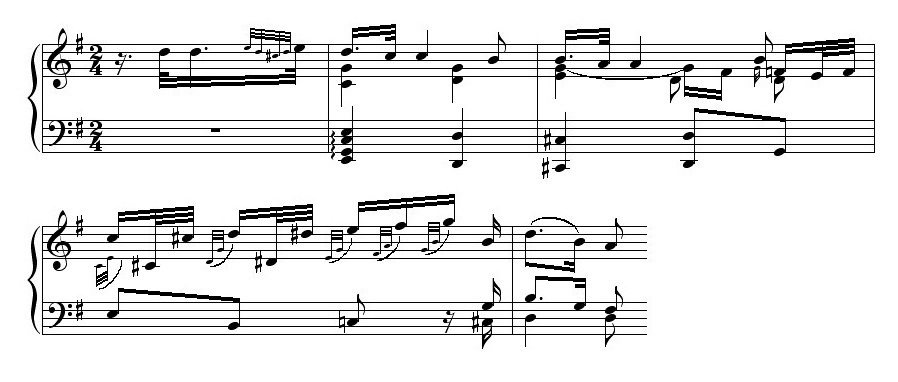
You are introduced, the crowd is applauding, the theatre is dark, and you walk onstage, weaving towards the piano; you bow and before you know it you are seated and you are staring at this:


How can you thank a composer sufficiently for giving you something like this to play? It is not one of those delicate, evasive beginnings whose success depends on the pinpoint execution of a number of small details, in the heat of the initial moments. You begin with a few strums, as if trying out the keyboard, and before you know it you are mid-inspiration: in the throes without even trying. It is so generous, it seems to express love but in every possible direction, plurally, democratically, towards the piano, towards the listener, and even towards lowly me the performer. And you just let it fly. There is only one puzzling moment, at the end of the provided example: I have "gotten stuck" here so many times, wondering how to play this descending fourth, G to D; a pothole in the too-perfect road; at this moment, Mozart, instead of spinning out perfect, inevitable melody, seems to be "treading water," merely filling in the harmony with an unexpressive interval... Do I play the low D as if Mozart is reaching into the underlying harmony, into another voice? Or is it part of the main melody? Luckily, just at this odd, flagging moment, the left hand interjects another strum and this seems to wake up the right hand, which leaps into another (perhaps even more unbelievable) phrase: we are back on top, baby.


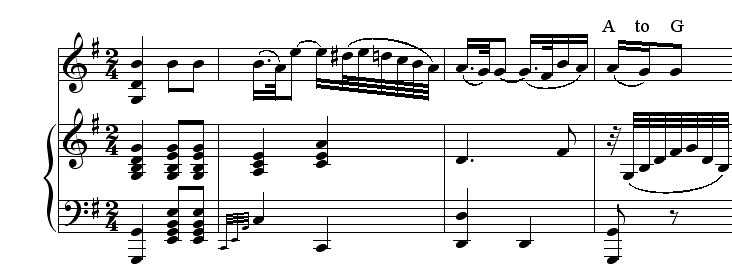
I believe this "odd flagging moment" to be an intentional flaw, the one thing to make the magic melody not work. Why would Mozart choose to fail, even for a moment? Because when the violin enters, playing the same melody, and it comes to the same juncture, it "corrects the problem":


Between the piano's G-D, and the violin's A-G, an enormous abyss. The piano's resolution was non-committal, structural, neutral, a girder at the end of the phrase, holding it (classically, at a distance) in place; while the violin's resolution is made of flesh, sound, sensuality; the sweetness of the violin's suspension somehow finally encapsulates, expresses, condenses the generous loving idea which the piano has set forth. In that one aha! moment, the violin shows the piano how it should have been done, and brings the ecstasies of the opening down to earth. But if the piano had played the violin's resolution earlier, at measure 4, the piece would have been prematurely complete; so the piano "had" to fail. The piano had to look for a second phrase to answer the questions of its first, but the violin makes it clear that the answer was already innate in the opening statement: that we need look no further. Rather than two paired question-answer phrases (the paradigm of classical rhetoric) we have a beautiful symmetrical setup where the initial question becomes the answer.

This resolution (over which I realize I am obsessing), in one of those beautiful paradoxes native to music, brings one motion to an end, and sets the piano on another motion: the aha! moment is the elision of the end of one endless arc, and the beginning of another: the intersection of paradises. Speaking of intersections, yesterday I was playing the "Kegelstatt" Trio, and the page turner and I were having a delightful time, like conspirators back there, because I was excessively drawing her attention to some delicious things that happen in the left hand of the piano in the last movement. You have your thematic moments, you know, when the bass has a kind of purposeful, defining motion ("boring" as such), and then you have these great moments where Mozart slips into a kind of vamp, where the bass just oscillates tonic-dominant or vice versa, and there are these simple little bassline ideas, snippets, making their smiling statements down there.... Mozart draws us into vamp hypnosis, letting us enjoy the wandering, and then--and then--just when are going under, just when the vamp nears vapidity, the theme reappears out of a twist of events, and the bass becomes happily disciplined again, does lovingly its dutiful thing, and those moments at the intersection--in which the theme, a mere thing, appears like revelation--are so wonderful you just want to kiss somebody or something. Unfortunately this is usually not appropriate onstage, and a musical moment is very hard to kiss, except by playing it just so. So it floats on by, the kissed or unkissed moment; you play it the best you can; oh my lost ones.

Thursday, June 01, 2006

Hypocrisy

A couple of my close friends know very well that I have A PROBLEM with hearing about people's dreams. A friend will call in the morning and start in on some dream they consider mind-blowing and I will be listening in agony and distress, pulling anxiously at my sense of friendship. "And then the pink elephant turned into my mother, and started talking through its nose about mortgages, and meanwhile the sidewalk was made of chocolate and I broke off a piece and ate it, and it turned out to be a piano key." My problem is partly a matter of timing; people are often inclined to tell me their dreams in the morning, just after they have had them, before they can vanish in the fog of day, and this happens to coincide with the dangerous period of the day when I am ramping myself up on coffee to forget the unpleasantness of awakening (no morning person here am I). There is always a jittery, irritable period somewhere in the middle of the coffee cup and the dreams often come over the phone to me around that same time, when my feet can barely keep still, much less my mind. There's no narrative focus! I want to scream at them, before tossing something out the window.

So it is with no small dose of trepidation and hypocrisy that I offer this morning's dream to you.

...the ultimate cliche of Denk dreams: the concert. I am on stage with Joshua Bell and we are beginning to play the Tchaikovsky Violin Concerto. Just as in Oberlin, nearly 20 years ago, I muff the chords just before the violin's entrance, and it seems the very same faculty members from 20 years ago are there, muttering amused, knowing disparagements. We are playing this piece (which we would of course never play in concert, never mind) and somewhere along the way, I feel a tug at my right arm, someone trying to show me how to play a series of chords better, with more arm weight ... more roundly. There he is on stage, interrupting the performance, a mystery man in a black trenchcoat (Death? Tchaikovsky?), offering trenchant remarks. I begin, while playing, to sense a general fracas. Someone tries to "take out" the mystery man, who evades the nameless tackle. Intermission is thereby called. Josh and I walk endlessly down a hallway to our waiting place. People are passing everywhere, talking to us, buying outfits (it seems our dressing room is also a mall), eating meals; there is no sense of a concert whatsoever. I keep begging people to start things up again, but they don't. Finally, inexplicably, we are walking back into the hall. But this time we are in the audience, and the stage is taken up with a giant television screen on which a football game is playing. In a detail which seems gruesomely true-to-life, people are suddenly much more enthused about the game then they were about the concert. Josh is watching very attentively; I poke his shoulder to remind him about the concert but he pays no attention. I begin to shudder. "Will this concert never end?" I realize with horror that this concert may never end, that it may continue for the rest of my life, and I am not at all in control.

And I woke up. Light was streaming through the steamy morning air of my apartment in Charleston. Reassuringly, I glanced at my DVDs of South Park on the bedside table, stacked atop poems of Eugenio Montale. Ah yes my life makes as little sense as always: this must be reality. I downed a glass of water, listening to echoing mental remnants of the Tchaikovsky Violin Concerto. I tend to feel the intrusion of nonsense in dreams as a negative force, as a dangerous slippery slope, a dark destructive underside. But it seemed to me suddenly that dreams interpose a very tangible, useful nonsense, something like a surreal vitamin, into existence. Their deliberate undermining of the 1+1=2 school of life, to which we cling ... an antidote to logic's sadness and completion. The idea that concerts have definite time frames; that performers have a sacred realm onstage; that also the backstage area is a private, elevated zone; that there are spectators and performers, and they are totally separate entities: all of these "truisms" are questioned by the dream, beautifully, which replaces certainty in all these cases with a fuzzy interchange, a nexus of shifting meaning. At least that's what I think I thought. The very red curry before me on a white plate right in a delightfully cool dining room in Charleston, SC, is but the tip of an enormous strange iceberg, and as I gobble it down, I contemplate the surreality of existence with an uneasy delight.

Saturday, May 20, 2006

Shards

This last week in New York was supposed to be an organized and organizing diving board for the summer. Instead, it was a frenzied jumble of experiences, which I grabbed at uselessly like a tray full of dishes I have dropped. No way to hold on to any of them: they slip and fall and I accept their breakage as a receipt for time.

Some were good. A broken, ruined afternoon became a miracle. I had to wait in the dentist's office for a couple hours and my only possessions were the clothes on my back, an insurance card, a credit card, and Faulkner's Light in August. This poverty was enriching. Hilarious women stumbled in and out of the office, wagging their damaged mouths incessantly at their cellphones, arranging playdates and pickups for their children, while their cavities and abscesses were X-rayed, and the sarcastic Jewish dentist poked his head out from time to time, summoning them like naughty but amusing children, and arranging treatment which was always too late. Normally, a fertile Petri dish for Denk irritation, but no, all this fluorescent bustle ignored me; I was in a magic circle, traced by the power of the written word. You do not need a beautiful place to read a book, no forest nook or bay window, no idyllic lighting or comfortable chair; this office was poorly lit, crazed, uncomfortable; what you really need is a great book and some mild willingness to surrender.

This was one shard of the week. In another, I was gazing at the chilly dark blue of an evening sky somewhat up the Hudson and sipping a cold white wine, and admiring the perfect shape of a tree. Then we were hurtling down the road in a car, and I was looking over the trees at the perfect bluish glinting of the river, which the sun was just leaving behind, and I was nearly screaming at the driver about beauty and trying in some way to hold onto the moment: a moment defined entirely by its own waning. (Are there any moments defined by their clinging?) My dear driving friend, and the oncoming summer, in which I feared mere repetition, and the year past, now appearing as a sum total, as a lost, accomplished thing, all merged into a windy blue journey to catch a train, the last train of the year, as if I would not escape from the past if I didn't make this fucking train. We were rushing for the train, which was rushing; and the sun was slipping away too; trees slipping from green into black; the river never rushes, but unlike the train alongside it, it never stops. This was my birthday.

In a third shard, I was listening to a wonderful concert in Zankel (David Robertson, et al) and this movement of the Ligeti piano concerto began with a transcendental, eerie lament, and concluded with the most ridiculous harmonica passage, something like a barbershop quartet cadence: totally absurd. Wawawawa. And I laughed out loud, and looked around and saw no one else laughing, and wondered why. Luckily friend S looked over and clearly acknowledged that something was afoot, so I knew I wasn't just going mad, quietly there, in Zankel. Then post-concert I found myself at dinner and I looked up from my plate of pasta, and briefly and suddenly had no memory of walking to the restaurant whatsoever, or the concert; it suddenly seemed as though this post-concert dinner were not connected to the immediate past or future, but to all the other post-concert dinners of my lives, which were now freely floating in a timeless haze. What was I doing there? It seemed I could leap off one cloud and end up on another, for example, at some post-concert dinner in Louisville with a mint julep, or at the coffeeshop eating nachos in Marlboro, or any number of places, having just played or listened, and consuming in the wake of applause. Suppose we could organize the passage of time in our lives using items in the Hold Everything catalog. How would we sort the past? Chronologically, or by subject matter, by import, or by genre of experience? If we put all the post-concert dinners in one basket, would some hidden pattern appear, or would we just stuff that basket in the closet as far back as it could go, in the hopes that it will not have to be opened? Would it be a tasteful rattan basket or one of those plastic dealies from Staples? Luckily, somebody does the organizing for us.

When I was an undergrad student at Oberlin, I often felt rhythmically chastised, and unjustly corralled. I guess I was semi-famous for being rhythmically ridiculous, and it seemed to me my teachers were bores, kind of Ward Cleavers of pulse, leaping on rhythmic diversions as if they were mortal sins. I would plead "Daddy, can't this beat be a little bit late?" and off to the confessional it would be. By my doctoral days, at Juilliard, I felt freer to express my disdain, and mocked mercilessly an endless talk by a very famous music theorist which spent an hour attempting to "prove" that it would be reasonable to take (a bit of) time in a particular measure of Mozart. (As if this phrase "taking time" could mean anything except in the very act itself; as if one needs permission; time is different in every single phrase you play, is conditional upon tactile sound. I'm sorry, but we performers, even more than composers, and so much more than theorists, own time. So there.) But now, these "wiser" days, I often find myself asking of any rhythmic event: "Why?" Cunningly, analytically, heartlessly, I ask myself: is note X late because of my mind, or my finger? I feel the creeping need to justify any departure from the beat--this tyrannical beat to which I have become addicted. Rhythmic organization seems more beautiful to me now, whereas chaos seemed better then. I believe I have to take this onrushing wisdom with a grain of salt, as a partial lie; to place it in quotation marks; to not accept the solution of conformity too easily, not let its power and fashion seduce me. It is possible I was right then and I am still right now, when my convictions are so different in nature.

A week like this last one suggests the allure of the beat, of routine, of pattern. Slipping, sliding from Monday to Friday I found each day a bit terrifying, in my own lack of preparation, and the intensity of each experience. No, wait, I'm not ready to feel that way! And indeed, as I was playing through my beloved Davidsbündlertänze, warming up for a Friday night recital, I was surprised how surprised I was; where are those feelings coming from? They seemed the cadence of the week's phrase, and no ridiculous harmonica anti-conclusion, but as logical a conclusion as emotions can summon to tie together the unprepared jumble of a week's worth of dropped dishes: events cleared of their connecting, supporting strands, coming like accidents, but crashing into a floor which is no accident whatsoever. And then the new Denk reorganizing the old Davidsbündler, finding all the ways in which 21-year-old Denk was lazy about the beat, and stripping time away like varnish, and looking purely at beats without pull. This takes time, and I was still stripping things clean minutes before the recital, and it seemed there was a lot more to do, and each act of temporal cleaning made the piece look unfamiliar, an alien beautiful thing. The piece was once again outside me, rather than the old, absorbed friend. I felt the pastness of the old way, the age of my experience. I was not able to prepare myself for this shock. Playing something with a conscious change and having it sound different from ever before is a mild out-of-body experience, the proof of unpredictability. And particularly in the last three dances, moving from humor to uncertainty to lullaby to memory to tragedy to some thing well beyond any of those, in which Schumann attempts to "summarize" the unsummable, there I felt I couldn't hold on to the piece which was changing and bucking below me like this last week. And I felt suddenly some reason and unity to the preceding days, leading to that moment; sometime, yes, there will be time to gather and organize, and really you should get on that, but in the meantime: break what needs to be broken.

Monday, May 15, 2006

Adorno

"The maturity of the late works of significant artists does not resemble the kind one finds in fruit. They are, for the most part, not round, but furrowed, even ravaged. Devoid of sweetness, bitter and spiny, they do not surrender themselves to mere delectation. They lack all the harmony that the classicist aesthetic is in the habit of demanding from works of art, and they show more traces of history than of growth. The usual view explains this with the argument that they are products of an uninhibited subjectivity, or, better yet, "personality," which breaks through the envelope of form to better express itself, transforming harmony into the dissonance of its suffering, and disdaining sensual charms with the sovereign self-assurance of the spirit liberated ... It is as if, confronted with the dignity of human death, the theory of art were to divest itself of its rights and abdicate in favor of reality.

...

Death is imposed only on created beings, not on works of art, and thus it has appeared in art only in a refracted mode, as allegory. The psychological interpretation misses this. By declaring mortal subjectivity to be the substance of the late work, it hopes to be able to perceive death in unbroken form in the work of art. This is the deceptive crown of its metaphysics. True, it recognizes the explosive force of subjectivity in the late work. But it looks for it in the opposite direction from that in which the work itself is striving; in the expression of subjectivity itself. But this subjectivity, as mortal, and in the name of death, disappears from the work of art into truth. The power of subjectivity in the late works of art is the irascible gesture with which it takes leave of the works themselves. It breaks their bonds, not in order to express itself, but in order, expressionless, to cast off the appearance of art. Of the works themselves it leaves only fragments behind, and communicates itself, like a cipher, only through the blank spaces from which it has disengaged itself. Touched by death, the hand of the master sets free the masses of material that he used to form; its tears and fissures, witnesses to the finite powerlessness of the I confronted with Being, are its final work.

...

[Beethoven's] late work still remains process, but not as development; rather as a catching fire between the extremes, which no longer allow for any secure middle ground or harmony of spontaneity. Between extremes in the most precise technical sense: on the one hand the monophony, the unisono of the significant mere phrase; on the other the polyphony, which rises above it without mediation. It is subjectivity that forcibly brings the extremes together in the moment, fills the dense polyphony with its tension, breaks it apart with the unisono, and disengages itself, leaving the naked tone behind; that sets the mere phrase as a monument to what has been, marking a subjectivity turned to stone. The caesuras, the sudden discontinuities that more than anything else characterize the very late Beethoven, are those moments of breaking away; the work is silent at the instant when it is left behind, and turns its emptiness outward ... Objective is the fractured landscape, subjective the light in which--alone--it glows into life. He does not bring about their harmonious synthesis. As the power of dissociation, he tears them apart in time, in order, perhaps, to preserve them for the eternal."

--Adorno, Late Style in Beethoven, tr. Susan H. Gillespie

Sunday, May 14, 2006

Happy Mother's Day

In accordance with the Denk Law of Bags and Possessions, the outer pocket of my new "hip" shoulder bag is now filled with the pulverized remains of a Digestive Biscuit. No blender or food processor, no matter how powerful, could attain the sheer level of dispersion that simple Denkage is able to achieve, through the regular processes of Life. The Law of B&P cannot really be put into words (being one of those mysterious, generative laws of the cosmos), but its essential effect is this: no matter how much Jeremy Denk invests in a new backpack or bag, and no matter the care taken with it, eventually its insides will be coated with the diffused remains of many inappropriate items, sometimes foodstuffs (bananas, muffins, Clif bars, ketchup, stewed prunes, etc.) and sometimes other sundries--provided that these other sundries are able to somehow damage or affect the bag irreparably--for instance glue, indelible ink, or Hydrochloric Acid. One can thus "carbon-date" or "scum-date" the bag's existence conclusively on the basis of a perusal of its insides.

I have come to accept these accidents, in short, as essential: the ink with which my history is written.

By accident, I became a good guy yesterday, for seven minutes. I was getting off the LIRR from Jamaica, at Penn Station, when an elderly lady with a cane asked me to help her with her luggage. Throughout the slow walk to the elevator, I felt both the pleasures of patience and the unfamiliar glow of simple virtue (helping a lady with her bags, how quaint!), and this glow warmed when she began to talk to me about opera. Her accent dripped Long Island; it was a thousand Greek salads eaten in a thousand diners; she told me she went to Rigoletto and found it "so beautiful." The word beautiful took a long time for her to say, and its sincerity was unquestionable ... so different from the standard formulas we musicians are forced to exchange with each other backstage ... beautiful without any reservations, and self-contained, like a flowerpot. As the elevator ascended, she asked me about another opera, "Cavalry something," and I pronounced it for her in Italian, "Cavalleria Rusticiana," with a slightly overdone, proud pronunciatory flourish, and she smiled at me such a charming "look-my-son-grew-up-to-be-a-doctor-and-he-also-speaks-Italian" smile that I realized I had much more than recouped my investment of time with her; it was I that was exploiting her; I had replaced a harried luggage-hauler (the Jeremy-who-would-have-been) with a charmed elevator-rider who might as well amble, since time is not money but infinitely more precious.

The scales at least partly came off my eyes. We emerged onto the concourse, and she started to ask me "when are you playing in New York? Can you..." I told her I wasn't playing really much until October, or December in New York... she asked me where and I told her and her eyes googled in amazement. "Can you...?" she began again, and I assumed she wanted my name and contact info; I asked her if she had an email address, and then the terms of our dynamic changed. "Goodness no," she said, as if it were the most absurd thing in the world, and her eyes hinted vague distrust. A nice lady like her, using email? I offered my number, and she looked even stranger ... I thought I saw my error, and wrote my name on a Harrod's receipt and gave it to her, told her to look for me in the concert listings. This crumpled inscribed receipt, especially, did not impress her. This was understandable; I had no card, no official thing; I wracked my brain. But the source of her disappointment was elsewhere: "What?" she said, "You don't have any tickets?"

I laughed. What else was there to do? It is so nice to laugh in Penn Station, a relief from the linear harassment of the concourse. Yes, I was carrying around free tickets for all my upcoming concerts, and giving them out like candy? I saw in her eyes that while I had once impressed her, I had already travelled deep into a ravine of disappointment. I was also slightly disillusioned myself; she was, after all that, like the rest of us, looking for a free ride. In that short space of the elevator ride, I had travelled the full gamut of a parent-child relationship; from the first mysteries of her discovering who I am and what I like to do, through pride in my accomplishment, to the inevitable coloring of disappointment; the drawn boundary inevitable, as the child asserts its own self, finds its own way, and begins to see the parent as human too. Was this a pre-Mother's day message? Or just, in the immortal words of Homer Simpson, "a bunch of stuff that happens"?

I laughed, and we parted ways, and I could tell she wasn't going to keep my receipt for very long, but it was all good. I ate a Red Sicilian slice in honor of her, and thought of her sitting through Cavalleria Rusticiana, smiling and clapping ...