Monday, October 30, 2006

My Umbrella

My umbrella needs no Viagra. It jumps at every chance. It attempts to come open under tables, in drawers, as I am passing through doors; it is coiled kinetic energy; it is a teenage umbrella in heat and I have considered buying it Judy Blume books just to calm it down. I am nervous it will embarrass me at any moment. If it is possible to screw up the purchase of an umbrella, in every imaginable way, I have done so. Attention to detail, even in failure, is my strong point. Fed up with the evil person who stole my last magnificent green domed colossus from the locker room at New York Sports Club in the middle of a tremendous downpour (bad, bad karma, whoever you are!), and no longer willing to humor its substitute, a tattered, paisley, hopeful but pathetic remnant of cloth, its frame poking crazily askew like a squashed metal spider, I finally strutted into Duane Reade on a rainy morning with a mad, to-do-list-checking, umbrella acquisition urge. But every New Yorker knows, you should NEVER buy an umbrella in a store: you should only buy them on the street, from suspicious vendors, in the middle of a precipitation event. Only then do urgency, need, opportunity, and economy-of-scale meet in a flash of cash-only swiftness which makes one glad to be alive. Haste makes waste, and bad taste; my foolish desire and unusual simplicity-of-action bade me ignore the sign reading "The I Love New York Umbrella," with its typical, disgusting, rebus-substitution, and I bought what appeared to be a black normal umbrella (is that so much to ask?), but which turned out horribly to be a TOURIST umbrella, broadcasting on two of its panes "I [heart] New York," a sentiment which this magnificent city, in all its industrial bespattered grimy cynical splendor, can only regard with utter distaste. Yes, we [heart] you too, all you people from Iowa, or Minnesota, and let us express our love with refrigerator magnets.

Wow. Kinda lost it there. Apologies to all from Iowa/Minnesota. That burst of Manhattanism was really just an emotional reaction to the stress of walking down Broadway in the rain, suffering all the trials of a New York resident, living in what other people would consider a cupboard, but still having to appear to all the world like a tourist. And moreover that Duane Reade, the ultimate depressing New York City drugstore, would betray me thus! Et tu, Duane?

Speaking of losing it, and Minnesota. A week ago, I was slated to do a rather ridiculous thing, i.e. fly altogether too late to a concert, fly the morning of a concert out to Bemidji, MN.

Now, it is a journey out to Bemidji, and I had played it semi-safe by booking, through my manager, the earliest possible flight. My schmancy alarm clock thus buzzed most unwelcomely at 5:30 AM, in the palatial West Wing of my apartment, and there ensued that daze and misery of the sudden urgency and the socks that won't go on properly and the assembly of clothes and the impatient phone call of the waiting limo driver and the scurrying of my various butlers, all of which I survived to find myself at JFK's Terminal 4, at a respectable 6:35.

But my hubris of timeliness was ill-rewarded. There was no reservation under my name, or under any of my many aliases (all very sexy and mysterious), and I ended up with a quivering cell phone under my ear, learning from a very sweet lady that I would have to buy a fantastically expensive ticket then and there to get to my destination, and, there was nothing available on the 8 o-clock flight, and, so I'd have to leave at 11:30, and pretty much barely make it.

Please understand! I am already in a very vulnerable emotional state in those early-airport moments, something like a baby that emerges from the womb only to face a firing squad.

Nonetheless I am a proud frequent traveler, averse to exhibit the base emotionalism of all the "amateur travelers" who get all cranky when their rental car is not the color they requested. I was the soul of politeness to the Northwest Airlines staff, whose fault this situation was not, and did not let the depth of my distress leak to them ... except for occasional aphorisms such as "life is a vale of tears." But once I had my ticket, and I found myself adrift in the food court for several hours, with just not quite enough time to get home and back again, a whole new existential situation began to present itself. I began to think the saddest thought I have ever had: my bed, lying empty, without me in it.

Bed. And again bed. Rustle of sheets; sensual whisper of pillow. The glow of the pre-sleep moments, the soft sinking of consciousness, the surrender to rest and relief. I imagined myself in a fetal position, clutching Marcella Cucina, my favorite cookbook, as I sank into dreams of Risotto. Meanwhile, the fluorescent light of the food court bounced horrendously off the yellow formica of my table, and I squirmed painfully on my concrete bench, and sipped another in a series of recurring coffees which did not wake or calm me, but exacerbated my neither/nor-ness (not a word). Ranting cell phone calls were placed, and many weekend minutes were tossed casually into the vault of wasted time. My rage spun slowly around its object: whatever had happened to my reservation. And then I paced, Rilke's panther in the cage, paced again and again past Sbarro and McDonalds and Sharper Image, the bars behind which no world appeared, and when I unwrapped my Egg McMuffin I dropped the egg upon the floor (indignity of the imprisoned man!). I sought relief in the world of ideas, i.e. the bookstore, and unbelievably! the first book that presented itself on the first shelf I came to was William Hazlitt's On the Pleasure of Hating:

In private life do we not see hypocrisy, servility, selfishness, folly, and impudence succeed, while modesty shrinks from the encounter, and merit is trodden under foot? How often is "the rose plucked from the forehead of a virtuous love to plant a blister there!" What chance is there of the success of real passion? What certainty of its continuance? Seeing all this as I do, and unravelling the web of human life into its various threads of meanness, spite, cowardice, want of feeling, and want of understanding, of indifference towards others, and ignorance of ourselves, - seeing custom prevail over all excellence, itself giving way to infamy - mistaken as I have been in my public and private hopes, calculating others from myself, and calculating wrong; always disappointed where I placed most reliance; the dupe of friendship, and the fool of love; - have I not reason to hate and to despise myself? Indeed I do; and chiefly for not having hated and despised the world enough.

How comforting.

That evening, exhausted, I played two Bach Partitas and the Liszt Sonata. Moments after I finished, a woman about 50 years of age came by my dressing room and told me in a Midwestern rhythm that she felt it was a once in a lifetime experience and that many of her friends felt the same way and she thanked me for coming and making the long journey and her face was as plain as a blue sky. She let her eyes sit with me for a while and I could see that while many New Yorkers' faces seem to be a miracle of added-on layers, of wrinkles of experience and cultural accretions, her face over the many harsh winters seemed instead to have been whittled down; things had been removed with time and what was left seemed very honest. She politely excused herself and, as I heard her steps going down the corridor, something snapped and finally I felt myself let go of the held breath of the morning's frustration. I was still exhausted but now in a good way, in a real way which could be solved with sleep. I sat in front of the dressing room mirror and recognized myself. I was happy. I remembered a few phrases I liked in the concert and knew why I was doing what I was doing. And just then the Spirit of New York City came into the dressing room; it was pretty pissed off, yelling at me for getting "all CBS After-School-Special," and threatened to beat me senseless with my [expletive] tourist umbrella if I didn't pull myself together and get good and miserable for the long return flight home.

Thursday, October 26, 2006

Favorites

Favorite Quote of the Week

"We've done Peter and the Wolf so many times, we're starting to root for the wolf."

--unnamed person affiliated with the St. Louis Symphony


Most Ridiculous Quote of the Week

"There is absolutely nothing artificial about Glenn Gould's playing."

--Bruno Monsaingeon

Polite response: a certain stylization is actually somewhat characteristic of his work. Less polite response: I mean come on, what kind of Kool Aid are you drinking? Is there anything NOT artificial about his playing?


Favorite Meal of the Week

An egg-salad sandwich on toasted white bread with iceberg lettuce, a pickle, a glass of ice water, and a Wild Turkey on the rocks.

and finally,


Runner-Up Favorite Quote of the Week

A photographer friend is looking desperately for an apartment, and has been in email contact with all sorts of persons to that end. He received the following philosophical missive which seems to stray off the subject of subletting considerably:

"Thanks for giving the world nice photos and for being Gay. I'm not Gay, but I support full Gays rights, and I wish that I would wake up in the morning and find the 95 percent of the world population has turned Gay. The world would for sure be a better place. This might save the world because it's too over populated and mother nature doesn't have a chance."

Thursday, October 19, 2006

In Which All Is Explained

Dissonance is cool. Its cool-factor and yuck-factor are often, however, at war.

For every elderly concertgoer who wrinkles his face and complains "it's so dissonant!" there's a conservatory student in his late teens at a carrel in a listening library hearing Gesualdo or Kreuzspiel for the first time, beaming, eyes wild, thinking "dude, that's f*&*()#$ awesome!" You know I'm right about this. So am I suggesting youth cherishes dissonance and age consonance? Or just bandying stereotypes? I know, for example, my parents are in their 70s (I don't know if that's considered young or old anymore) but they can be quite dissonant in the mornings, especially when my dad's making green chile and eggs and mom gets in the way of his frenetic journeys to and from stove and sink. Anyway.

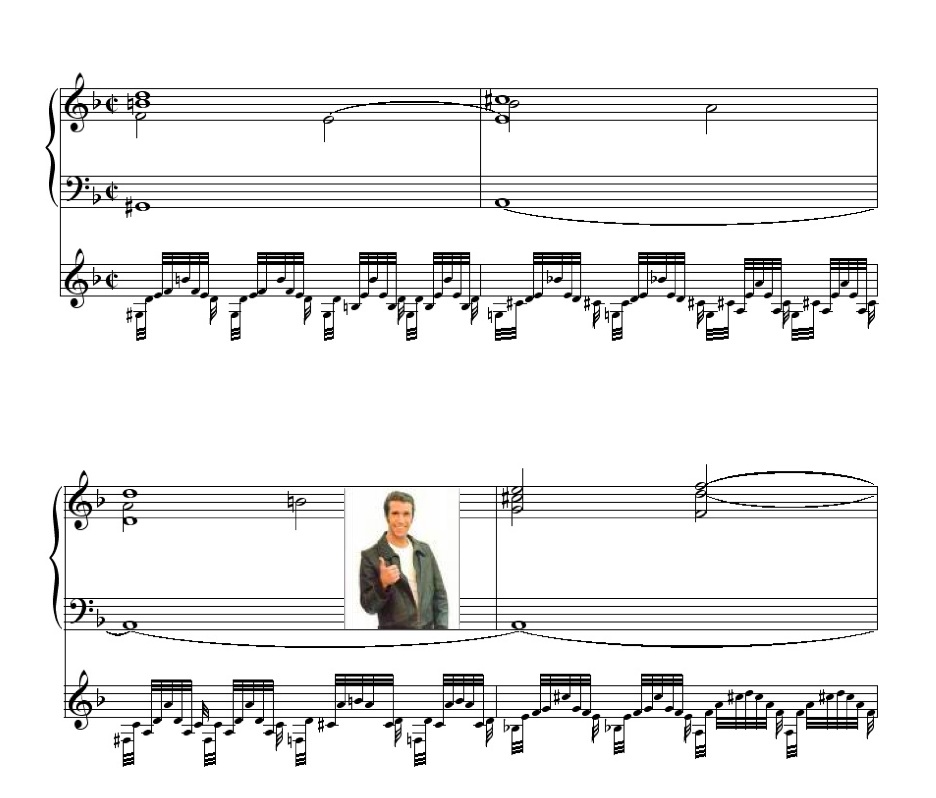
Syllogism: Dissonance is cool. The Fonz is cool. Ergo: dissonance is the Fonz. He (or you can imagine a female Fonz if you like) strides in in a leather jacket; he does what he wishes; he cares not for convention; he is not fazed by conflict; he makes waves, stands out, attracts attention; he is seductive; he attracts and exists in clusters; he resists resolution, i.e. conformity, but he values his relationships; he knows where he is going, but is in no hurry; he loves to be prolonged (aeyyyyy!); he has a distinctive identity; he lives over the garage... Imagine if you must all the dissonances living in a little apartment over a garage, partying harder and harder through the 19th-century, testing their limits, until finally Schoenberg comes along and emancipates them all (the Abraham Lincoln of dissonance); suddenly with a shudder and one last mournful Tristan chord they come to realize all the fun's gone and that without limits the party's just a lame bunch of drunken dissonances above a garage, getting old and with nothing to do.

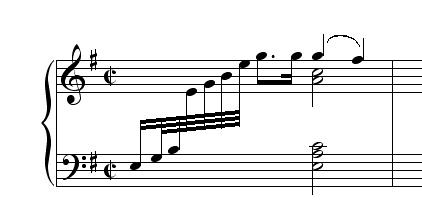
The cool "Fonzian" dissonance of the day (should this be a regular feature of Think Denk?), which prompted these "profound" reflections, comes from good old J.S. Bach BWV 1052:


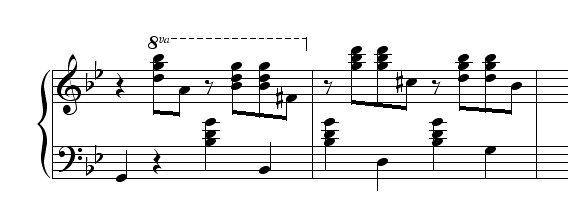
Just look at that puppy! Madrigalian, searing dissonance. The F-sharp there in the bottom of the cembalo, travels down to F-natural, on its way to E-natural, just slidin' on down "innocently" (nobody here but us chickens!); meanwhile the A in one treble voice is heading up to C# and has to pass through B-natural, and there it is, the "Fonzian tritone" (I so TOTALLY invented that term, dude) that results, F-B, the ultra-hip diabolus in musica, a viscerally satisfying traffic accident of passing, colliding lines in which no one needs to get hurt but there is all the thrill of conflict and the onward rush of the incompatible. The B-natural is also wonderfully dissonant against the A pedal (the dominant pedal, that is) and the general D minor-ness of everything (music theorists, moan if you must, at this imprecise labeling, moan on and on, I'm not listening lalalala), and its searing ascent reverses a large extraordinary pattern of preceding descent, so it's also semantically dissonant, so there! These dissonances are linked, spiritually connected, to the ongoing tension of the dominant; they symbolize and represent the music's captured, caged, not-yet-allowed-to-hit-the-tonic fury. If you are at the Carnegie concert on Dec. 2, or at the other Orpheus appearances, and you recognize this moment, and you remember to think of the Fonz, please say "Aeyyy!" to yourself, quietly, in your mind. If you say it out loud, it might be distracting. Or say it to me backstage, I'll be delighted.

In a mostly unrelated note, one of my exes delightful, dear old friends studied my concert schedule and casually invited herself to stay in my apartment while I was away playing. During her tenure, my dish soap apparently gave out (certainly not due to overusage on my part!) and she replaced it not with Palmolive but with one of those so-called Natural Soaps from the Organic Aisle. For months I have been using this Natural Soap, as if under the evil, irresistible spell of Whole Foods, and I had apparently forgotten the real nature of suds; for today when the natural stuff ran out and I had to use some new Green Apple Palmolive, it was like being reborn in the Scrubbing Garden of Eden. The suds fairly overflowed the sink with joy at returning after long exile to my besoiled domicile, and I too couldn't help smiling as the smell of a green apple jolly rancher filled the kitchen, and I meditated that dissonance is a lot like a green apple jolly rancher, sour but tasty and eventually melting, etc. etc.

P.S. I have never been and probably will never be a fan of the show Happy Days. I obtained the proper spelling of the Fonz's catch phrase from this indispensable website, in which the cultural milieu of my pubescent years is enumerated.

Tuesday, October 17, 2006

Matters Major and Minor

Yours truly settled warmly into plush, red row W at Carnegie Hall, in a single seat at the end. I felt suspiciously glanced-at in my unaccompanied state (no, really, I have a life!) by my more elderly neighbors, and little suspected I had forgotten how K. 503 went. I thought I knew my Mozart (idiotic mistake), I smugly clutched my glossy program in preemptive assurance, and was later so abashedly, completely happy to have forgotten. Perhaps a professional classical pianist should not "be able" to forget 503, or should not admit it, but I really don't care.

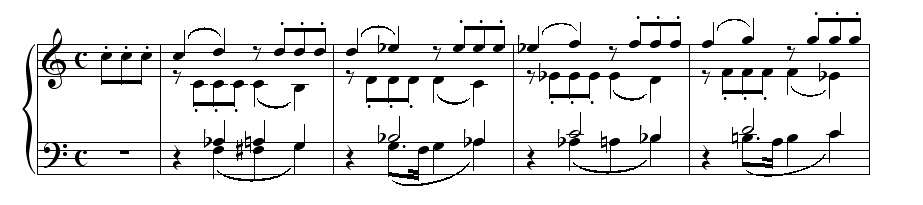
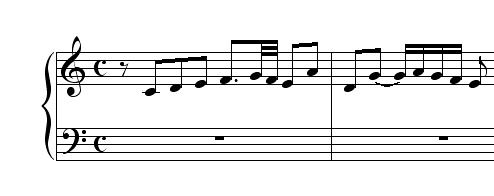
As all those "in the know" know, the piece begins with a rather grand gesture, taking its time through two 8-bar phrases to say "here I am." (Benignly, nobly: not at all like, say, Jack Nicholson making his axed entrance near the end of The Shining). This Mozartean hello matched my memories; things were proceeding C-majorly, according to plan. There was even time to observe the similarity of these opening sixteen bars to the archetypal first four of the Well-Tempered Clavier:


But, as those "in the know" also know, the second 8-bar phrase is met at its conclusion by a little accident, a 2-bar extension. That's the evil jargon we boring musicians use to express the idea of some "extra" measures at the end of a phrase, some kind of musical so-called superfluity. Extension, by the way, like so many music theory words, always seems like much too heartless a descriptor--it calls to mind a reprieve on a paper, or some add-on to a house, rather than some deliberate, beautiful volatility or asymmetry introduced into an evolving text. (Any readers who wish to propose a substitute name for "extension," please do!) By the dastardly genius of Mozart these two bars are pretending to be no big deal, just a little echo, i.e. the same as the last two bars of the phrase, but in the minor key. They are, however, a big deal.

It was at this moment, just after the little echoing 2-bar minor key pivot, that my memory failed. Precisely at bar 19, I had no idea what was happening or was going to happen. And what seemed to be occurring onstage, in my ears, or brain, or near the ceiling, or wherever (no specific site for the happening) in this new unknown space seemed to be unbelievable, at least for a moment: a moment of creation and possibility. I say this without exaggeration. I felt: if that could happen--

why, anything could happen.

At intermission I ran into friends E and J and I tried to put my 503 excitement into words, but the words coming out of my mouth were flat and unsuccessful: something "wouldn't take," something elusive, crucial, misplaced.

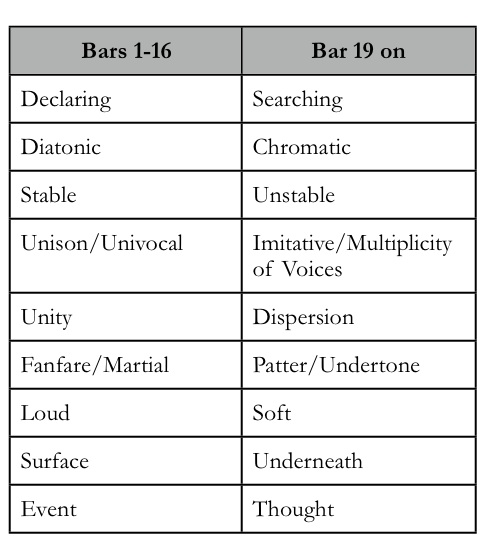
The basis of my happy disquiet was the feeling that there were two worlds, or two spaces. Mozart first poses the obvious, the overt and harmonically noble, the world of grand operatic entrances and declared high purpose (musically speaking, a world of slow unfolding I-II-V-I, circular perfect tonic-establishing entities). But then he immediately poses an undermining counter-text: a chromatic, agitated sequence in the minor key ... Later on, in rampant caffeinated pursuit of the something that wouldn't take, I indulged myself and tried to make a little table contrasting the two materials, grouping simple musical contrasts with associated metaphors:

I realized: this contrast, this shift to minor, would not nearly be so riveting if it did not seem to immediately and fundamentally strike at the very meaning of the opening material. (Bar 19 is not different in kind, but different in essence.) The first sixteen bars are all about certainty; they define, they enumerate, dispose, declare, set forth. They confine themselves; there is nothing to call a melody; there is simply harmonic assertion; there is no fancy, no diversion; the phrases are rhythmically identical, martial, symmetrical; they flirt with the conventional, even: the stodgy. Having gone to such lengths to dispel doubt at the outset, to create such a capital-O Opening, why suddenly intervene so early on, so disturbingly? I think this (rhetorical) question is near the crux of what was hitting me so hard about the piece.

I love those moments in music (but perhaps not so much in life) where you feel the ground has been pulled out beneath you, and inexplicable profusion ensues. Here in bar 19, certainties vanish, the musical ground vanishes--easy to define and enumerate (rhythm, major-key, texture, style)--and so also disappears a whole set of associated metaphors and ideas, which are harder to define. There is a sudden vacuum created by dispersed certainties, by this vanishing of meaning, and the thing Mozart creates, places in this vacuum, poses as a new possibility, is compelling, suspenseful, with unprecedented rhythmic energy, as if we were suddenly inserted in medias res into the really interesting part of some high, tragic drama, perhaps some moment of wonder or enigma in which various characters are at odds or wondering what is going on, a point just before some sort of climax or revelation. But (!) we are not at the climax of anything yet; we are barely settling in.

To rephrase, this moment is essentially double-edged: with one turning act Mozart creates and destroys; he creates a void only in order to fill it; he erases certainties in order to inscribe a new world. This world does not naturally coexist with the first, but it is "in communication" with it. It is not enough to say the turn of events is a surprise; it is more fundamental than that, a more revolutionary change of perspective. For some reason a ridiculous analogy comes to mind: those moments so common in movies where a character is standing on what he/she thinks is solid ground which turns out to be the hand of a monster, or a giant living tree (when the camera pans out), or the mouth of a whale. The walls are alive, the moment seems to say (the harmonic walls of the piece). There is something quickening in the heart of the piece which is antithetical, perhaps threatening, to it.

The magic, oft-invoked word in The Classical Style is "synthesis," which the great 3 composers are said to have achieved. Mozart is praised for balance, proportion, grace, naturalness, ease, among so many other things. But I'm not sure this moment feels "organic" or "natural." It is, rather, perfect but unnatural; it feels like a rhetorical interjection, the insertion of an Idea, the intervention of Thought. Its genius is not an easy flowering and development, but a sudden dizzying epiphany, a slippage of the mind.

Though the minor literally comes after the major, I'm not at all sure succession is the primary communicated meaning. To me it has a much more interesting relationship to time, something like coexistence, not narrative: the side-by-side vision of opposites. In other words, its message is not "this happens, then that happens" but rather something more disturbing: "it could just as well be this, or that." And then when the major returns after our "bubble" of minor, does it seem to other people that it's just a little too eager to assert itself, that its rising scales and triumphant sequences almost ring a bit hollow, too much of a muchness? Come to think of it, perhaps the opening was a bit too certain of itself as well. Why does it feel to some extent that that grand façade of the opening is peeled away to reveal this inner minor-key angst (raising questions of opening as façade, as curtain, questions of musical "truth")?

I wouldn't obsess over this moment if Mozart didn't set me up for it. This first minor key intervention is so striking, that it forces us to ask: if it happened once, why not again? It isn't really possible, in the Classical cosmos, to have something so extraordinary happen and then not to follow up on it (events follow, in the Classical world); and yet, and yet, this minor-key shift isn't really typical of the Classical cosmos either; how can a non-Classical event be understood or developed in a Classical way? The listener is on high alert, even in the gilded, privileged confines of Carnegie Hall. And Mozart treats this uncertainty as a Theme, in the literary sense. The minor key keeps poking its head in, at regular and yet unpredictable intervals, enough to maintain a perpetual doubt-of-meaning, a constant waver in the fabric of the piece; it shimmers to show the dark minor side and shimmers back into major so that gradually you begin to perceive the work not as a solid entity but as a window, always promising or threatening another side. One can no longer say, comfortably, "this is an antithesis," or smugly: this is major and this is minor. You begin to see yourself, as perceiver, as narrator, stuck between.

I caught myself doing something, I think ... When bar 19 started and my familiarity dropped away, I caught my brain just for a second, like a swimmer in trouble, thrashing, trying to "make sense," to map the pattern of the present onto the past. But I was unable to match the events either to my memories or to the first 16 bars of the piece: to anything at all. There it was: my mind was searching for a pattern connection between the two parts, and Mozart's music at that moment depended on that activity, depended on its attempt and failure (its failure was Mozart's success). I realized, part of the work of the composer is to create roadblocks to pattern perception, beautiful areas where the brain gropes blindly. I realized, too, part of what makes some music sound "too easy" or vapid is the absence of that kind of challenge; allowing the brain to laze around like a couch potato processing patterns in a daze. Mozart, the easy listening, un-dissonant composer (so I read in an interview in the program, aghast, as if this music wasn't living and breathing dissonance nonstop), this long-dead Mozart was the one poking my brain, saying: stay awake, stay awake, keep living, you never know what will happen!

Friday, October 13, 2006

Rules for Counterpoint

Life's dangerous. You could be walking down Broadway, round 94th Street, and find yourself in a near-head-on collision with a former student. These sorts of things happen all the time. Clutching cellphone to ear with another friend, you say a cautious external hello, wondering: what tutelage grudges have been stewing all this time, waiting to explode?

Take comfort, gentle reader, this is a friendly encounter; Former Student is harmlessly (?) heading off to teach Counterpoint. I am returning from Starbucks Odyssey episode 2,342.

One of my little life-improvement dreams is to ruthlessly restudy counterpoint until my species are all settled down and in their proper places. Back in the halcyon year of 1995, I studied copiously (like the little good boy I am) for my Juilliard Doctoral Placement Exam, in the New Mexico sun, while ingesting huge amounts of chips and green chile salsa, dripping and smearing wonderful amounts of salsa on my music notebooks which gave the counterpoint exercises a kind of antique quality, a spicy charm -- at least so I felt at the time. But this chile-induced crammed knowledge could not last long, it was bound to melt like cheese on a quesadilla.

"What are those rules of counterpoint?" I inquired hypothetically of Former Student. I was curious not to hear them, of course, but to know how he would express them.

He started with the curious ploy of the obvious. "Well, no parallel fifths." As if, ironically, taking the question seriously? Then continued, "no unisons... which is really funny." At least I think that is what he said; his mind moves faster than a Roadrunner across the top of a mesa in the creosote smell of the desert after a good rainstorm. Sometimes FS's thought processes leave even this Generation Xer mystified, I who should by right of Birth be cynical of Everything and mystified by Nothing.

I decided to leap in. "Parallel fourths are a problem too, sometimes?" He began to enumerate the situations when they might or might not work, then (I speculated) got weary, in the present moment, with the sun shining down, and the day beckoning, and the brisk cold reminding the skin of its own very existence, of the dos and donots. Perhaps it was all a failed experiment in postmodernism. "There are exceptions."

The breeze blew. A minisecond passed. My other friend waited on the cellphone to tell me something more that I should know about the strange way I conduct my life, or she hers.

Former Student's voice interrupted its own pause impatiently. "There are lots of exceptions. The exception is if you're dead you can't do any of those things." The Carpe Diem School of Counterpoint was thus defined and founded on the corner of 94th and Broadway, in front of a liquor store.

Sunday, October 08, 2006

Scholars Unite!

Saturday 7:50 am. I woke to the wreckage of nail salons: crumbling glass, scattered particle-board, chairs, and three dusty men dismantling endless hours of beauty. Helpful sign explains: “WE HAVE MOVE.” It seemed early to be pillaging, at least on the Upper West Side. Why, most people haven’t even finished their Pilates yet, not to mention walking their pugs and baking their organic brioches. I was irritated to find that the new staffperson at the 93rd Street Starbucks seemed to think we were living in the ‘burbs. She smiled a TV smile (in HD) and threw me a perky plastic how-are-you, and when I (grudging, mumbling, quiet) returned the formality she went into a story about how tired she is [insert braying laugh a la Rachael Ray here]... but she’ll make it, thanks. My subsequent smile was like the crisper in my refrigerator: full of wilted, dried-up, and congealed things. If I had been carrying a volume of Sartre I might have climbed over the counter and attacked her with it. Morning is not my time.

Ah, safely back in the apartment. Whew. I try to really make an art of my grumpiness while it lasts, to live it to the last drop; I am not sure it is not a strange, amphibian form of happiness.

Speaking of grumpiness, I was over again seeing how a real blog works at The Rest Is Noise, and I read the following:
... the one [concert] that cannot be missed is the mainstage Carnegie bill of Electric Counterpoint (with Pat Metheny), Different Trains (with the Kronos), and Music for 18 Musicians (with Reich and his ensemble). I don't see anything as exciting on the entire New York season schedule...

Ummm, excuse me? What about Jeremy Denk’s super-wuper fantastically exciting all-Bach recital on Oct. 20th in the new exciting totally unusual late-night format at the Kaplan Penthouse at Lincoln Center (tickets available)? Or Jeremy Denk’s thrilling debut wild-possibly-involving-naked-supermodels appearance at Carnegie Hall with Orpheus Chamber Orchestra, Dec. 2nd? Just to pick a couple items at random from the concert schedule, items I have no stake in whatsoever, you know, just, by the way. I thought I worked that in pretty well, don’t you? Not too pluggy, kind of seamless?

And then to speak again of grumpiness, a while back I went a bit to town on the first episode of Greg Sandow’s book on the future of classical music. I have to admit I’m not in love with the formulation “performing” a book, but I let myself be carried full tilt into high dudgeon, overhastily. I went back there and it appears he took in a lot of criticism and decided to start again, writing more tightly and with less anecdote; he seems to be reangling it as a kind of historical account of how classical music got “boxed in.” The following passage made me pause uneasily:

This scholarly, detached, analytical view of classical music then gets translated into the formality of performances, the immobility and silence of the musicians and the audience, and the lack of communication, the lack of any explanation of what's really going on (which I've criticized so relentlessly in earlier episodes). All this turns many people off, especially since it runs directly against almost every trend in contemporary culture. How can people who (for example) listen to pop music that offers strong views about contemporary life, and about which listeners have really strong opinions--loving this band, hating that one--accept a classical music world in which they're told, repeatedly, in measured, unexcited tones, how great the great composers are?

But there is something courageous about it. Here on Think Denk, we try to get as excited as we can about Bach etc., and try to pass it on through verbiage and (soon to come, exciting exciting!) sound bites, but we (royal) have to admit Mr. Sandow has a generally true-feeling point. To argue with what he is saying seems like arguing with commonsense, with the same pros and cons. Go ahead and argue; you may be right, but ignore it at your peril. In fact he has a lot of points that feel queasily correct in the main though I get nervous about the wide net he is casting ... To cite my main qualm, I guess I feel he’s a little too comfortable with generalizations, and with the deadly Grouping Of Stereotypes Fallacy (“scholarly, detached, analytical”)... Scholarly does not have to be detached, or analytical, for instance. Analysis is not necessarily detached either. These are all free-floating "connotations." And then he equates the scholarly attitude with the detached immobile performances, claiming a causality. But often it seems to me just the opposite: the scholars are the ones getting excited about the music while the performers, who are too busy to hear from them or don’t want to hear from them or think they don’t have anything to offer, ignore them and offer up the same old same old conservatory crap. How’s that for blunt? Strike one for scholars!

So I have my Denkish qualms, but am impressed by the rewrite and new approach. Go read Sandow’s stuff, and I apologize for jumping on the first post: so very Jeremy and so impatient. The ocean is still teaching me (vis a vis last post).

Then, to survey other areas of the Classical-Web, I noticed there’s a big discussion of the “pretentiousness” of classical music going on at Sequenza21. This seems to me largely a discussion between composers, and am I generalizing too much (a la Sandow) if I see this discussion and the word “pretentious” as a euphemism for what is quickly becoming the Composers’ Eternal Question:
Should I write tonal, boppy stuff, or not?

I imagine the devil posing that question, slyly, in the postmodern wilderness ... Please enjoy, among other things, the myriad spellings of “pretentiousness” that sprinkle this forum, which made me doubt my own memory, and which evokes, charmingly, composers at play, perhaps multitasking, transposing on Finale or Sibelius in the background while burning CDs in another window and pondering music’s moral state in between, too busy to avail themselves of a spellchecker. This is all coming out overly snarky ... am a big fan of Sequenza 21 ...

Without being presumptuous, I guess it will have to be up to me to answer the Eternal Question for all composers for All Time. I would refer them once again to Roland Barthes’ wonderful dictum “there is only what I would choose to write, to put forth in this world of mine, and what I choose not to.” I apply this dictum daily, thousands of times, when playing the same old boring totally unexciting (just kidding, for those with no ear for irony) Bach phrase again, or some stupid out-of-touch-with-modernity (still kidding!) Beethoven thingy, and I am teetering between “Ways To Play This” and some are Interesting, some are Unexpected, some are Classic--oh oh oh, the burden of choice!--and then finally there is a period of honestly asking myself, “what would I choose to hear? how is this meaningful to me? what makes me sit back and say that is beautiful?” and there is the test, does this wow me, is what I’m hearing interesting to me, 2006 Jeremy?, and I look for the answers through that set of questions (and similar)... through the self-wow test ... It’s all really spectacularly beautiful heady totally tremendous stuff, so that when I have to go out of the apartment and away from my Linus-esque security blanket combo of piano and Great Masters to get some coffee from some perky young thing I get a little, you know, on edge.

Tuesday, October 03, 2006

Itinerary: Prussia Cove - Upper West Side

At Saigon Grill two black-haired, scruffy male singers are arguing over a melody, singing it to each other in solfège. I admit, I find this reprehensible. As I settle in for yet another Vietnamese luncheon, I wish to be sonically neutral, awaiting my steaming gleaming heaping plate; solfège gives me preemptive indigestion. “It is a joy,” one explains unctuously to the other, “it is nice.” Instantly I want to smash and pulverize their joys so they would sit, at least, in shocked silence, which would be--what is the right word?--preferable.

They continue conversing semi-musically; I lose the thread. But then the more vocal one pipes up his instrument and says: “I was like” -- cluck -- “honey,” initiating the cadence so familiar to New Yorkers, the beautiful scraping rhythm and refrain of someone finally informing an irritating other exactly how clueless they are, “that’s the problem... you have NO technique.” His hands move quickly outward in a paradoxical demonstration of nonexistence.

Ah, I have travelled so far.

I climbed over and between black, brown and gray rocks, negotiating a route which just seemed too detailed. Patience-testing. Each rock, I thought, is a different shape. Very few were obligingly flat-topped, and some were slippery with seaweed, and the long beach was there in the distance like advertised paradise, awaiting my trip through rocky limbo. I crawled, stepped, braced, squeezed; time passed. Finally the rocks began to thin, and I found a sandy strip and pulled off my brown shoes and set them on the gray wet sand and also my white socks which looked so strangely luminous-white, and set them in a safe zone away from changing tides, and went out to the crescent of soft sand with the beautiful shallow approaching waves, waves an inch deep at most which crept up the sand like long water fingers.

Alone--on a huge isolated beach with water coming up which would eventually touch the crumbling cliffs at my back. Ah, I thought, addressing the ocean in my mind, now we can really get down to business. Now we must have that heart-to-heart we’ve been postponing for so long, great Mother Ocean, and I prepared almost to fight it like a child taking on a bully. Kick it, splash it, give it what fer. Give vent to my joy. But the most extraordinary element, really, was that it was so apparent there was nothing to fight. Or I guess: it was amazing how this became apparent. There was a rhythm to this revelation. Some vector of intention which I had brought with me eagerly to the beach, some totally undeclared purpose, melted as my feet numbed happily in the cold shallow water. I swear the ocean seemed to answer with a giant radiating slow silent word. No question was asked. The word, I repeat, was not the sounding waves; it had perhaps just as much to do with the slatish sky or the green gorse which hovered around on the perilous cliffs looking down to see what I, or it, might do. It was not spoken, it was situational, it was like air. Patient ocean, so different from I, hurried rock-clamberer. I searched my state of self; I did not feel affected, prideful, stupid, foolish, pressed, hopeful, hungry, insightful, wishful, accomplished, thoughtful, selfless, fretful, calm, centered, or scattered; adjectives fell off me like water off rock, innumerable.

If one thing could really be said about my situation is that I wanted to take greater advantage of it, to be worthier of it, to do justice to the word “experience.” And it was not following the conventional script, starting with “such a beautiful spot” and ending with a snapshot for one’s desktop picture... Yes it was incredibly beautiful and I felt enclosed, cuddled, sensually alive ... But most importantly some sense of presence occurred which reversed the conventional structure of action, not “I saw a beautiful place” but “A beautiful place spoke me.” Not spoke “to” me, for fuck’s sake; spoke me myself and myself only without prepositions, as if a man opened his mouth and out came a picture. My desire--more, more, experience this more--was only a kind of impatient vibrating at my own boundaries. If only I could be this way in the presence of other people, those dear to me, if only I would let them speak me, then I might speak them too; and it was very clear from the sea’s silent crashing that I was the only obstacle. Ocean was not approving or disapproving, just observing and for once I didn’t resent its personal advice. I was the only living rock on the beach, brightly clad, rolled-up jeans rock, pacing back and forth in the sunset, the only rock which was not married to the ground and sand and against which the sea might break itself merrily, if only I would let go of something more.

An hour or so later, I stared out the window of the main house at the Last Sunset, which daubed just the tip of the black promontory yellow-green, and listened to the crashing waves, now pane-muffled. Two banks of clouds sitting awkwardly in the sky were lit too at their tops with surreal sunlight and when I blinked, and looked again, a half moon had appeared between them, and it seemed like there were just too many beautiful events all at once and you just had to keep looking until some inner switch clicked off and you knew. Then: a melancholy dark dinner with candles and goodbyes; a short swift night drive down country lanes hurling headlamps against the endless curling green hedges; and white bunnies, lit up whiter-than-white, fleeing the oncoming car like scattered ghosts; and a long, clattering machine carrying me, us, back to civilization and do, re, mi.

7:37 AM, Paddington Station

A certain cellist who shall remain nameless (but whose initials are those of a very popular magazine with a recurring swimsuit issue) seems to think Clara Schumann may have not been a very nice person. I cannot supply a transcript of the late night discussion here, for reasons of decency. The Great Clara Debate, pro or con, rages on, as if we are somehow angry with Music History for allowing two of our Favorite Guys to fall in love with the same Controlling Woman.

However, I was shifting somewhat Pro-Clara (doesn’t that sound like a shampoo?), while playing her husband’s piano quartet.

Clause one of the universal indictment: she applied pressure to her husband, encouraging him to write in classical forms (sonata etc.) when his genius was suited to a more radical reinvention of form: to shorter pieces linked in chains, or some other solution which he might have found if only Clara hadn’t been such a stickler. This indictment is irrefutably founded on hypotheticals. I too am impossibly seduced by what Schumann might have written. Yes, we have Davidsbündlertänze, we have Carnaval, and the strange sonata amalgam of the Fantasy ... but don’t you sometimes catch yourself imagining some even more revolutionary work, in which Schumann’s tremendous imagination dissolves the whole Narrative Ethos of Western Music into heartrending fragments, in which one no longer longs for, no longer requires coherence? Something which would have ended the whole infantile fetishization of Sonata Form, which at times debilitated even the greatest Romantics? I do.

Rufus Wainwright has something to say about Schumann; he just came on the Starbucks soundtrack here in Paddington ... but I can’t quite translate the message ...

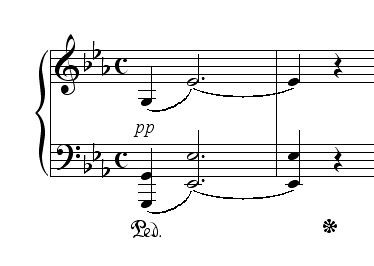
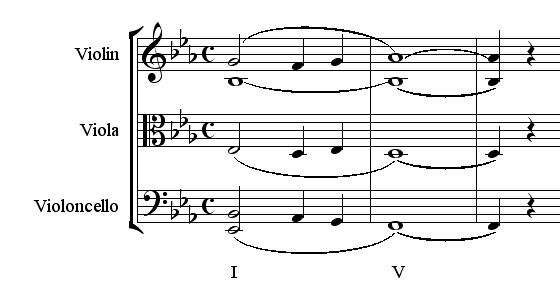
But let’s consider another tantalizing hypothetical: without Clara’s pushing Robert might never have pondered in depth the delicate “fantasization” of the Classical harmonic world. Sitting in Prussia Cove, I find myself close to the place in my brain I inhabit when I am in love (substituting music as so often for elusive reality), listening to the unfolding opening of the Piano Quartet. The strings play E-flats, and the piano plays an ascending sixth:


This resounding sixth, made blurry totality by the held pedal ... a fantastic otherworldly sound, predicated on the simplest proposition: the first note, the bass, is not the root of the chord, but its third. Why couldn’t other composers think of that bar? Something Brahms only rarely (if ever) learned to do: make the first bar an “extra” bar, an unnecessary item, a non-event depending on how you count events -- a bar for listening, not telling (Beethoven slow movement of Hammerklavier opening). A bar in which semantic space is opened, not defined.

The pedal and the ascent from the deep bass--the bass which refuses to go away just yet, at least not until we have truly heard it--is a Romantic symbol, connoting space, aura: as if E-flat major (that most classical, refined, elevated of keys) were echoed off something greater, were the mere worldly reverberation of a more profound spiritual force. (Pedal: echo, overtone, undampened string, vibration.) E-flat has arrived from somewhere; the piano suggests somehow the existence of this other place without being able, in music, to show it. Incredibly, the phrase that the strings play in response to this enigma could easily be an opening by Mozart/Beethoven/Haydn--simple, textbook, linear, architectural, tonic-to-dominant.


The Classical Phrase is thus “born” out of the sound of E-flat major, out of the pedalled ambiguity. Classical clarity has been reframed, resituated--in the context, perhaps, of pure sound. (Schumann’s opening bar implores us to hear sound as sound, not as discourse.)

The opening, “listening,” bar is Romantic enigma, and the next two bars are pure Classicism; the slow introduction is a gentle (but absolutely riveting) dialogue between these tendencies: not a competition between them but an interlacing, in which fantasy and phrase (yearning and definition) use each other as points of reference, to supply each other’s lack.

So, too, the opening of the ensuing Allegro non troppo. Schumann launches us with what could be a classical antecedent:


but then composes a strange, spinning, asymmetrical consequent:


There is no way to know when the piano will finish; the chain of notes is endless, undelineating and undelineated, as if the pianist is simply lost in the idea, in the joyful setting-forth. So: in place of the answered question, we get a wandering curlicue. Schumann adores placing the ungrammatical in the grammatical niche, sticking an adjective where the verb must be. In this case, no resolution of the dominant seventh ... simply an elaboration of it, a giant Romantic ornament.

Somehow, Schumann’s cross-pollination of Classic and Romantic maintains a Mozartean transparency, a charm and elegance. The junctures are strange but not jolting. In the Piano Quartet he provides Romanticism without decadence or decay, in joyful, prideless, humorous possession of aesthetic discoveries, not collapsed into struggle or conflict or any kind of despair or confusion. In other words: a high water point, a magical moment in Music History. Where would all this be without Clara? Unanswerable question. Schumann’s encounter (in this case) with classical form produces an unbelievable and delicate fusion, a kind of perfection in which the gushing Romantic is not at all tiresome in his teenage accesses of passion and does not wear himself out yearning but makes his passionate singing useful to the adult world. He refutes Rilke’s annoying, pretentious Zen-ishness:

Song, as you have taught it, is not desire,
not wooing any grace that can be achieved;
song is reality...
Young man,
it is not your loving, even if your mouth
was forced wide open by your own voice--learn
to forget that passionate music. It will end.


He (Robert Schumann) says: Rainer, I prefer not to forget that passionate music. I am a young man loving, and I will woo, and achieve grace. Which is why I (Jeremy Denk) will--for the moment--defend Clara from the besmirching hand, and live for a few more days with Schumann’s magical-classical E-flat major (like magical realism), and not so much with Rilke’s melancholy, oh-so-enlightened, resigned “reality.” Schumann's passionate music does not seem yet to have found its end, so there.

Saturday, September 23, 2006

Learish Addenda

As I was rereading King Lear, I came across the following lines of villainous Edmund:

Pat he comes, like the catastrophe of the old comedy. My cue is villainous melancholy, with a sigh like Tom o'Bedlam. -- O, these eclipses do portend these divisions. Fa, sol, la, mi.


A helpful note in the Arden edition reads:

Fa ... mi Edmund sings, as if unaware of Edgar's approach, in order the fourth, fifth, sixth and third notes of the scale of C major, a discordant motto, Hunter suggests, appropriate to the character of Edmund: 'He thus moves across the interval of the augmented fourth, called diabolus in musica (the devil in music).'


Now, without really doing any hard research except a Googling, it seems this footnote must be wrong, and I am so very eager to ascribe it to a general cluelessness about music prevalent among some theatre people... I smell a rat discussing "C major" per se in the 1604 environs ... and F, G, A, E, does not outline a tritone; there are even no tritones within it. Before I burn my Arden edition in a fit of rage, are there any Shakespearians out there who can clarify this mystery? Pretty pretty please?

Also, to add to my last post about Bach and Lear, the following wonderful quote:

instead of one unitary passage of time, then, there are many temporal dimensions leading us back into Bach's fugal workshop, in which musical thinking and the relations between musical ideas and God-given principles of harmony exist in a tension with the ultimate order in which the results nominally appear.


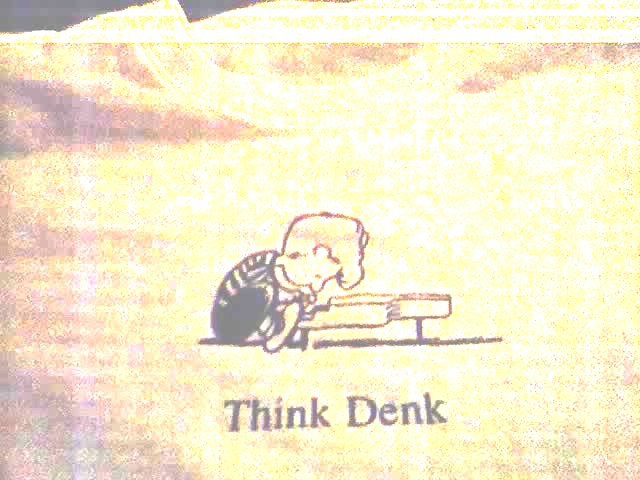
And lastly, a dear friend has sent me the very first Think Denk T-shirt:


Many thanks.

Thursday, September 21, 2006

Rereading, Rewriting, Being

Whole painstaking books vanish from my mind like dreams. I stare at their spines on my shelves and wonder what they were ever about. I completely forgot I had read Ian McEwan’s Atonement, and I “began” to read it with enthusiasm until, about 40 pages in, familiarity overwhelmed me, dusty characters came to life, and I closed the book, smarting with an unpleasant sense of uncontrollable deja vu: a sense of being lost in a memory labyrinth, with no bread crumbs or string. We are curiously attached to knowing the when and where of the beginnings of our memories, the origins of shreds of information (where do I know that person from?, why is this important to me? etc.), perhaps because without the labeling system, without a chronology and a cause, information and events become depressingly infinite. Infinite in the manner of Kafkesque, recursive visions. Proust asks himself a question: why is this madeleine meaningful to me? and seven novels later he finds, more or less, an answer: an answer which simultaneously “solves” the problem of happiness.

This business of forgetting books makes me question the purpose of reading them in the first place. In order for me to really remember a book, some extraordinary thing must happen; I have to almost rewrite it within myself. The process of remembering is painstaking. The book must lurk around, by the bed, in the kitchen, floating around the floor, hanging around my feet like a pet: a friend or foe who won’t go away; it must turn up at unexpected, undesired times; it must be picked up on random, elusive, unmotivated occasions and read and reread until its cadences and turns and twists begin to separate from from the contingent, temporal crossing of the novel-from-beginning-to-end. I imagine Bach’s pupils copying out by candlelight the preludes and fugues of the Well-Tempered Clavier.

There are of course many musical works I have absorbed in this fashion, so that I could perform them now at a moment’s notice, or probably write them down with only a few mistakes on manuscript paper; these pieces have made the difficult journey from outside to inside... Come to think of it: music is constantly being copied onto the hard drive of my brain. I’m sure there are occasional “errors” of overlap--in the jargon perhaps “buffer overrun,” please correct me here--where the music gets written into the parts of my brain I use for, say, interpersonal interaction. So when a friend comes to me in a bad mood and I am trying to cheer them up, some of what I do and say is actually Op. 111, encoded, almost by accident. Because total disentanglement is impossible. I’m sure this is true: that bits of music are floating around my brain liberally, radically, and influence my behavior at all times--when I’m ordering coffee, or when I’m sticking my bankcard yet again in the ATM. Just a few days ago, I began practicing the first fugue of the Well Tempered Clavier, and I can feel now the subject and its permutations working in me, like a spider, spinning webs of remembrance which get blown apart and reconstructed; the piece is trying madly to write itself within me before I can forget. Probably the “sensible” (but ultimately stupid) part of unconscious me is trying to fight these memorable notes, whose will is so strong, to make place for other, newer, less important memories. I am walking home from the gym, in the first coolness of fall, surrounded by mangoes on carts and ladies with canes and offers for rent and bottles for sale, and in the chaos of the city street the fugue subject stays with me absolutely: at the ends of sentences, around the corner of every other thought, behind every approaching face, an incorporeal yearning friend. I ascribe the powerful will of the notes to be learned to some greatness of the notes themselves, to the composer’s skill and invention; but this is partly a copout. I have with long practice turned myself into a note vacuum and now the mechanism cannot be stopped; I am, let’s face it, a machine for absorbing music. And, like any useful or useless machine, I am for sale.

That sounded rather dreary, or negative. I do not mean to be; I was just helplessly and tangentially following a thought. The theme of Bach which is coursing through me right now has nothing negative about it...
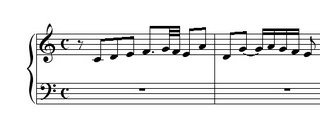


And as I sing it to myself (though without singing, actually... what is that way of thinking a phrase without singing or humming? is there a word for that? we should invent it right now...) it lifts me up, makes me feel like I am becoming... To escape its perpetual it-ness and this tension of happiness I try to account for the vector of this little constellation of notes and dip in my reservoir of words for a few sad pseudo-synonyms: “purity,” “ascent,” “balance,” “transference,” “intervallic space,” “intersecting fourths,” most too general to be meaningful at all. And when I think about Op. 111 “as a whole,” for instance, when I try to call to my mind the idea of the piece, what is the piece?, inevitably the return of this operation includes, for example, a night when I played it in Philadelphia, and my parents locked their keys in their rental car; a certain turn of my head at a certain moment when I felt the phrase went just so; an afternoon in Beacon when the high pianissimo notes seemed to fly into the rafters, looking for the stars they seemed to symbolize; a lecture in Vermont about trenchant anomalies; a party in Bloomington; a late night of practicing it in my apartment interrupted when my mate came in to complain about me practicing so late, which ended predictably, with us making out at the piano, smashing out inadvertent clusters; a sad morning hungover in South Carolina eating barbecue at the airport, waiting desperately to either stay or go home: in other words, the piece in all its immaculate musicality and purity, in order to express itself in my brain, reaches out for bits of me (some quite impure) it can use as “words;” it reaches into the other areas of my consciousness, grabbing onto the other areas like walls it wants to climb into meaning.

I began to think about “rereading” for the silliest (and therefore most wonderful) of reasons. The other day, in my farewell to the WB channel, I referenced King Lear, and suddenly felt like that play was way too far from me, my vision of it was too vague. In the middle of paying bills, sorting mail, vacuuming, practicing fugues, and a million annoying errands, I began to reward myself with a page at a time of Shakespeare. The horror dawned; I had made a most colossal, embarrassing error in my WB post, as of course Lear’s eyes are not plucked out, but Gloucester’s, and what kind of idiot (i.e. me) would forget that, as the meeting of the two complementary victims of fate--the now totally senile Lear and the eyeless but still lucid Gloucester--could possibly be regarded as the emotional climax of the play:

GLOUCESTER: ... Dost thou know me?
LEAR: I remember thine eyes well enough. Dost thou squint at me?
No, do thy worst, blind Cupid, I’ll not love.
Read thou this challenge, mark but the penning of it.
GLOUCESTER: Were all thy letters suns, I could not see one...
LEAR: Read.
GLOUCESTER: What? With the case of eyes?
LEAR: Oh ho, are you there with me? No eyes in your head, nor no money in your purse? Your eyes are in a heavy case, your purse in a light, yet you see how this world goes.
GLOUCESTER: I see it feelingly.
LEAR: What, art mad? A man may see how this world goes with no eyes. Look with thine ears...


The madman lectures the blind man on vision and truth. A passage that every musician should have at hand or at mind. The difficult question pokes at me: how could I have read this painful, incredible exchange, and forgotten it completely? (I feel sure I’ve read the play at least twice.) The Moment seems indelible, unforgettable ... but somehow I had not managed to write it within myself; perhaps I hadn’t looked with my ears?

The removal of Gloucester’s eyes has horror-value, of course, and also drama-value, serving as a climax proving the cruelty of Regan (until then somewhat in doubt), but its most seductive function is, I think, theme-value, or its terrifying resonance in the world of ideas (idea-value, language-value, meaning-value). To state the obvious: the literal blindness is really only the creation, in so-called reality, of Gloucester’s earlier blindness to reality, i.e. to the real nature of his two sons. It is a stripping-away; but it is the removal--we are made to understand--solely of the appearance of sight (a beautiful paradox), of sight’s external manifestations, as punishment for a deeper truer preexisting blindness, a terrible forced coincidence of state-of-mind and state-of-body. And just when he can no longer physically see, suddenly moral sight begins to come to torment him: similar paradoxes and Catch-22s of life run off in every direction like rats in this play, as if Gloucester’s predicament were a virus of meaning that everyone must catch. Shakespeare’s unfolding of the drama, his conception of the plot, is obviously shaped and forced to include numerous “rereadings” of this blindness theme, seemingly infinite permutations where Gloucester’s condition is subject to linguistic, metaphoric, thematic play: Gloucester comes into contact with his son, but does not recognize him (“see” him); he is led to his desired suicide by this disguised son, but is tricked (once again blind, doubly blind, living in a world others create); he lives and is lectured by mad Lear, who is oddly sounding truer than ever before (what is “to see,” “to know”?); he sits on stage looking obviously at nothing while the battle rages and defeat for Cordelia and Lear results (blind injustice?); he finally learns his son’s identity and at that moment of solace dies (to see equals death). Magnificent riffs on sight and sense are everywhere:

GLOUCESTER: I have no way, and therefore want no eyes:
I stumbled when I saw. Full oft ‘tis seen
Our means secure us and our mere defects
Prove our commodities. O dear son Edgar,
The food of thy abused father’s wrath,
Might I but live to see thee in my touch,
I’d say I had eyes again.


So, one can reread King Lear. But within the space of the play, Shakespeare is also rereading; his writing is a rereading, of an idea, a character, a node of meaning... Every time that we graze over this theme, there is a kind of resonance; some deep string is plucked again, at a frequency very different from Plot; this string crosses over the temporal order of the play, creates an atemporal order, a second plotting, a second vision, a second sight: a contrapuntal voice?

I was sitting on the stage of the Academy, playing for the second or third time through the Sarabande of the E minor Partita, when this aspect of the Partitas became very strangely and hauntingly apparent to me: tangible-ghostly. Why do ideas occur to one at a particular moment rather than another? (Why does one remember one book and not another?) It was an odd, tired moment of extenuation when the body and mind were wrung for one last drop of inspiration.

The dialogue of the various movements suddenly seemed like a process of remembering or retracing: a holding-on, like trying to find some meaning in the notes that will stick, that will not vanish. Why is this motive meaningful to me? Or perhaps: through struggle and recurrence and varied contemplation, trying to find and create a new meaning (a new “invention”), a new definition in the dictionary. And the Sarabande seems to rove farthest and dig deepest. Blah blah blah; I could reiterate what I have said here before, replucking a tired theme, throwing out yet again the Music Theory Lecture Talking Point: that the Sarabande “reworks” (all that meaning into one stupid verb) the opening motto of the Toccata. But--after all the searching for a way to say it, it does so much more than that: it is completely woven from the earlier idea in such an extraordinary way that it seems to be grappling with it, addressing consequences, ramifications, connotations: pursuing the chain of musical metaphor.

After all, the opening idea of the piece is not really a theme (in the musical sense); it is more a Theme (in the literary sense).
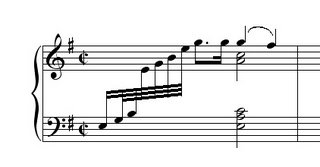


It is too universal and too brief to be Melody; it seems constantly to ask the question: what will I create? It has tendencies; it has combinative force. All but a few (exceptional) moments of the Sarabande can be understood as satellites, as Its creations. The composer does not just vary or rewrite it; he rereads it, obsessively, like someone desperate not to forget. In the Toccata the Idea appears, paradigmatically, as a pair of discrete, marked question-and-answer phrases; or at least it is made to form them, just as Gloucester’s spiritual blindness is made to be an actual blindness (incidental, but essential). But, in the Sarabande, these binary pairs, these simple phrases, are gone, are subsumed into winding, sinuous, inescapable totality: the Idea is now read as a run-on, elusive, impossible sentence, still however rambling constantly back into its selfsame Idea. Each strange miraculous corner of this sentence is marked by this Different-but-Sameness; each chord of landing, each instance of the motive is a different event, a new “interpretation” of the idea. Sometimes the winding brings us into major keys, contradicting the tragic connotations of the Idea, creating heartbreaking paradoxical readings (“I stumbled when I saw,” “a chance which does redeem all sorrows/That I have ever felt.”). The grammar of the Idea is [dotted rhythm:dissonance:release] and Bach rereads all of these, concealing or exaggerating the dotted idea, extenuating the dissonances, transforming the releases into further dissonances. Particularly at the outset of the second half (which begins with a kind of dutiful inversion of the Idea), Bach toys with enormous expansions, almost beyond hearing, of the dissonant chords. At these moments he wanders so far afield that you barely think it is the Idea anymore (at this moment the annoying student in Music Theory class pipes up to say “do you think Bach really heard that--irritating whine here--as a variation of the main idea, aren’t you stretching things a bit?” and you give them the look of death and you wonder where they ever got the notion in their undergraduate heads to define the limits of Bach’s hearing), but you are forced to wonder anyway; he forces you towards the border where the individualized Idea (the motive, the essence) begins to melt into the total, undifferentiated possibility of all Ideas, of everything: the terrible place where the Idea could be forgotten, like so many books on my shelves.

Is this chain of readings intended simply to make us remember the Idea? Just to implant some sort of “hook”, to get us to whistle the tune, to come back for more? Of course not. The myriad readings keep leading us back to the Idea and then back out to the next reading, and on and on in an endless loop, a loop which delineates and symbolizes, I think, an attempted act of understanding: something as simple and unattainable and infinite as a human thought.

On the stage there, in my socks and not at all well-dressed, leaping around between takes like a puppy, by turns caffeinated out of my mind and fading fast, I added each take to the last and trusted/hoped the microphone would remember at least some of my meanings, some of my thoughts. I felt haunted, by a sense of Bach haunting himself, grappling personally with the material, like any other human, grappling and seeing the limits and possibilities of the Ideas he himself had created or invoked. His musical ideas were his books and he wanted to really know them, not to look at them like strangers. This vision ended on the train ride after the session, where I looked out the gray window at the impending hurricane and felt a slight fever begin to come on, dark evening, the houses with lamps depressingly distant and me passing by in the wracked train, stressed out for no reason, making nonsense of the simplest possible thing. I typed on the computer: “To recover the powerful experience, the archetypal experience, and to believe it.” And I went on about the fugue/Gigue, talking about it as if it were a book to be read:

“In the fugue subject ... melody as self-sufficient character or identity (I am what I am, take what meanings you can); then the second subject is a layer of clarification (the theme can “take comfort” from the other subject, from a bassline); the third entrance... gradually it is harder and harder to hear the theme through the density of other voices.... so the theme loses itself in its own understanding... the “miracle” that the various voices are able to coexist, the thrill of more going on than the conscious mind can simultaneously process; the constant onset of dissonances, like a kaleidoscopic grammar; the abandon of counterpoint.”

And I fell asleep and forgot everything.

Injustice

Some good friends of mine are heading out today to Laramie, Wyoming to play a concert. I have never played there, which really doesn't seem quite fair, for obvious reasons:

There once was a pianist named Jeremy
Who flew out to give concerts in Laramie
But as he sat down to play
A rip at his rear made him say
"My buttocks are really quite bare, Ah me!"


Apologies. Real post later. It seems to me the first two lines are pretty much set; if you come up with any better conclusions, please let me know.

Sunday, September 17, 2006

Not Arrivederci, but Addio

There are some cultural events so momentous, dear readers, that I must suspend the daily rotor of events, must pause even mid-Venti, unfolding and plugging in the aluminum square which skeptical future generations, uncomprehending, will have to speculate was some sort of universal God or Icon, and lay fingers velvety over the clicking surfaces, and scrounge around in the inaccessible, ever-disappearing-behind-a-curtain gray matter for some appropriate thunderbolt of expression, some wordnugget to convey their magnitude to you (“Hypocrite lecteur,” cf. Baudelaire, Fleurs du Mal). Such is today’s WB Farewell (link here).

My friend A was first shocked by this news, as she knew what a blow it would be to me. Before she could shield, deflect, and conceal the rush of empathetic emotion, her naked sense of my vulnerability leaked through: “But your fantasy world... will shrink ... and dry up ... like a raisin ...” (I’m paraphrasing a bit here, she was more eloquent and her simile was less nutritious.) It is not every morning that you contemplate pre-coffee the destruction of your extended adolescence. It is true:


--I have spent lamentable hours banging head against wall wondering whether Ben or Noel would be the preferable mate for Felicity;

-- I have imbibed numerous margaritas on my nearly astroturf carpet and swallowed back horrendous oily torrents of Chinese food watching unlikely boyfriends get run over by buses and submit to all sorts of preposterous plot twists;

-- I have wept in Middlebury on a cloudy cold afternoon (when I should have been practicing) while watching wobbly VHSes of season 5 of Buffy (yes the one where she dies, twice), and have seriously compared the cold onset of early winter, and the running of half-icy streams, to Buffy’s Dostoevskian trials, her angry submission to fate, the teenaged opposite of late Beethovenian peaceful resignation, but with the same result;

-- I have laughed at Angel’s supernatural irony, at the postmodern pancake of vampire and teen cliche, and have allowed it to permeate my pores, contaminating my aesthetic judgment permanently;

-- I have winced and groaned under the sheer obvious manufactured pathos and lesson-learning of Dawson’s Creek, and I fought the pain of perpetual insults to my intelligence, and still found time to get teary-eyed whenever Joey gets conflicted (often), or when Dawson and Pacey throw their man-child tantrums with elicited unconviction, or when slimy nostalgia vomits all over the script and no one bothers to clean it up, including me;


This and so much more, I have done. I cannot confess it all; the sins I have committed with the WB are beyond number, like strollers in my 93rd Street Starbucks. And now, having defiled me, having taken the virginity of my image-repertoire, the WB plans to just up and leave, to dissolve into some other corporation and leave me adrift, high and dry, in my 30s, with a heap of desiccated psychobabble at my feet in the sands of unplotted time. As A wryly observed, “you might see this as an opportunity,” a time to quote-un-quote, “throw away the short pants.” I pretend to have no idea what this expression means. And yes I deliberately put quotations redundantly around the quote-un-quote, do you have a problem with that?

I’m not sure if this is true, but that of course will not stop me from saying it, in a really exaggerated, declarative manner: I believe the WB represents a climactic, pivotal event in the transformation of the American Pop Culture Narrative, in which all stories, no matter how great or small or implausible or profound, can (nay, must!) be transferred into the theatre of the American campus/schoolyard. In fact, I think there can be only two choices for the writer of a modern script (as Barthes points out, “there is only what I can choose to write, to put forth in this world of mine, and what I choose not to”): high school, or college. Once you have chosen, your casting is pretty much done, then pop whatever timeless narrative you wish into it, superimpose the element of Wanting to Be Popular if necessary, contrive a scene with a swimming pool (to get your money’s worth out of the Young Bodies you have employed), save it to disk, and await royalties. Soon, I am sure, there will be a King Lear set in high school, and the doddering protagonist will be played by an over-the-hill senior, who has been driven senile by too many late nights at the drive-thru, or by some chemicals they put in the tater tots (King Lear meets Erin Brockovich?). He (or she) will pass power down to some nascent popular boys or girls and I think the rest writes itself. I will call it King Larson. Larson/Lear will be played by Chad Michael Murray.

His eyes will not be gouged, but his sunglasses will be seriously damaged. Thank you, thank you, send bids for the script to my friend A ... as revenge for her too-penetrating analysis of my emotional situation. Anyway, back to my serious point, which is that, in the world of American Narrative, (ridiculous generalization follows of course, but that is only my revenge on the generalizing nature of Narrative, generally), beyond the college years yawns an endless abyss where only pockmarked policemen and disillusioned spouses dwell in a purgatory of nondefinitive endings. Jack McCoy lurks as aging icon of sexless justice (world of the mind!). Need I mention NYPD Blue? There is no easy “venue” for these “late-life” dramas; they are always gritty, or tormented. I eagerly await a prime-time drama about graduate students doing their dissertations (let’s call it “ABD”, and of course it would have to be on ABC). If you want to explore this existence beyond the 21 mark, you must then do a story about elusive disintegrations, loss, memory, or put in a compensatory amount of violence; something must either trivialize or literarize the story. I loved You Can Count on Me, but case in point: it is tinged with sadness, regret, loss, and it is no longer really a STORY. It is just kind of a moment between further disintegrations. The Narrative, these days, is so dependent upon the geographical limitations of the campus; like a nervous child dropped at school, it gets frightened when it has to wander off; writers behave as if the geographical boundary also creates and implies some welcome emotional limitations: as long as they stay on campus they are safe and a story can be told.

The WB, by planting not just naive, sexually precocious youngsters (paradox?), but also vampires and demons, on campus, and by framing their shows, despite all contradicting transcendencies of time and space, to begin and end with matriculations and graduations (“behold this is the world”), created and glorified this campuscosmos and invited us to live in it, if only in the mind. And I today, between 5 and 10 Eastern time (4/9 Central) must bid farewell to the landscaped, hour-parcelled world they seduced me into; I must lose, finally, even the benefits of my Faustian bargain. If I arrange to videotape today’s episodes, and watch them again and again, will that still constitute some sort of mature moving on, or must I just let it go, watch and weep and let them vanish into ether and memory? What would Buffy tell me to do, I wonder ...

Wednesday, September 13, 2006

Overdue Recommendation

I advise readers of this blog to hear Gabriel Kahane's masterful setting of a CraigsList posting ("Neurotic and Lonely"), immediately. Go to his MySpace page, and click on CraigslistNeurotic...

Friday, September 08, 2006

Unnoticeable Variability

“Yes, I confess, to my eternal chagrin I am indeed a chip man.” I couldn’t really believe this sentence fell out of my mouth. If you haven’t traveled on Amtrak recently, you are in for a surprise; pursuant to some distant policy, the Acela workers are now aggressively pushing product. I came up, ordered a hot dog and a soda, and in those pregnant, magical moments while the dog steamed in a mysteriously recessed industrial microwave, the man behind the counter proposed a bag of chips. “Nothing could be better than a cold soda,” he said, his eyes seeming to mist, “a hot dog, and some chips.” I was swept up (as so often) in his faux emotion; I paused, teetered, acquiesced. He smiled toothily. “Yeah, I thought you were a chip man, just from the look of you,” he said, and I had to admit the obvious. And that’s when I said the ridiculous sentence. I got a laugh from the woman next in line, and went back to my car and smeared Grey Poupon on my sweaty dog with an undeserved smile on my face of comic accomplishment.

Last night I found myself again clutching chips with amusement in a train, some baked KC Masterpiece Lays chips. Perhaps some distant delicious barbecued pork might, if perfectly cooked and served, be declared, after a beer or five, a “masterpiece,” with genuine slavering emotion, and yet, and yet! ... after the translation of the barbecue to the sauce and of the sauce to the sauce powder and the powder into the baked, processed potato chip: in that process somewhere the “masterpiece” may have been lost. After eating several chips I ran my hands through my hair and realized now the reddish powder was part of my “do,” and thus decorated (a soldier of Sodium Benzoate) I braved the fluorescent return to the city. I held my head high as I strode through Grand Central Station, a man who is willing to enter the metropolis becrumbed. I must admit, to return, like some composers, to a recurring unimportant theme: I am truly a chip man; I perpetually feel a tension between the finite nature of life and the seemingly infinite nature of chips to be consumed. Many evenings have I succumbed to late night chip-and-salsa cravings only to wake at 3 am with a sour post-vision of chile and garlic and the oily remnants of fried corn tortillas weighing down my pores. And despite all this punishment and regret beyond measure the chip still stands, still calls... like a Siren ...

I have been peripatetic of late and obviously the to-and-fro has tolled upon my brain horrendously. When you travel you often practice in strange places and of course, like any migrating species, you have to explore your new terrain, get a feel for predators, food supply, etc. I was sitting in a beautiful studio in NEC (thanks so much Ms. Byun!) and when you are in teachers’ studios and you find yourself unable to concentrate you wander and peep. There were several xeroxes on a counter and this one caught my eye:

But precisely the most important and best thing, namely, that unnoticeable variability of the tempo, of the timbres, simply does not happen in a mechanical way and through rehearsal...
The greatest technical correctness and control one can achieve does not replace the lack of inspiration; but it does have the most fateful consequences for music making as a whole. Excessive technical control, that is, the evenly executed technical perfection of all details, which as such take on a completely different character than intended by their creators, who in their conception always proceeded from the whole. The naturally productive route by which the details are viewed and interpreted by way of the whole, is turned around. The improvisational element is essentially lost, indeed it loses its very concept--this improvisational quality, which does not represent some mere accident, something one can do with or without, but rather is, quite simply, the ultimate source of all great, creative, necessary music-making.
--Furtwangler


Wow. I was really enjoying that quote, from very near the outset, with that enticing phrase the “unnoticeable variability of the tempo, of the timbres.” It’s so very true, that the smallest shifts in tempo feeling are what often make the difference for me between redemptive and annoying performances; or as my late teacher used to say, motion is not as important as mobility. It was late in the evening; Boston lights twinkled; and I was gradually giving in (not very reluctantly) to the notion that no more practicing could be done and thinking emotionally about the softness of my bed at the delightful Bertram Inn, when I realized I was listening, without knowing it, to some student practicing the Chopin G minor Ballade. Mystery Student X assayed a plain version of the coda, which all persons affiliated with the piano must view as one of those inescapable obstacles of music education; as one of those perennial iconic misfortunes which the great genius of Chopin visited upon the planet, in order that endless multitudes of students and faculty learn to suffer and endure; a passage of brilliance, originality and virtuosity so endowed with attraction that it must paradoxically be destroyed under the steamroller of endless repetition. I’m talking about:


And after one run-through of that, X was obviously dissatisfied. Perhaps it was uneven? It all sounded clean to me, through the wall, a notoriously unreliable filter, but perhaps (and I know it well) there was some lingering fear of possible future missed notes, even in the absence of present ones. And so X began practicing “in rhythms”:


AAAAAAAHHHHHH! I stared at the Furtwangler quote, propped on the piano, and he seemed to be speaking, screaming, begging for the Chopin to stop, begging for the Details to be forgotten and the Whole once more to be glimpsed and attempted; and I envisioned the forces of Evenness and the forces of Variability locked in mortal combat, grappling for the soul of the modern Conservatory. The student could never have known how ironic his/her practicing was to me at the moment. It was all too much, I snapped up my Chausson and my quote and my bag and left NEC behind in my dust, via the agency of an insane Boston cabbie (is there any other kind?), who wanted to take lessons from me (me! the madman who fled the Conservatory at 10 pm!) and back at the Inn half-dressed I watched doctors slowly and methodically remove a 200-pound tumor from a woman, and wondered how it got to be 200 pounds, and fell into a deep but unnoticeably variable sleep.

Saturday, August 26, 2006

Wholes

Music gazes at its listener with empty eyes, and the more deeply one immerses oneself in it, the more incomprehensible its ultimate purpose becomes, until one learns that the answer, if such is possible, does not lie in contemplation, but in interpretation. In other words, the only person who can solve the riddle of music is the one who plays it correctly, as something whole.

--Theodor Adorno, The Relationship of Philosophy and Music, tr. Susan Gillespie


Every since I picked up a volume of Adorno essays at my beloved Labyrinth Books, I have been going through a mild Adorno phase and I especially enjoy hauling this volume to the New York Sports Club and barely stuffing it into the little bookslot of the Stairmaster and staring smugly at my neighbors with their pitiful People Magazines. They stare back at me with empty eyes, and I must admit as the sweat begins to pour down my face that it becomes hard to concentrate on a passage like--

Hence the ontological definition of music as a language sui generis is either so abstract that it says nothing more than that between the individual musical facts there exists an articulated context that is "logical" in its own way, as Harburger, for example, has attempted to demonstrate in his book on meta-logic.


--A footnote suggests there is more to learn about Harburger, but I do not interrupt my workout to check.

Somehow that sentence about the empty eyes and the interpreter solving the riddle of the purpose of the piece made it through to my brain, despite all the distractions of the NYSC, and left an impression. I abandoned my dampened Stairmaster more pensively than I climbed it. A piece, even one you know well, can feel like you just dropped all the items in your shopping bag and they are rolling across the floor in every direction. Every day, every performance, every iteration you have to gather them again (freshly, or else). But in this case, extending the metaphor as usual ad absurdum, before you return an item to the bag you must know how it belongs with the others, and even why you wanted it in the first place: a very emotional trip to the supermarket of musical ideas. You tie them together with (hopefully) invisible thread (the act of interpretation?), which can be drawn too loose or too tight.

Adorno had put into words what I realized was one of the motivating (subconscious?) themes of my practicing: the desire to bring all the parts into a whole, or to put it another way, the desire for the whole which allows the parts to exist meaningfully. I have been feeling this process and the tugs of these desires very intensely as I prepare the 4th and 6th Partitas of Bach. The Partitas are collections of dances, pieces written in genres, in a fixed stylized order; they don't have the obvious, free literary or narrative sweeps that one is assisted by in works of Schumann or Beethoven, for instance; but despite being collections and varied and myriad and stylized and fixed they each seem to be hovered over by some sort of guardian angel, a uniting spirit. Each seems like a miniature cosmos. Without trivializing, I hope I can say that the D major feels to me like some sort of total vision of happiness (which includes melancholy and reflection). Its final gigue is a virtuosic release: the most overt, affirmative kind of joy, and it seems to sum up without needing to "answer" or "correct" or "propose" or right any wrongs that may have occurred before. (Unlike, say, the last movements of Beethoven 5th and 9th Symphonies, to name some ridiculously contrasting examples.) It is the one I find myself most passionately attached to right now. I can even discriminate between the "type" of happiness of the D major and the more extremely comic, lighter (but perhaps less profound?) happiness of the G major.

The E minor, by contrast, lies in some uneasy relationship even to the idea of emotion or mood. Its first movement seems to have an obvious "emotive agenda;" it deals with the most prevalent tropes of musical tragedy: the falling sigh motif and the descending tetrachord. The first movement explores them exhaustively, in improvisation and in fugue, then the subsequent dances are haunted by the same ideas in disguise, most remarkably in the Sarabande. But the signifier and the signified are in a strange dance around each other. After the Gigue, is it possible to feel the piece has a tragic or melancholic effect? (Even after the Toccata I am not so sure.) The minor keys in Bach so often do not seem centrally about sadness, do not seem a vehicle even for an emotion primarily; they seem to have a dual role; they evoke the tragic while simultaneously creating a pathway to daring, to intellectual adventure, to compositional wildness. I am not saying that Bach thereby drains the music of emotional content (the hackneyed charge of Bach as an "intellectual" or "cerebral" composer); but the affective content becomes a conduit and not the subject of the discourse; this kind of altered state is evident in the Gigue, which to my mind is lit by an intense fire, with its leaps and constant interplay of voices, sometimes altogether overwhelming, more intensity than "can be played." Its difficulty (aside from technical demands) lies in that there is so much going on, so much density of tension, an unbelievable compression ... But after an altered state like that, it is not so easy to say what the whole "tone" of the piece is (it represents no emotion that I know); its very daring makes it difficult to compress into a whole, to solve its riddle.

At the same time that the piece thrills you, it draws you into its strange questions, including the "useless" question: what does it all mean? Play it as a whole, Adorno says, and you the player ask: well what the *(&(*)# is that? But somehow you also know. And maybe you're sitting over a dinner plate and your friend is telling you something and it occurs to you, how to play some moment in an Allemande (some wending, wonderful moment of ambiguous arrival or departure status) and you stare at your friend with empty eyes and can't wait to get back home, you grab a cab instead of the subway and throw your keys on the floor and play it and why is it never as good as it is in the mind? (Charles Ives, a great lover of Bach, laughing in the background: "My God! What has sound to do with music!")

Thursday, August 24, 2006

Summer Clothes

Here is a picture of my closet after all the summer's dirty clothes have been piled in it, so I can walk to and from my bed relatively unencumbered:


Who among you, faced with this kind of squalor, this daunting mountain of drudgery, would not prefer to escape forthwith and tout suite into the perfect ideal world of music, into its dancing spheres and lines?


Ah, but the wheels turn and even before my first cup of coffee it occurs to me. Perhaps I create a situation in my apartment, deliberately but subconsciously, so that I will be all the more tempted, nay even forced, to get myself to the piano right away! Perhaps it is not really laziness and slobbery but the most fiendishly clever practice motivation technique ever invented! Anybody with me? Anybody buying it?

Monday, August 21, 2006

Whatever

Rats scurry into subway tunnels, teens discuss real estate with premature machismo, and airconditioners hum and drip irregularly. Sigh; all is as I left it here in New York City. It is now night and some of the edge is off. Earlier today, I sat in the backseat of my parents' rental and stared out a tinted window at the totally clear pure blue sky and dreamed of my feet over the edge of a pier, dipped in a cool northern lake. But compulsion drew me in, inexorably, out of the infinite green beauties, away from the fields, silos and flowers, into a small tight gray corner-metropolis. As I drove myself (different stage of the journey) down the Thruway, I imagined all the other people, leaving their families and vacations and the purity of the mountains and forests for Reality, Vice, Career and Corruption. It was such a cliche. How many of us there on the road were doing the same thing? Pondering their families while driving 70 miles-an-hour away from them? (Really, officer, I was only doing 65.) I thought of all the strange citythings that could and should never be communicated at the family reunion. They would not only be inappropriate; they would be meaningless there, Sanskrit scribblings. I guess reality can sometimes make these two imaginary worlds intersect, strangely. I thought about how I had to return from one world to the other, I thought of the metaphor behind the miles. Then, restless, trapped in my white rental car, I moved from metaphor to my dream--I could escape, head up to Schroon Lake for one last breather of the summer--but I turned the car south and smiled and gritted my teeth and paid the tolls and here I am.

Let the record state that a) if the Arnold Palmer is Iced Tea and Lemonade, b) the Jeremy Denk is Cranberry Juice Cocktail and Ginger Ale.

Let me address a totally different question: how does a touring musician while away down times? I sat In my Rhinebeck hotel room, surfing channels and always seeming to stop at the WB or F/X before accusing myself of vulgarity, etcetera: an endless cycle of TV self-recrimination. I am an artist; how can I watch this drivel? My reading material had run out, and off the shelf came an extraordinary thick volume: Danielle Steel's The House. Ah, yes, something even more empty than television ... Ever in search of exotic experiences, I began to read, with an odd compulsion, and then I sincerely could not stop, though I skimmed madly, in search of understanding, through its 533 large-print pages; I told myself I was a cynical visitor in quest of the key to its badness, but also I was just a plain old sentimental sop wanting to know how she would bring this train-wreck of a plot to an end. I have a little file on my computer called "first lines" where I put all the cool first lines of novels I will (probably) never write; I spend endless hours dreaming of interesting hooks to bring the reader into the worlds of these hypothetical narratives. But Danielle is not hung up on beginnings; boldly, even impudently, she dreams up the most boring imaginable first sentence, and lets it fly:

Sarah Anderson left her office at nine-thirty on a Tuesday morning in June for her ten o-clock appointment with Stanley Perlman.


I LOVE it. There's so much uninteresting detail, and so little grace. I have wracked my brain, but don't think the Tuesday has any metaphorical significance, and Danielle really wants us to know, though there is no future plot juncture depending on it, that it takes a half-hour to get from her office to Stanley's place. I suppose the sentence does convey a sense of specificity and punctuality, a kind of no-nonsense, life-is-not-about-wiffly-waffly-images kind of thing. Curious, for a romance. A pragmatic romance? Along those lines, I love her choices of names: nothing quirky, nothing off-type. The men mostly have nice masculine one-syllable names (Jeff, Phil, Dave, George) except for the French professional bachelor, Pierre. The women are a more gentle two-syllable crowd (Sarah, Audrey, Mimi) except for the uptight French wife, Marie-Louise, who needs a lot more space to be haughty. Interestingly, the money-hoarding genius at investing is named Stanley Perlman. Surely, there's no stereotype there.

Now, let us be the first to admit!: we are no strangers here at Think Denk to clumsy metaphors. But, one has to bow in reverent admiration at Miss Steel. Generally she avoids prose that is too far from naked fact, or generic account, preferring for instance:

Sarah came back to the apartment to put her dry cleaning away, and after that she went to the photography exhibit at the museum, and found it beautiful and interesting. She would have liked to share it with Phil, but she knew he wasn't crazy about museums. She went for a walk on the Marina Green after that, to get some exercise and air, and she was back at her apartment as six o'clock, after stopping at Safeway to buy some groceries.


Proust, eat your heart out. A passage like this makes me want to bring back Susan Sontag for a diatribe. But here Miss Steel goes trying out a little metaphor:

The day without him, his spending it with his friend without calling her, the way he talked about Dave's ex-wife and his girlfriend, and the exceptionally good sex she and Phil had had. All put together, it made for a puzzle where none of the pieces fit smoothly.


Aha! One tremendously awkward ("his spending it," "had had"), ungrammatical sentence, followed by an explanatory metaphor. Probably, I would suggest, "All put together, THEY made for a puzzle where none of the pieces fit smoothly." Anybody else agree on this? I'm not a stickler; plurals can become singulars and vice versa; to my mind, it's no biggie. But I sense Danielle felt she had gone too far out on a linguistic limb, that the meaning was not clear, and so she elucidates:

She felt as though she were trying to fit pieces together that showed trees, sky, half a cat, and part of a barn door.


And yet further, in case you missed the point:

All together they didn't make a picture. She knew what the images were, but none of them was complete, and she didn't feel whole, either.


Kerpow! Thud! Idea pounded into my head, for good, so hard that in fact my head hurts. Now some of you don't like it when I get too mean-spirited and snobby and stuff here on Think Denk and so you probably won't enjoy this little Danielle Steel moment. Can you forgive me? It's true, I can be a jerk. I'm just trying to show you that sometimes you can get so bored in your hotel room that in fact you will do ANYTHING, including read romance novels, and sometimes these unexpected, desperate diversions can be very diverting. I skimmed all the way to the end of The House and seriously had to know how it ended. In fact, once the heroine buys real estate, everything seems to fall into place. Her architect becomes her boyfriend, both her mother and grandmother find new husbands, the old boyfriend is revealed as a cad--

He could have been plunging into the spectacular blonde when she walked in, instead of whatever they were doing under the covers. Fortunately, it had been a cold night, and his apartment was always freezing, so they had stayed under the duvet.


--I admire the attention to climatic, and not just climactic, detail. Really a whole lifetime of growth and happiness seems to be compressed into one heavy mortgage, and I wondered if Danielle was in cahoots with the broker lobby. All my criticism is beyond useless, however; this authoress is laughing, has laughed, will continue to laugh, all the way to the bank, and if I got some laughter out of it too, and you readers do also, then who's really suffering? No one. I apologize to all Think Denk readers, in advance, who are Steel fans, and I hope Sarah and Jeff live happily ever after and I'm sure Phil will continue to be a selfish self-absorbed jerk and where's the remote?