Friday, July 08, 2005

Boone

Rule #1: Pursue hints of unexpected pleasure. Rule #2: relax. These rules are applicable to both life and musical interpretation.

Two nights ago, at dinner, a lovely bartenderess. Same bartenderess (go figure!) shows up at coffee joint while I am blogging yesterday, chats me up. I took the hint, and invited her to join us for drinks/dinner last night, and there she proposes going to hear some zydeco being played at the Boone Saloon. FANTASTIC! I discovered the real reason to come to Boone. I watched people totally consumed with pleasure: good old (and young) country boys, whose faces seemed at first reticent and reserved, began to stomp the floor with contagious musicality and abandon, with unmistakable unfeignable joy in life; and the girls were bouncier, a little goofier, floating all sorts of hilarious and eclectic moves around them... I remember thinking I have never enjoyed a dominant-seventh chord more (it was prolonged so long, almost like Tristan and Isolde). Though it was a bar, the music and the dancing were clearly the main thing, much more so in some ways than in the classical concert hall, where the focus is enforced. I don't want this to be another "I wish classical music were more unbuttoned" post, but .... what can I say? I wish classical music were more unbuttoned, but only in a certain, not vulgar way. (Carnegie Hall, but with pool tables?) The Boone Saloon didn't feel vulgar at all, though the floor was sticky with spilled beer and people wore wide-brimmed cowboy hats and there was a hefty mean-looking bouncer at the door: not even seedy, just: real. I think it was the music that did this, that made the space perfect. It was fantastic to watch the violinist too, who looked completely uninvolved, almost moronic; his bow arm barely seemed to move; and yet his playing was super-energetic, uplifting. There's a lesson for my own piano playing in there. I followed both rules above by the way: I pursued the hints, against better judgement, and I got an unexpected pleasure, and my elation relaxed me.

...

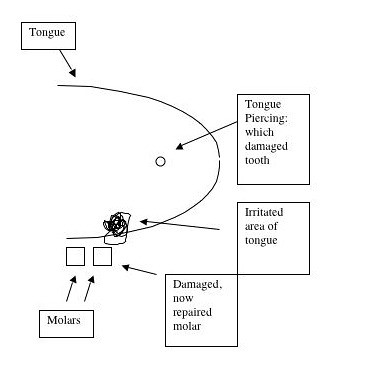
To quote (or rather paraphrase) Alex Ross, "there is no specifically musical reason for including" the following, but it seemed noteworthy. As last night's bartenderess (which is not same as earlier bartenderess) served us our appetizers, she regaled us with a tale of tooth damage. An old chipped tooth had become rechipped, and she had gone to the dentist to have it repaired. Lest this not be sufficient detail, she drew us a diagram (no, this is true, this actually happened) on a cocktail napkin, which we could study next to our bruschetta:

tooth

Magnificent. Especially the way she scribbled horribly with the pen, nearly tearing the napkin in two, to indicate the irritated part of her tongue. I have tried to simulate this, as best I can, with my laptop trackpad. Why did this dose of dental reality not turn me off as I sat at the rather fancy bar, preparing to eat? It seemed merely hilarious and not disgusting. This would never happen in New York; nor would the repair of said tooth cost a mere $22 (I am not kidding, that is what she paid). Have I seen people dance like that in New York either? I have to admit I will play the last movement of the Brahms A major Piano Quartet quite differently tonight, with a little hillbilly in my gypsy.

Thursday, July 07, 2005

What's The Score?

I have been blog-lazy; no more. I've been storing up thoughts about scores and musical interpretation, which sounds like a truly annoying and boring post, and probably is.

Basically, I've been trying to find a recording of Davidsbündlertänze (by Robert Schumann) for my new friend X. X does not demand anonymity, I just enjoy naming him/her X. I have dibbled and dabbled, online and elsewhere, and due to the nature of the piece, it's fairly easy to extract little bits -- it's a piece made of little bits, a meal of German, evocative, romantic, elusive tapas. I won't name names, but I've consulted quite a few recordings and found none remotely to my satisfaction. The problem, you may say, and I will say, lies with my unending need for satisfaction rather than the artistry of the various recordings... So far, I have not recommended X a recording. (V. Nabokov, when asked "what's your favorite book?" answered: "the one I am about to write.")

Inciting event: X and X's colleagues were arguing with me in a bar that Schumann really was not such a great composer after all. Well into my second, or third, Belgian ale, my arguments distilled themselves frighteningly into a very narrow retort: simply the word "Davidsbündlertänze," nearly screamed, several times in a row, with accompanying head-shakes and signs of distress, like those of a mental patient. Feeling rather replete, I adjourned to the facilities. Upon my return, my argument was not augmented: I simply kept saying, overly loudly, in the Irish pub, the title of my favorite Schumann work, (I feel sure I was the only one in the pub using that particular word, possibly ever) which seemed to me the purest, most eloquent defense of Schumann's genius ... How I longed for the powerful, calm derision and reserve with which, say, Mitsuko Uchida might have looked upon persons who dared to question Schumann; if only I had been able to consult her as to what to say, what to do. I could almost see her, perched over an Egg McMarlboro (at Marlboro, of course), her eyes narrowing ... I myself was a clown in comparison.

Davidsbündlertänze is full of clowns and clowning, the boisterous Florestan messing around with the ruminative Eusebius... full of moments of silliness, but that kind of humor which is so extraordinary and manages to coexist with the most unbelievable, haunting sadness. (The humor that virtually generates that sadness.) That would almost seem to be the piece's premise: the posing of funny, displaced fragments and their metamorphosis/assembly either into crazy, lopsided dances, or long lyrical outpourings, or laments, or whatever: come what may.

So there I was listening, to my favorite moments in one of my favorite pieces, and so often the pianist would seem to miss the "main point," that is, the sort of overarching gesture, mood, gestalt of the thing. And I would say to myself: you are imposing too much of your own desire on this! Try to listen impersonally, to see what they see. Because these are serious artists, they see important things. And so I would try again; I would start the track from the beginning, and try to listen through their lens, pay attention to their priorities, hear their desires. Sometimes this works for me, but in this piece I could NOT. I had to give up too much, it was too painful, too many intervals went unnoticed, too many searing moments passed by, it just couldn't make emotional sense to me. I gave up, unhappy, kind of exhausted. I took the coward's way out: I went and played it myself.

I think (and this may be partly the cause of my unhappiness, above) this is one of those pieces with an amazing plural--whether because of its "loose" structure, or its dependence on fragments (where just a few notes are made to take on a lot of meaning), or its utterly Romantic frame of mind, its intense if brief emotional states. We are used to saying and thinking that a piece has any number of possible interpretations, and we are used to hearing the expression that certain performances/recordings can be considered fairly "definitive." I would like to express my total detestation of the word "definitive;" a performance is never a definition, unless we are willing to reconsider entirely our definition of definition.

We classical musicians lurk under the idea, a burden, that there may be, hiding in the score, somewhere, some "true" interpretation of a piece, some original composer's intent. But I have begun to wonder if even the composer, as he puts his notes down on paper, considers the score-as-written already, partly, his enemy? (It limits what he has to say, what he has meant to say; on the other hand, it lets the piece loose from the limits of his mind, opens it to other, maybe lesser, minds.) We say, casually, that a musical score "lends itself to many different interpretations," which is a sort of cliché which makes us comfortable with the difficulties of scores. I want to go further:

A musical score does not just "allow for" differing interpretations, for disagreements; it provokes them. This is because a set of notes will inevitably suggest nuances that cannot be simultaneously realized--which are antithetical to each other. The score is a provocateur, a trickster (although it is of course also a comfort, a guide, a resource). It contains paradoxes, and thus makes consistent, complete definition impossible.

This is truer of some scores than others. Every performance leaves out, by definition, a good deal (an infinite amount) of the score, of its possibility. This would seem to be a negative view of performance, from a performer. What does the performer put in its place, how does he/she fill the space cleared away, the destruction wreaked, by his/her choices? I have to admit I tend to distrust those colleagues of mine who seem to know every dynamic, dot, dash, and marking of the score, every last articulation and expressive indication, and who seem to feel they "know the score" as a result (not that it is bad to know the score well!)... I guess it is an emotional thing, I always prefer to think of the score as harboring yet some unknown, as a jungle whose overgrowth will not be pruned, penetrated... I hate to think of it as a cleared field, as laid bare, too clear, too evident, prematurely disillusioned. Only with the performance is the score temporarily bare (temporarily absent), and then from the moment of applause onward the score reasserts itself, just as impossible to untangle.

To take up this thread of "definition," I love the notion of every word as a "fossil poem." (Words as active, not passive, webs of force, not solid, named things--read Hugh Kenner's The Pound Era...) Think, if we reawaken each of a word's origins, etymologies, mythical antecendents, the primal acts of classifying, connecting, understanding, which finally gave way to the "civilized" word, its so-called definition? Poems do indeed reactivate these sense of words ("give words back their tribal meaning," is this Mallarmé?). Okay, in this sense, I could imagine a "definitive" performance, one which makes the musical word active, definitive not as in "really getting it right", not as in just-as-the-composer-"intended" (How do we KNOW the composer had a single intention? Don't we think the composer might have been just as mystified and overwhelmed by the options of his own notes?), but as in opening up some active possibilities of the piece, working backwards to origins and forwards to consequences, an act which I think is closer to "un-definining" the piece, removing it from the dictionary... freeing it.

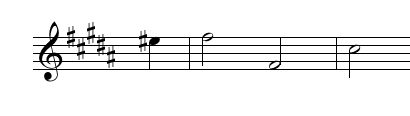
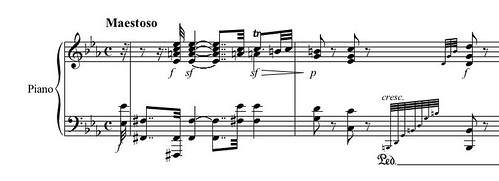
For an example of the sorts of notes in Schumann that particularly defy this notion of "definitive," perhaps:
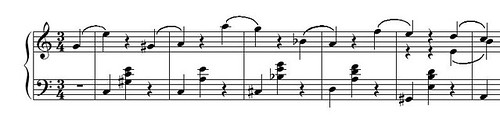
davidsopening

It is a waltz, (a waltz in fragments) that much is relatively certain (this notion of waltz is somehow extramusical, right? it brings in a whole cultural world, codes of nostalgia, loss, experience)... but which notes to "go to," which to emphasize, and how? Nothing is more idiotic than the comment in rehearsal, the agreement to "go to" a particular note... how will we go there? Rhythmically (by rushing, ritarding)? Dynamically (by crescendo, diminuendo)? Texturally? Emotionally? The possibilities are infinite, and each has a satisfying opposite. Everything is going or coming, to say "let's go here" says (almost) nothing.

For you music readers, including X, if you do not feel a shiver of pleasure, a moment of "perfect Schumann" at the end of this last example, when the second voice enters, at the "wrong time" (in the middle of the established grouping), and deliberately in order to form a dissonance with the upper voice... (C against B) ... if you don't "get that moment," if you aren't waiting to see in what beautiful fashion the wrong-note B will resolve, you are voted off the Schumann island. (You non-music readers, just listen to the last track, shouldn't be too hard to follow). This dissonance, which is just the edge of longing to which the preceding fragments allude, becomes generative, becomes an obsession; the waltz, though sad and gentle, is suddenly full of these dissonances which need to be resolved, which create more, the sense of clash, every note's (by turns) inability to live with itself:
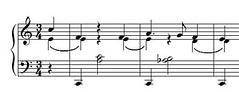
davidsmiddle

... a stream of consciousness leading from that first entrance of the "second voice," from that generative dissonance, following the idea of the dissonance to whatever consequences ... and another stream, gradually attempting to "fill in" the fragmented waltz, to swing gradually from halting pairs of quarter notes into a more typical, dotted waltz rhythm (see example above, second measure, A G F E): this second stream, an urge to find melodic/rhythmic continuity. Two streams, and many others which we haven't mentioned, and how can you possibly feel them all while playing? Not to mention, in public? All these are in the score, simultaneous, clamoring: a bewildering cacophony of thought. The score is impossibly demanding.

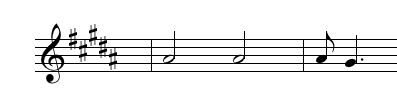
The streams seem to lead gradually downward, smoothing out their dissonances, to this "answer":
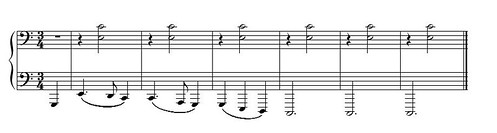
davidsend

Yes, it is the same sixth leap which began the waltz, G up to E, but now instead of fragments and half-steps and half-phrases, there is just a long, unbroken, lilting descent... I adore this final phrase, partly because I feel it is not enough, it does not really, truly resolve; but it is heartbreaking for me: the essence of tenderness, too late. I have words for this final phrase; I have written them in my score; but I will never tell anyone; anyway, they are nonsense words, meaningful only for me, German words with no grammar whatsoever. (Tribal meanings?) Can I say that this beautiful phrase "resolves" the previous longing and dissonances? Yes and no, I'm not sure that I totally "understand" the relation of the final phrase to the rest... it is a meager connection, sustained by slight threads of thought, threads that can never be definitive.

It is totally infuriating to imagine a music theorist at this point trying to describe the form of this last piece. (Is it ternary? binary? modified binary? Arrggghhh!) With a piece like this, Schumann seems to satirize even the idea of musical form, the notion of completeness, and its relevance. And it was infuriating to hear all these beautiful, sensitive versions which did not capture even an iota of my tremendous emotional attachment to this last waltz... they were all incomplete somehow. I can't help thinking of my own hypothetical version. Someday, when I return to this piece, my version ... will hopefully be even more incomplete, even less definitive.
Wednesday, June 29, 2005

Unexpected

I am dangerously attempting to begin this post without having truly consumed an appreciable amount of coffee. Sip sip. But it may not kick in soon enough...

I just thought this event was surreal enough to warrant mentioning. Yesterday afternoon, I went down round 5 to the hotel fitness room, to do some stairmaster. And I was full-on sweaty and stepping and dazed, when I heard the door open; I turned my head, and to my utter shock and disbelief: Leon Fleisher entered the room. For you non-pianists or non-musicians out there, this may not seem like such a big deal, but pianists will understand... (for a scientist, the parallel might be that Einstein entered the room; for an author, Salman Rushdie... I don't know, you get the idea). It is the sort of thing that would happen in a dream. Listen to this, man: last night I dreamed I was washing the dishes, and Leon Fleisher walked in and told me to do it more spiritually, etc. What's more, it was too late for me to turn off the drippy romantic comedy about three aspiring country western singers I was watching (at FULL volume), starring River Phoenix and a young Sandra Bullock and other people too mediocre to mention. (I certainly could not claim I was NOT watching it; the stairmaster faced the TV completely and closely). They were making their way onscreen to success via love, loss, and the sober road of experience. Leon seemed not to notice this more profound aspect of the film as he cast what I (perhaps overly) interpreted as a rather dismissive glance in the movie's direction, and headed for the treadmills. How could I explain to him, without becoming ridiculous, that I had brought Cervantes' Dialogue of the Dogs with me to read (certainly a philosophical and profound entertainment), but that this particular stairmaster had no holder for reading material? That therefore I was a helpless TV consumer? That I had read much of Proust on the stairmaster as well, in years past (in lost time)? How could I explain that I was allowing myself to be moved (were they beads of sweat or tears on my brow?)by country-western music just hours before my Mozart Double (my debut, for God's sake!) with the Philadelphia Orchestra? Why was I watching this drivel instead of, say, the MacNeil-Lehrer News Hour? No. All explanations were moot; all I could do was finish my routine, and slink out of the room. So it goes. I noted, as I left, that he was watching the weather. Ah, indeed, sigh, that is what a great artist does on the treadmill, I thought! Perhaps he did not even notice the weather forecast; it was only a background for his great treading thoughts, as the ever-changing weather is a background for our lives.

My new favorite quote: "The best part of repentance is the sinning."

Wednesday, June 22, 2005

Better

I'm better today, thank the powers that be. I thought I would post another installment of the subway poetry "experiment"... zipping back and forth from 91st street to Mozart rehearsals on 58th street, I found plenty of time to contemplate the #1 trains... for those who don't remember, it is a not-so-subtle attack on the whole "subway verse" thing, by intermingling lines from the posted poems with the surrounding advertisements and public service announcements. I wish I could say I was continuing by "popular request," but really I'm just continuing for my own perversity. The following, to my mind, gives the nihilistic and famous speech from Macbeth a kind of post-modern, ironic punch, which it probably didn't need:

Tomorrow, and tomorrow, and tomorrow.
Investing in futures
creeps in this petty pace from day to day.

Tighten skin without surgery
to the last syllable of recorded time.

Lighten up!
And all our yesterdays have lighted fools.
Please don't rush or push on
the way to dusty death. Out, out, brief candle!
Number One makes all stops.

Life's but a walking shadow, a poor player.
My future: a theatre director
that struts and frets his hour upon the stage.
What you thought you knew is history
and then is heard no more; it is a tale
it's a work in progress,
Told by an idiot, full of sound and fury--
He may be without a home, but he's not without help,
Signifying nothing.
Get prepped for success!

I feel the end is even more bitter than the original? Comments, including cease-and-desist orders, are welcome, but may be ignored.

Tuesday, June 21, 2005

Carter and the Things You Want

I'll admit it. I'm in a foul mood today. For me there are three kinds of foul:

1) "Irritable" foul: where everything just peeves me, from the wait in line at Starbucks to the cheery hello of my doorman.
2) "Overwhelmed" foul: when the volume of unopened mail and unattended crap gets all metaphysical on me, and makes me feel panicky.
3) "Seriously" foul: where something deep has shifted, and part of me has yet to adjust.

Today's foul is a bit of 2, mixed with a lot of 3. It's funny: I'm cheering myself up just a bit, even enumerating these foulnesses. Ironic that my foul day should be the longest day of the year. (Bitter laugh)

What does all this have to do with music, you ask? Well what I'm suffering from is a fascinating medical condition known as the Post-Festival Blues, COMBINED with a little bit of Pre-Festival Panic (since I am simply between festivals). Post-Festival blues is like the melancholy of the last day of summer camp... all of us overgrown classical-music-children, going to camp every summer, making friends and enemies, not writing home as much as we should, and then it's over... This one is particularly bad, for reasons that are hard to pin down, irrational reasons; it feels as though something were given to me, and then taken away. And I want it, even though I'm not precisely sure what "it" is.

As it is impossible for me to deal with any personal issues in my life without sublimating them into music first (just kidding, kind of) it got me to thinking about musical passages where this sort of thing happens: and it seems to me that this giving and taking away is not a bad thing in music, but an essential part of its meaning... I've often enjoyed the quality of certain music where only a few notes are made to suffice (not TOO many notes, because that would ruin it, overwhelm it): one of the great virtues of modernism. Late Romanticism: a giant surplus of notes, of "explained" meanings, of overblown programs, of chromatic complexity. Modernism converts

O fair white silk, fresh from the weaver's loom,
Clear as the frost, bright as the winter snow--
See! friendship fashions out of thee a fan,
Round as the round moon shines in heaven above ... [etc.]

to

O fan of white silk,
clear as frost on the grass-blade,
You also are laid aside.

Less is often more; the single word (the single note) connotes more, is free, open-ended. (For example, the fabulous
"also.")

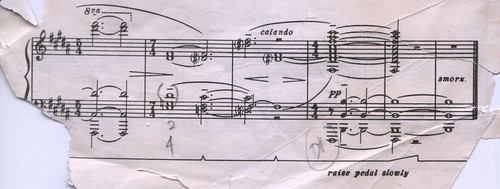
I played the Elliott Carter Piano Sonata this last Saturday, and while I was practicing it I kept playing over the final section; it seemed at once elusive, impossible (because of its spareness) and also to hold, behind its reserve, the most profound and beautiful thoughts. The piece continually plays with the giving and taking away of harmonic information, the expansion of one or two notes into an complex harmony, and then back again, until you are made to find satisfaction in fewer notes, to find resolution in absence. It is so beautiful to trace his thinking in this manner in the last bars of the piece: he carefully delineates which notes should be retained with the pedal, and when precisely should they be made to vanish: a constant game of resolving to "too few notes," then adding some other notes which raise new questions, which necessitate further resolutions, which keep the piece alive. Just when there is too little, he adds something new (which is "too much," which needs to be dealt with in some way, just like I need today to deal with my unresolved, undirected wants)...

Each time I played it, I couldn't get over the beauty of the final bars, of the piece's "answer." Let me be analytical for a second: here Carter summarizes and merges two main themes of the piece, this melodic cell:

cartertune

and this rhythmic motive:

carterrhythm

Both of these are "protagonists" of the piece; we have heard them millions of times (seemingly). But not like this, their merging moment:

smallercarterending

F# (high), F# (low), C# (top note of chord)... that would seem to be it, one more recap of the "tune," BUT as you slowly release the pedal, the B emerges from beneath its cloud of notes, a lonely, uninflected, uncluttered tonic. This note, on the "weak beat," the unaccented syllable of the sentence, a rhythmic aftershock ... turns out to be the strong foundation, the center, the fundament from which the other notes have radiated. Carter does not want it to be played so much as revealed. Instead of overtones coming off of a played note, Carter here allows the "undertone" to come from its overtones, allows cause to follow effect.

And there it is: just that B. You hold it until it fades away. The other notes, beautiful B major notes like A#, F#, C# linger in the memory more faintly (vanished overtones). And why do I find this so affecting? When I start to hear just the B, there is at first a rush of pleasure: it is so pure, perfect, so resolving; then I begin to feel its relation backwards, its threads of connection... I want to go back and play the whole piece again, to hear his flights of fancy, racing through fifths and fourths from B up and down the keyboard... those amazing scorrevole passages from the first movement, the giant jazz fugue in the second. But no, it is over. The B is a relinquishing of all the other notes, not at all a triumphant arrival, but a removal...

Right now, in my foulness, in my apartment with laundry and dry cleaning to do and millions of unopened bills and pieces to practice, I would love to go back also, perhaps to the last festival, and argue about Schumann with quirky musicians in the sports bars of suburban Detroit; but today, there is only the B and the thought of what notes might come of the B--entirely hypothetical musings, speculations. I am awaiting the return of my overtones.

Saturday, June 18, 2005

Groceries

For those who suspect classical musicians are a different breed, I have solid scientific evidence. The other evening, I was playing a concert with violinist Soovin Kim and cellist Peter Stumpf. In a distant (15-20 miles) suburb, cellist Andres Diaz and violinist Chee Yun were also playing a concert. After our concert, Soovin and I parted company with Peter, who went home to drop off his cello. Soovin and I then decided, on a whim, to go directly to the grocery store for post-concert treats...

We wandered the lonely aisles, selecting the usual gourmet fare: an Entenmann's danish, white peaches, a frozen pizza, baked Cheetos... and there at the checkout counter, we ran into Peter, who had just then run into Andres and Chee Yun! We were like migratory birds, destined for groceries, magnetically and mysteriously drawn from distant climes to a single Kroger at a particular hour... What Beethovenian machination of fate was at work?

One further oddity: Soovin's and my white jacket and tie drew some amused remarks from some 30-ish ladies ("nice tuxes")... who then kept waving at us in the parking lot, kind of desperately, as if we were soldiers going off to war. Soovin thinks they were trying to "pick us up," but my theory is they were like minor divinities, somehow associated with the fateful musical convergence, trying to deliver us some omen or message which we will never, ever know. As Rilke says, "we must live the questions, and someday our lives will become the answer." Or something like that.

Following up, finally, on the narcissistic theme from the last post, I went to Barnes & Noble (boo hiss) to pick up some Montale poetry which had been very inspiring ... (texts for an Elliot Carter piece which I just heard). Alas, there was no Montale in the Bloomfield Hills B&N, as I was informed by a pierced, patchouli-scented aide; but next to where he might have been (again fate) was Ovid's Metamorphoses, which I drew out of the shelf to refresh my memory of the tale of Narcissus. What a beautiful tale! Especially the encounter of Narcissus (the boy in love with his own image), and Echo (the girl who can do nothing but echo what other people say)... what a spectacular, symbolic, heavy, association-rich episode this is in the tortured history of the Western mind! And super-fraught with associations for us migratory classical musician-birds: we are forced to echo pieces written long ago; in one sense, we are as helpless as Echo, we can only say what "has been said;" but what we get out of them, the return of our encounter with them, is always at least partly ourselves. We cannot help seeing and feeling ourselves, reflected in these pieces. These pieces (great masterworks, texts of seemingly infinite association and possibility) are like mirrors to us, like Narcissus' fatal pond... mirrors against which we cannot help but feel insecure, vulnerable, incomplete.

Thursday, June 16, 2005

Wow and Wind

Anonymous writes, "this entire blog is an exercise in narcissistic pretense." Hooray for anonymous! He/she is correct, as always. Pretense courses through every entry: things are omitted, rewritten, made readable, given "a style, a voice"... there lurks in the background that pretentious word "literary." I can't, therefore, present myself, whoever that might be; I seem to present how I imagine myself, or even how I imagine others imagine me, or--and these are the parts I admit, in my narcissism, I like the best--myself as illuminated by certain passages of music, the cross-section between my persona and certain sound patterns... Some parts of Jeremy Denk: did they exist until I encountered particular phrases, pieces of music? Chicken and egg: until the "Dumky" Trio, was humanity's sense of nostalgia less rich? (Or did "Dumky" depend entirely on preexisting emotional patterns in humanity?) Did those tender phrases permanently add to mankind's emotional repertoire, give nostalgia a definitive auditory example?

Today (for me) is a joyous day, with a fresh cool wind blowing through the suburbs of Detroit... (oppressive summer lifts)... I am so happy today and part of this happiness is stuck to, glued to, the act of putting my hands down on the piano keys a certain way and coming up with a luminous, sensual sound, a sound of which I approve, which suggests further sounds, further motions, further pleasures. The exact equality of the intention and the result; motion=sound; idea=event. Me me me. But add to this the liberating fact that the music is already written for you (Dvorak, Mendelssohn for me tonight), so that you just "throw yourself into it." I am a puppet with strings pulled by dead European composers; but I love it, this willing marionette is me. Don't you think the puppet influences the puppeteer? I think so (in my narcissism). Dvorak depends on me to express something about Dvorak. Pooh on the people who say it's all on the page; it most certainly is not.

In the puppet vein, I saw a production of Pierrot Lunaire this last weekend featuring Lucy Shelton's riveting, completely possessed sprechstimme, a delightful life-sized Pierrot puppet (Blair Thomas puppet theatre of Chicago), and my fellow Oberlin alums, the ensemble Eighth Blackbird. The work was frantically staged, and all the musicians performed from memory! It was tremendous to watch Lucy interact with the puppet, to "literally" address Pierrot (who eventually is brought out, poor fellow, in a wheelchair); but my favorite part was how she and the puppet interacted with the instrumentalists (and even their instruments). Musicians are usually "left alone," treated with deference (after all, they must concentrate!), but here they were treated irreverently, like just another part of the surreal gang. Music inspires choreography, which in turn rebounds back and influences the music, the musicians, draws them into the game... There they were, marching across the stage behind a prancing Pierrot, who jumps into the piano, turns back to look at them... the musicians in turn look back, as if to see what Pierrot is looking at... who or what are they looking for (is there some secret agent in the wings?)... Who or what is in charge? No member of the ensemble seemed to lead, to be privileged. Which to me is the perfect way to express the unhinged, expressionist mind.

I really liked the sense that the musicians were forced to confront their own creation (like a mad scientist, like Dr. Frankenstein); the music they were playing almost attacked them! There are musicians out there who aim to be pure, uninvolved channels for music to pass through, who look on impassively while their fingers create... For them, this Pierrot would be kind of a nightmare. I have never been able to pursue this ideal (never cherished it especially, either), except to the extent that you don't want your personal involvement, your emotional attachment to the music to get "in your own way," to hinder auditory expression. In my narcissism I find that the music keeps turning in on me, and vice versa, and I cannot stop this wheel from turning, except every so often to send it back the other way, like a pendulum or seesaw. And so this Pierrot was like an actualization of something I feel so often: the meddling of music in my personal life, its lack of boundaries, of respect for my "personal space."

Saturday, June 11, 2005

Rubato from Another Planet; or, Waking Up Early

Last night, inexplicably, I put a new CD in my CD alarm clock. (Avid Think Denk readers--is this a plural? or even a singular?--will recall volume two of Nina Simone's "Tomato Collection" residing there previously.) I felt no particular urge for change; it just hit me, like the smell of sour milk emanating from a Mr. Softee truck. And let me tell you, there is nothing like waking up, bleary, at 6:50 AM on a Friday morning, after staying up stupidly late staring at an over-packed suitcase and a list of things to do upon awakening (1. Throw out garbage 2. Pack toothbrush and toothpaste 3. Pay rent 4. Check wallet for credit card and drivers license) and trying to remember music I might have forgotten to pack... there is nothing like waking up after one of those short, stressed-out nights to zany Viennese lilt, chords and notes flying everywhere, and sudden blasts of tender, lyrical playing unheard of in modern days: in other words there is nothing like waking up, exhausted, to Ignaz Friedman's Alt Wien. It coaxed a silent laugh out of what is often my darkest hour; I was awake for a strange non-moment before it came on (curse my inescapable, time-laden consciousness) and I drifted back to sleep; with a harrumph it began in B-flat, and I was smilingly, totally awake; its joyous abandon blasted into the half-lit, half-cleaned apartment like secular incense, blessing my early morning scramble.

I meant what I said about the "harrumph." In the boisterous waltzes, Friedman's downbeats have outrageous, tremendous impulse; they are huge, sprawling, but also springy, dancing catapults ... the intervening 2 and 3 beats are often overwhelmed, virtually swallowed within the downbeat's energy, in a way that modern conservatory education would find unacceptable (tut tut! don't swallow those beats!) I yell back: Yes Friedman, swallow them! Keep it coming! Go for it, baby! This is taken to almost comical extremes, admittedly; sometimes neither the rhythms or notes of the 2 or 3 are very clear or accurate, there is only a vague sense of intervening chatter between the rollicking, galloping 1s. This is when Friedman surrenders himself entirely to the waltz as frenzy, as leap, as twirl... then he stops, reassembles, recomports himself, a tender strain enters ... everything is suddenly placed again, the internal beats are nuanced, proportioned, perfect .... ah, Vienna, the good old days...

A very famous pianist (and irreproachable artist) of my acquaintance disparaged Friedman for being too crass. I know he is wrong. Or, maybe, I think he is right but I don't care; when he says it it passes into one ear, one lobe of my brain, and I smile an empty smile; the other lobe recalls all my favorite Friedman moments and adores them internally while I pretend to agree. Am I a hypocrite? Anyway, Friedman makes up for any vulgarities--his sudden accents, added octaves, etc.--with an abundance of grace. His B-flat Chopin Polonaise (which comes right after Alt Wien in my Naxos recording) is a virtual philosophical demonstration of charm (Hmmm, apply the Kantian Categorical Imperative: what if every pianist in the world today were suddenly compelled to play as charmingly as that? Would piano playing in the modern world come to an end?), he transfigures an "ordinary" piece: Chopin's filigree has never been so light, and not sugary-sweet-syrupy-silly... simply appropriate, decorative, the pianist's hand passing over the keys, "like a feather."

I know what it is: Friedman's playing is not limited by a Beethovenian "es muss sein" (it must be)... it has a place for the arbitrary and the accidental. Sometimes he seems motivated by rhythmic/musical forces from another planet, and there is no way to know what he is thinking, and why he is thinking it. This makes me happy; I puzzle over his rhythms with pleasure. For example, Friedman's account of the opening (rather simple) bars of the B-flat Polonaise doesn't resemble any way that anyone I know would play the dotted rhythms they contain. It is as if some other layer of harmony and tension, unbeknownst to mortals, was apparent to Friedman, made it impossible to play the dotted rhythm in its typical tum-tee-tum; somehow the "tee" is too important to him, it's got something to say, it drags against itself. I adore these rhythmic displacements in his playing, irregularities born of secret expression which sometimes succeed and sometimes fail. I know a lot of pianists out there cannot accept the "sometimes fail" (despite this, they still sometimes fail, as we all do)--they must aim for the "always succeed."

In case you don't own any recordings of Ignaz Friedman, go on and buy one. Obviously he is one of my heroes, especially at 7 in the morning. And when else do we need heroes more desperately?

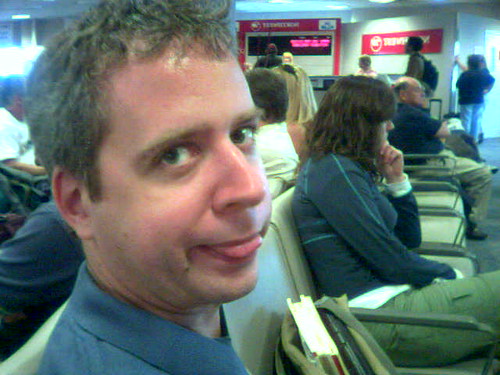
If you thought the writing in this post was a bit fanciful, perhaps it can be explained by this photograph, taken "candidly" in the Northwest airlines terminal, awaiting the flight that Friedman woke me up for, which I feel captures my state of mind perfectly. I append it with no further comment.

gmail

Friday, June 03, 2005

Release

For the first time, blogging by request... A friend suggests by email that I write about the Quartet for the End of Time and (what do you know!) I just finished playing my last one here in Spoleto at the 1 pm concert. I am happy to blog about it because the performance was totally overwhelming for me personally, for mysterious reasons. Was it exhaustion, or accumulation, or release? Daniel Phillips (one of my favorite musicians) was playing the last movement, and I felt that I was going to lose it on stage... i.e. burst out crying. This is rare for me... After some polite goodbyes, I decided to "celebrate" by walking home alone, away from cars and people; I ambled down quiet Church Street, and tried to give my brain its own time.

It is a piece for the "end of time," and yet the pianist (yours truly) has to be time. In the cello and violin solo movements, I simply play chords, awkwardly slowly, marking moments which are much slower than seconds, and marking (with my harmonies) a larger, really time-free, arc of meaning under the melody. In no other piece do you feel such a tremendous strain between something achingly large (something that only eventually will be expressed) and the snail's steps you must take to express it. But he (Messiaen) manages it; not a note is out of place in the last movement; every harmony is extraordinary, an essential step, a grammatical and striking word of the holy overall sentence... somewhere toward the middle of the last movement, I began to feel the words that Messiaen marks in the part, I began to hear them, feel them as a "mantra": extatique, paradisiaque. And maybe more importantly, I began to have visions while I was playing, snapshots of my own life (such that I had to remind myself to look at the notes, play the notes!): people's eyes, mostly, expressions of love, moments of total and absolute tenderness. (This is sentimental, too personal: I know. How can you write about this piece without becoming over-emotional?) I felt that same sense of outpouring ("pouring over") that comes when you just have to touch someone, when what you feel makes you pour out of your own body, when you are briefly no longer yourself -- and at that moment I was still playing the chords, still somehow playing the damn piano. And each chord is even more beautiful than the last; they are pulsing, hypnotic, reverberant... each chord seemed to pile on something that was already ready to collapse, something too beautiful to be stable... and when your own playing boomerangs on you and begins to "move yourself," to touch you emotionally, you have entered a very dangerous place. Luckily, the piece was almost over... When I got offstage I had to breathe, hold myself in, talk myself down.

It wouldn't have gotten to that state without the architecture of the whole, its obsessive completeness. The clarinet movement with its desolate slow melodies ("abyss of the birds")... total despair. Then the amazing, sensual cello movement ... As I walked home I meditated on the idea that the whole piece is somehow in E but only truthful about it occasionally... when the "E majors come," they are such solutions, total releases of implication, homecomings for the soul. I think it was a release for me: the release of all the stress of the concerts (true enough, if not that interesting), and/or the release of some bottled up affection? This second is more intriguing: Music as Therapy. I was therapized by today's concert, by the end of time. It was a difficult session, I but I think I enjoyed it... where will all that affection go?

Sunday, May 29, 2005

Call of the Wild

"Fie on Charleston for clogging your blogging." So writes reader Erin, and though Charleston deserves no fie, I am grateful there are readers to know when there are no posts. I have returned from two concerts (11 am, 1 pm) where I played that joyful, bounding, cloudless Schumann work Faschingsschwank aus Wien. God, what a wonderful piece! And in the somewhat dry Dock St. theatre I felt able to articulate all sorts of things, to come out from Schumann's occasional muck. (Sometimes one wished for a small helping of muck). And then I have had the delicious pleasure of peeling off my somewhat dampened concert clothes and draping them semi-carefully on chairs and bedposts, and reverting to shorts and flip-flops... aah. Flop I go on my wicker sofa. The relief after a concert, after what one considers a semi-successful performance, is luckily almost as deep as the anxiety that precedes the next one.

Charleston is one of those places that makes you think sensually, constantly. So now, as I go over in my head the eternal question "how do I want to spend the rest of my day?," what occurs to me is not a list of tasks but a rush of feelings. For example: sand beneath my feet; the cold of a coffee gelato; the breeze as I pass through Charleston's historic alleys, fast, on my bicycle; the taste of a grilled tender scallop; and certainly not the godawful cold clammy fluorescent light of the one practice room with its poor bedeviled piano, which is acting like a Northerner unused to the heat and becoming grumpy, with several sticky keys... new ones each day! Oh the sensual deprivation of practicing! Only after a hour's persistence do you finally get to the meat of the matter, to the place where you can deal mentally with your issues... and during that whole hour the outside world calls to you, you imagine people streaming down King Street, their sandals slapping against the pavement as they window-shop, as they stop for wings and beer, as they attend cute cultural events and jibberjab and argue about parking. Today it may be too much for me; the sensual may overwhelm the cultural; and so off I go....

Saturday, May 28, 2005

Morning

It is 8:33 AM. I have been awake for 33 minutes and have to play a concert in slightly less than 2 1/2 hours. I am on my second cup of coffee and have to judge how much will keep me alert until concert time, without sending me into a mania. I shake my head back and forth, wiggle my cheeks, and make silly sounds ... will that help? Charleston life is so very different from New York life, and my brain does not seem to function in a linear, Northern way, I begin to think like a mint julep and blogging seems exotic, bizarre, impossible. Post, an inner voice says, post! And yet the gelateria beckons. Perhaps a walk around the battery, or just a sit in my own lovely garden. Or a casual bikeride around this most beautiful of towns.

Curse the man/woman who invented the morning concert. And I have played so very many. The morning is already the "difficult" part of my day, the mini-crisis of every day. In the afternoon, I often look back at the person I was at 10 AM and think, what a silly boy, what complicated, difficult thoughts he deluded himself with, life is really so uncluttered and simple... but then again at 10 AM the next day it is the same thing, the same morass. Coffee is the acid with which I cut through that primeval, post-sleep ooze. Then add the stress of pre-concert preparations, etc. (where's my suit? is my shirt ironed? do i have my music? blah blah blah) to the whole mix: a morning with a concert is just a mess... i have to evolve from dinosaur to aristocrat in two short hours. Just not enough time: too often a Tyrannosaurus Rex walks out on stage...

Sunday, May 22, 2005

Irreconcilables

Yesterday morning I awoke in a shuttered suite, bathed in pastels, sunshine leaking through the cracks, and when I flung open the curtains (averting my bleary eyes) I saw pristine white boats preparing for a day of fishing in a calm ocean. And I finally put my head back down again in my darkened New York apartment, lulled by "Manhattan waves": the rush of cars up and down Broadway.

Both places had clutter in common. It is amazing; no matter how spacious and sumptuous the hotel room, it seems I react to it like an artist to a blank canvas: I must fill it, or die trying. From the bed yesterday morning, I could see sneakers, dress shoes, socks, shirts, boxer shorts, etcetera laying a trail into the distance, until they reached the living area, where leftover cheese, crackers, and fruit took up the slack: a clump of Boursin here, a used red wine glass there, the wrapper of the crackers placed "just so" on the floor next the coffee table. It was a composition! I had replaced the sanitary perfection of the suite with my native, magnificent disorder, and in record time! Is there a market for this sort of art?

There must be a Latin saying along the lines of "If it is there, it will be consumed." (Perhaps in Spanish: "the tapas will always be gone by evening"?) This hotel was certainly a marvel of consumption. I was not blameless; I fell in with the herd; I ached to consume every inch of my room, every lotion in the bathroom, and in a fit of pique over my $34 room service charge for oatmeal, coffee, and juice, I shoved all the unused toiletry items into my suitcase. (Needless to say, I do not recommend this resort for my more frugal friends). The room service bills were like veritable poems of greed, an endless tally of fees and surcharges which you would hopefully forget about on the beach, in the sunshine.

And I did; I opted against practicing (using the trusty "when in Rome" excuse) and ambled to the beach with nothing other than my shades and my Moleskine notebook (in which I wrote nothing). There I cell phoned my friends, who were amused and/or jealous (my intended effect). I ordered a mango frozen beverage. Then I sat, and baked, and tried to imagine Beethoven. I am not kidding. Actually, I think it was Beethoven (that dead European jerk) who wouldn't leave me in peace. Phrases from the "Spring" Sonata (which I was supposed to play that evening--a piece for which I have never had a totally natural affection) kept popping into my head (how will you play me tonight? don't you owe me something?), and then, when I tried to ignore them, more imperious phrases from the last Piano Sonata (Op. 111) attacked at will. In front of my eyes, the world's most perfect surfer girl and boy settled themselves on chairs to tan (though they were spread perfectly with brown, as if to demonstrate the very Platonic form of "tan"), pulling off shirts, stretching their lithe bodies, with almost comical languor--it was like an Abercrombie & Fitch poster--and while I was observing this, sweating profusely, attempting to appear like I naturally "belonged" here on the beach, like the crabs and the jellyfish, the dotted opening phrase of Op. 111 kept jarring my brain awake:

op111beachbeginning

Could Beethoven have written that piece, here on the beach? I imagined him sitting there, in his shades, with sheafs of manuscript paper, his brow knitting with anger and anxiety, getting ready to notate that first, shocking diminished seventh chord ... when suddenly a 17-year-old girl in a tight, becoming shirt comes up and says "may I take your drink order?" Would he scream at her, tell her to go away? Or would he crumple up the manuscript and have a daiquiri? And could you imagine the surfer boy and girl listening intently to the variations of Op. 111, following them to their transcendental conclusion? No; Op. 111 and the beach are irreconcilable.

Problems basically have two categories of solutions, either to hold on harder (concentrate, buck up, pull up your bootstraps, put your nose to the grindstone), or to let go (release your tension, get some perspective, some sleep, some peace of mind). A lot of my work these days at the piano is directed at increased attention, sending my brain more intently and constantly to the tips of my fingers, trying to keep track of both hands, make them lively, active, willed. And the music I play rewards this attention, richly... I realized on the beach how difficult it was to let my attention wander completely, to "let go," how strong the boundary was between practicing and tanning (as strong as that between Beethoven and surfer chick). I was so used to paying attention; I could even feel myself bringing concentration to bear on my relaxation. I wondered if lying by the pool or ocean, drinking daiquiris and reading People magazine, slathering lotion and eating quesadillas... well, is that really the ideal way to let go? It seems to be a societally recognized method; Florida is one vast spigot through which Americans drain their anxieties. The pool was mobbed with reddened relaxers.

And so, on I theorized... I won't say I didn't enjoy my time at the beach, but I enjoyed the evening performance much more. The release of acting, of creating a phrase more or less the way I wanted (in the "Spring" Sonata which had molested me earlier)--it felt enormous, true, complete. But that's me. Probably I just need to learn how to relax. But in the meantime, I better go practice.

Wednesday, May 18, 2005

Mythologies

Yesterday morning it was on ABC News, and today it hits the New York Times: mystery "Piano Man" is now a big-time star, complete with an alluring photograph, where he clutches his music and the sun glints through his hair. (Kudos to Dean Olsher for first alerting me to this breaking news; he knows what is and isn't news!) The Times shares my cynicism, opining obliquely: "There is, of course, the delicate question of whether the man is a bona fide patient..." The "of course" says it all; it's a figure of speech intended to bring us all into communal agreement, whether or not that agreement exists; it is the implication of hushed, huddled gossip, of connivance; it says that what it's about to say needn't really be said, since it is obvious, and yet it will say that thing, since something needs to be made manifest, has to be expressed... "There is, of course," [what?]

Let us hypothesize for the moment that we have a delicious sham on our hands, and that Piano Man is a monstrously clever chap who has decided to create a career through this bizarre and instantaneous publicity. What he has done is very simple. He has merely externalized the internal metaphors which we all carry around in our mythology of "the artist." He has made the cliché into reality:

The artist is a loner. Check: he was found wandering alone on the Isle of Sheppey. No kin have come forward.

The artist speaks only through his art. Check: he has not spoken to hospital personnel; he only communicated one thing, his drawing of a grand piano (drawing=art, not speech).

The artist is a foreigner, an exile, "not one of us." Check: he seems to have emerged from the sea itself, soaked in ocean water (though wonderfully, in a Kafkaesque touch, still in his concert attire). From what distant, exotic land could he have emerged? My bets are on Atlantis.

The artist is the survivor of trauma, which he communicates to an audience. He suffers for his art. Check. This trauma is even more powerful because we have no way of knowing what it is. It is, therefore, unimaginable. Did he throw himself overboard because of a lost love? Etcetera, etcetera. Or more appropriately: yadda yadda yadda.

The artist is attractive. Since what he/she communicates is beautiful, he/she must be beautiful too. Check. Without this, the whole scheme would be ruined. One must count one's assets.

The artist is insane. Check, as defined by his current accommodations.

The artist has no identity, outside of his art. Check: No kin have come forward. Labels, even, were cut out of his clothing. Nothing about him is inscribed. On the contrary, the artist inscribes, does all the writing, the telling, the showing. He himself is a blank slate, a pure expressive instrument. No one can truly know the artist, since he has no "self." Artists, therefore, only truly love their art. Etcetera.

Against which, I must counterpose the "reality" of myself as artist, on May 18, 2005, in a Manhattan apartment, clutching coffee in one hand while I stab at my laptop keyboard: the difficult reality that I must once again go to the piano and try to begin again, with that giant pile of wonderful, clamoring music. The labels are still on my clothing. Like my apartment, my playing is full of things I would like to "fix up;" there are some things that could be remodelled in a single go, but most things require constant care, mundane attention, a daily calisthenics of the fingers and the mind and proddings for the imagination... The greatest pianists I know seem to approach even their most familiar pieces like blank crossword puzzles, as something to be filled in fresh; each time just as daunting, the whole piece must be "understood again." This is reality as I know it. The clichés of Piano Man can be understood in a flash, as a totality; that is why they make great news. They have the completeness of image. But the Schubert Trio (the E-flat Major) I am about to practice: I know I will never traverse it completely, ever. Which is a good thing.

Monday, May 16, 2005

Desire and Forgetting, a Birthday Blog

Birthdays are usually days where I insist on indulging myself to the fullest, to the point of making myself very unhappy. Case in point: my 21st birthday, where, extrapolating from my love of coffee, I declared that I would drink as much coffee as possible (based on theorem more=better) resulting in an irritable, cranky, wired mess. Today life seems to be indulging me however, and I am content to let it. For example, this morning at 9 the TV provided me with not just "any" episode of Charmed, but the very first episode, so that I could see exactly how the three witch sisters first came to be aware of their awesome powers, and I could wonder how the show ever survived its pilot. A highlight: when Piper's boyfriend, "Jeremy," turns out to be a horrible, murderous demon--much as I was on my 21st birthday after three thermoses (thermi?) of Kenya AA.

Then, I received a delightful email from my friend regarding a lonely, speechless, piano player found wandering a windswept road on the Isle of Sheppey. Though the article is meant to be somewhat touching and melancholy, I laughed and laughed. The "windswept road" is my favorite touch; the article author is given over to literary pretensions, to be sure, a la Thomas Hardy, perhaps, of The Mayor of Casterbridge? Are we sure these are not the shenanigans (the brilliant maneuvers) of some out-of-control publicist? Perhaps this "mystery piano player" will soon be touring the world, appearing in Carnegie Hall to sold-out crowds, etc. Please be assured, this is not me! I have never been to the Isle of Sheppey.

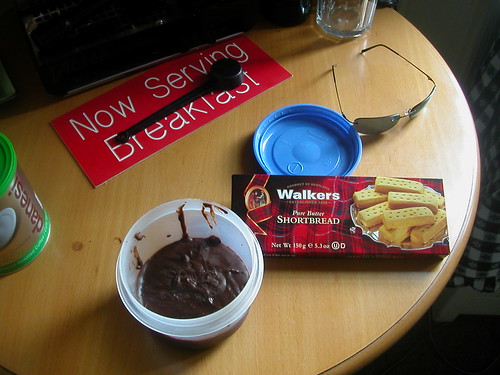
Finally, though, on my "indulgent" birthday, I had to make a choice, between a carton of butter cookies and some delightful leftover chocolate sauce (Belgian chocolate with cream):

DSCN0532

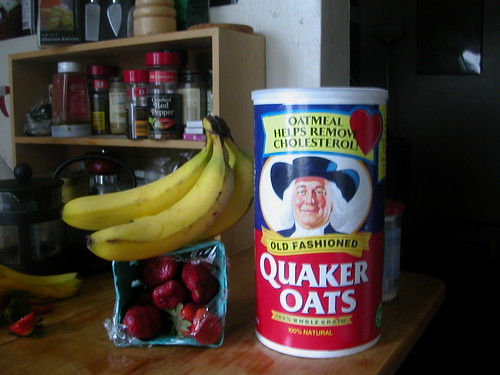
or oatmeal with honey, strawberries, and banana:

DSCN0533

Basically, a choice between virtue and vice. I am happy to tell you I chose virtue. But what does the Bible (or any other religious document, for that matter) have to say about choosing virtue in order to feel less bad about subsequent vice? For indeed I chose oatmeal as a sort of counter to expected and likely overindulgence in food and drink with friends this evening, in the Village. It would seem just to be a roundabout way of choosing vice, of ameliorating vice. I turned not to the Bible, but to the Tao Te Ching, trans. by Stephen Mitchell:

Stop thinking, and end your problems.
What difference between yes and no?
Must you value what others value,
avoid what others avoid?
How ridiculous!

Hmmm, not too helpful. Seems to free me to do just about anything! How about:

Free from desire, you realize the mystery.
Caught in desire, you see only the oatmeal and/or chocolate sauce.

(I have slightly edited this translation for current circumstances.) This is better; perhaps I should not get caught up in desire for either oatmeal OR chocolate sauce, or margaritas, or that delightful dish I can't wait to have this evening with the stuffed poblano peppers with the pomegranate seeds. Oops. Turning back to timeless wisdom:

... the Master
acts without doing anything
and teaches without saying anything.
Things arise and she lets them come,
as for example pilots of Charmed,
and emails about piano players,
When her work is done, she forgets it.
That is why it lasts forever.

Actually I REALLY LOVE those last two lines, the business about forgetting! They gave me another delicious birthday pleasure, which was a connection to another quote I love, which is my true birthday blog indulgence, just for me... some more Roland Barthes:

"Yet reading does not consist in stopping the chain of systems, in establishing a truth, a legality of the text ... it consists in coupling these systems, not according to their finite quantity, but according to their plurality (which is a being, not a discounting): I pass, I intersect, I articulate, I release, I do not count. Forgetting meanings is not a matter for excuses, an unfortunate defect in performance; it is an affirmative value, a way of asserting the irresponsibility of the text, the pluralism of systems: it is precisely because I forget that I read." --S/Z

And I will now (finally) take the advice of the Tao:

Express yourself completely,
then keep quiet.

Saturday, May 14, 2005

Schumann's Sleight-of-Hand

I read a wonderful quote the other day: "A mathematician is a device for converting coffee into theorems." (Don't ask me to source it, I forget.) And today, from my first sip, blogposts bloomed in my brain, begging to be let free. I want to follow up on some Schumann stuff... Yesterday I compared a passage in Roland Barthes' Lover's Discourse to the various "manners" of Schumann, and lying in bed this morning, further examples of the three "stages" (affirmation, doubt, re-beginning) leapt to mind. For you Schumann fans, the Fantasy, Op. 17, last movement, is a perfect example of this "let us begin again," this return which is not a repetition, the affirmation of difference, and the love affair in question here is between Schumann and Beethoven, an austere, distant, but intense love, visited with all kinds of anxiety and power imbalances, like any good relationship. Haha.

But I would like to get technical today, and for those of you non-musicians, don't freak out because I am going to make all kinds of oversimplifying analogies to language and physics which will have two virtues: 1) to make it easy to understand what I'm saying and 2) to infuriate any music theorists who might be reading. In fact, I will forward this post on to a couple especially crusty music theorists I know and hopefully there will be all sorts of withering commentary, like my favorite remark scribbled on the margin of the first draft of my Juilliard doctoral document: "Yuck."

Oversimplifying analogy #1: Music is a language, i.e. it has a grammar and a syntax. For a given phrase, we've got a "home key," which we call (don't freak out) the TONIC. And the harmony which leads us to the tonic is the DOMINANT...

DOMINANT goes to TONIC

and then of course before the dominant we might have the dominant's dominant, the pre-dominant...

Dominant of Dominant
goes to
Dominant
goes to
Tonic

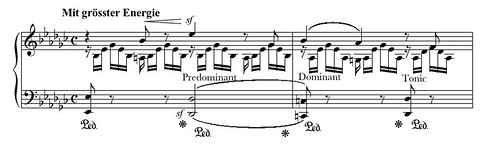
(Musicians reading this will be bored. My apologies. This is all, like, basic musical "logic.") Now the tonic is, in a sense, the "object" of the phrase. Oversimplifying analogy #2 coming up. Let's take the sentence "Last night I ate risotto." If I say simply "Last night I ate..." your listener will certainly be wondering; did you eat a roast beef sandwich at Subway, or New Zealand red snapper with caramelized persimmon and coconut-candlenut foam (as I did at Jefferson just the other night, highly recommended)? Analogy: what you ate (object of sentence) = tonic of musical phrase. Take it or leave it. Now, take this phrase of Schumann, the opening outburst of the Intermezzo from Faschingsschwank aus Wien:

intermezzo

In this phrase, we have all the "logical" ingredients above: predominant, dominant, tonic. I have labeled them all up there in the score ... take my word for it, or ask a crusty music theorist to confirm it for you. But the way that Schumann writes the phrase, ALL THE EMPHASIS IS ON the subject and verb (predominant/dominant), and THE TONIC IS NOT really a significant part of the gesture. Consider the melody: there is a leap up to an accented note (the predominant) then a beautiful turn-around gesture (the dominant)... on the tonic harmony there is no melody, only absence--the resolution only occurs in the left hand. All the semantic emphasis is in "the wrong place." Last night I ate (risotto).

Schumann in this phrase is acting like a magician. Through his sleight-of-hand, our attention is "misdirected." Instead of the harmony to which all the harmonies are headed--instead of the goal--we are made to notice the predicates, the preparatory harmonies. The resolution, the conclusion, is parenthetical, a "non-event." Schumann slips it in where it won't be noticed, "under our noses."

What's more, radical Robert Schumann persists in these sorts of phrases, perpetually putting the accent on the wrong syllable, and by this inversion creates a kind of reverse syntax. This mirror syntax is on the one hand perfectly logical (since all the harmonies are there, in the right order), and on the other hand unsettling, asymmetrical (as the emphasis is always away from the proper place, as if the rhythm of tonality constantly has to be rewritten, challenged, undone).

Now, Schumann can build whole pieces on these "imbalanced" phrases; he loves them. Let me take this a step further. For me, as a listener and performer, I feel like the main force here is not any one chord, but the tension between the predominant and dominant. ("Music is between the notes.") They exert a kind of gravitational pull towards each other. When I play them, I feel a kind of tension and release in my gut, or somewhere... Oversimplifying analogy #3 coming. But: the main sun of this solar system is the tonic, it is the ultimate source around which the other harmonies "orbit." Without that tonic, the other harmonies would have no "meaning." The tension which Schumann adores is between two moons; he neglects the sun.

How does one build on swirling tension (for that is what this Intermezzo does)? If the brick is a "feeling of tension or pull," how can those be solid enough to hold up a musical building? This tension is not quicksand; those "preliminary" chords, those pairings (predominant/dominant) feel awfully strong; the piece, though unsettled, has tremendous energy (note the tempo marking, "with the greatest energy.") Schumann... revolutionary, Romantic... redefining the terms, forcing us into a different frame of reference, finding strength in reversal.

Friday, May 13, 2005

Today I Bite the Hand that Feeds Me

... Never bite the hand that feeds you. But today I will.

Yesterday, apparently (according to an urgent communiqué from my mother), my performance of Brahms E-flat Sonata with Richard Stoltzman was played on NPR's Performance Today. Apparently the host of that program, the delightful and eternally curious Fred Child, mentioned my blog, and there is a link on NPR's site!!! I am grateful.

But then, by a curious twist of fate, today I read an article on Slate ... an article also featured on NPR's Day-to-Day... which has enraged me, beyond reason. In it, the author attempts to "reconstruct" a recipe for Proust's madeleine from Proust's own words. Read it yourself, if you must; he comes to the conclusion that the madeleine, such as Proust describes it, "never existed." Short rebuttal: duh. Longer rebuttal, with ranting:

1) Anyone who obsesses about the madeleine and Proust hasn't really read Proust. ("Oh yes, Proust, the chap with the madeleine, rather long book, that.") There's a lot more book out there, kids, go to it! If you get past page 40, let me know! I'll be really proud of you!

2) The WHOLE MASSIVE NOVEL is ABOUT the elusiveness of experience, memory, time... it debunks "realist" description at every turn. Nothing is ever as it seems; everything is in flux, subject to change, perception, etc. etc. Therefore, it is not a place to seek "recipes." Again: read the book! The whole thing!

[Insert Howard Dean-esque scream here. Magnify times 10. Then imagine me in my pajamas running around my bedroom yelling like that as I read the article, and write this post.]

3) OK, I'll quote from the article: "Many cookbooks claim that you can reproduce Marcel Proust's magical madeleine in your own kitchen. But do any of the recipes yield the genuine article? " Aaarrgggghhhhh. Repeat after me! THERE IS NO "GENUINE ARTICLE." Keep repeating until you have a literary sensibility. The whole proposition is patently absurd! Then later on, he refers to Lydia Davis' translation as the most "accurate." Again, with the ridiculous words!

It's enough to send me scrambling through my volumes for the perfect debunking Proust quote, and within 5 minutes I found:

"For things ... as soon as we have perceived them [i.e. the madeleine] are transformed within us into something immaterial [are you listening?], something of the same nature as all our preoccupations and sensations of that particular time, with which, indissolubly, they blend. A name read long ago in a book contains within its syllables the strong wind and brilliant sunshine that prevailed while we were reading it. And this is why the kind of literature which contents itself with 'describing things,' with giving of them merely a miserable abstract of lines and surfaces [refer again to article, and various diagrams in it], is in fact, though it calls itself realist, the FURTHEST REMOVED FROM REALITY [emphasis added, mea culpa, I'm in a mood] and has more than any other the effect of saddening and impoverishing us, since it abruptly severs all communication of our present self both with the past, the essence of which is preserved in things, and with the future, in which things incite us to enjoy the essence of the past a second time. Yet it is precisely this essence that an art worthy of the name must seek to express; then at least, if it fails, there is a lesson to be drawn from its impotence (whereas from the successes of realism there is nothing to be learnt), the lesson that this essence is, in part, subjective and incommunicable."

This endless baker's dissection of Proust's description... reminds me so much of cocktail party conversations where nothing is ventured or gained, where trivia are exchanged endlessly and knowledge hovers in the background, unable to penetrate. Also to some extent, it reminds me of some post-concert receptions, where people come up, very friendly, wonderful people, and ask me all sorts of bizarre minutiae about composers, their eating habits, the strings on their pianos, their views on elephants--I don't know, whatever. And while I am telling them I have no idea, I am thinking "I could tell you a lot, maybe, if you'd ask the right questions."

Smart and Not-So-Smart

Writing about music: a hazardous enterprise. I'm comforted that sometimes even brilliant people can write stupid things about music. Roland Barthes is one of my heroes; nothing makes me happier, for example, than his unique book The Lover's Discourse; but then:

"... the same composer can be minor if you listen to him, tremendous if you play him (even badly) -- such is Schumann."

Schumann is a "minor" composer if you listen to him????? Can you see the smoke coming out of my ears? Actually, I tend to have the opposite feeling. My first days practicing a piece of Schumann tend to be awkward, uncomfortable, like a shotgun marriage--not at all a torrid, instantaneous love affair.

But my first Schumann listenings are torrid in the extreme. The first time I ever heard Davidsbündlertänze, for instance ... My brain retains things from the Oberlin (undergraduate) years in categories. Certain things are rawer, more vivid, they cut me more deeply. This Schumann is one of them. It is one of the chosen, cherished moments my brain has culled from exams, parties, study guides, dormitory meals, dormitory showers, piano lessons, lectures, rehearsals, first friends, lost friends, first kisses, and late-night snowbound walks. My brain said: REMEMBER THIS. And it is so. If I call that piece to my mind, a set springs into place: a dimly lit concert hall, a girl (now woman) playing the piano, seeming far away, and myself in the seat, blown away by the music, not quite believing what I am hearing... it is like a photo thrust in front of my face. It is odd. This is primarily a memory of a sonic event, of moving (affecting) sounds. The memory only came into prominence, gathered significance (like a rolling snowball) from the nature of the music. But it comes back to me completely as a visual event, a film still, a snapshot--timeless, soundless.

It also brings with it a feeling, a sinking, blurring feeling which is the collapse of the past into my present, and the sense of all the things I could teach that 18-year-old boy now if I were sitting next to him... He seems tangible; I want to touch him (though he is me). What would my then skin feel like to my current hands? Would I be able to reach that stubborn, enthusiastic, overworked teen and tell him what he needs? Would he laugh at 34-year-old me? But this is all after-the-fact.

The moment in Davidsbündlertänze is also after-the-fact, it is a recurrence, the recurrence: the second piece of the set comes back after a long absence. After the piece's many events, its varied cast of characters, its ebullient and melancholy dances, a memory arrives, the first (only) real memory, which then unexpectedly surges into a tragic, violent outpouring, a revolt (no this cannot be a memory, cannot be MY memory, no this sadness cannot return, I cannot take it again, no I refuse to allow the penetration of the past into my present), and the only solution: the final piece, a luminous, otherworldly waltz. The waltz is nonsense (not present, not past, only future?); though it feels like a memory, it is not; it is in the "wrong" key (therefore absurd as an ending, though it is one), it is fragmented, halting, and what does it mean?, perched as it is between comfort and farewell and anticipation and loss... in the words of Roland Barthes:

"Love has two affirmations. First of all, when the lover encounters the other, there is an immediate affirmation (psychologically: dazzlement, enthusiasm, exaltation, mad projection of a fulfilled future: I am devoured by desire, the impulse to be happy): I say yes to everything (blinding myself) ...

[Could there be a better description of some of Robert Schumann's music? I don't think so]

There follows a long tunnel: my first yes is riddled by doubts, love's value is ceaselessly threatened by depreciation; this is the moment of melancholy passion, the rising of resentment ...

[... which describes pretty well another goodly portion of Schumann's music... ]

Yet I can emerge from this tunnel; I can "surmount," without liquidating; what I have affirmed a first time, I can once again affirm, without repeating it, for then what I affirm is the affirmation, not its contingency: I affirm the first encounter in its difference, I desire its return, not its repetition. I say to the other (old or new); Let us begin again."

[And this, I think, accounts for the remainder... those unusual Schumann moments which are not consumed either in fevers of enthusiasm or melancholy but somehow define another, transcendent category... like the last waltz of Davidsbündlertänze.]

Now, I think that's pretty good stuff. Roland, let's make up. I forgive you for calling Schumann a "minor" composer (sort of). Let us begin again.

"

Thursday, May 12, 2005

Touchable, Tangible

I was innocently "enjoying" a roast beef sandwich at my local Subway sandwich place when in walked a group of teenage boys, and one of them said something quite unexpected. He said: "I want something ..." (yes? pause for effect?) "Something tangible." He then went over to the counter to order.

I thought it was an interesting choice of words.

Exactly what "intangible" things might you expect from your Subway franchise? (I imagined going up to the counter and ordering the categorical imperative, on Parmesan-Oregano bread.) My sandwich, chips, and soda all seemed solid, real enough. I touched them to be sure. (No, I'm not lying, I really did this.) One of those annoying radio stations is always blaring in there; the walls are electric yellow, riddled with prefab maps and historical pictures; the lighting is odious and fluorescent; and perhaps particularly the tiled floor is the most inexplicable element, ugly beyond ugly... like the floors and the walls are locked in some life-and-death struggle to be more hideous than each other. Indeed, it is no Rothko Chapel, no site for meditation or simplicity, not a likely place to find the great Unknowns.

But of course I was sitting there, Mozart running through my head. The styrofoam sandwich I was consuming was somehow the perfect vehicle for my brain to come off its post-practice spinning, to idle back to rest. As I swallowed (taste had nothing to do with it), different thoughts about how Mozart puts his pieces together--and especially the ways that the opening solos of his concertos seem to really "open things up," to promise distance, future, invention-to-come--crystallized, became tangible. I was very happy, sitting there, looking out at the sunshine on Broadway, consuming nameless nutrition, singing fragments of phrases, hearing arpeggiated E-flat major chords...

Every day I start practicing with the idea "I must practice." (Tautology; a performative.) There is nothing less tangible than this "abstract" need for work, the sense something must be done. What must be done? No clue. It is a caveman urge. And I sit down at the bench, and I start to play at something, and it is always painful at first, halting. It is unfocused, my brain goes from one annoyance to another (no you are tightening here, no that sounds bad, no you must start over like this, okay finally, but look over here your left hand is a disaster! aaah!). But gradually as the session goes on something happens and the connection from brain to finger becomes somewhat electric. I "feel" each note (each note is "tangible," I am functioning as a vehicle for my own ideas.) This feeling grows, and at some point I become a bit cocky about it, it feels too good. Yes, this, and this, oh man, that's exactly what I wanted! And at that point, the point of maximum enjoyment, it is time to stop. It has passed from intangible to tangible to decadence. And it is time for a Subway sandwich.

Monday, May 09, 2005

Jealousy

I was doing the dishes the other day (applause, applause) when jealousy struck. Boredom and prune fingers are more typical side-effects. It was because Nina Simone was singing "The Pusher" in the other room (from her Blues album), and she'd just got to that place where she says "the pusher is a MONSTER!!!!!" It's a great place. Her voice (never lush) passes over into this astringent yowl, the honk of an existentialist goose; it buzzes and grates; the pitch wobbles but somehow sticks to its fabulously ugly spot. Yes, Nina, the pusher is a monster. (What sort of monster? The sort that would consent to sing like that.)

Now, the source of my jealousy: where in the classical rep can you really "let go" like that? Where can you howl and yowl and curse the very ground you walk on? (Metaphorically speaking.) I will allow that such a wonderfully expressive, sustained sound, growing and shifting like an amoeba, is not really possible at the piano. But are there similar places, where one aims for the wild and untamed. The first example that came to mind wasn't so good: near the end of the Strauss Violin Sonata, 1st movement, both players indulge themselves in a huge, operatic climax; it goes on and on and on, in waves, arpeggios... sigh. Yes, you "go to town;" but it's a clean town, sort of like Columbus, Ohio, or worse yet, Lake Forest, Illinois, with its faint, unappetizing whiff of elitism and polish and pride. Not that I'm complaining; I always enjoy playing the Strauss Sonata, and I certainly get my jollies during that moment; but it's not like Nina's "monster."

The second example I thought of was better: the final chord of the Bartok 1st Violin Sonata. It's a giant, wonderful splat:

bartokfinalchord

Sometimes audiences are a bit thrown by this chord, the conflation of three "normal" chords. It's not that there's no harmony to deal with... there are too many harmonies to deal with, all in bluesy, dissonant relation to each other. I myself imagine Bartok (or the ghost of Bartok) saying, right afterwards, "that, my friends, was the TONIC," with a wicked, joyous smile which bursts into a cackle as he walks off into the night. He doesn't stick around for the puzzled applause. The real Bartok was probably too earnest for this, but who knows?

I end up thinking also about how at the end of the Nina Simone tracks there's applause, but through the applause the pianist and various other instrumentalists just kind of "go to town," as if letting free certain ideas which they had wanted to play during the actual tune... The pianist riffs up and down, crazily, and it all seems to be a transition to the next piece, a moment of liberated musical time, as opposed to the more structured time of the songs themselves. Of course, in the classical world, these in-between moments are known as "uncomfortable silence," during which people make catty or complimentary comments about what they just heard; during which girlfriends ask their boyfriends what they thought, and boyfriends try to think of something to say; during which programs are crumpled and uncrumpled, and really only repressed coughs are let free. In classical music the boundary between piece and non-piece is very rigid.

I think if the ghosts of composers do show up occasionally at concerts, they usually leave before the applause starts. In fact, they're probably making their way to the door during the final measures, hoping to time their exits exactly with the last moment of the piece (and if they're in Carnegie Hall, they probably have to fight with a considerable number of eager home-bound New Yorkers in the process). This isn't because they hate the performer, or the attention he/she is getting, It is because they envision the ends of their pieces are exits in and of themselves, and they don't want to let those exits get stale and overcooked. I often feel the end of a (good) performance as the beginning of a larger momentum, as inspiration to go and do and be fruitful and multiply etc. etc. In fact, come to think of it, I never think of the ending of a piece as a closure, or stoppage, as a dead end; the more satisfying the ending, the more of a beginning it seems.

Lest I get all skewered on this simplistic idea that jazz lets go, while classical holds in (jazz=freedom/classical=repression)... in which I am incidentally a repressive figure... I was noticing the ways in which the blues template "holds in" some of the extremities of meaning which the singer declaims. In "The Pusher" Nina says some pretty outrageous stuff:

If I was the President, hear me,
of this land
I'd declare total war
on the Pusher man
I'd shoot him if he stands still
I'd cut him if he runs
I'd kill him with Bible, my razor, and my gun.

And yet somehow these words don't feel so violent on record as they appear, written on the page. The recurring pattern, the blues syntax, seems to take the message out of itself, to displace it. It's still, after all, only the blues, the music seems to say; the chord changes (which never change) make it OK; the violence of the words is only "musical," a kind of expression of rage celebrated (there is something celebratory about this song, though it is about a tragic subject... is it celebrating the musical catharsis, the very existence of an acceptable expression of this rage?) In many classical songs, in those of Mahler for example, there is no such reassurance. The music is almost too responsive, will accommodate and mirror the wildest words. And when Schubert, at the end of Winterreise, shifts to a skeletal, nearly non-song, the barest, saddest outline of a hurdy-gurdy with only a few notes to play, he ups the ante even further, he almost renounces composition itself, he says "I give up, and you should too." There is no comfort, anywhere; the aimless patterning is totally unconsoling, amusical, music writing out its own demise. That's how far the classical world is willing to take it.

So I take it back. No need to be jealous. "My" repertoire goes to all sorts of extremes. So there. But if you see the ghost of Bartok (perhaps having martinis at the Redeye Grill after some concert or other), tell him thank you for me, I love his dirty chords, that he brought over from folk songs to classical, civilized climes. I love that I can play them and feel dirty, their rough feel in the ear and the hand, the naughty thrill of sinking into one of those "ugly" chords before a mildly tolerant audience, and (especially) that I don't even have to clean up afterwards.

Thursday, May 05, 2005

Pencils and Nuts

Today I am a squirrel. I am stocking away fingerings for the long, hard festival season. The squirrel hoards for the winter, and I for the summer. Presenters (you know who you are) don't always seem to care about my peace of mind, and thus for a given trimester of festivals I rarely have a single overlap, a single piece played twice (unless I really throw a tantrum) ... At a certain juncture in the summer--the "tipping point"?--the pace of oncoming concerts overwhelms my accumulated credit of preparation, and at that point it is every man for himself ... no, every piece for itself. Me, I am adrift, a contestant on Survivor: Chamber Music -- stay tuned, will the next piece kick my butt?

I am squirrel in other ways as well. I have a huge pencil problem at the piano. Consider this "simple" process:

a) pick up pencil from music rack
b) neatly write fingering
c) put the pencil down in the same place for easy retrieval

Something about this confounds me; it can "gang agley" at a, b, and/or c. For example, I put the pencil back down on the music rack. I am playing along, happily, I feel I sound reasonably OK (as probably occurs too often), so I don't stop, I turn the page, swept up in the moment... (at the very least my page turn will be done with gusto, will express the spirit of the passage I am playing!) At this point the pencil, perched innocently on the music rack, gets caught up in the fracas, flies away, onto the floor--cruelly and perversely landing behind a huge pile of music waiting to be learned (and fingered). I bravely ignore this, but when it comes time again to put in another fingering, then I have to stop playing, crawl on the floor, look for it, and past experience (cruel mother of statistics) has taught me that I have at least a 40% chance of thereby bumping my head against the bottom of the piano (collateral damage). Usually this irritation overwhelms my desire to write in the fingering, and so no more fingerings will be written. So there.

My solution is brilliant, and yet socially unacceptable. (Luckily piano practicing is a deeply antisocial activity.) I keep a pencil in my mouth (!) at all times while practicing, and this makes me look rather idiotic... like a squirrel or chipmunk. But the pencil is thus always at hand (at tooth, I should say), and I have become quite attached to this posture; this idiocy tames my mind, arranging it in the ideal "flow state" for practicing. Sometimes all I need to do is put a pencil in my mouth to put myself "in the mood" (not tonight, Steinway, I have a headache). Pencil is to me as blanket is to Linus and yes I know Schroeder was the one who played the piano but Linus was and is my hero.

After three hours of fingering yesterday, I headed to my local sleepy Indian restaurant, which, judging from its takeout menu, is "Under New Management." There is of course no reflection of this in either the service or the cuisine. As always, I order "Balti Jalfrazi," and, as always when I eat in the restaurant, it is totally in another planet of tastiness from the same dish, delivered. A bowtied, elegant waiter wipes my plate with a pristine white towel before gently laying it down on the table in front of me. The dish is presented in a beautiful, miniature copper pail. Fragrant basmati rice steams from an oval platter. I refuse to believe the food suffers that much from the four block journey to my house. Here is my theory: when you sit in the restaurant, they are forced to confront you "as a person," to believe in your existence... they cook with courtesy, ethically. But as a mere delivery, a numbered apartment on a numbered street, it is just business, just the endless flow of curry up and down Amsterdam Avenue...

Bon Vivant

If to seek the last beans out of the coffee bean bag is to "suck at the marrow of life," then consider me today a Bon Vivant:

coffeebeansearch

A rough measure of the urgency of the coffee-making process is the amount of coffee spilled in getting from the grinder to the French Press:

DSCN0510

Wednesday, May 04, 2005

Poetic Experiment

New Yorkers know that their subway cars are peppered not only with advertisements for chemical skin peels and trade schools, but also with sponsored snippets of poetry. It would be noble, perhaps, to enjoy these bits of verse as an artsy escape from the maelstrom of the trains, the screeching of their brakes, the scurrying of rats on tracks, and the other, more generalized difficulties of the commute--but I am not noble in this respect. The choices are often insipid, and the poems seem to me so out of place, uncomfortable, artificial, on their little slanted panes. It seems too desperate, kind of sad, like raising a golden retriever in a New York studio. Poem, run free!

In response, therefore: this. I composed it on my way home tonight. It is the first (and maybe last, depending on feedback) of a series of poems in which lines of "Subway Verse" are interspersed with lines from other ads and posters in the specific subway car. Here goes:

Music, when soft voices die,
must be made available to people with disabilities,
vibrates in the memory--
Map it!
Odors, when sweet violets sicken
on the subway,
live within the sense they quicken;
please be aware that not all disabilities are visible.
Rose leaves, when the rose is dead--
(you'll be seeing this a lot)
are heaped for the beloved's bed:
This is the symbol of our commitment.

And so thy thoughts
must be in one of the first five cars.
When thou art gone,
Become a dental assistant!
Love itself shall slumber on:
This could be the last ride of his life.

In case you didn't enjoy this, in the words of another subway poster: "It's a work in progress."

Monday, May 02, 2005

Children and Time

One could have paid a lot of money over the last week to see grown adults act like children. There was Dawn Upshaw , daring to prance around the august stage of Carnegie Hall on an imagined hobby-horse. And there was Richard Goode, tenderly coloring Mussorgsky's quirky chords around and behind her, making tritones sound like a child's wrinkled nose.

I find this Mussorgsky set -- "The Nursery" -- an unbelievable masterpiece: brilliantly funny, perceptive, so exactly mirroring a child's behavior, in all its innocence and inconsistency ... and quite sad. The child is visited by little tragedies (crashing on his hobby horse, for instance, getting a little "boo-boo") and in these melodramas, these minor losses-of-innocence, I feel the adult's premature, imposed regret: the implication that the child's miniature sadnesses are precursors of (rehearsals for) greater, later ones.

But then, Mitsuko Uchida and Mark Steinberg played the E minor Sonata of Mozart (among others) on Saturday night. The first movement is the adult tragedy that Mussorgsky foresees: stormy, brainy, beset. And so, too, the beginning of second movement, a melancholic, minor-key menuet. But finally:

mozartvlnsonatapart1

She played with the wonder of a child. We have not really heard E major before in this piece; for me it was more like I had never heard E major before, ever. And certainly nothing like the seventh chord which the E major leads to... She played the beautiful, rising response:

vlnsonatapart2

And then there is the longer phrase, with the motion temporarily moving to the left hand, the phrase that connects, the longer arc that "justifies" the two preceding fragments:

vlnsonata3

In the Mussorgsky, a child's innocent pleasures are somehow colored, spoiled by adult awareness. (What could the child possibly be nostalgic for? his former life? Really, only adults are nostalgic ...) Time and events encroach. But here, in Mozart, the (extraordinary) adult's music is rebuked, refuted by this (even more extraordinary) bubble of E major, this frozen wisdom of a child. Nothing encroaches on it; time is, as they say, suspended; it is not threatened by possible decay; it is immortal, pure, rounded.

Mitsuko taught me many things in her playing of this section... In the longer phrase (3rd example, above) I had always looked for beauty on "the way up," on the leap from E up to C-sharp. But the most beautiful moment (the defining moment) of her version was, subtly, one measure later, on the way down. (The two arrows show the two places.) I had always deceived myself, or let Mozart deceive me. The phrase appears to be about rising, towards something; but it actually turns out to be about relinquishing. After all, we have heard that C-sharp already, in the second "phraselet;" it is letting go of the C-sharp that has yet to be accomplished.

I always found this place intimidating to play. If a musical moment is so concentrated, so distilled, you want it to last forever, or at least longer than "real time." It is easy to get in a Catch-22: no matter how much you stretch it out, it never seems long enough; and if you stretch it too much, it gradually falls apart, like dough. It is of course written in the "language of time;" without a certain timeliness, without its rhythm, it would become meaningless, and yet, and yet... it seems to grab at time, attach its hooks to it, not want to let go. So as a performer I feel torn between two selves, the person who must keep playing the quarter notes, feel the pickups, the meter; and someone else who just wants to listen, to savor, to enjoy ... between an adult and a child?

EVEN BEFORE MY COFFEE yesterday morning, the very first thing I did (usually I start counting events of any day from the moment of my first sip of coffee... not A.D. but A.C. ... nothing "really happens" before coffee) was go to the piano in my pajamas and try to play these phrases, try to absorb what Mitsuko had shown me about them. This means it was an emergency for me. After a couple tries, I won't say it was the same, but it was "good enough." I did not feel hurried, or distended; I could savor the beautiful chords (as sonorities in their own right) and still keep things moving and meaningful. I was happy and I made coffee with a serene self-satisfaction. I stole this happiness from Mitsuko, or borrowed it...

One more thing Mitsuko and Mark did to cement and circumscribe the beauty of this section... There is a pause in its second half; they waited out this pause, the last time; they both breathed a long breath. It was longer than it "should have been," but they entered together, without anxiety... So that there was this effect of infinite patience, combined with anticipation... for the last time we will hear the theme, for the final, rounding E major strain. That way, I could hear it, one last time, fully appreciate it, and let go. I'm not sure I've let go of my childhood with the same equanimity.